


In 1932, the city of Krnov announced a competition for the design of a gym building. This was done after an initiated fundraiser and a donation by the city in the form of a plot of land northwest of the historic city center. With this step, it wanted to join the German municipalities that demonstrated their modernity and prosperity through the implementation of sports buildings.
The project of the Krnov native, architect Leopold Bauer (1872–1938), won first place in the competition. He designed a sober, modernist-style building with a flat roof, strip windows and a cylindrical projection in the side facade, along with an external covered ramp for spectators. However, before construction began, he had to revise the project several times. It had to correspond not only to his vision, but also to the low budget and the vision of the image of national architecture on the part of the political establishment, as well as to the demands of the members of the Krnov Turnverein.
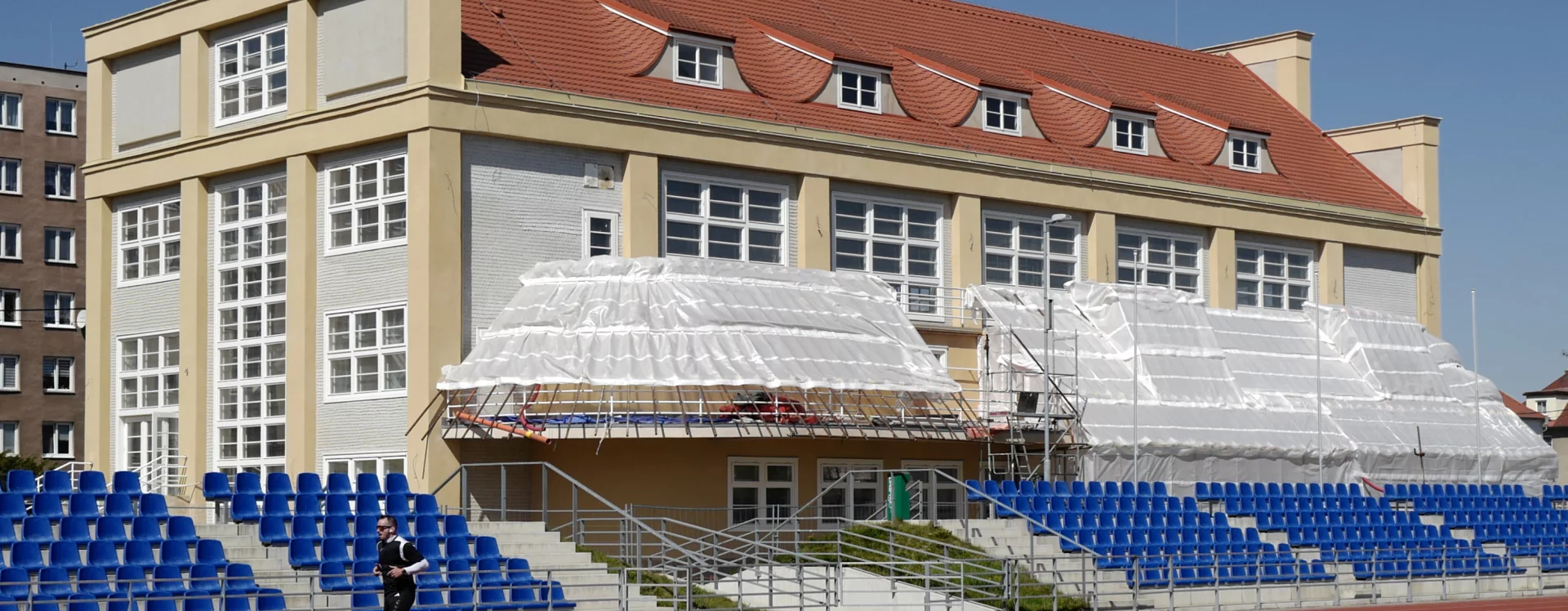
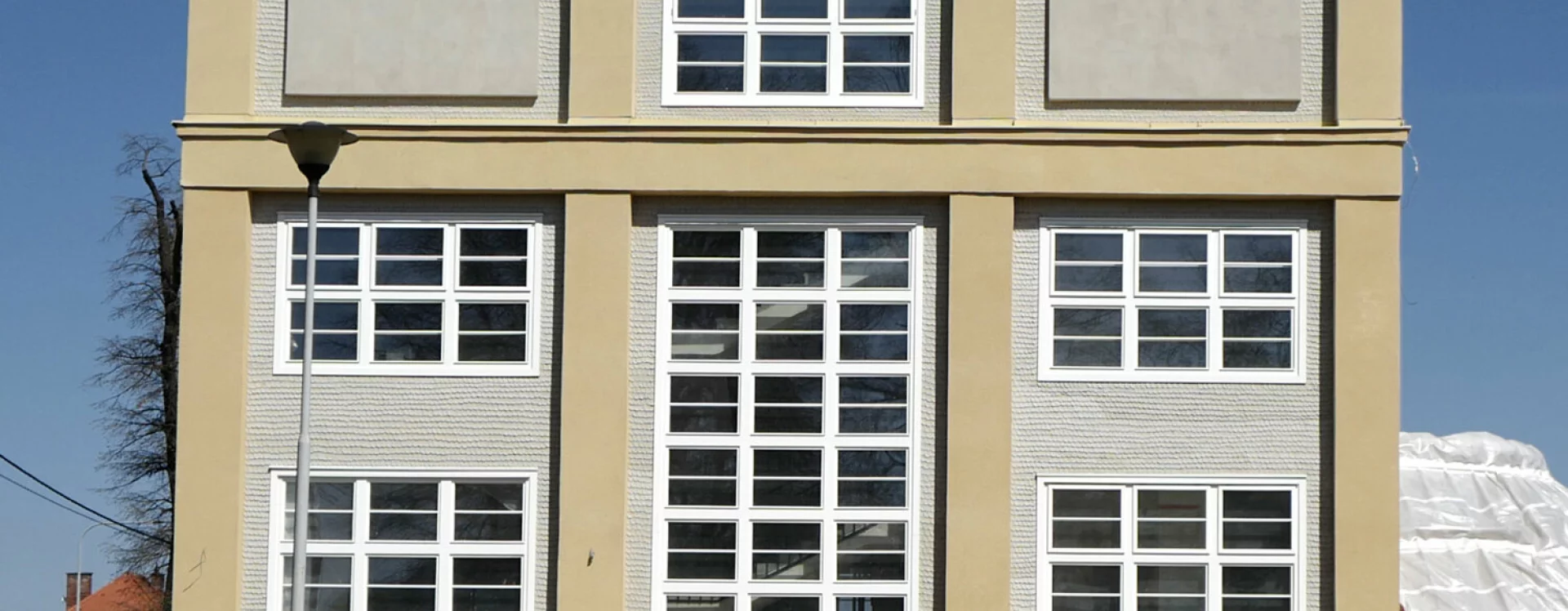
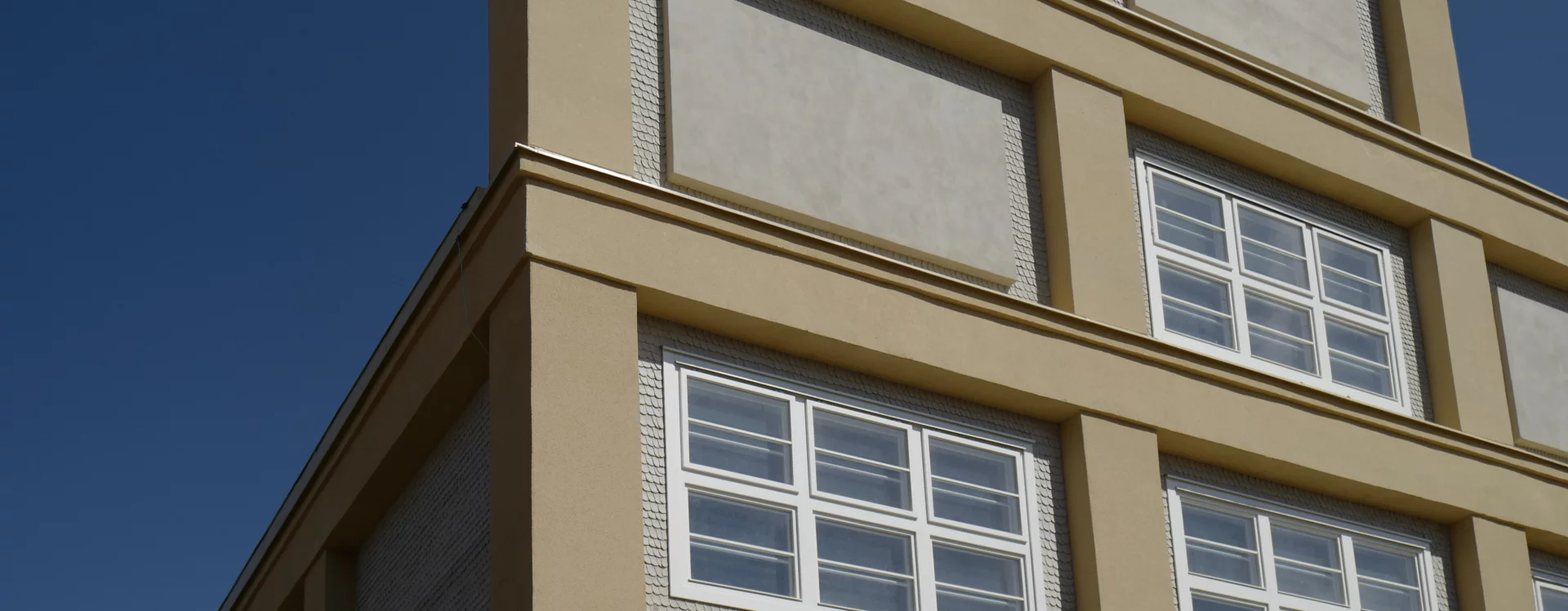
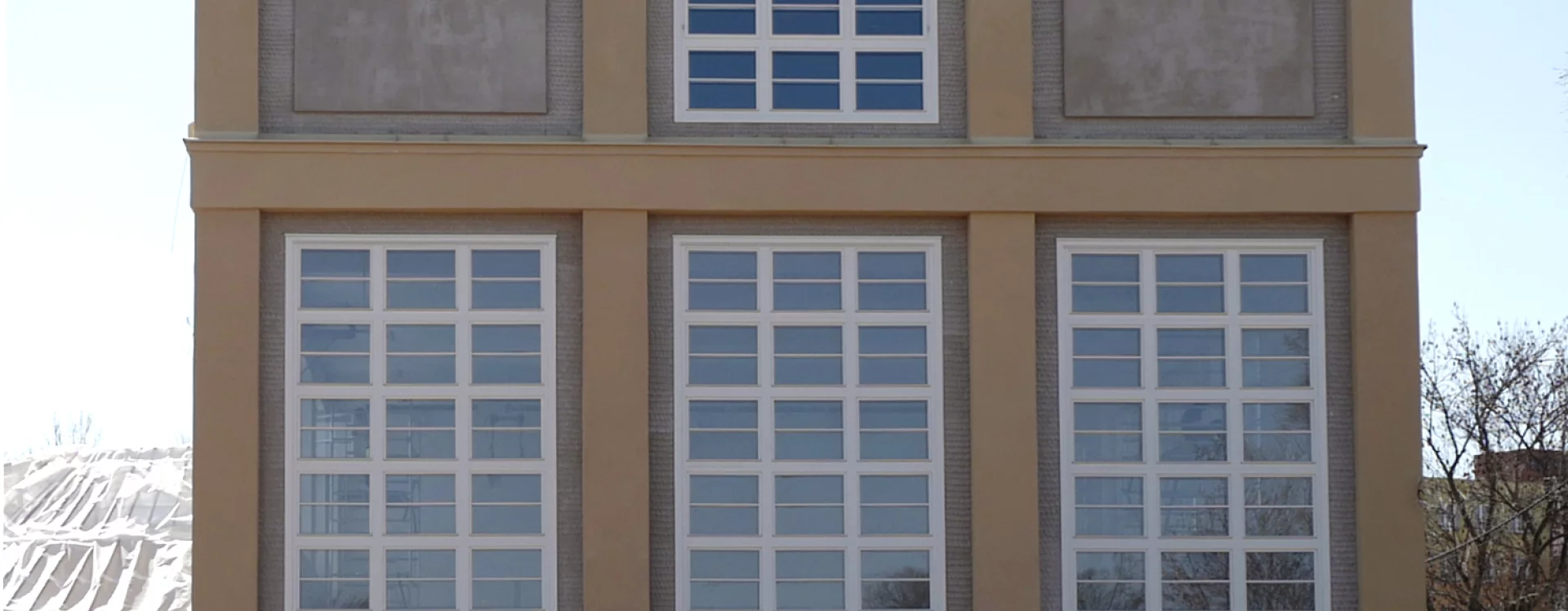
There were several alternative designs, and Bauer arrived at the final design after a year of unsuccessful attempts. He developed the final version of the city's Turnhalle in the form of a traditional rectangular, albeit fragmented, ground plan with a reinforced concrete structure in combination with modernist, multi-level walk-through outdoor terraces with a nautical tubular railing along the side length of the facade. The term Turnhalle referred to German gymnasiums associated with nationalist gymnastics associations with a paramilitary function (Turnvereine). For the final project, Bauer had to abandon his modernist ideas in favor of the Heimatbaustil – perhaps in response to the political turn in neighboring Germany – whose elements are particularly noticeable in the form of a gable roof with dormers and high gables. Until the end of World War II, their surfaces were decorated with gymnastic crosses folded into their shape with four letters F. These were the symbol of the German gymnastics' society founded by the Prussian educator Friedrich Ludwig Jahn (1778–1852). After the war, the Czechs had this symbol of German athletes removed from the facade. The style mode, known as Heimatstil, Heimatbaustil or sometimes Heimatbaukunst, was formed as a traditionally focused counterbalance to the architectural modernism formed at the turn of the 19th and 20th centuries. Since the 1930s, the use of this architectural style often represented an effective visual means of propaganda for the emerging totalitarian regime, which, through the intended functions of the implemented buildings, fulfilled the program of the Nazi movement with the desired social dimension.
The ceremonial opening of the Turnhalle in Krnov took place on November 19, 1933, and the poetics of Bauer's original design was only reminiscent of the tubular railings used, open staircases and small nautical windows. The designs also included an adjacent stadium and an outdoor terrace from which the athletes could be observed by their entourage or coaches. However, due to the war, the project was not implemented, and the stadium was built in a different form only after 1945.
The building was significantly affected by continuous use, but also by the modifications carried out, especially those carried out in the second half of the 20th century. An admirable fact is that most structural elements and architectural details have been preserved in their original form. Whether it is wooden glazed partitions, metal side staircases, floors made of cast terrazzo, the balcony mechanism in the roof or the unique truss, whose reinforced concrete structure is combined with classic wooden elements. In addition to the technical and social facilities, the building has a small (1st floor) and a large (2nd floor) gym. The authenticity of the space is enhanced by the functional original gym equipment.
In 2023, the Krnov representatives approved the general renovation of this important building, and its renovation is to be completed by the end of 2025. The reconstruction will preserve the original purpose of the building as well as the layout and construction of the Bauer gym. All additional elements will be removed, and the outdoor terraces will be made available to spectators. The Krnov Turnhalle complex will continue to serve its original purpose – sports and physical activities – even after more than 90 years. The Krnov Municipal Gymnasium, listed since 1958, is one of Bauer’s last completed buildings and is an exemplary work combining constructivist efficiency with modernist architecture.
Barbora Macháčková
Literature
Hledání kontinuity a řádu v díle Leopolda Bauera. In: Umění. 1989. s. 438–453.
Jiná moderna Leopolda Bauera. In: Umění. 1998. s. 230–240.
Průvodce architekturou Krnova. Ostrava, 2013. s. 234–235.
Jindřich Vybíral. Leopold Bauer. Heretik moderní architektury. Praha, 2015.
Prameny
Deutsche Turnhalle. Zemský archiv v Opavě, fond SOkA Bruntál se sídlem v Krnově, Archiv města Krnov, inv. no. 2494.
Plán tělocvičny. Zemský archiv v Opavě, fond SOkA Bruntál se sídlem v Krnově, Archiv města Krnov, inv. no. 1028.