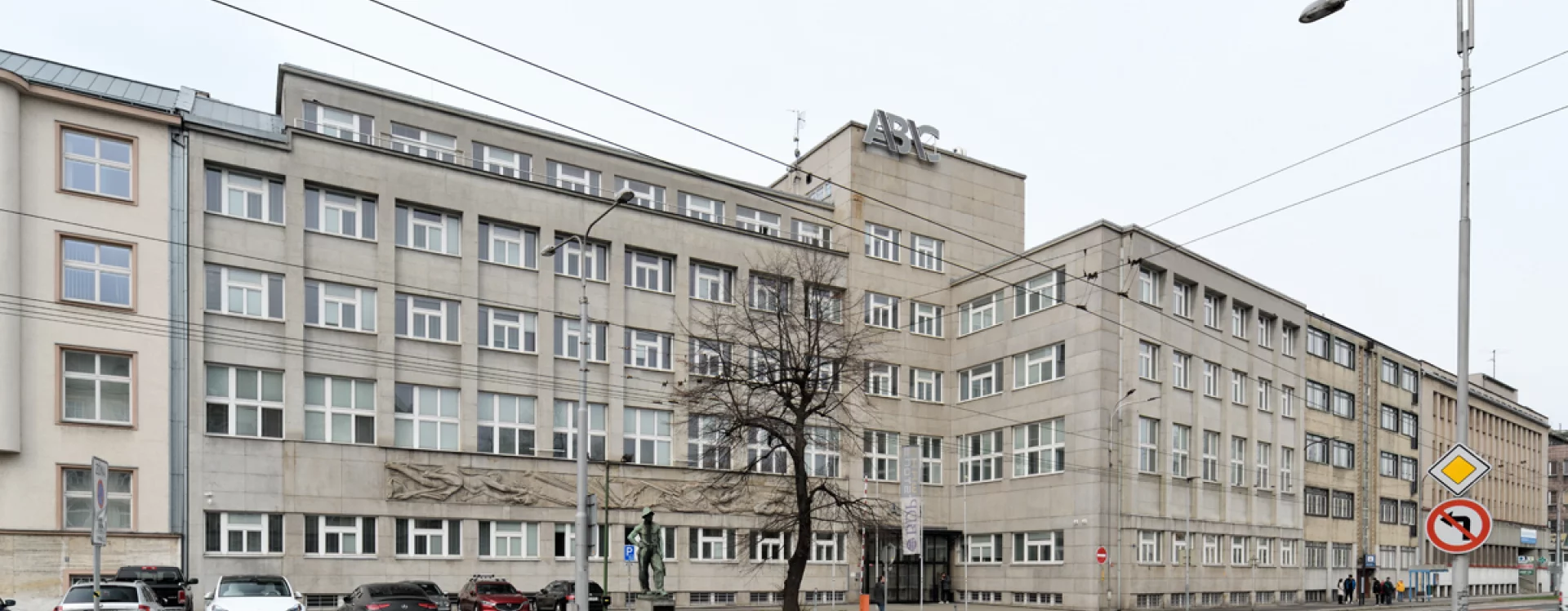
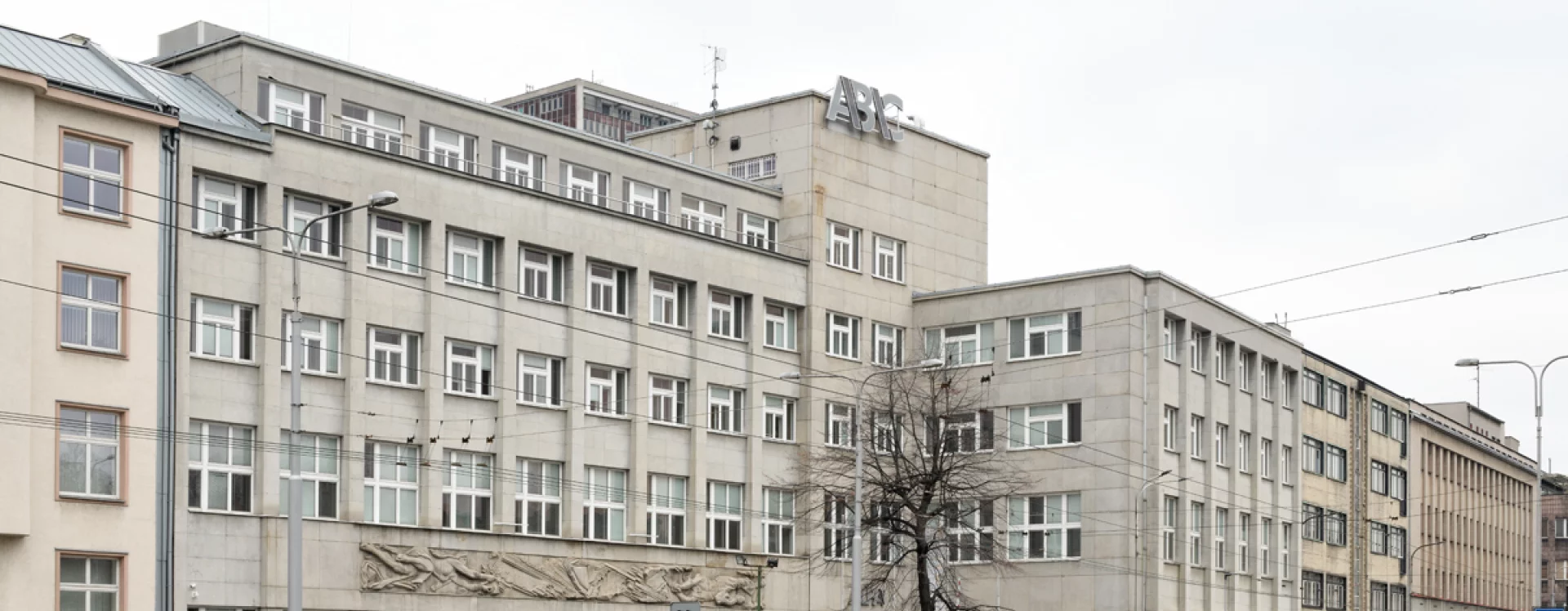
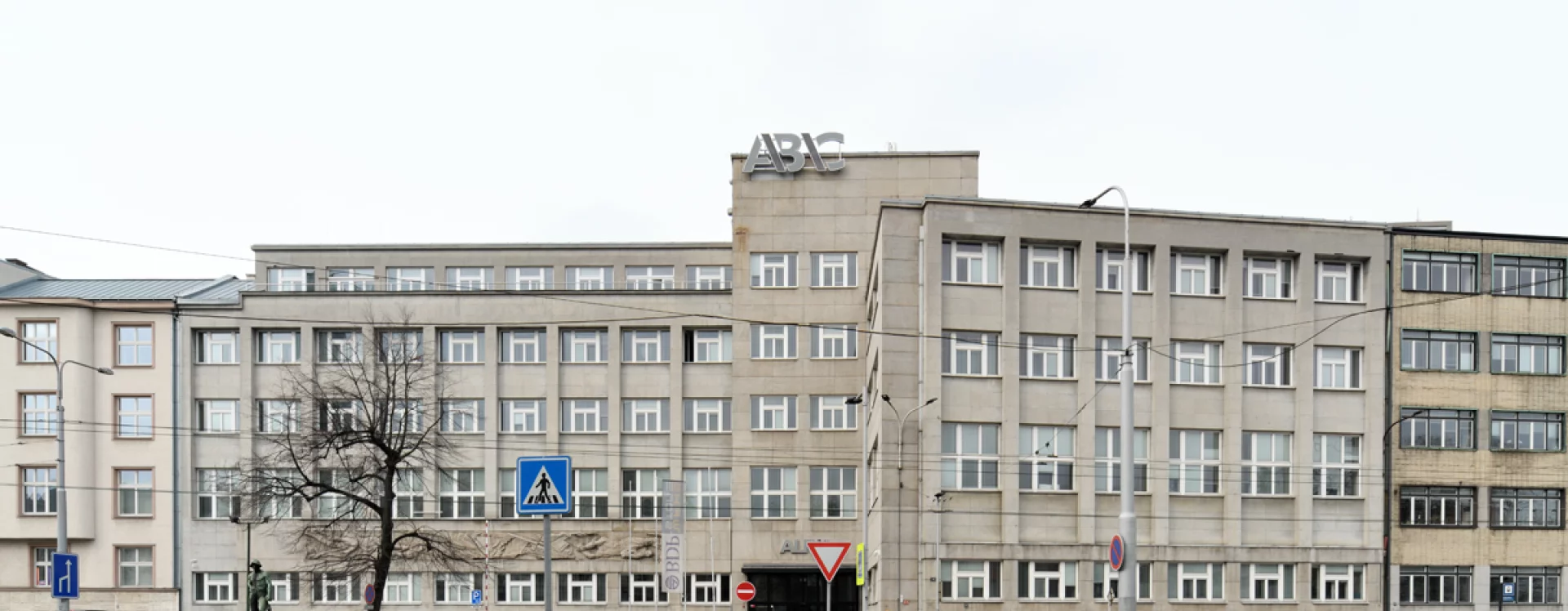
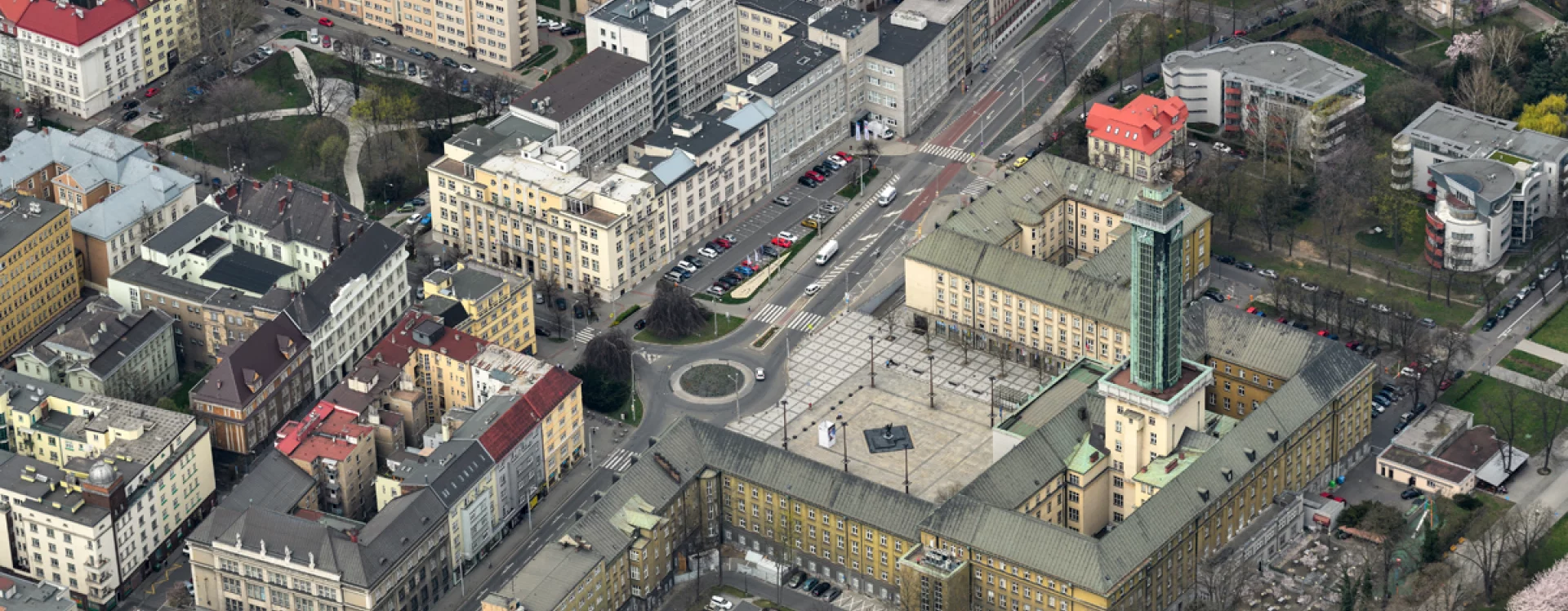
The administrative building of the former General Directorate of the Ferdinand Northern Railway forms, together with the opposite New Town Hall and the nearby former headquarters of the Mining and Metallurgical Company, one of the defining architectural components of Prokešovo Square. At the same time, the building symbolises the final stage in the development of this once key industrial and transport company.
The Imperial-Royal Privileged Emperor Ferdinand Northern Railway (Kaiser Ferdinands-Nordbahn, KFNB) was founded in 1836 and became one of the most important railway and coal-mining enterprises of the Habsburg Monarchy. Its initial mission was to construct a railway connection from Vienna to the Ostrava region and further towards Kraków, following designs by Vienna Polytechnic professor Franz Riepl. Alongside this transport agenda, the company gradually expanded its industrial operations, particularly in the Ostrava region, focusing on the extraction and processing of hard coal – a field that became its main area of activity after the railways were nationalised in 1906. At that point, the company adopted the name Ferdinand Northern Railway (SDF).
After 1918, the company was nostrified, and Czech managers assumed several prominent positions, including engineer Ladislav Jerie (1878–1969). Jerie joined SDF in 1911 as a specialist in coke production at the František coking plant in Přívoz and gradually advanced through the hierarchy. In 1926, he became Deputy General Director, and from 1933 until the German occupation in 1939, he served as General Director. Following the German occupation, he was arrested and imprisoned, later rehabilitated after the liberation in 1945. Jerie was also a noted collector of modern art and maintained close ties with artists and architects. In 1929, he commissioned architect Karel Kotas (1894–1973) to design a weekend retreat for his family in Ostravice in the Moravian-Silesian Beskydy Mountains. The brick summer house became a gathering place for friends and artists, and it marked the beginning of an extensive collaboration between Jerie and Kotas. This collaboration later produced a delicate garden pavilion in Ostravice. Its most significant outcome, however, came towards the end of the 1930s.
Shortly after the company’s centenary celebrations in 1936, Jerie commissioned Kotas to design the new head office together with an adjacent residential building, both located at the emerging Prokešovo Square. The result of this commission was a five-storey palace of irregular plan, based on a three-wing configuration with a central staircase tower placed at the junction of the wings. From the perspective of the square, this tower occupies an internal corner of the spatial composition. The building thus defines Prokešovo Square on its north-western side and forms a major landmark both along Sokolská Street and within the spatial framework of the square.
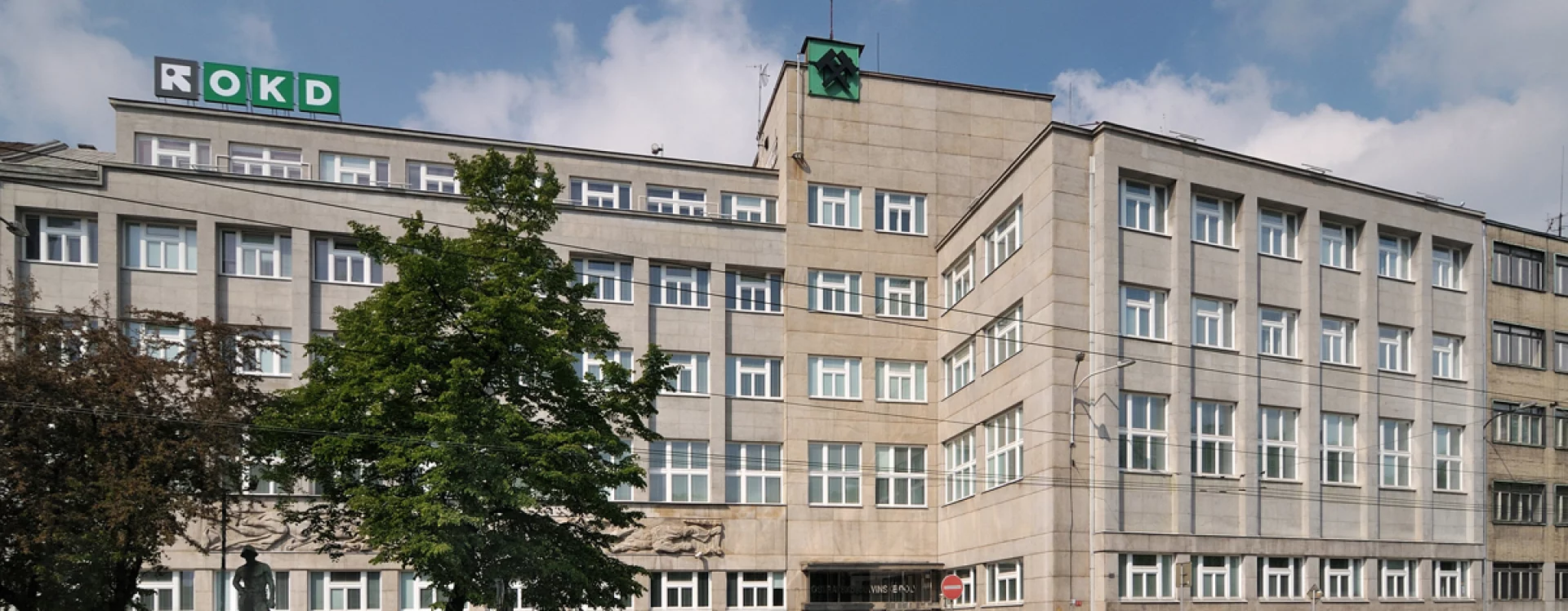
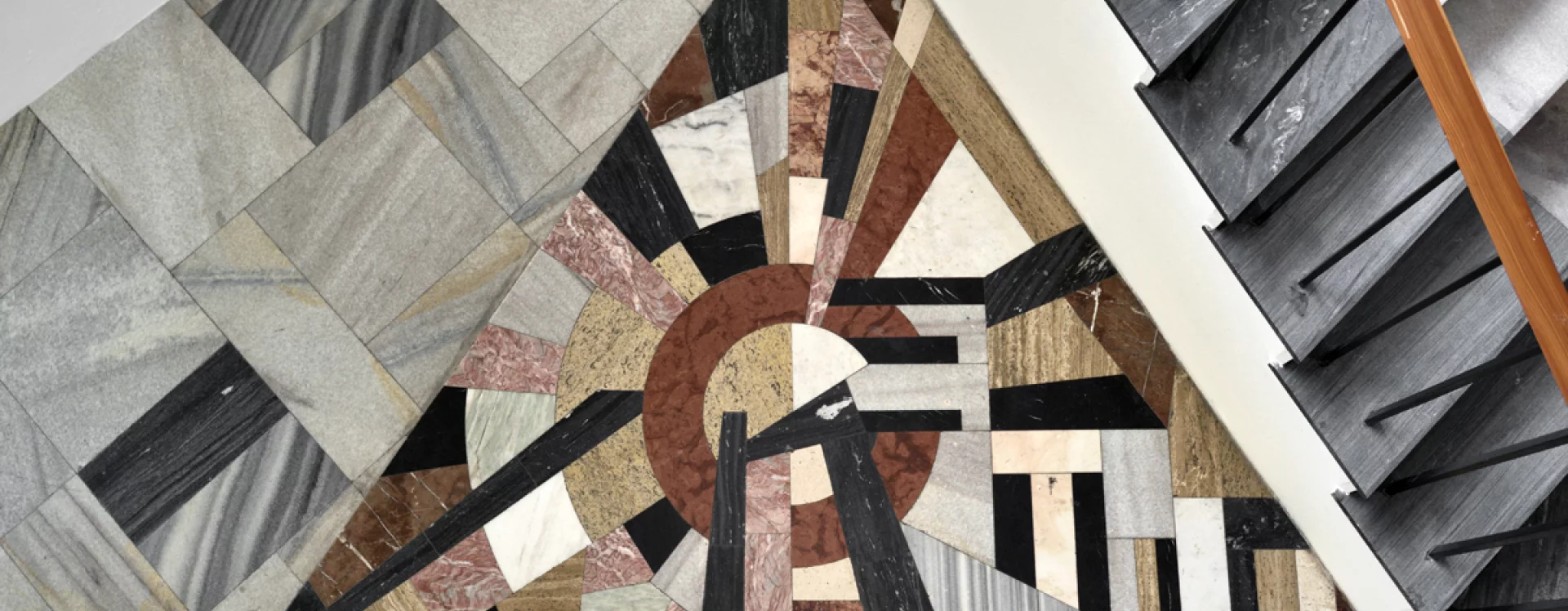
The building employs a reinforced-concrete skeleton structure. In the wings facing Prokešovo Square and Sokolská Street, Kotas combined a triple-tract layout with a central corridor; the courtyard wing is designed as a two-tract. The building was equipped with state-of-the-art facilities, including a paternoster lift. The principal rooms featured wooden panelling and high-quality interior fittings, many of which were later altered or destroyed. The architectural emphasis is clearly expressed in the composition, materiality, and detailing of the main façade. Both the ground floor and the vertical plane of the tower are clad in granite; the remaining façade areas use artificial stone. The central tower, positioned at the corner where the three wings meet, was originally crowned with a square anticorrosive metal panel depicting mining symbols – a crossed hammer and pickaxe. Although known today only from drawings and archival photographs, this detail was integral to Kotas’s design. His plans also included the company name in capital letters placed below the attic, and a flagpole next to the mining emblem.
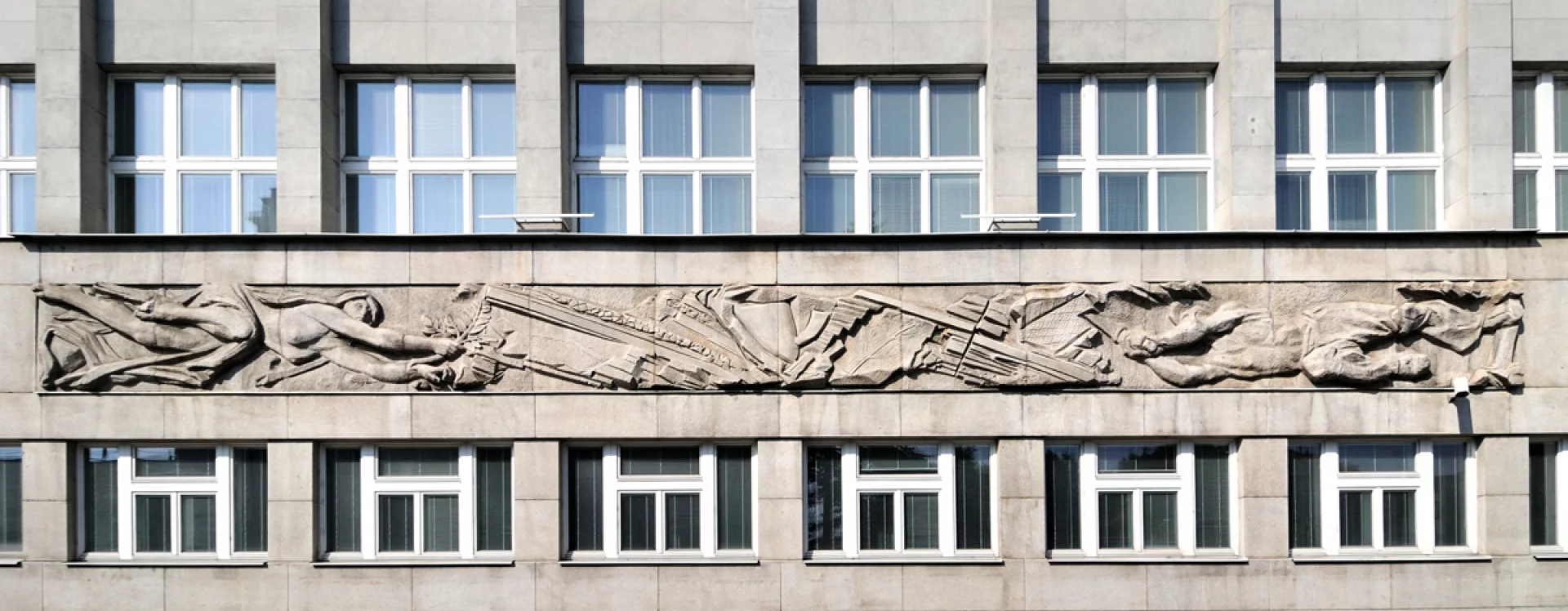
Kotas reserved the most prominent surface – the broad horizontal band of façade between the ground floor and the first floor – for a monumental sculptural composition. Here he installed a granite relief by Prague sculptor Jan Lauda (1898–1959), a close friend of Jerie. Entitled The Birth of Coal, the relief measures 20 × 1.5 metres and consists of large granite slabs. Installed between September and October 1940 and finalised in 1941, it depicts a miner extracting coal on the north side, a female figure with a branch on the south side, and fossil motifs between them. It was likely one of the largest examples of modern sculpture integrated into architecture in its time. Given that Nazi Germany – which by then controlled Central Europe – denounced modern art, the installation of such a work was an act of significance extending far beyond the local context.
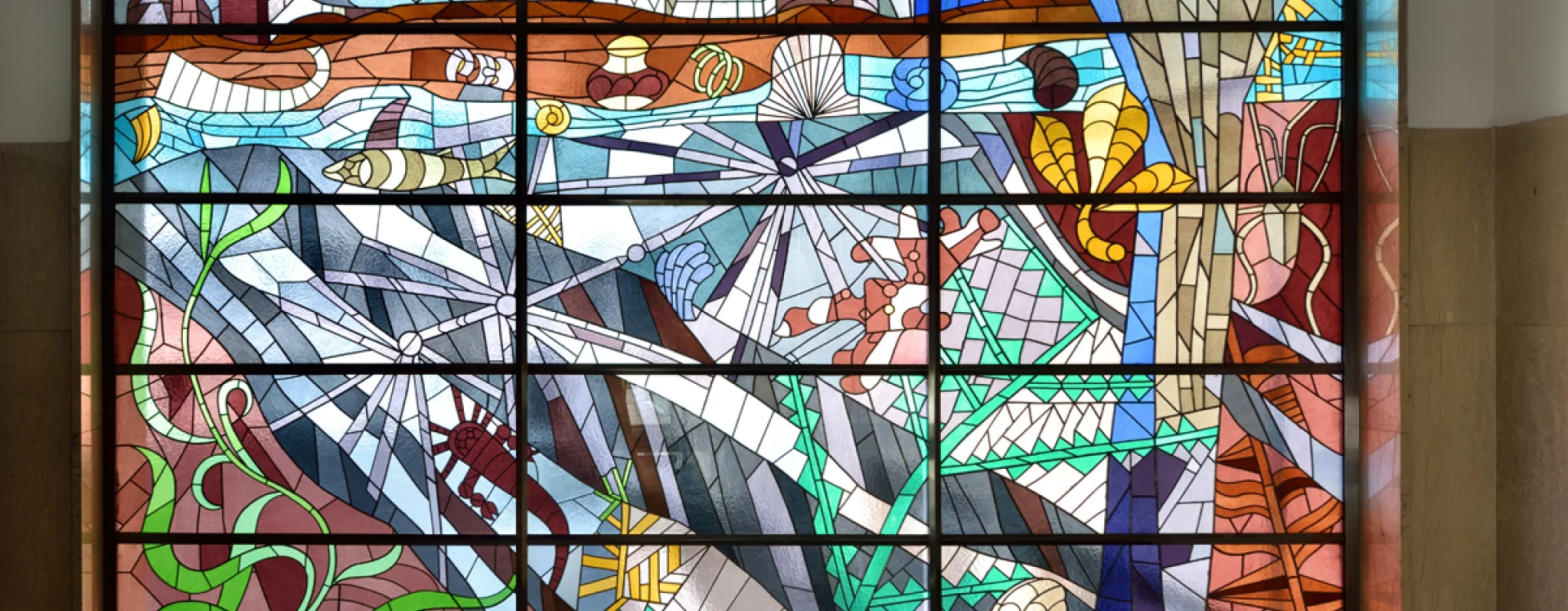
A second work of art, Coal Mining, was created in 1939 by the painter Jan Bauch (1898–1995). He designed a monumental stained-glass window measuring 5 × 3.7 metres, which adorns the landing of the main staircase between the ground and first floors near the offices of the General Director. In the same year, Bauch created yet another work for the building: two walls composed of etched mirrored-glass panels titled Elements Creating Rocks, each measuring 5.5 × 3 metres and consisting of 15 glass panels. Due to later insensitive alterations, only one of these walls has survived, as documented in a 2016 photograph by Roman Polášek.
The head office of the Ferdinand Northern Railway is a key achievement from the mature phase of Karel Kotas’s career. It is, in many respects, a groundbreaking work. Kotas experimented with a modern interpretation of monumental architecture, employing contemporary construction methods and a mix of modern and traditional materials such as stone cladding and terrazzo panels. He succeeded in integrating three large-scale works of art – Lauda’s relief on the main façade, Bauch’s stained glass on the staircase, and the etched-glass wall in the conference hall – into a single cohesive architectural whole. The building thus stands as a unique example of late 1930s and early 1940s modern architecture and its interaction with monumental art.
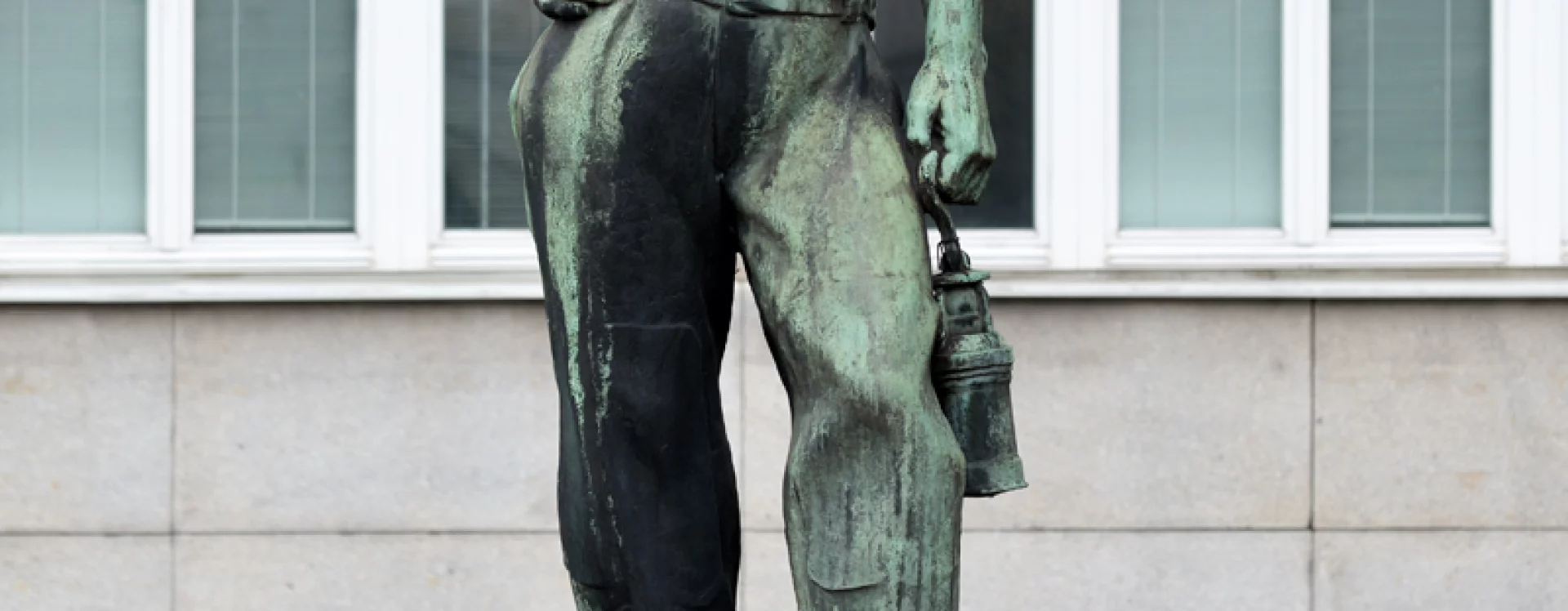
After the liberation in 1945, the building was transferred to the state under the nationalisation decrees and was used as the headquarters of OKD, the Ostrava-Karviná Mines enterprise. Numerous alterations followed. Between 1946 and 1947, an extension containing a rectangular meeting hall was constructed in the courtyard, based on a design by architect Jaromír Moučka. In 1946, as a reminder of the role of fine art in shaping the building, a bronze statue of a miner by sculptor Antonín Ivanský (1938–1939) was installed in front of the main façade at Prokešovo Square.
During the 1960s, the courtyard wing was connected to a new building on the western side of the block, facing Gregorova Street. After 1989, the building became privately owned following the privatisation of OKD and is now leased commercially. The original multi-pane casement windows were replaced during later modifications. The most significant external alteration was the removal of the metal mining emblem, a logo depicting crossed miners’ tools. The destroyed emblem had formed an integral part of Kotas’s design for the main façade. It also embodied the historical context, referencing the local mining tradition, the Ferdinand Northern Railway Company, and the figure of Ladislav Jerie, an outstanding expert, art enthusiast, and initiator of the building. The vacant space was subsequently filled with an unrelated logo of the building’s current owner.
MSt
Literature
Průvodce architekturou Ostravy. 2009. p. 125 a 393. ISBN 978-80-85034-54-7.
Tvořit město. Opava a Moravská Ostrava 1850–1950: architektura a urbanismus. Opava, 2017. p. 168, 207, 229. ISBN 978-80-87789-46-9.
Jindřich Vybíral. Zrození velkoměsta: Architektura v obraze Moravské Ostravy 1890–1938. Šlapanice, ERA, 2003. p. 95-97. ISBN 80-86517-94-2.
Karel Jiřík (ed.). Ostrava : příspěvky k dějinám a současnosti Ostravy a Ostravska 18. Šenov u Ostravy, 1997. p. 176.
Bývalé Generální ředitelství Severní dráhy Ferdinandovy. In: Památkový katalog. Available from: https://pamatkovykatalog.cz/byv-generalni-reditelstvi-severni-drahy-ferdinandovy-13829493 [accessed 14. 11. 2025]
Ladislav Jerie. Available from: https://encyklopedie.ostrava.cz/home-mmo/?acc=profil-osobnosti&load=1704 [accessed 14. 11. 2025]
Zrození uhlí / Stvoření uhlí. Available from: https://ostravskesochy.cz/dilo/495-Zrozeni-uhli-Stvoreni-uhli [accessed 14. 11. 2025]
Dobývání uhlí. Available from: https://ostravskesochy.cz/dilo/496-Dobyvani-uhli [accessed 14. 11. 2025]
Živly vytvářející horniny. Available from: https://ostravskesochy.cz/dilo/497-Zivly-vytvarejici-horniny [accessed 14. 11. 2025]
Generální ředitelství Severní dráhy Ferdinandovy. Available from: https://ostravskepamatky.cz/pamatky/96-Generalni-reditelstvi-Severni-drahy-Ferdinandovy [accessed 14. 11. 2025]
Sources
Neznámý. k. ú. Moravská Ostrava.. fond Spisovna stavebního úřadu Moravská Ostrava a Přívoz, inv. no. složka čp. 2020.