The present-day Masaryk Square, known in the past as the Rynek or Great Square, was called Square of the People’s Militias before the Velvet Revolution in November 1989. Since 1990 it has borne its current name. It is the central square of Ostrava, laid out in the second half of the thirteenth century during the foundation of the town of Moravská Ostrava as a dependent town of the bishops of Olomouc on the border between Moravia and Silesia.
Originally, the square could be accessed only from streets entering at its corners: today’s Velká and Muzejní streets at the southern corner, Zámecká and Poštovní streets at the western corner, Solná Street at the northern corner, and Kostelní and Střelniční streets at the eastern corner. It was not until 1841–1842 that a new street was opened through the centre of the longer sides of the square. This street is today’s 28. října Avenue, which once led from the Hrabová Gate to the bridge across the Ostravice River. As a result, the former main route running through Velká and Kostelní streets became secondary, while the state road from Opava to Těšín, known as the Imperial or Reich Road, began to run directly through the centre of Moravská Ostrava and across the square itself before continuing over the bridge across the Ostravice River. The wider street made it easier to transport mined coal and industrial products through the town.
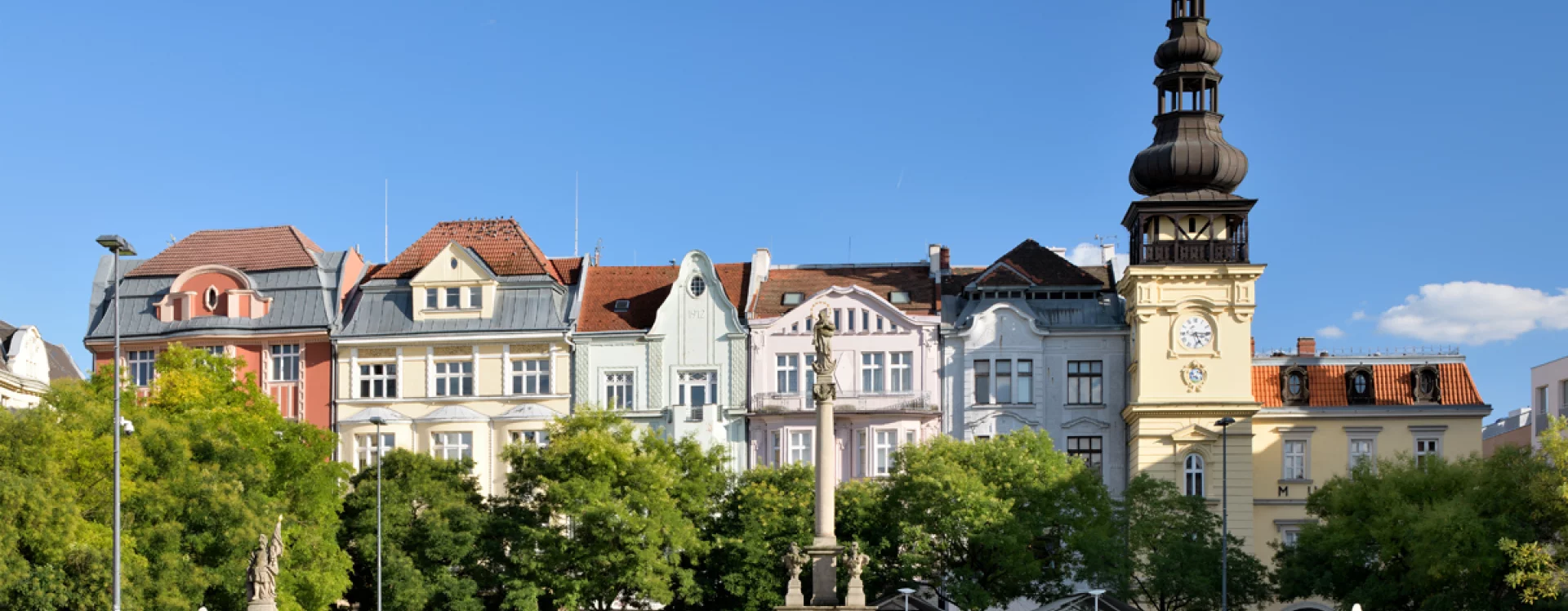
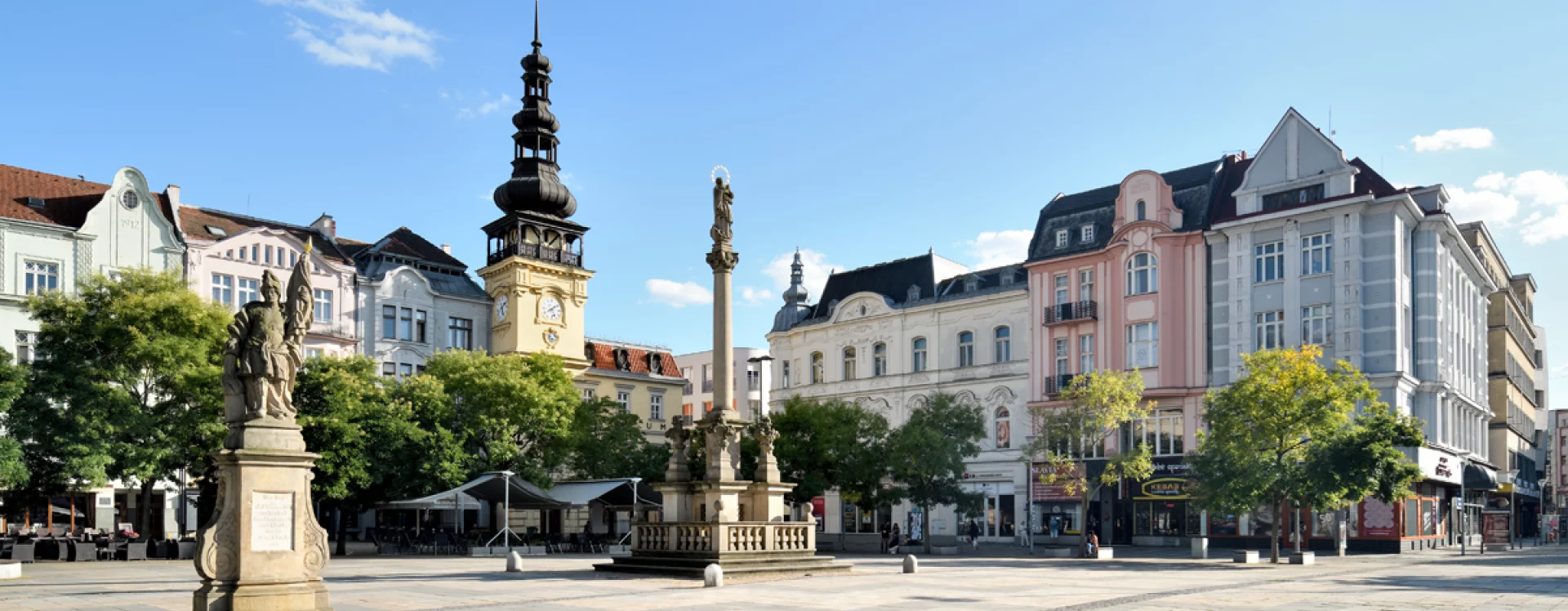
The most prominent building on the square is the Old Town Hall of Moravská Ostrava, standing on a medieval plot. The core of the building is Renaissance in origin, with later alterations in the Baroque period and further reconstructions in the nineteenth and twentieth centuries, which gave it its present appearance. As the population and importance of the town grew, the surrounding burghers’ houses were rebuilt in several phases and were largely replaced at the beginning of the twentieth century by apartment houses of metropolitan scale.
One of the most significant phases of redevelopment took place between 1911 and 1913, largely according to designs by local builders and architects. Among the most important of them was the architect Felix Neumann, author of the apartment house of the Schönhof couple (Masaryk Square 52/33, 1898) and the building at Masaryk Square 6/6 (1911–1913). Two new buildings were designed by the Vienna architect Wunibald Deininger: the apartment house of the heirs of Ignác Reisz (28. října Street 49/23, 1911–1913) and the neighbouring building at Masaryk Square 50/31. Later notable development is represented by two functionalist buildings on the north-eastern side of the square: the former Baťa Department Store (Masaryk Square 24/13), designed by František Stalmach and Jan Svoboda in 1929–1931, and the house of the composer Jan Pešat by Bohuslav Fuchs from 1932 (Masaryk Square 26/14).
The second half of the twentieth century brought a more complex and sometimes problematic development. The first intervention involved the demolition of houses at the point where Kostelní Street enters the square. In place of the older buildings standing on narrow medieval plots, an entire block was constructed according to a design by the architect Miloš Bartoň (Masaryk Square 2572/8), including a tower apartment house in Zeyerova Street and a connecting wing containing premises now occupied by the Minikino café (Kostelní Street 2572/3). Although this intervention altered the development of part of the north-eastern frontage from a transverse to a longitudinal orientation, it was not as disruptive as another demolition carried out on the opposite side of the same frontage.
This later intervention concerned the site where the Prior department store, later known as Laso (Masaryk Square 3090/15), was built. During construction the architectural design was radically altered, and the original author of the project, the architect Růžena Žertová, who had worked on the design in 1975, distanced herself from the realised building. The disagreements surrounding the project ultimately led her to resign from the Brno branch of the State Institute for Trade Design. Although the department store has undergone several reconstructions in recent years and has received a new façade (2006, 2019), its scale and architectural expression still make it appear somewhat alien within the historic fabric of Masaryk Square.
Another questionable intervention occurred in the 1960s when the block between the square and Dlouhá Street was demolished. The architect Bronislav Firla had planned to build Ostrava’s first supermarket here, as reported in the newspaper Nová svoboda during the Prague Spring of 1968. The project was eventually abandoned and the department store was built on the opposite side of the square (the aforementioned Prior). The cleared site directly adjoining Masaryk Square therefore remained undeveloped. It is still considered a potential location for a new building that could appropriately complete the historic centre of Ostrava.
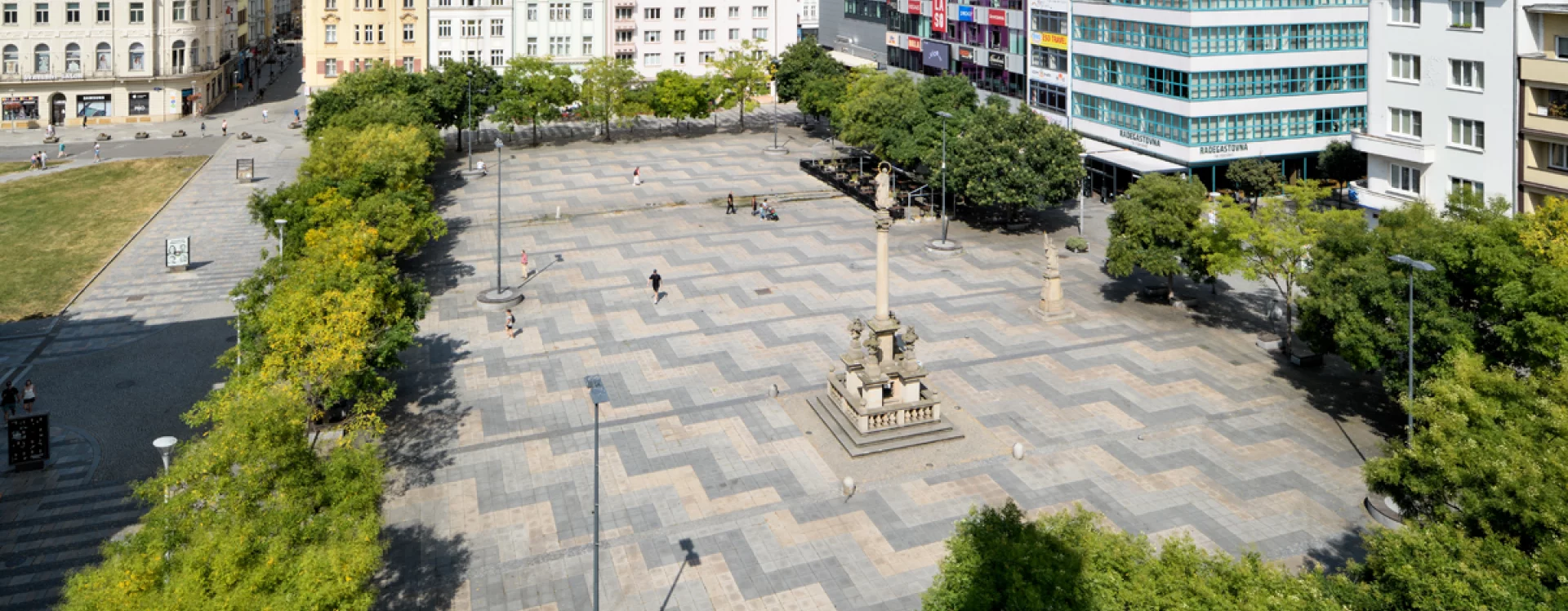
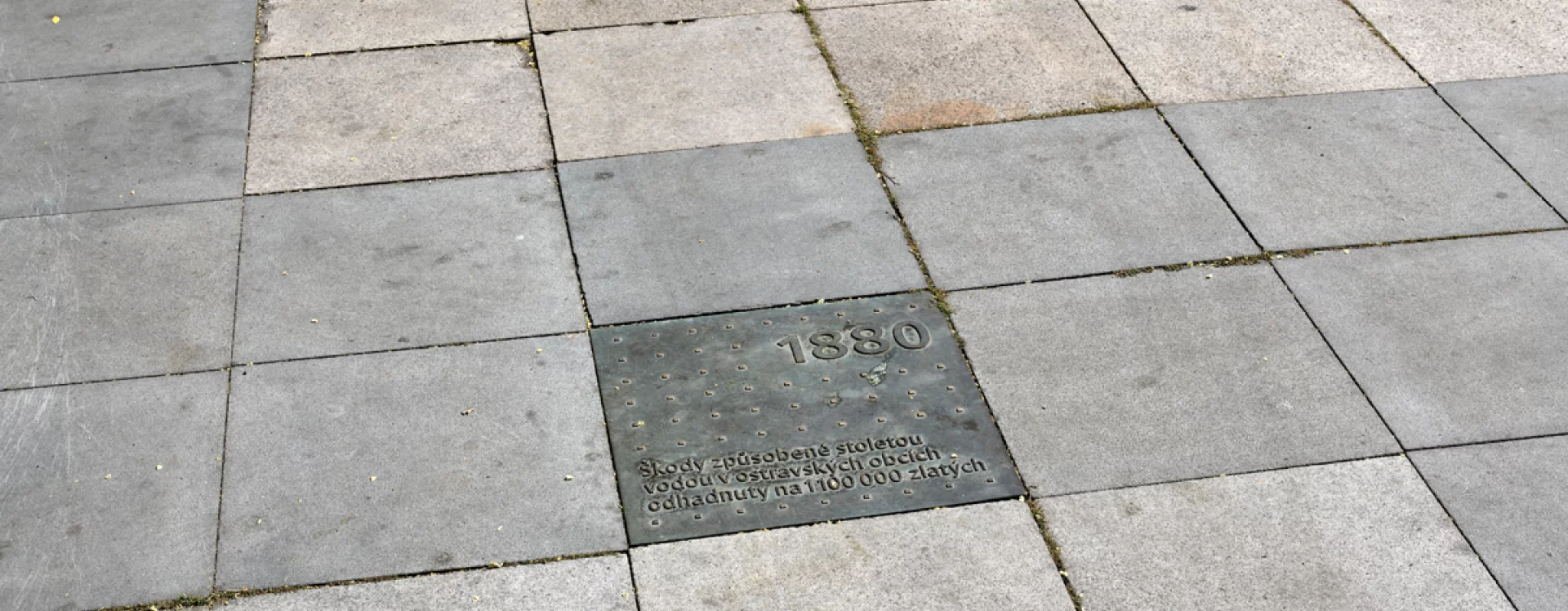
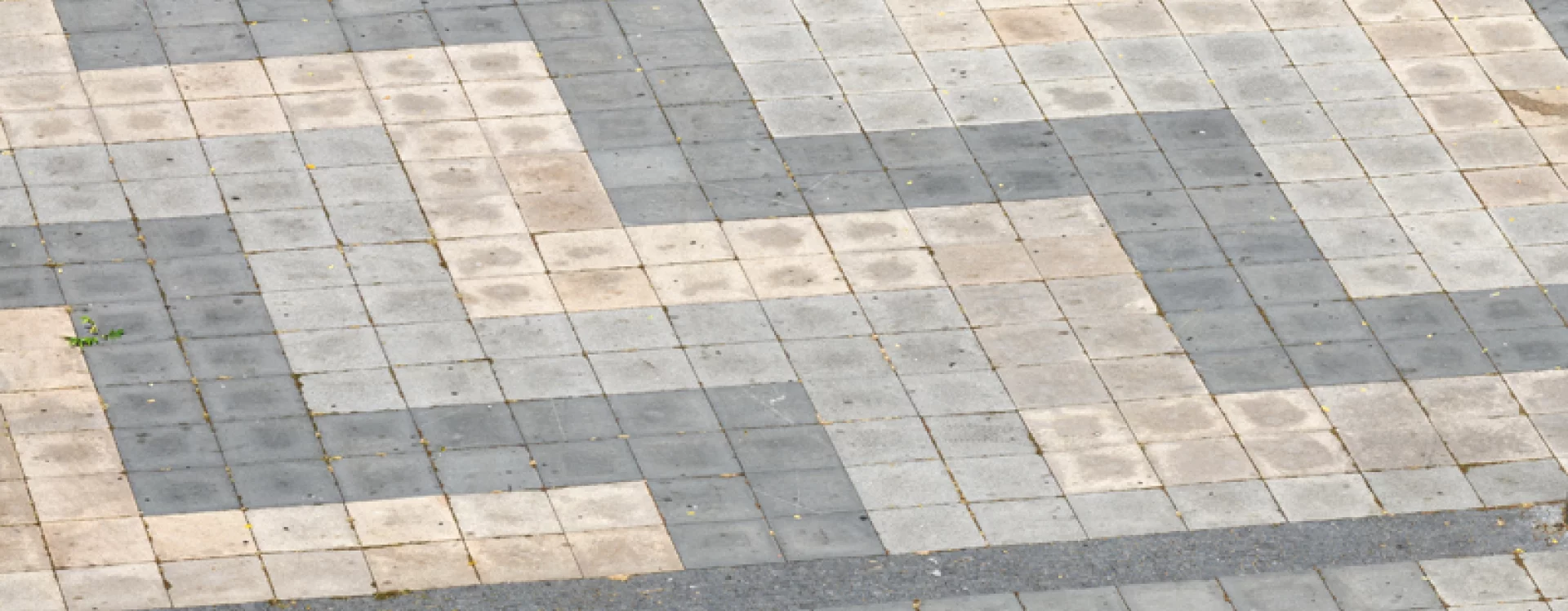
The current design of Masaryk Square itself is based on the winning proposal from an architectural and urban design competition held in 2002. The design was prepared by the Brno architects Tomáš Rusín, Ivan Wahla, and Petr Mutina from the RAW studio. They conceived the paving of the square as a carpet-like surface with a decorative pattern created from differently coloured stone slabs. The pavements along the sides of the square were designed as alternating light and dark bands resembling the fringe of a carpet. The elements added to the public space include a fountain integrated into the paving in the form of a line of water jets running parallel to 28. října Avenue, as well as a drinking fountain and rows of trees planted along all four sides of the square. The trees are Japanese pagoda trees (Styphnolobium japonicum), chosen for their resistance to de-icing salts. On the south-west side, exhibition display cases were installed along the pavement, while on the north-east side a chronological line of dates from the history of Ostrava was embedded into the paving in the form of metal plates. Both the water feature and the timeline were designed by the sculptor and designer Jiří Plieštik (1956).
The project also introduced new urban furniture, including circular benches made of granite blocks with recessed wooden seats of tropical timber and integrated public lighting columns, as well as bollards and waste bins designed as granite prisms. During the implementation, the statue of St Florian was also returned to the square. It had originally stood here until the early 1960s, when it was moved to the church in Hrabůvka during an earlier redesign of the space. Another new element is the bust of Tomáš Garrigue Masaryk by the sculptor Josef Mařatka, originally placed in the vestibule of Ostrava’s New Town Hall and later installed in front of the main façade of the Ostrava Museum on a pedestal made of black granite.
The reconstruction of the square was completed in 2007. Soon after completion, damage to the paving caused by the use of substandard materials had to be addressed. As part of warranty repairs, the contractor’s successor company Eiffage Construction carried out repairs to the paving in 2011. The experience demonstrated how important it is to supervise the quality of both the execution and the materials used. Despite these shortcomings, the reconstruction of Masaryk Square represented a significant improvement in the architectural and urban design quality of this central public space in Ostrava.
MSt
Literature
Architekt LIII-12. Praha, Obec architektů, 2007, roč. LIII, č. 12, p. 4-11.
Martin Strakoš. Průvodce architekturou Ostravy. 2009, p. 110. ISBN 978-80-85034-54-7.
Rekonstrukce Masarykova náměstí v Ostravě. https://www.archiweb.cz/b/rekonstrukce-masarykova-namesti-v-ostrave. stav k 30. 10. 2025