After the establishment of the Czechoslovak Republic, the legal system was expanded by a number of new laws which strengthened the social and labour framework for the lower and middle classes, including the position of workers in the workplace. Three laws from 1920 enabled miners to participate in the management of mines and laid the basis for the establishment of workers’ councils and miners’ arbitration courts. In mining towns, this led to the construction of Miners’ Houses, which were to accommodate the offices of district councils, trade unions, arbitration courts, and workers’ savings banks, while also serving as prestigious cultural and social centres. The construction of these Miners’ Houses was financed by the Ministry of Public Works.
In Moravská Ostrava, it was decided in 1923 to build a Miners’ House with a café, cinema, and bar, whose operation would help finance the running costs of the building, as well as fourteen modern flats. The miners’ trade union commissioned the Ostrava design and construction firm František Kolář and Jan Rubý to prepare the project. The chosen plot occupied a prominent position on one of the city’s main thoroughfares, Nádražní Street, which from the early 1920s onwards had become a preferred address for important institutions such as banks. In the immediate vicinity, the Anglo-Czechoslovak Bank building, designed by the prominent Prague architect Josef Gočár, was completed in 1924. Kolář and Rubý were subsequently asked to adapt their design for the Miners’ House to the cubic, classically inflected architecture of Gočár’s building.
The reworking, however, did not prove satisfactory, and the Ministry of Public Works therefore decided to appoint a new designer. In November 1924, minister Antonín Srba, asked the ministry official Alois Kubíček to prepare an expert assessment of the project. Kubíček focused on the layout and functions, criticising the excessive number of staircases (ten in total), the insufficient capacity of the cinema, the unsuitable location of toilets, the inadequate back-of-house facilities for the café, and the generally confusing and chaotic plan. Although Kolář and Rubý defended their design and argued that a ministry official could not act as the project architect, Kubíček was nevertheless commissioned, together with architect Alois Mezera (in whose studio he was then working), to prepare a new design. Kolář and Rubý were to draw up the working drawings.
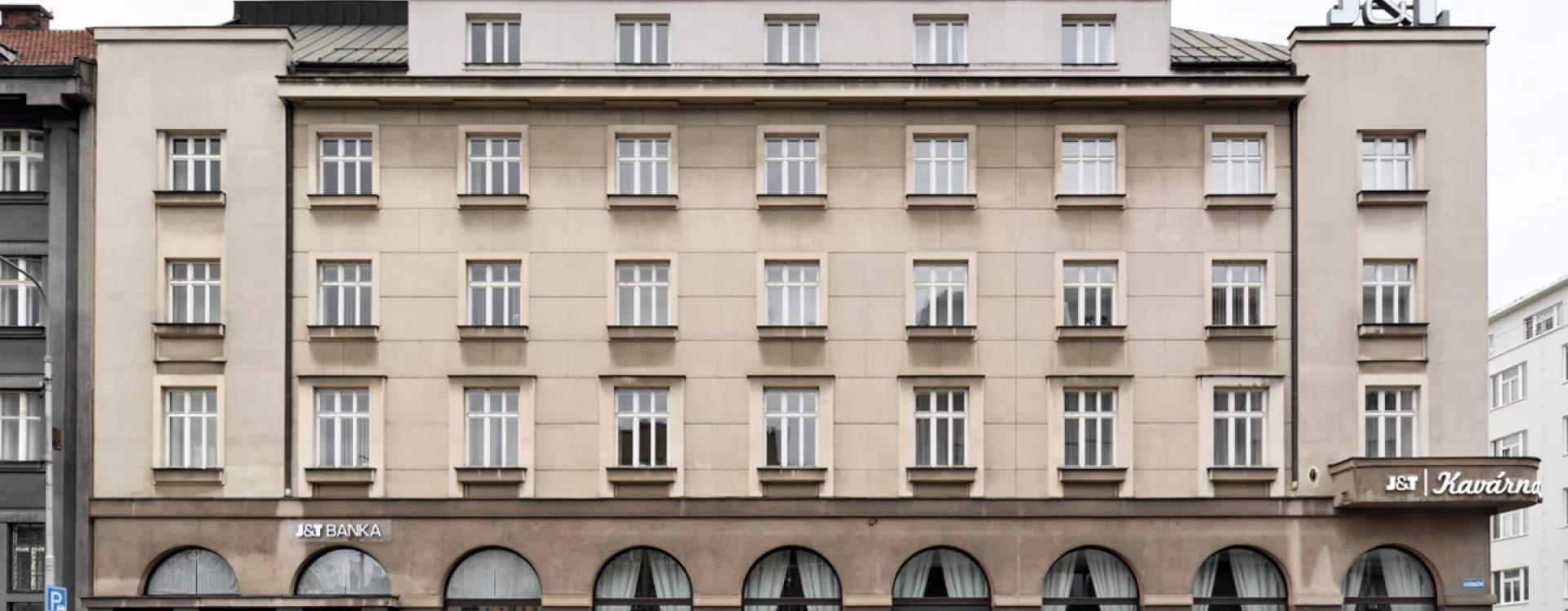
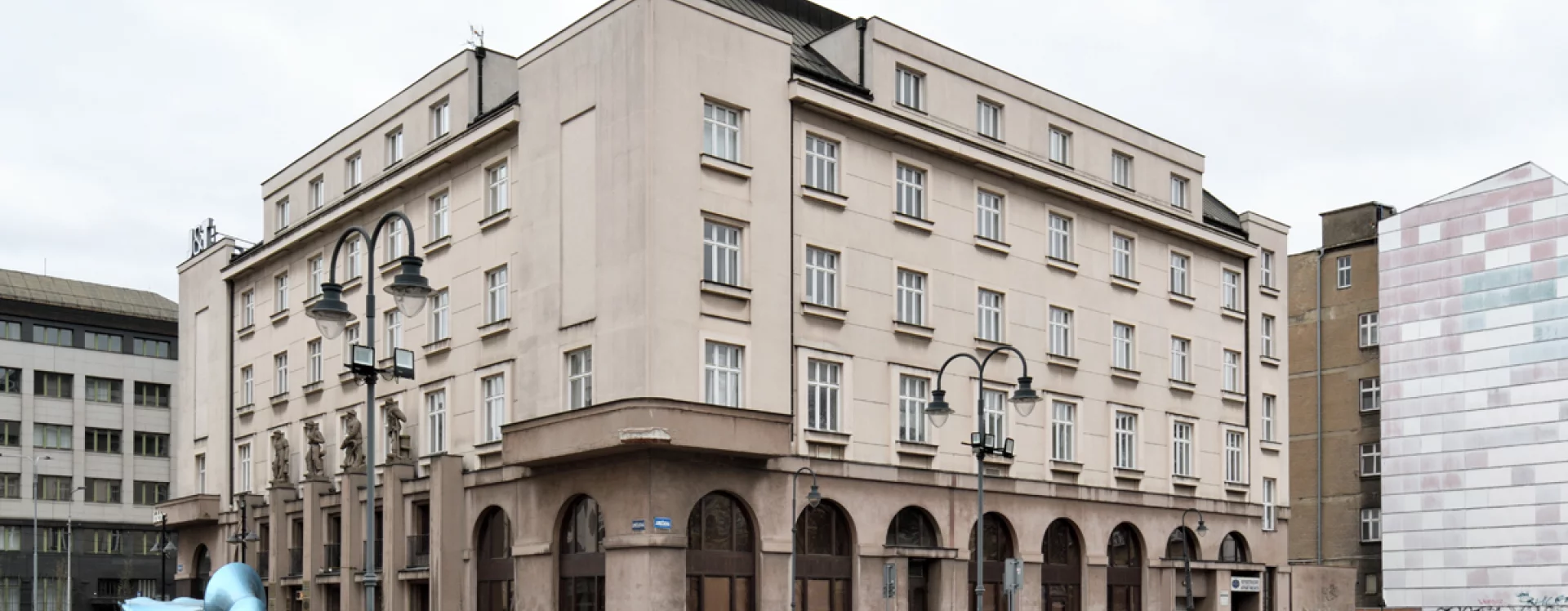
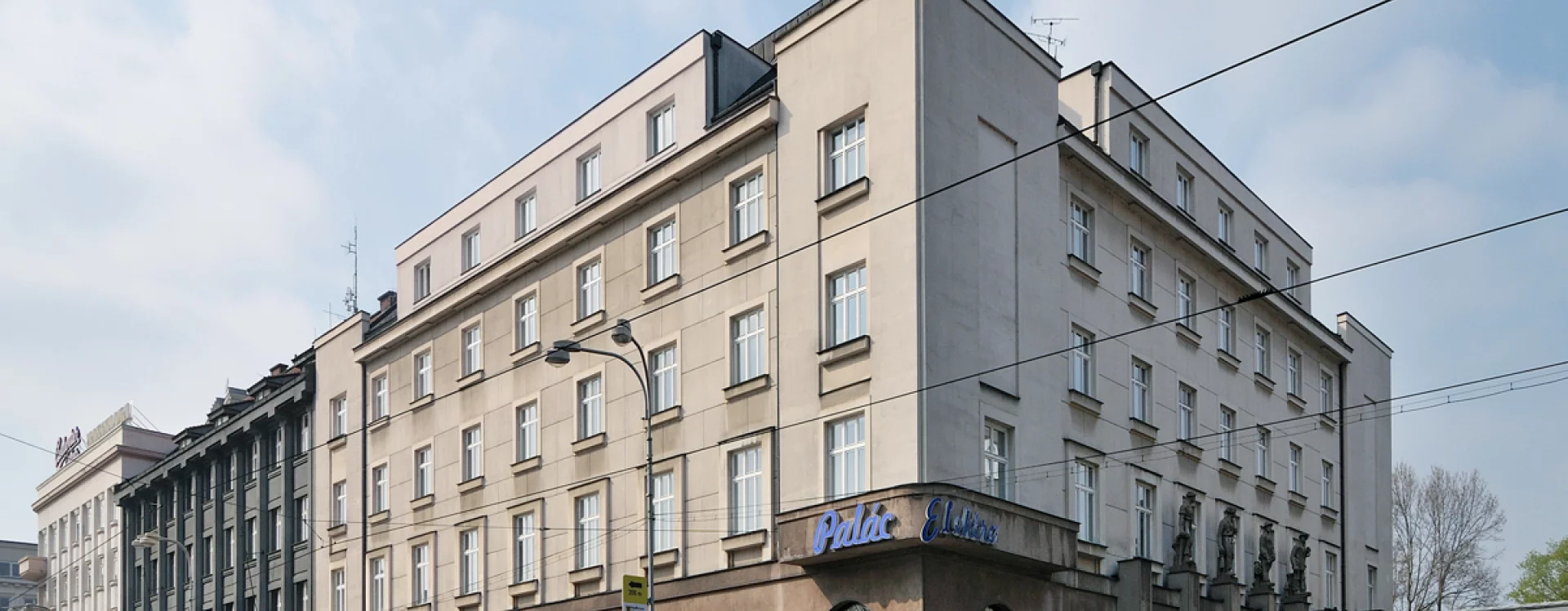
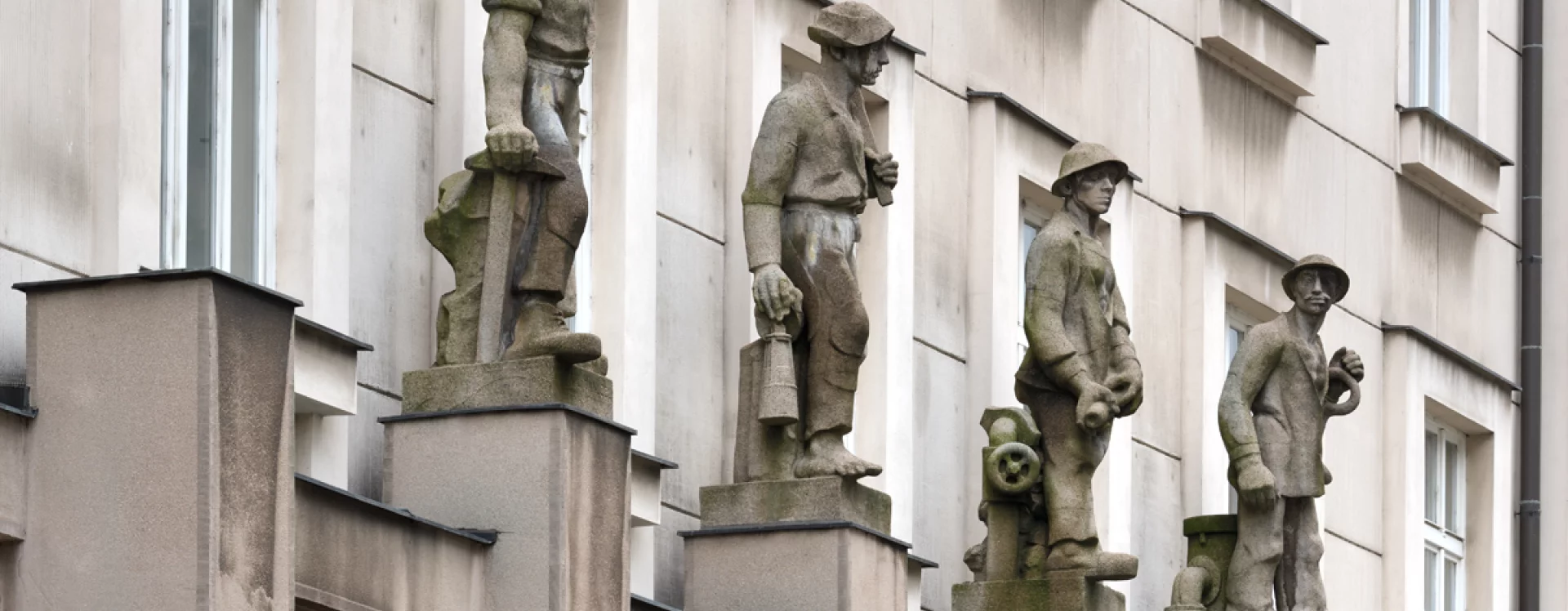
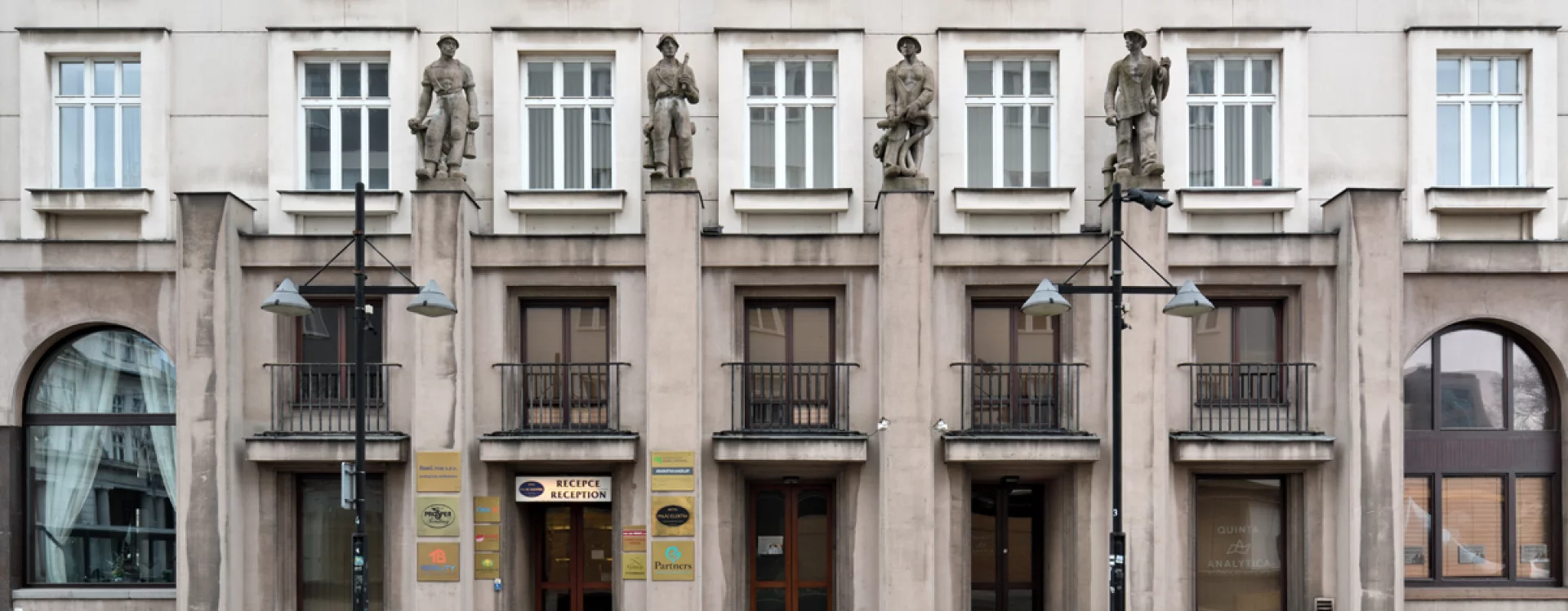
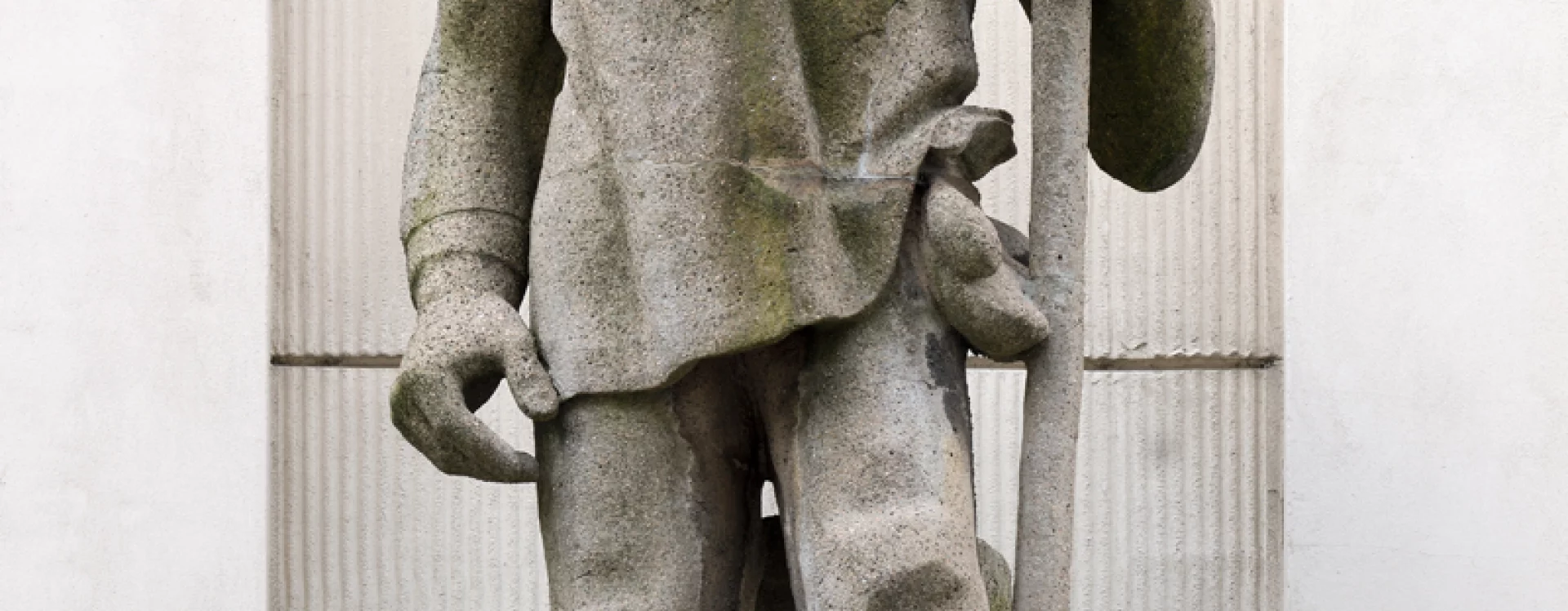
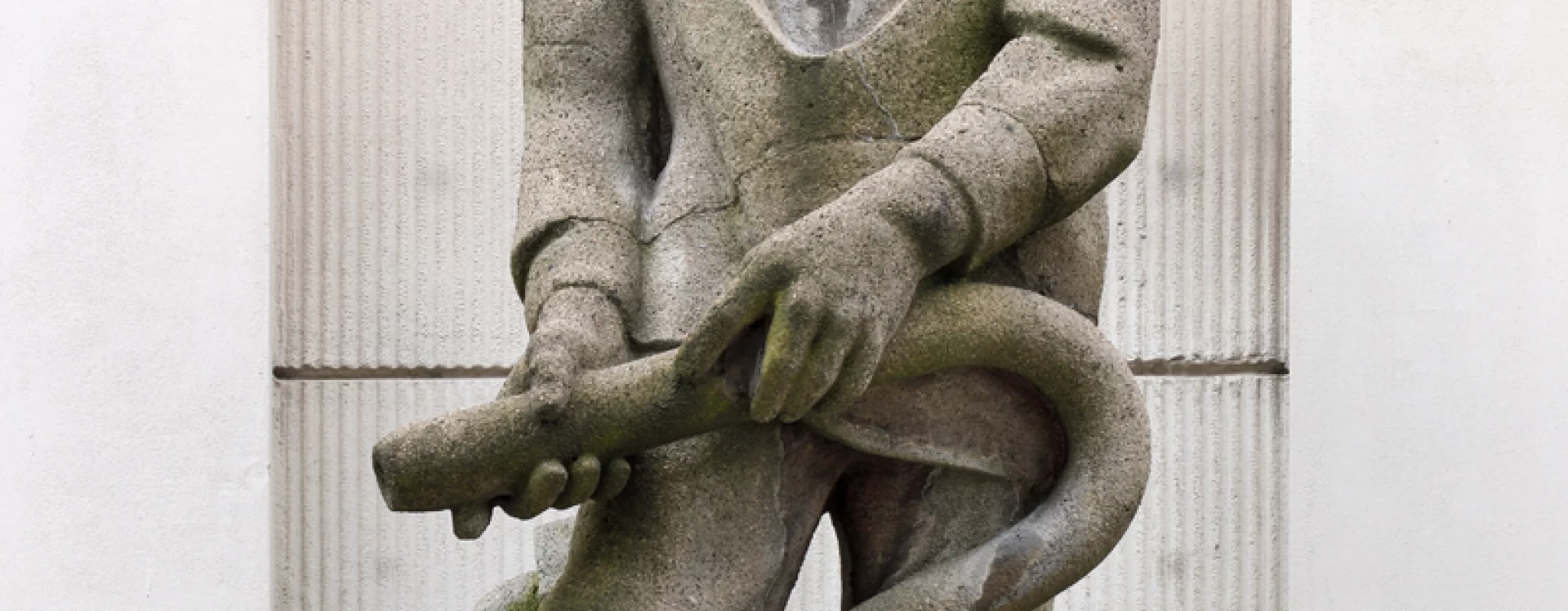
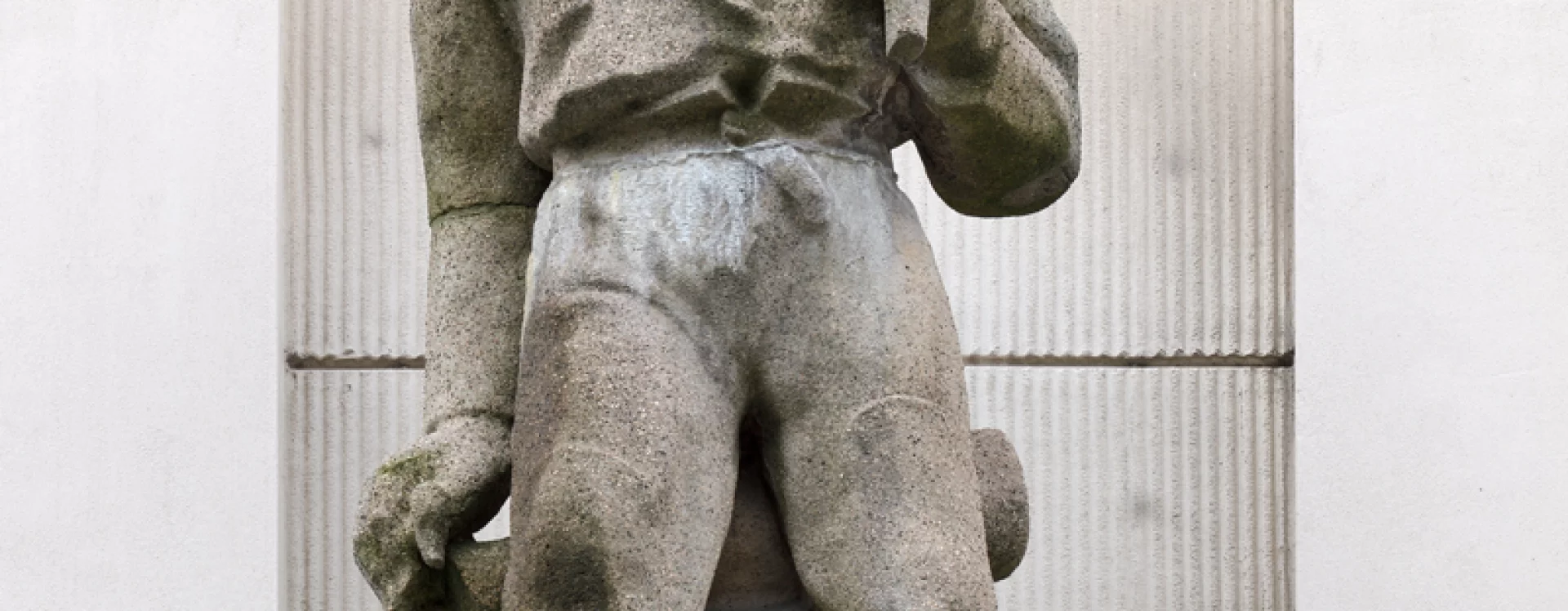
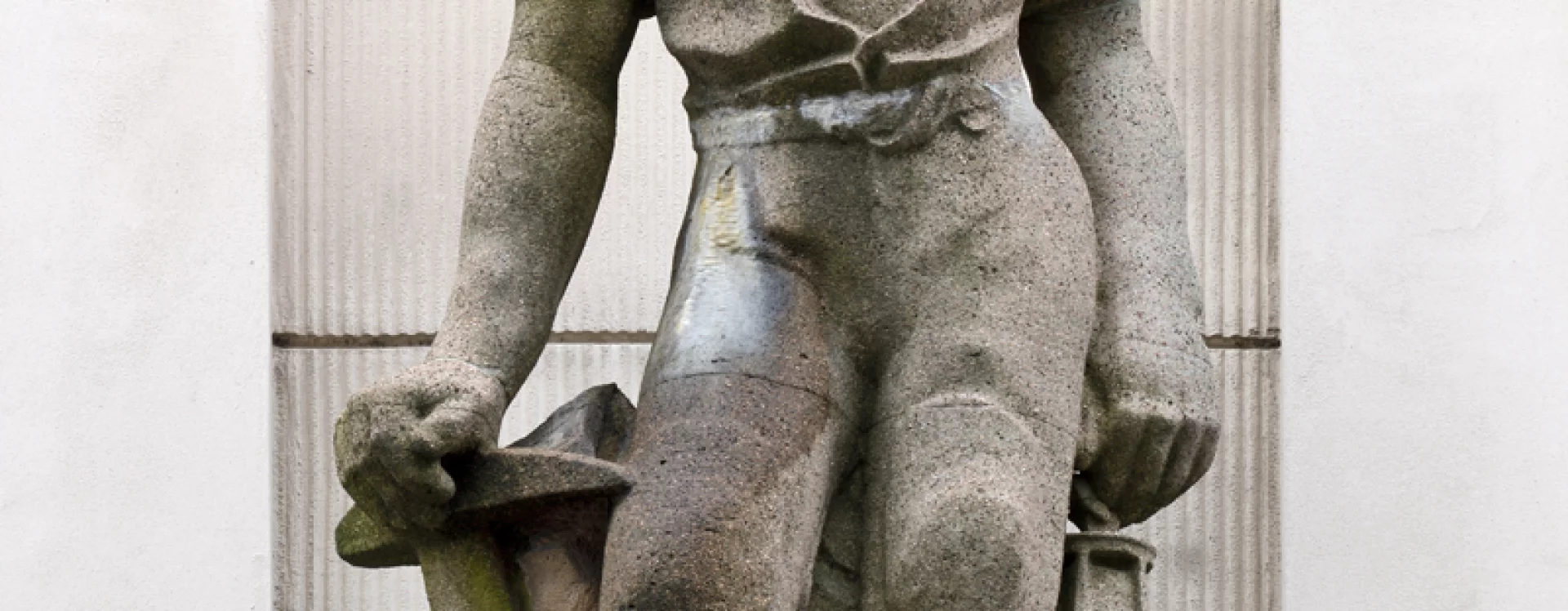
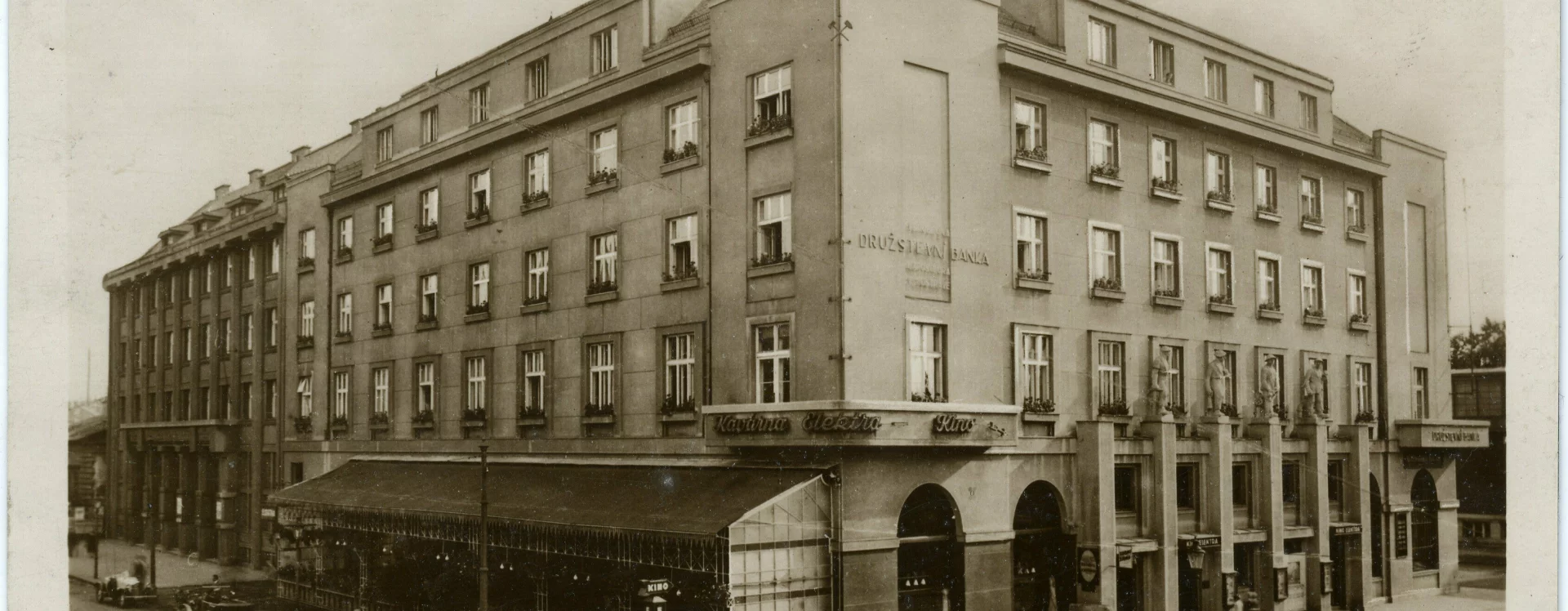
Kubíček retained the urban layout developed by Kolář and Rubý, but completely rethought the building in terms of massing, composition, and plan. He replaced a robust structure in the forms of New Classicism with Art Deco elements by a restrained five-storey, three-wing building in the spirit of modern Classicism, using a minimum of applied architectural detail. Both principal façades are framed by slightly raised side risalits whose articulation corresponds to the nearby, urbanistically dominant House of Art. The ground floor, faced in artificial stone with polished Swedish and Silesian granite cladding, is opened up by an arcade of tall, round-arched café windows. Across both corners runs a curved cornice bearing the name of the establishment. On Umělecká Street, the portico is rhythmically articulated by six pilasters, four of which carry allegorical figures of the Miner, the Steelworker, the Coke-Oven Worker, and the Pit Carpenter, sculpted in 1926 by the Ostrava sculptor Augustin Handzel. The upper storeys, with a regular grid of rectangular windows, are finished in a refined render with suggested rustication. The pronounced window ledges and surrounds are also made of artificial stone. The mono-pitch metal roofs are emphasised by continuous strip dormers in masonry. While the ground floor facing Nádražní Street was occupied by the Elektra Café, with an Art Deco interior featuring a large timber gallery, the cinema hall with 763 seats was placed in the courtyard wing. In 1940, the cinema was given a reinforced-concrete shell vault.
Construction work, carried out by the firm of Rudolf Kaulich, began in spring 1925 and was completed in 1926. By 1927, the palace had gained a covered outdoor seating area facing Nádražní Street. In the 1990s, the building underwent renovation. The café interior was restored using replicas of the original furnishings (timber panelling, balustrades). However, structural problems led to the demolition of the cinema vault and its replacement by office space, and an unsuitable façade coating obscured the original materials and colour scheme. In 2001, the café ceased operating and was subsequently, without official permission, converted into a venue called Hacienda Mexicana, which entailed highly inappropriate and visually intrusive alterations to the interior. In 2012, the café was restored in its original spirit according to a design by Brno architect Petr Hrůša for the J&T banking group.
RR
Literature
Průvodce architekturou Ostravy. 2009. p. 171. ISBN 978-80-85034-54-7.
Martin Jemelka, Gabriela Pelikánová, Romana Rosová, Martin Strakoš, Radomír Seďa. Jan Prokeš: Ostrava na cestě k velkoměstu. Ostrava, Fiducia, 2023. p. 38–113. ISBN 978-80-907934-5-3.
Jindřich Vybíral. Zrození velkoměsta: Architektura v obraze Moravské Ostravy 1890–1938. Šlapanice, ERA, 2003. p. . 110–111. ISBN 80-86517-94-2.
Martin Strakoš, Jiří Jůza. Sborník Národního památkového ústavu v Ostravě, 2014. Ostrava, NPÚ, ÚOP v Ostravě, 2014. p. 22–46. ISBN 978-80-85034-85-1.
Šárka Glombíčková. Ostrava. Příspěvky k dějinám a současnosti Ostravy a Ostravska 22. Šenov u Ostravy, 2005. p. 23.
Renata Skřebská. Oslava všedního dne. Architektonická plastika s atributy práce, dopravy, obchodu a peněžnictví. Ostrava, NPÚ, ÚOP v Ostravě, 2020. p. 165–166. ISBN 978-80-88240-21-1.
Lucie Augustinková. Stavebně historický průzkum prostor bývalé kavárny Elektra čp. 305, Nádražní 5, Ostrava. 2011, archiv NPÚ, ÚOP v Ostravě, Ostrava. ISBN nepublikovaná práce.
Hornický dům - Palác Elektra; J&T Banka; Kavárna Elektra. In: Památkový katalog. Available from: https://pamatkovykatalog.cz/hornicky-dum-13062927 [accessed 2. 11. 2025]
Památka 47. Available from: https://www.ostravskepamatky.cz/pamatka/show/47 [accessed 19. 11. 2025]