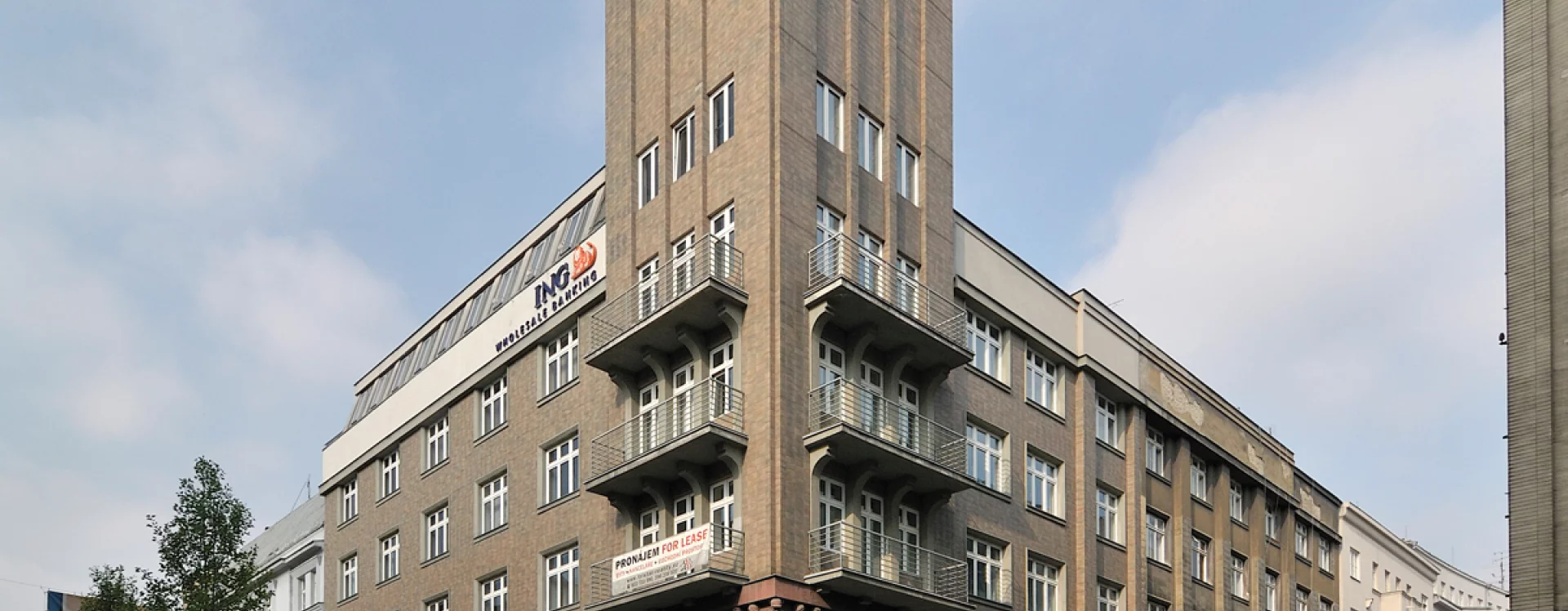
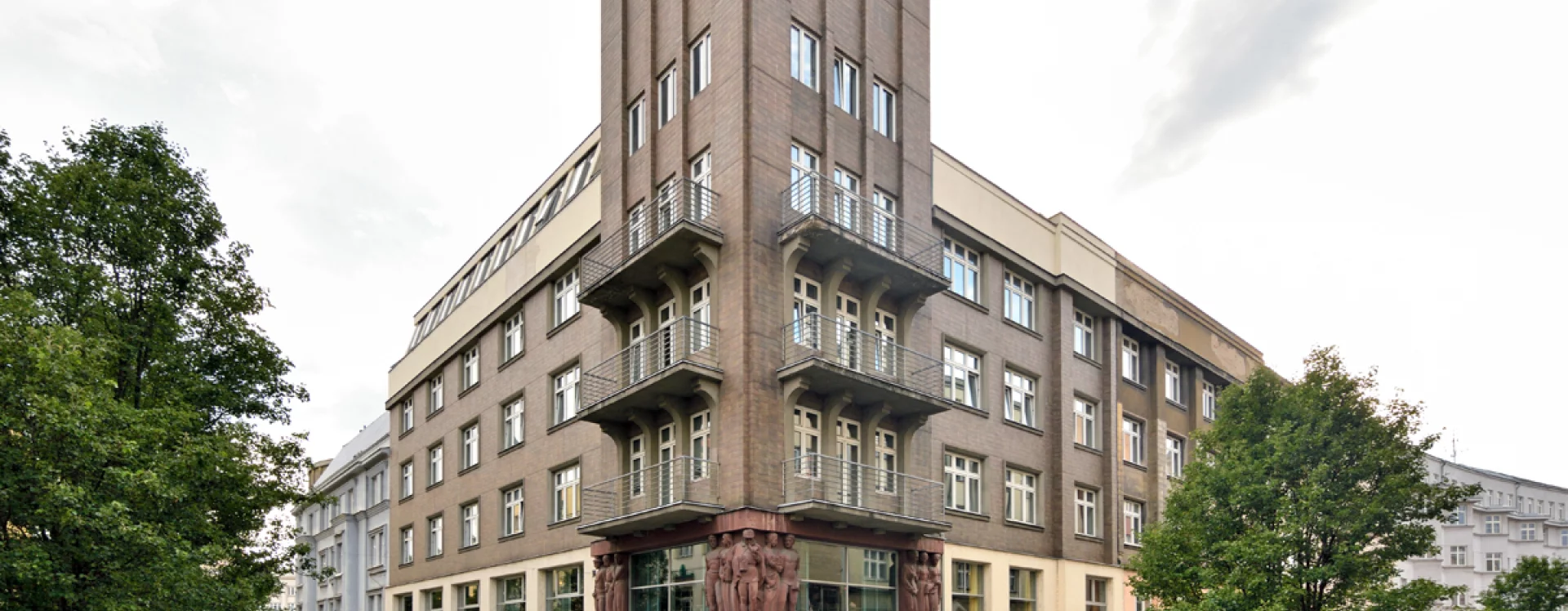
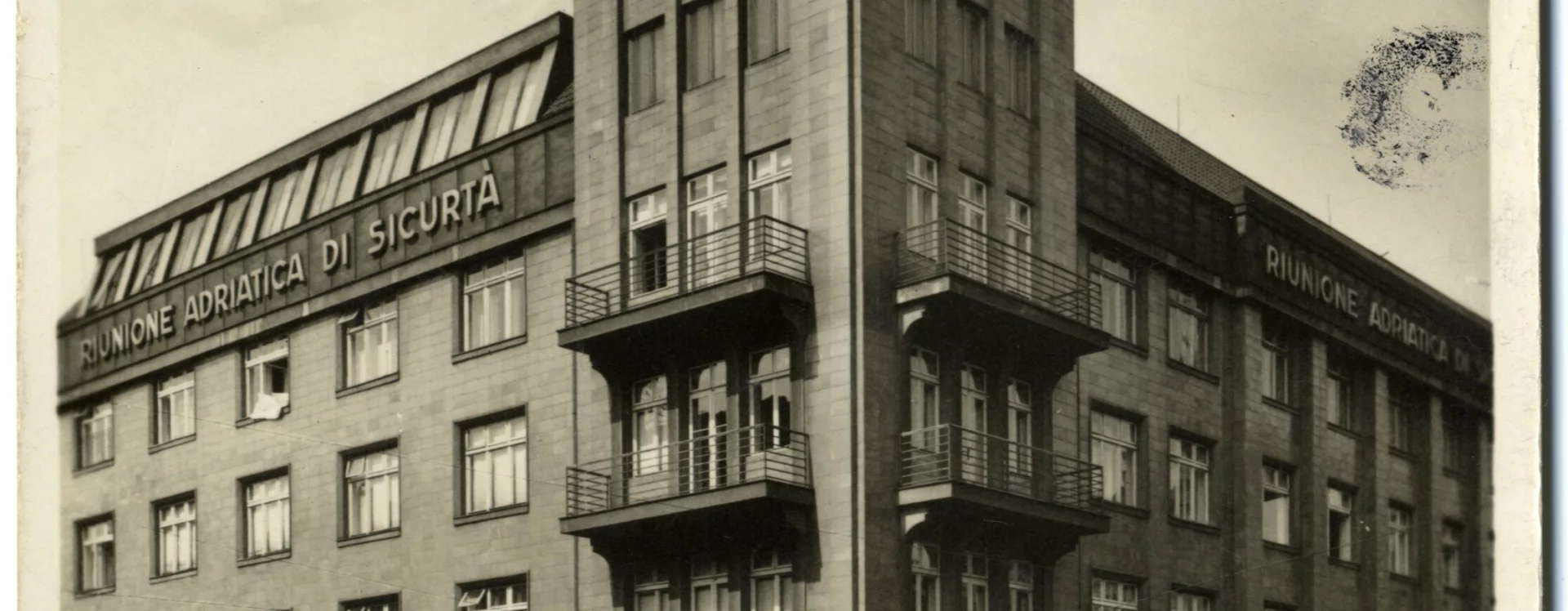
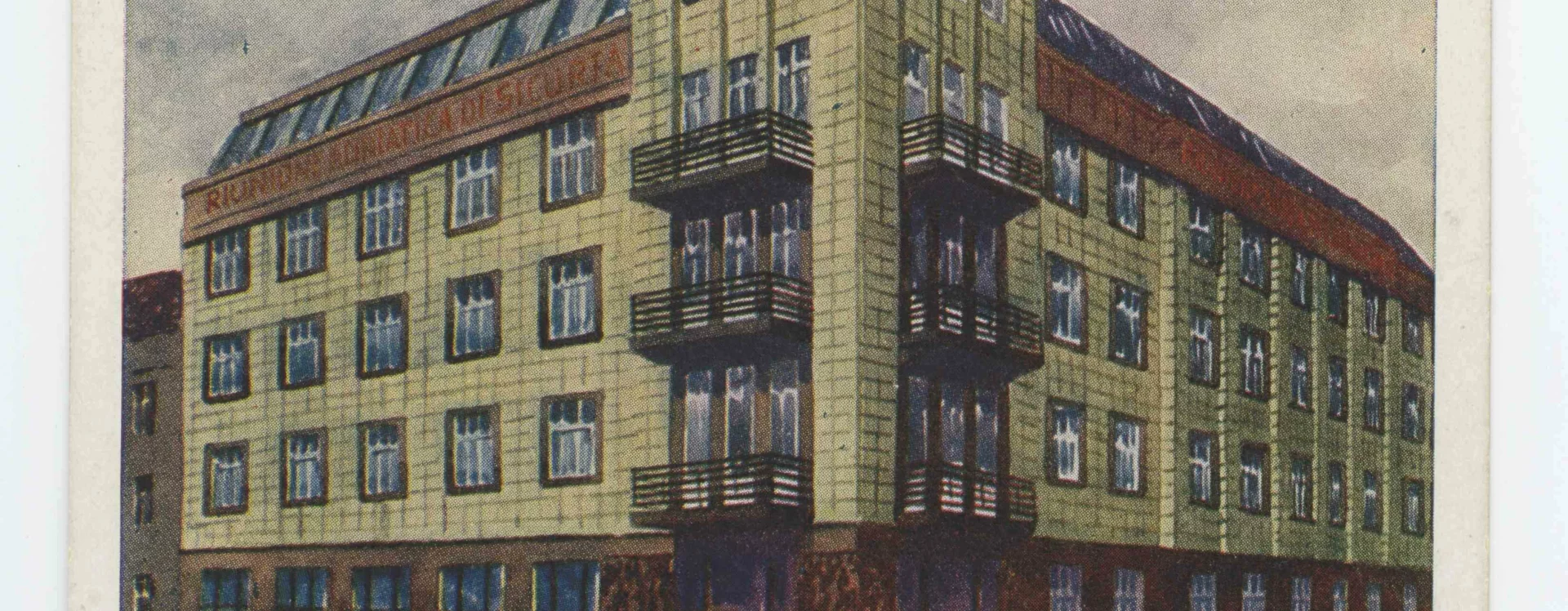
The Riunione Adriatica di Sicurtà insurance company was founded in 1838 in Trieste, which at the time formed part of the Austrian Empire, and focused primarily on fire insurance and travel insurance. Shortly after its establishment, the company opened branches in Vienna, Prague, and Budapest. After 1918, it became an Italian insurance company with representation in Czechoslovakia. It gradually constructed its headquarters there: the first was the Adria Palace in Prague, completed in 1925 to a design by Josef Zasche and Pavel Janák; the second followed three years later in Ostrava, designed by Karel Kotas. By that time, Kotas was already well established in Ostrava, notably through his work on the interiors of the New Town Hall and, above all, through the project for the Municipal Savings Bank. He later continued to work for the insurance company on several further commissions.
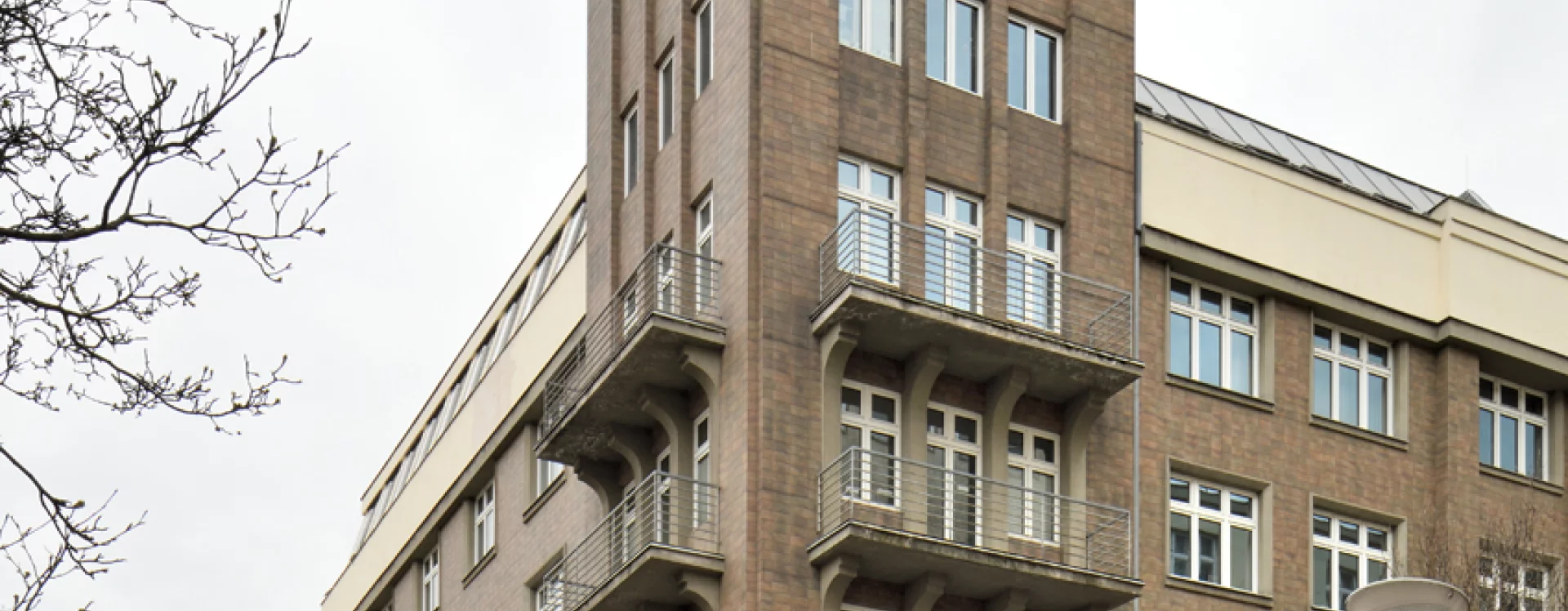
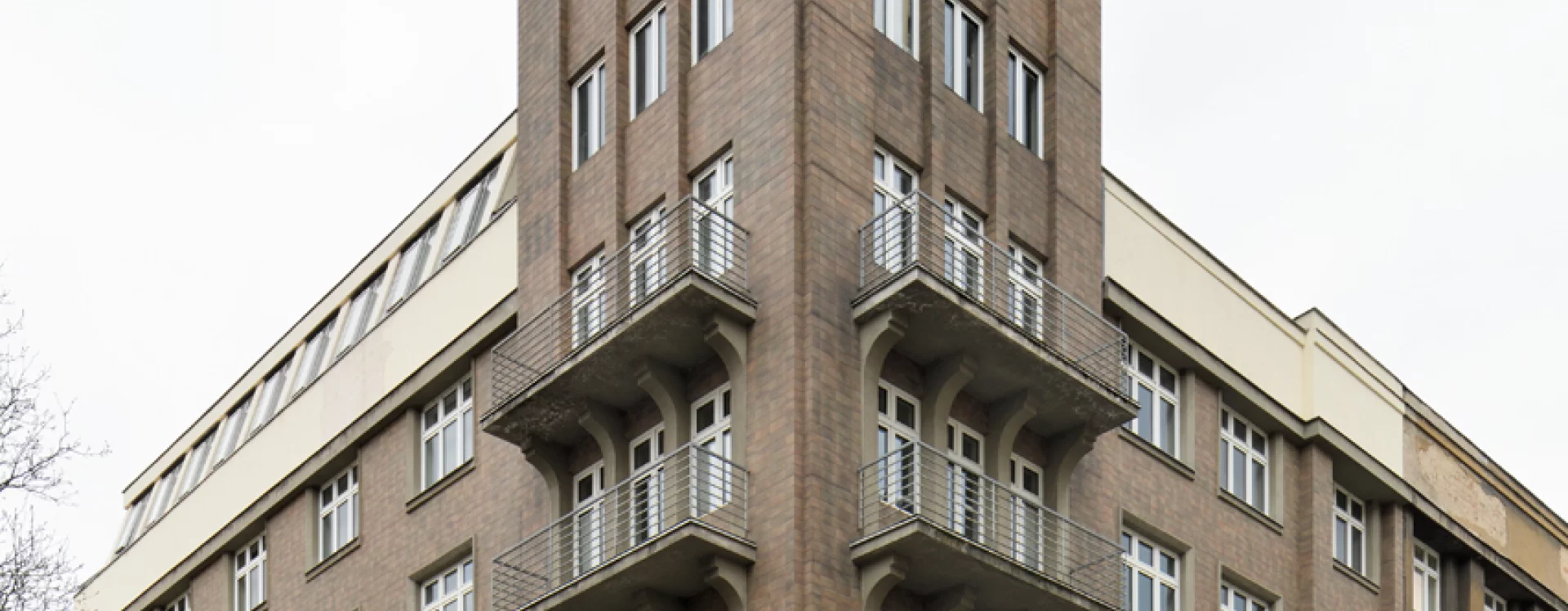
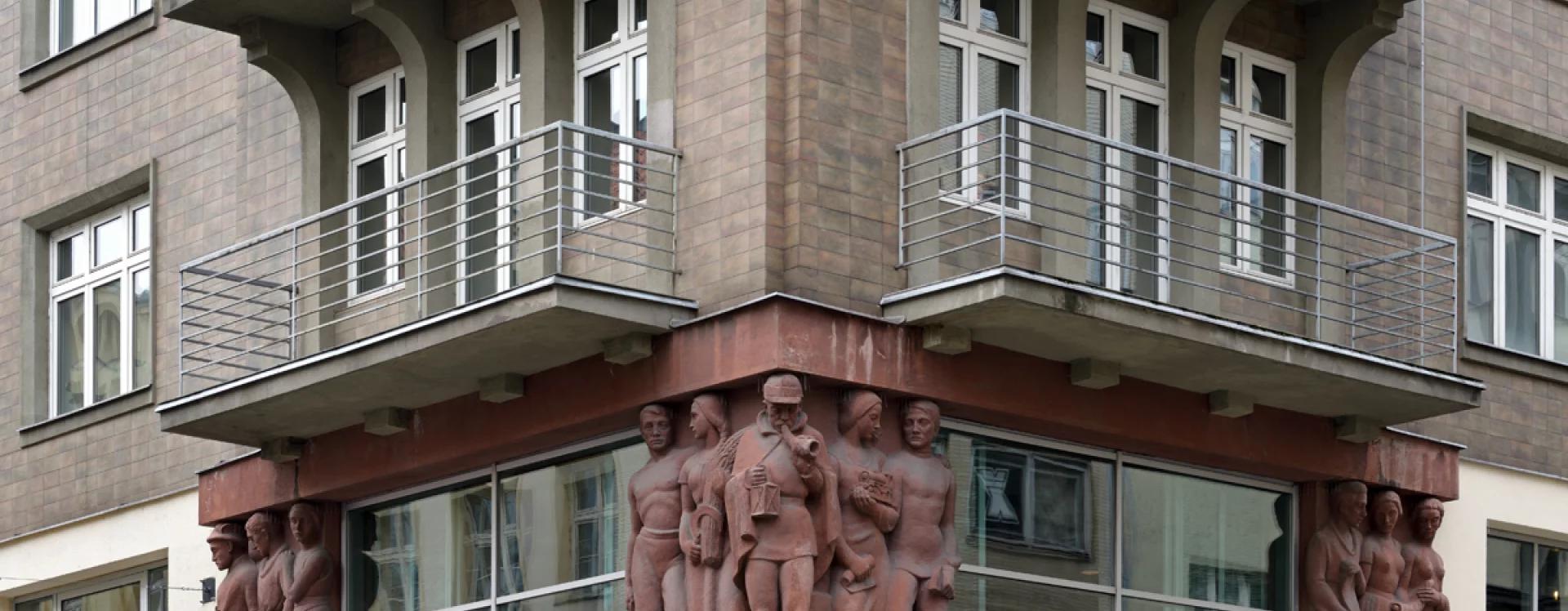
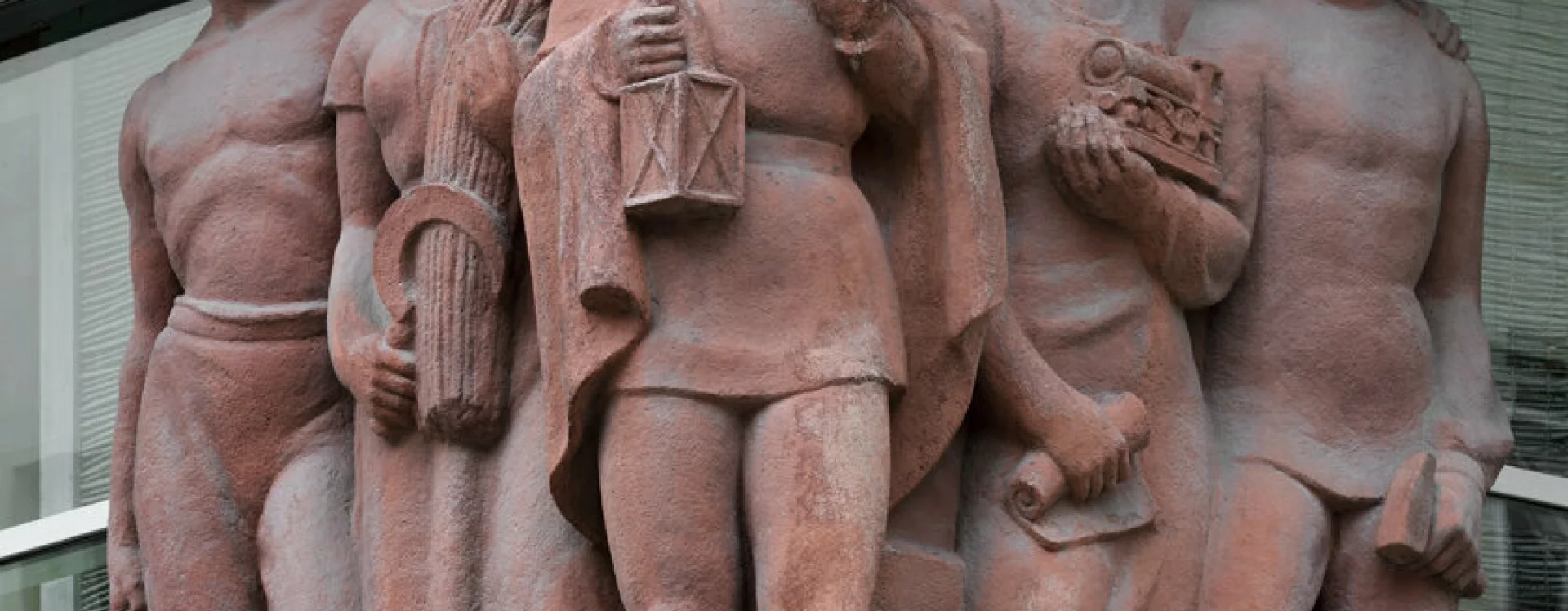
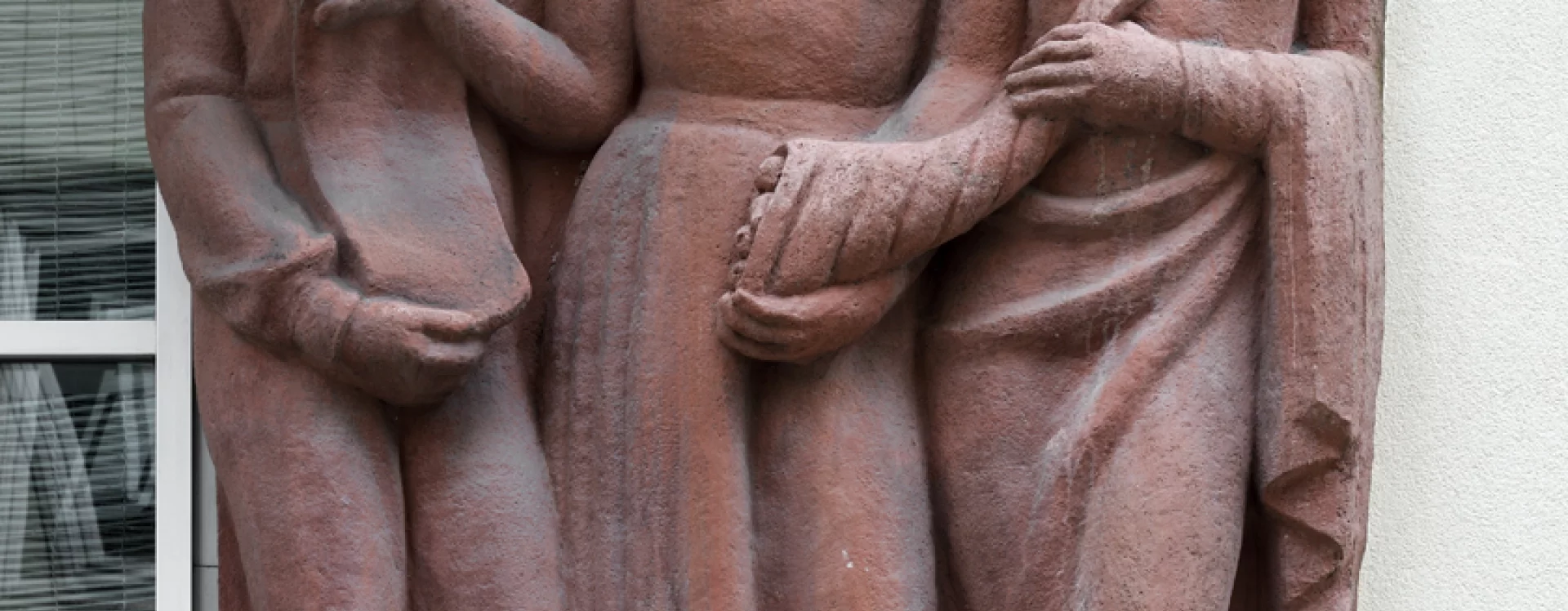
The palace, conceived in a purist modernist style, was erected in the centre of Moravská Ostrava on the corner of Zámecká and Puchmajerova streets. The five-storey, two-wing building is accentuated by a corner, markedly elevated prismatic tower referencing Italian architectural traditions. Its junction with the ground floor is visually lightened by a trio of terracotta figurative reliefs by the sculptor Julius Pelikán, symbolising commerce (the god Mercury), prosperity (a woman with a cornucopia), and professions (a miner, a labourer, a woman with a locomotive, a reaper, and a night watchman). The three windows lighting the tower floors are complemented by balconies with metal railings carried on consoles. Kotas further enlivened the façades through the use of colour. At ground-floor level, he combined black ceramic cladding with red terrazzo, while the upper storeys, rhythmically articulated by pilasters, are faced with beige cladding. The façade facing Zámecká Street is crowned by a mansard extension, while the elevation towards Puchmajerova Street is terminated by an attic.
The metropolitan character of the palace was reinforced by its art deco interior. Although the insurance company originally envisaged incorporating a department store, the ground floor and first floor were ultimately occupied by the luxurious Savoy Café, which opened in February 1930. At the centre of the ground floor, accessible from Zámecká Street, was a horseshoe-shaped staircase providing vertical circulation between the floors. Grouped around it were the service facilities (cloakroom and toilets) and a snack bar. On both sides lay the open café and patisserie spaces, articulated only by columns and finished with marble and mirrors, and equipped with the cubic and cylindrical light fittings characteristic of Kotas’s work. Gaming rooms and billiard tables were located on the first floor. The colours of the wall finishes, curtains, and furniture upholstery were selected in eye-pleasing contrasts.
In 1945, the building was altered to a design by the architect Vladimír Meduna. From the 1950s until 1990, it housed the Rozvoj department store. Reconstructions carried out in the 1980s and 1990s – most notably the replacement of shopfronts and windows with unsuitable contemporary elements, the substitution of the original envelope with new cladding differing in proportion and colour, and the destruction of the café – significantly damaged the architectural qualities of the building.
Literature
Šárka Glombíčková. Ostrava. Příspěvky k dějinám a současnosti Ostravy a Ostravska 22. Šenov u Ostravy, 2005. p. 7–38.
Renata Skřebská. Oslava všedního dne. Architektonická plastika s atributy práce, dopravy, obchodu a peněžnictví. Ostrava, NPÚ, ÚOP v Ostravě, 2020. p. 160. ISBN 978-80-88240-21-1.
Průvodce architekturou Ostravy. 2009. p. 178. ISBN 978-80-85034-54-7.
Petr Pelčák, Martin Strakoš, Ivan Wahla (edd.). Karel Kotas 1894–1973. Brno, Ostrava, NPÚ, ÚOP v Ostravě, Spolek Obecní dům Brno, 2021. p. 11–47. ISBN 978-80-88240-24-2.
Jindřich Vybíral. Zrození velkoměsta: Architektura v obraze Moravské Ostravy 1890–1938. Šlapanice, ERA, 2003. p. 141–142. ISBN 80-86517-94-2.
Palác Riunione Adriatica di Sicurita (bývalý obchodní dům Rozvoj; kavárna Savoy). Available from: https://pamatkovykatalog.cz/palac-riunione-adriatica-di-sicurita-13062356 [accessed 19. 10. 2025]
Památka 122. Available from: https://www.ostravskepamatky.cz/pamatka/show/122 [accessed 19. 10. 2025]
Palác Riunione Adriatica di Sicurtà. Available from: https://encyklopedie.ostrava.cz/home-mmo/?acc=profil_domu&load=21 [accessed 19. 10. 2025]
Kavárna Savoy. Available from: https://amo.ostrava.cz/vystavy-2/vystavy/vystava-vrele-se-odporucuje/kavarna-savoy/ [accessed 20. 9. 2026]
Sources
Muzeum umění Olomouc. inv. no. č. A 2496/1–15, Sbírka architektury.
Bez názvu. inv. no. složka č. 488 a 489, Spisovna Úřadu městského obvodu Moravská Ostrava a Přívoz.