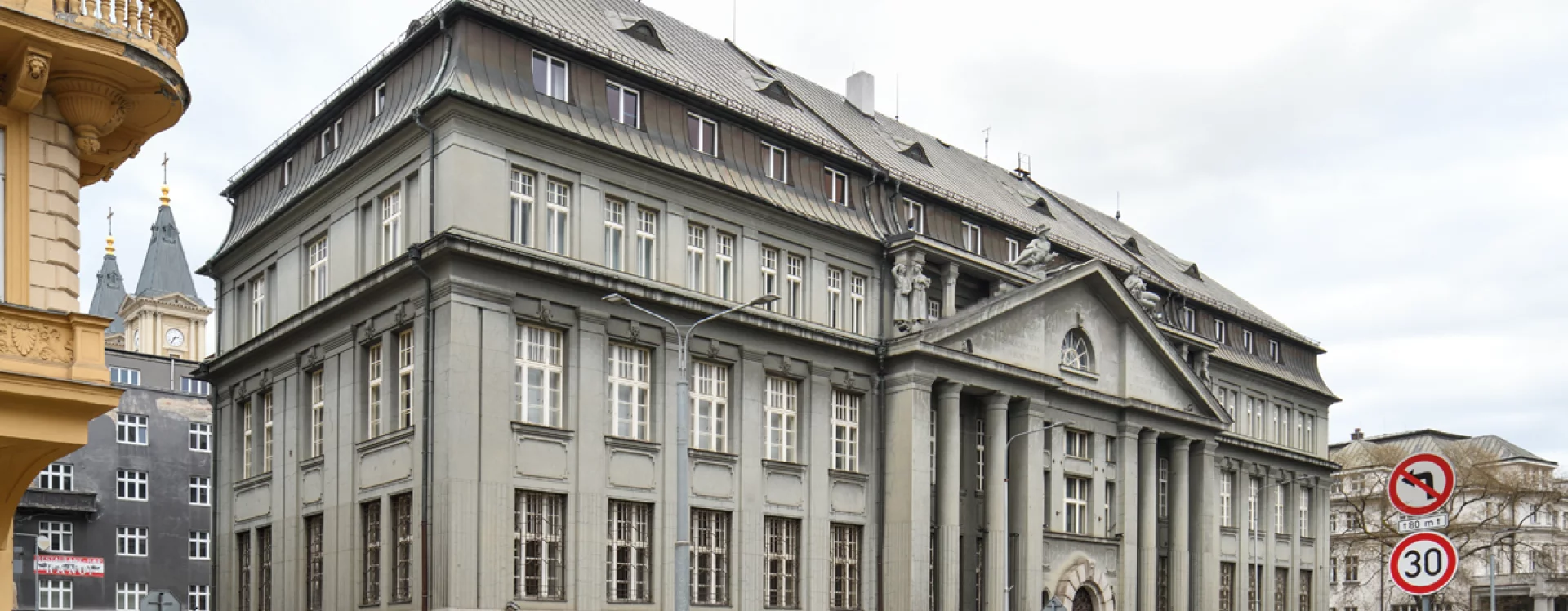
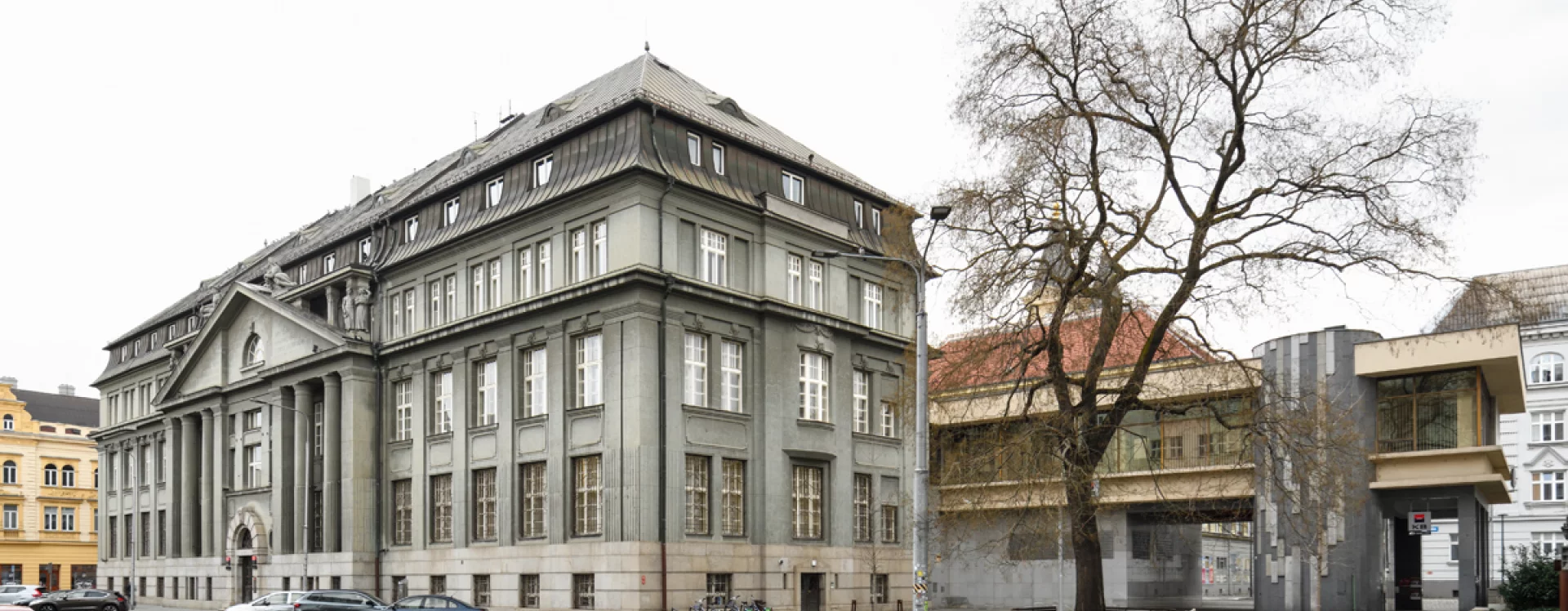
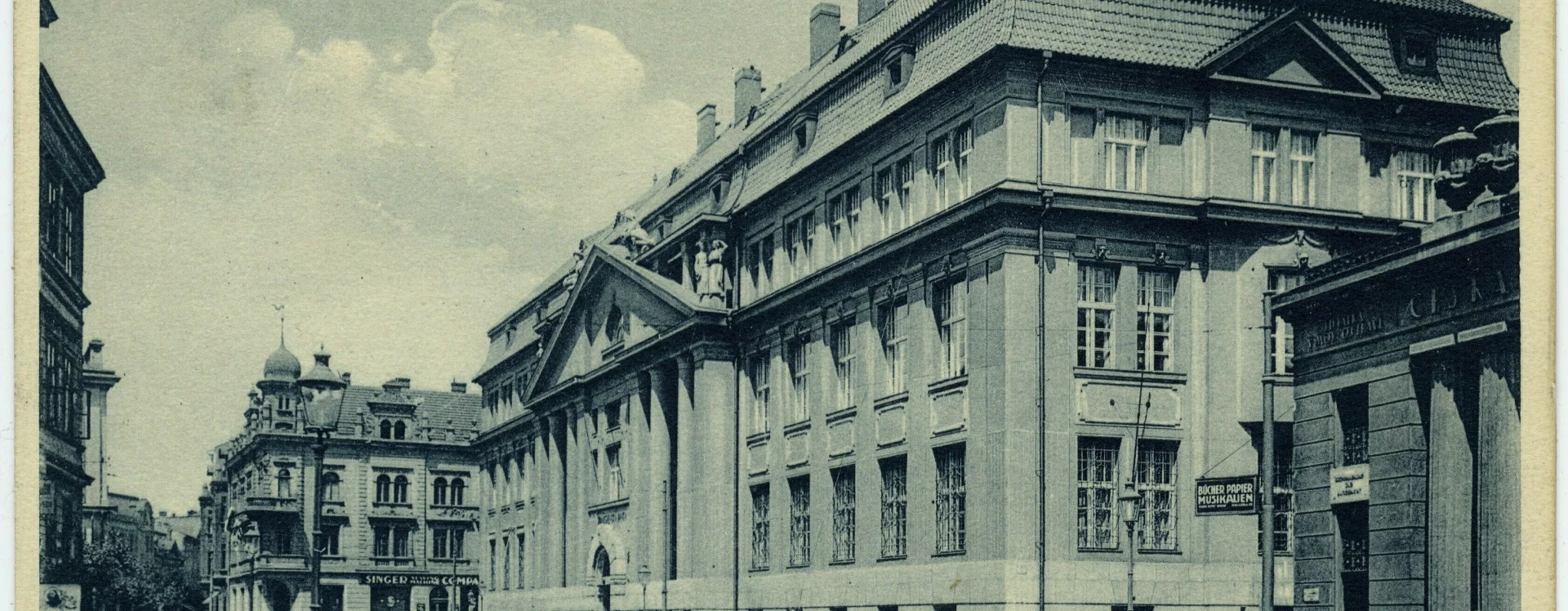
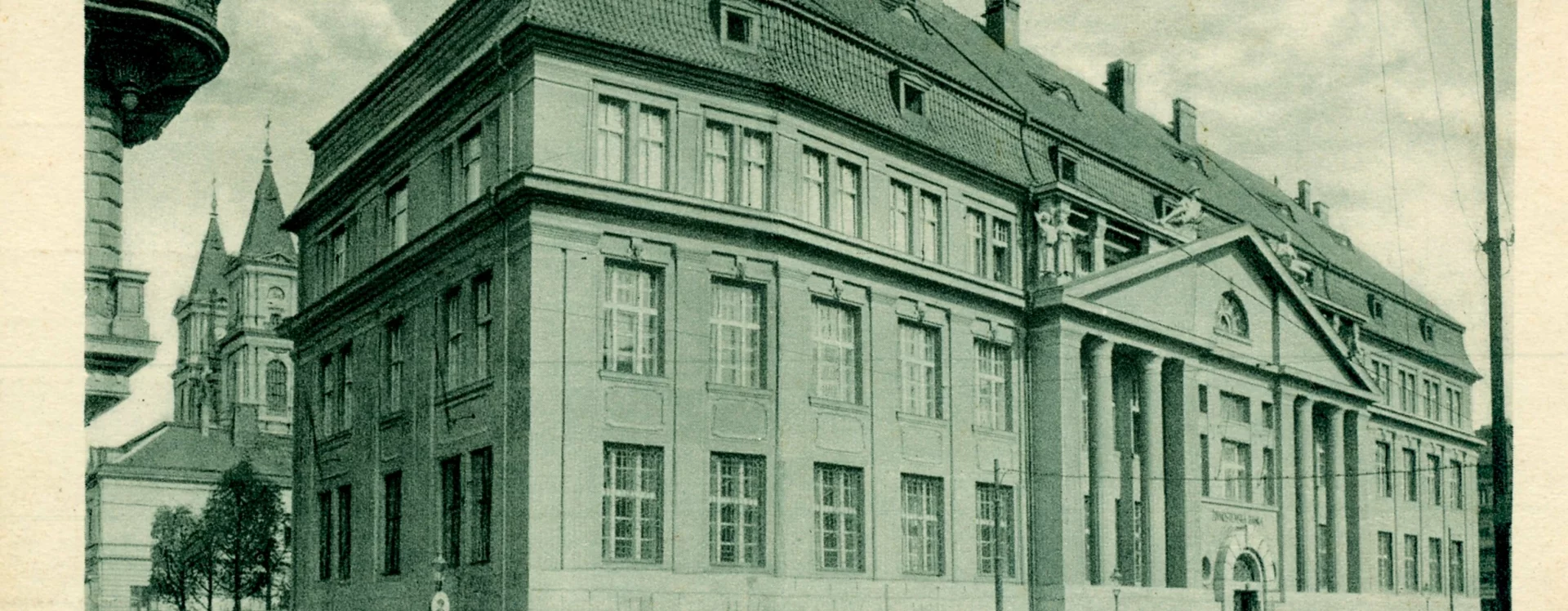
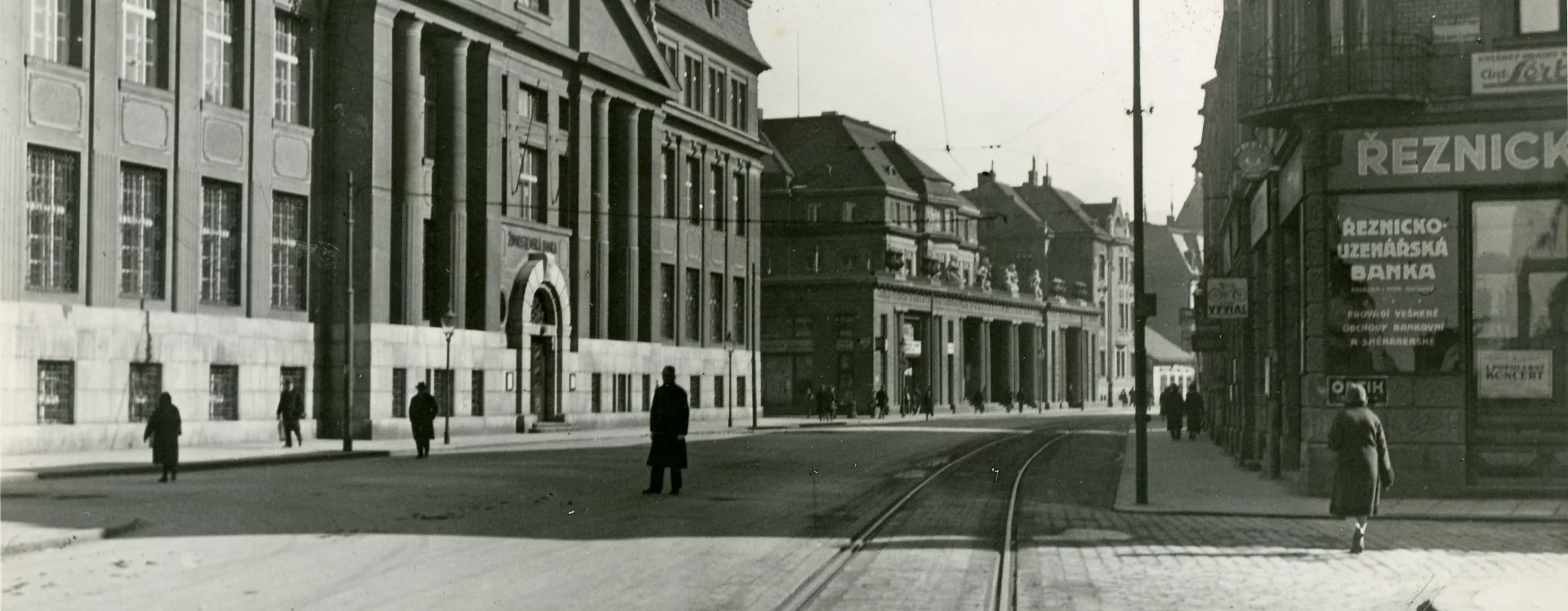
At the junction of Nádražní, Čsl. legií, and Hollarova streets, the building line of Nádražní Street curves slightly. The dominant building of Živnostenská banka (now Komerční banka) is set back from the street line here, creating a broader open space that is currently used as a car park. This urban configuration reflects the fact that the bank building is on a much larger scale than the neighbouring properties and that the designer envisaged an entrance forecourt in front of the palace-like structure. The original premises of Živnostenská banka was a late-historicist building on the corner of Nádražní Street and Čsl. legií Street. When the Czechoslovak Republic was founded, this early-20th-century building was no longer adequate, not only in practical terms but also for reasons of representation, and so Živnostenská banka purchased a plot across the street, next to the recently completed Unionbank. Prague-based Živnostenská banka, the largest banking enterprise in the First Czechoslovak Republic, commissioned the design from the leading Prague architect Kamil Hilbert (1869–1933), best known for his role in the completion of St Vitus Cathedral in Prague. This connection is evident from the drawings for the Ostrava bank building: Hilbert stamped them with an author’s seal reading ARCHITECT KAMIL HILBERT, BUILDER OF ST VITUS CATHEDRAL AT PRAGUE CASTLE. Hilbert conceived the Ostrava branch in a similar vein – as a monumental temple to the cult of money, with a robust massing derived from the classical tradition. By adopting this scale, he deliberately surpassed the surrounding buildings and allowed the palace to stand out accordingly.
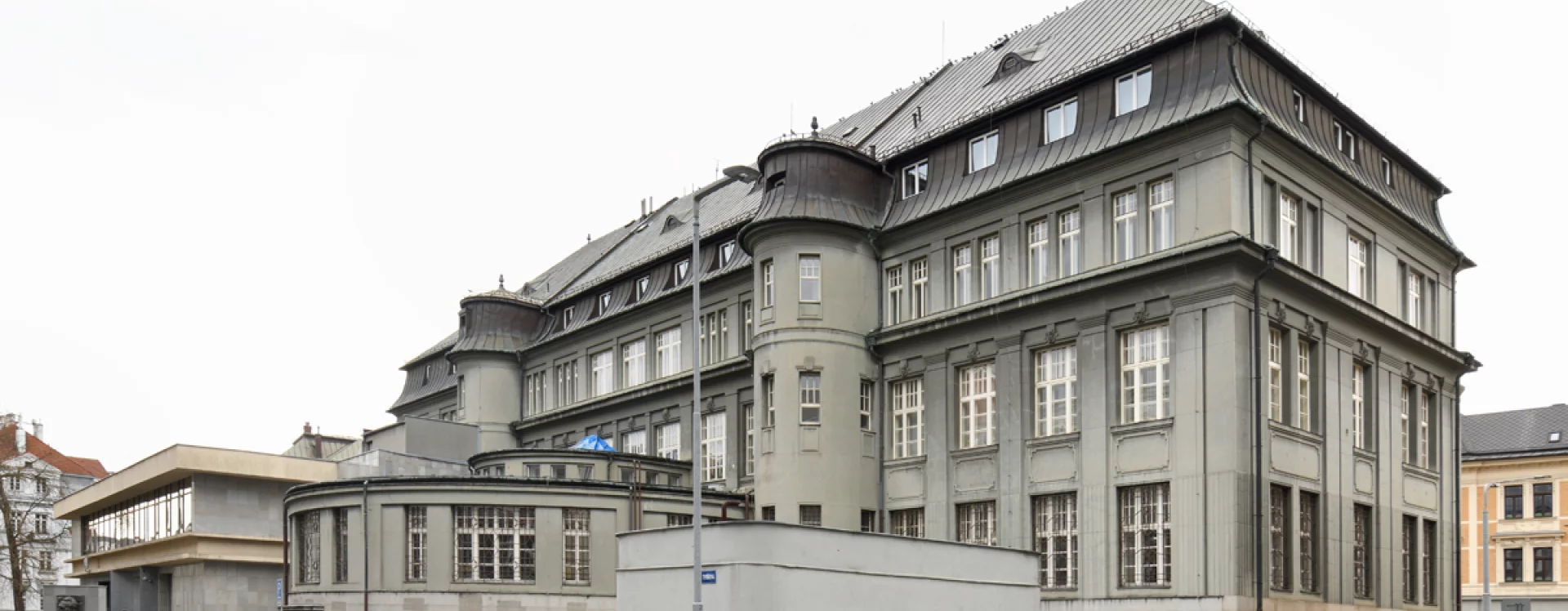
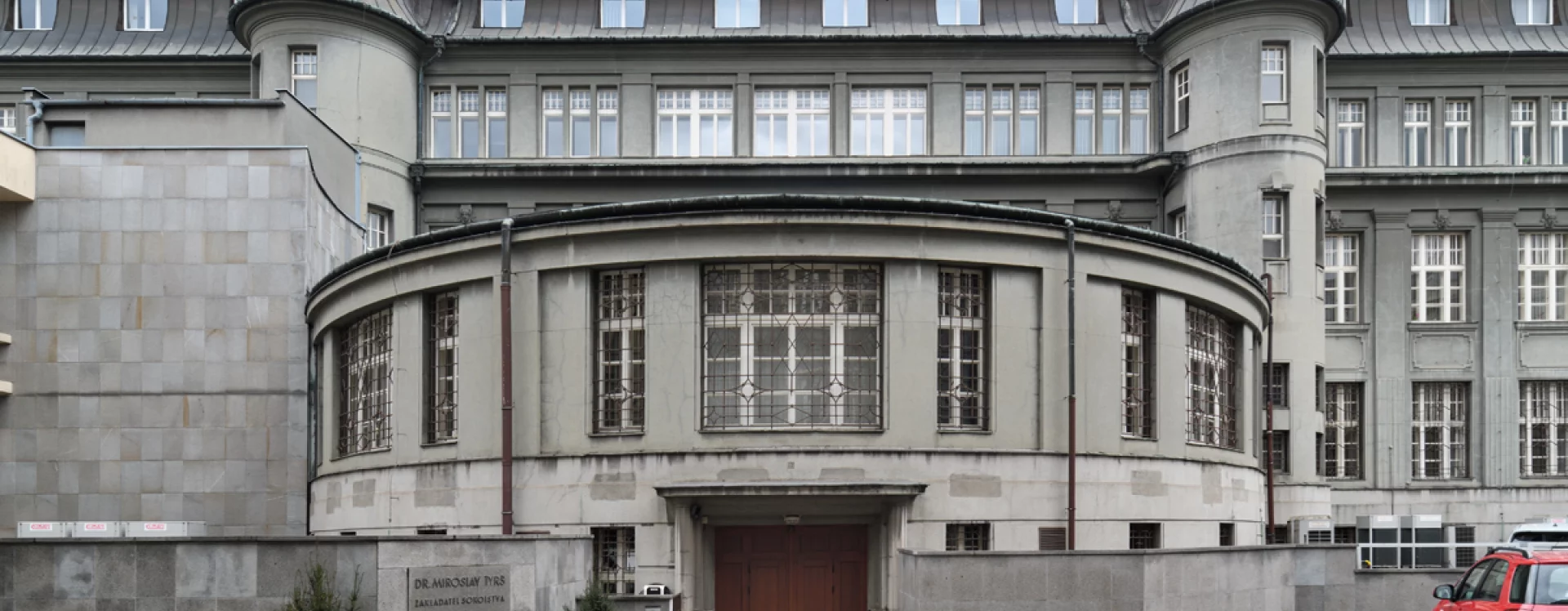
The result was a large three-storey building of rectangular plan, with a cylindrical risalit of the main banking hall in the rear courtyard tract and a pair of flanking cylindrical risalits there as well, housing the building’s service facilities. The original drawings show that the new bank building was intended to be extendable by two side wings towards Tyršova Street, which would have filled most of the rectangular plot. For reasons unknown, this scheme was never realised, and the block therefore remained partly undeveloped. The completed building is capped by a massive mansard roof with a later attic conversion.
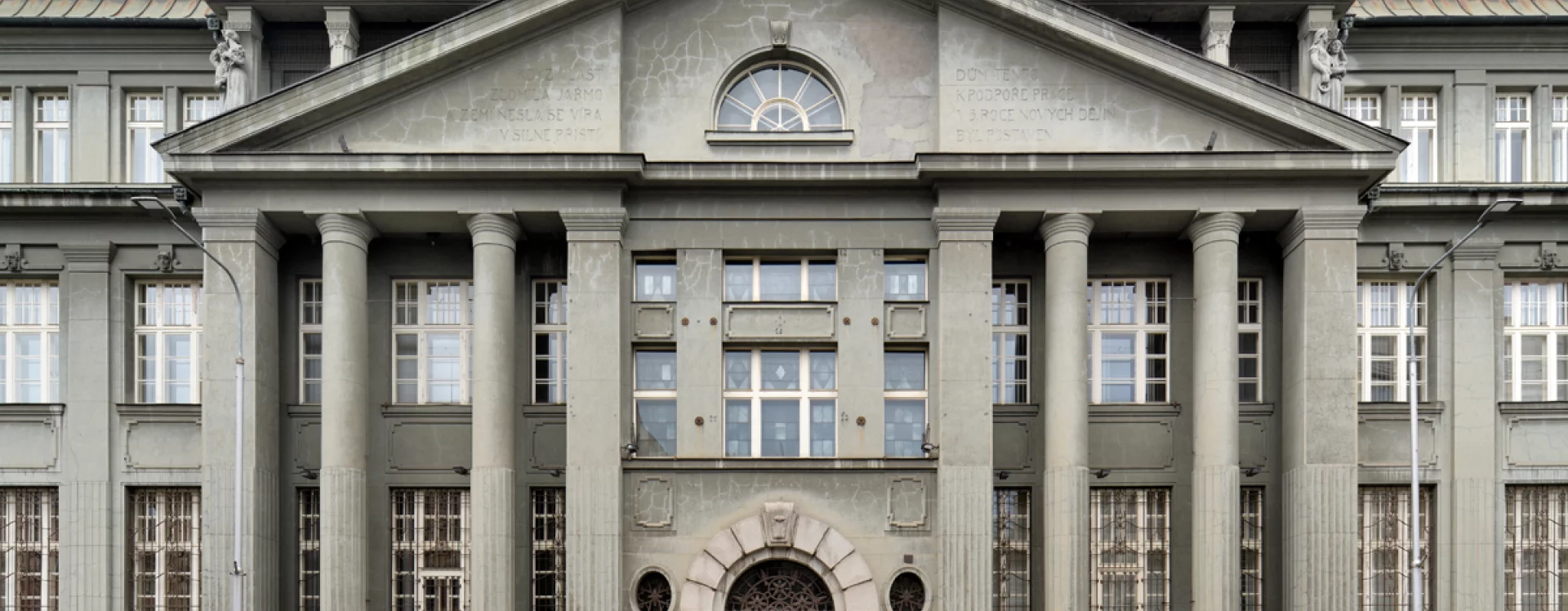
On Nádražní Street, the main façade is articulated in a 5 + 3 + 5 rhythm of window axes, with a broad central three-axis risalit pierced by the barrel-vaulted portal of the main entrance, fitted with large double doors clad in sheet copper and decorated with classicising ornament. The plinth is faced with granite slabs, while the upper parts employ artificial stone. Decorative metal grilles in a classicising mode are set in front of the timber box windows of the basement and the raised ground floor. The central risalit is structured by piers and columns with cornice capitals, fluted at ground-floor level and smooth on the upper floor. They support a large triangular pediment, slightly recessed in the centre and fitted with a thermal window. Hilbert reserved the flanking parts of the tympanum for an inscription, as discussed below. For this reason, he placed the allegorical sculptural decoration not within the tympanum itself, as might be expected, but above the pediment and the main cornice, which rises in the central part of the composition to connect with the upper part of the pediment.
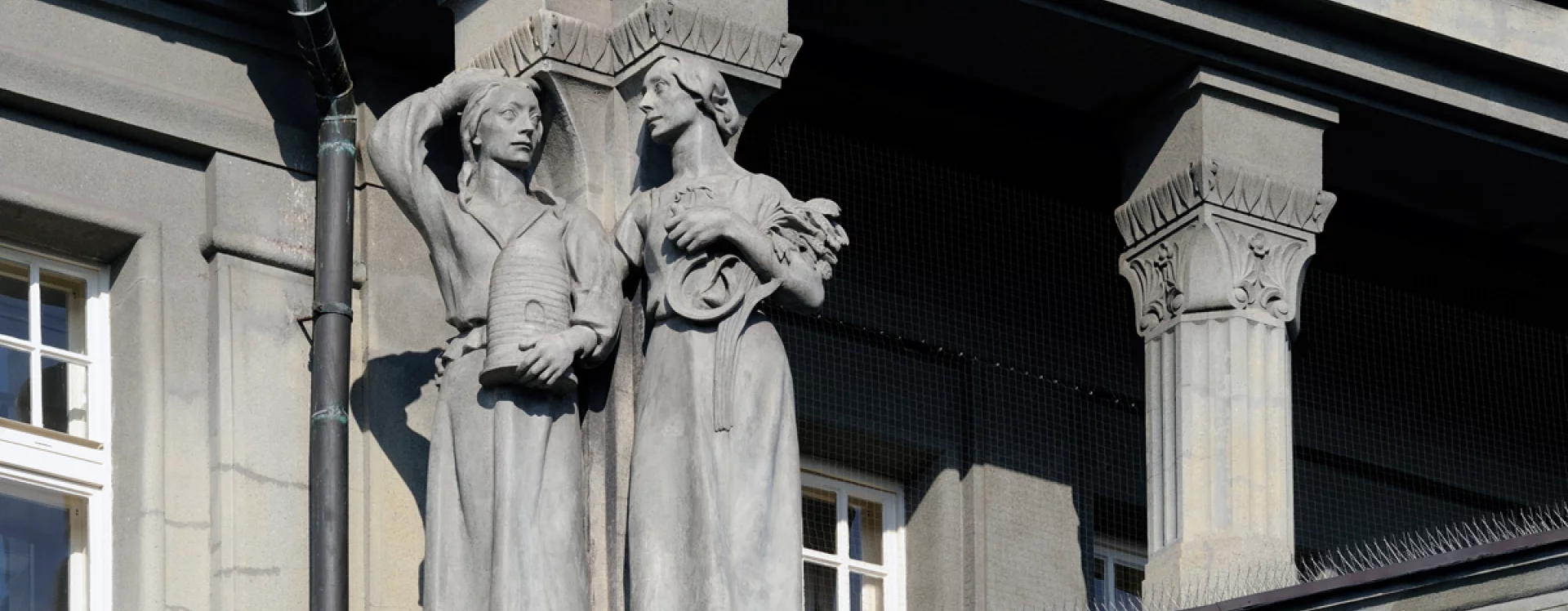
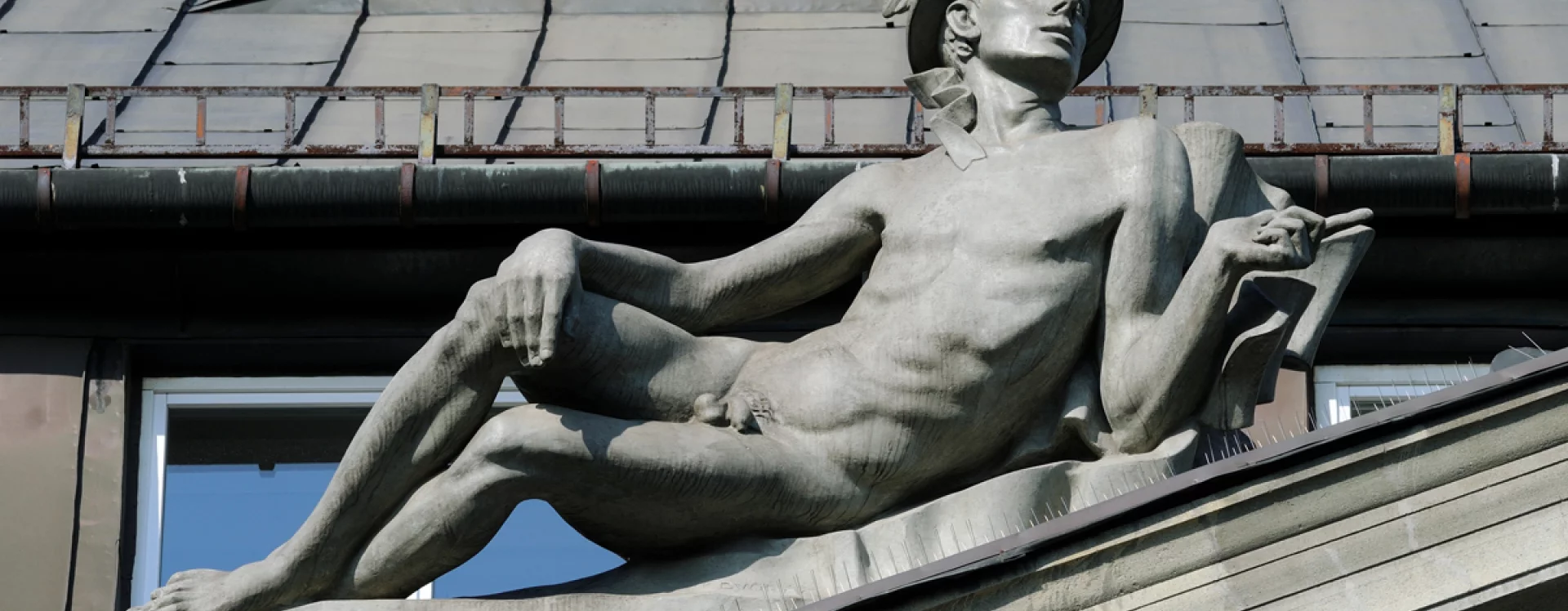
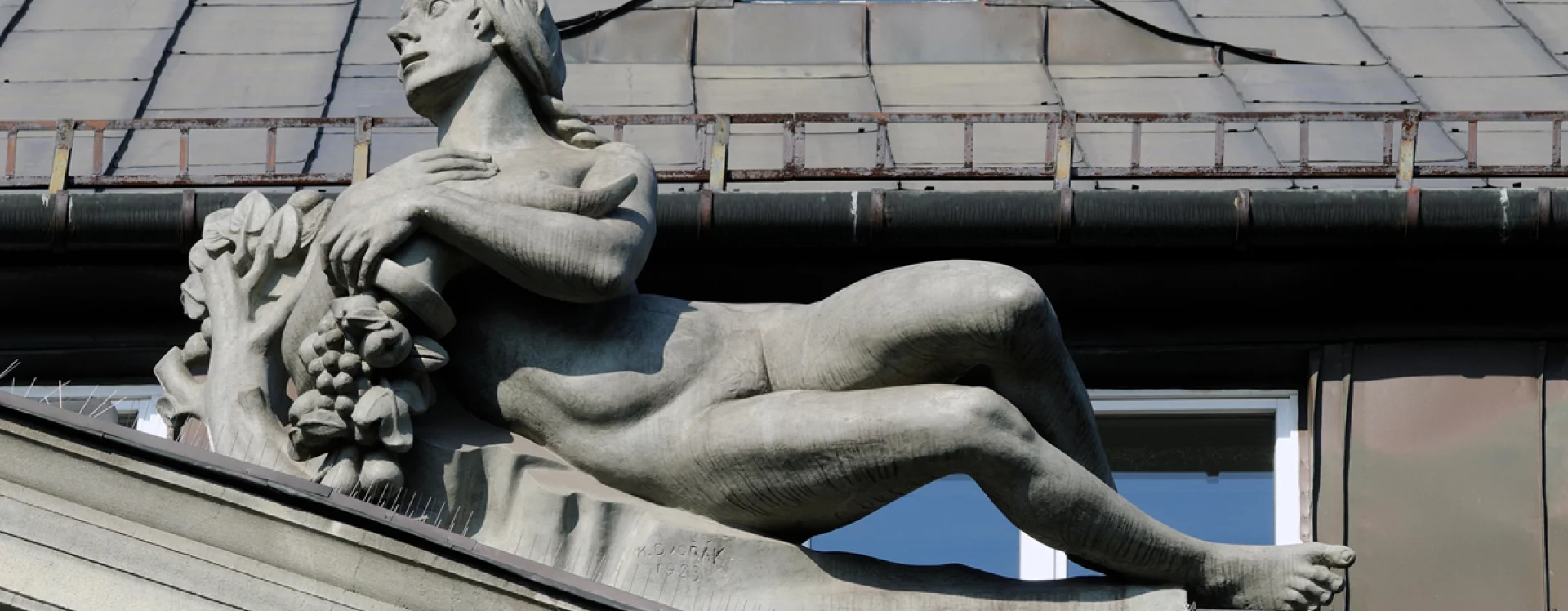
The allegorical figures were created by the academic sculptor Karel Dvořák (1893–1950), a pupil of Professor Jan Štursa. Reclining figures of Mercury, symbolising trade, and Ceres, the goddess of abundance, are placed on the main cornice above the centre of the triangular pediment. Flanking the pediment are figures that complete the piers supporting the cornice: on the north side, Diligence (or Thrift) and Agriculture, and on the south side, Industry and Construction. Set within the tympanum of the triangular pediment, a dedicatory inscription in capitals reads: When the homeland broke its yoke and faith in a strong future spread through the land, this house was built to support the work in the fifth year of the new era.
The new epoch and revolutionary ethos of the inscription refer not only to the founding of the Czechoslovak Republic but also to the French Revolution of 1789. This parallel raises the question of whether Hilbert’s sources of inspiration were, in fact, more extensive than is sometimes assumed. They need not have been limited to Theresian Baroque, or the “baroque box” as the architectural historians Pavel Zatloukal and Jindřich Vybíral term it. In this instance, Hilbert may have drawn on the updated tradition of neoclassical architecture of the late 18th and early 19th centuries. This is also linked to revolutionary France and its republican tradition, which was ideologically important for the young Czechoslovak Republic. In addition to certain motifs in the column and pilaster orders on the façade, this is suggested by the treatment of the central risalit with its tympanum and by the quoted inscription itself. A comparison with the neighbouring palace of Česká banka Union, designed by the architect Ernst Korner, further makes it clear that Hilbert was not primarily drawing on Viennese banking architecture, but was seeking inspiration in a different context – one that corresponded to the character of the newly formed Czechoslovak state. And which environment held particular symbolic value for the new republic? The answer is simple: republican France.
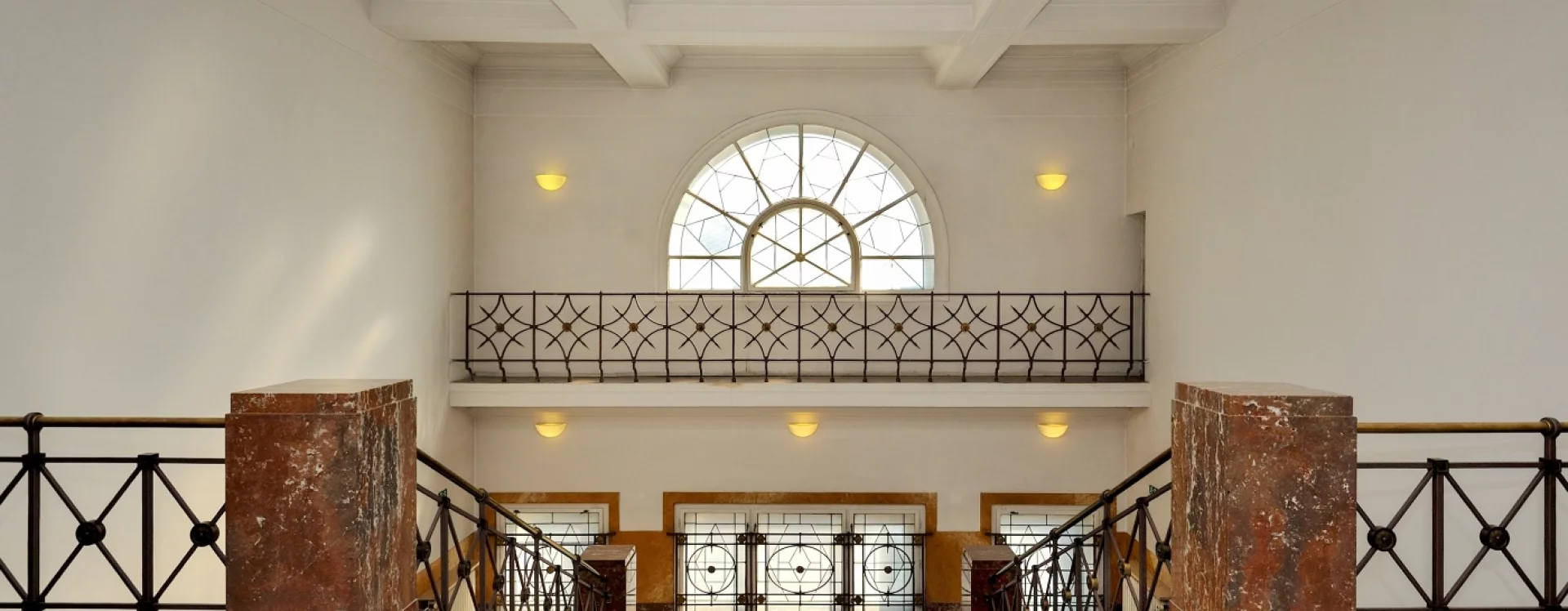
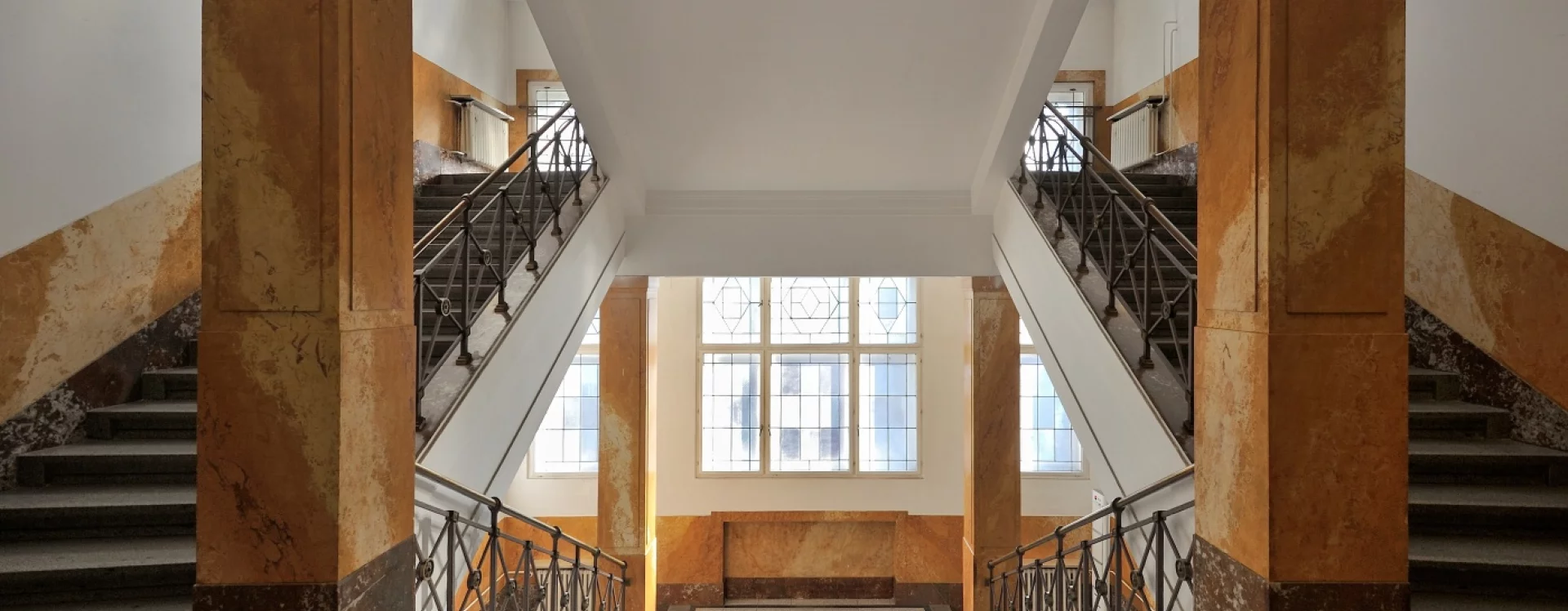
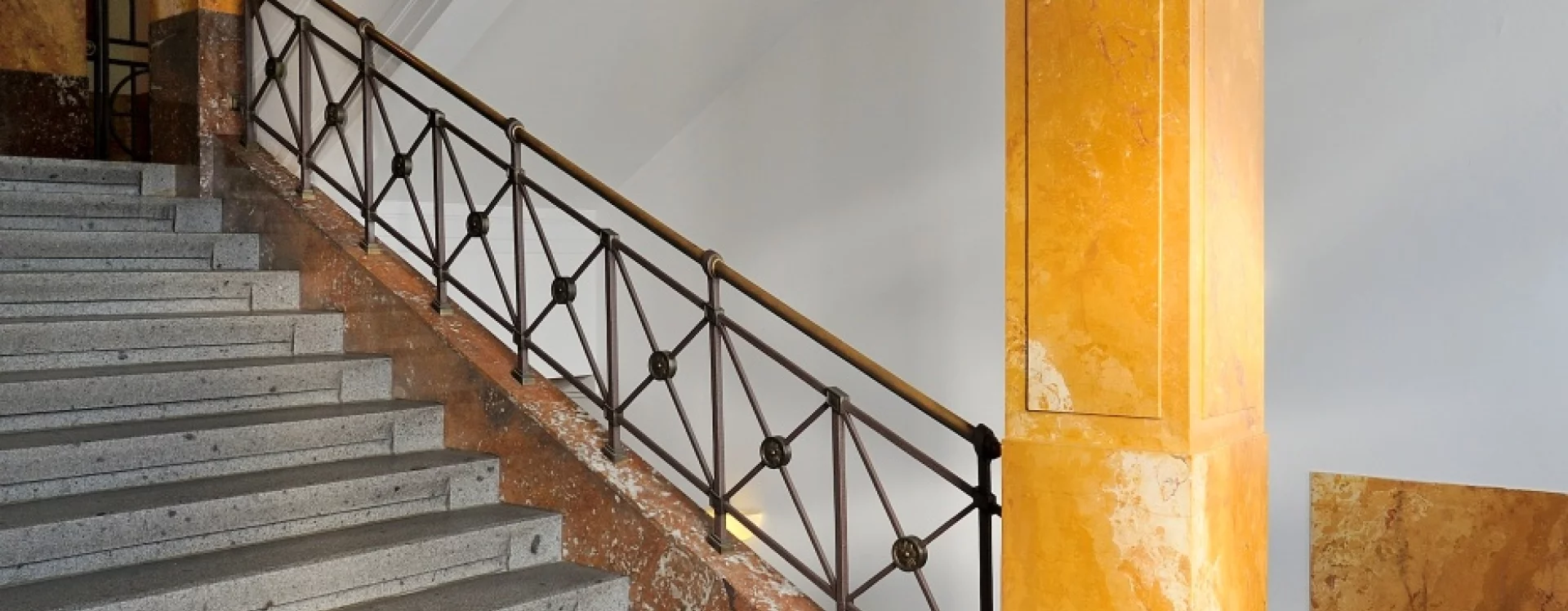
Beyond its external appearance, Hilbert based the building’s structure on a combination of traditional brick masonry and reinforced-concrete construction. This made it possible to employ, on the one hand, a three-bay arrangement with a central connecting corridor and, on the other, an open-plan office layout subdivided by counters. The dominant public space on the raised ground-floor level is the semi-circular cashier’s hall, which forms a low central cylindrical wing towards Tyršova Street. This motif recalls spatial solutions in bank architecture of the final third of the 19th century; one example is the cashier’s hall of the Austrian Postal Savings Bank in Vienna by Otto Wagner. Whereas Wagner used a multi-storey wing, Hilbert opted for a solution comprising only basement spaces and the raised ground floor. The main vertical axis of circulation within the building is a monumental three-flight staircase positioned above the main entrance in the front tract, connecting the ground floor to the upper levels and, above all, to the first floor, where the bank’s management offices were located. A service staircase was placed in the rear tract at the south-east corner, directly opposite the director’s office.
After 1945, the building housed Státní banka československá. Since 1989, it has been owned by Komerční banka, which continues to use it to this day. In the 1980s, the complex underwent a radical conversion. Near the south-east corner, a new two-storey rectangular extension with a flat roof was added next to the original building; at ground-floor level it contains a two-axis public passage leading from Nádražní Street to Tyršova Street. The late-modernist design of this extension was prepared by the architect Radúz Rozhon. Despite these alterations, the main building has retained the neoclassical character devised by Hilbert, which in the context of Ostrava symbolises the power and weight of money, and, more broadly, architecture associated with the representation of capital.
Literature
Ingrid Holzschuh, Sabine Plakolm, Forsthuber (Hg.). Wiener Wall Street. Ein Architekturführer duch das historische Bankenviertel. Innsbruck, Wien, Studien Verlag, 2023. p. 90-95. ISBN 978-3706560870.
Průvodce architekturou Ostravy. 2009. p. 125 a 393. ISBN 978-80-85034-54-7.
Martin Jemelka, Gabriela Pelikánová, Romana Rosová, Martin Strakoš, Radomír Seďa. Jan Prokeš: Ostrava na cestě k velkoměstu. Ostrava, Fiducia, 2023. p. 80-81. ISBN 978-80-907934-5-3.
Tvořit město. Opava a Moravská Ostrava 1850–1950: architektura a urbanismus. Opava, 2017. p. 168, 207, 229. ISBN 978-80-87789-46-9.
Jindřich Vybíral. Zrození velkoměsta: Architektura v obraze Moravské Ostravy 1890–1938. Šlapanice, ERA, 2003. p. 95-97. ISBN 80-86517-94-2.
Karel Jiřík (ed.). Ostrava : příspěvky k dějinám a současnosti Ostravy a Ostravska 18. Šenov u Ostravy, 1997. p. 172.
Státní banka Živnostenská banka (Komerční banka ; Živnobanka). Available from: https://www.pamatkovykatalog.cz/statni-banka-13066567.
Martin Strakoš. Památka 75. Available from: https://ostravskepamatky.cz/pamatky/75-Zivnostenska-banka-Komercni-banka [accessed 21. 10. 2025]
Sources
Bez názvu Spisovna stavebního úřadu Moravská Ostrava a Přívoz, ,. inv. no. složka čp. 1698, k. ú. Moravská Ostrava..