Automatic (or, more precisely, automated) telephone exchanges were a major construction project in socialist Czechoslovakia beginning in the 1960s. They reflected technological progress in the field of expanding telecommunications. Unlike in previous decades, connections were no longer made manually by switchboard operators, but by a system of relays grouped into logical blocks within a hierarchical, interconnected network. Transit exchanges provided supraregional connections between the central telephone exchange in Prague’s Žižkov district and local and node exchanges. They connected not end users, but long-distance lines. As part of the construction of a nationwide automated communications network, a transit exchange was also to be built in Pardubice.
The Federal Ministry of Communications and the Central Communications Directorate commissioned the specialized design organization Spojprojekt to carry out the project. The task was undertaken by a design team led by Jan Fišer, Jiří Eisenreich, and Jindřich Malátek, who were responsible for a number of iconic technical structures. They seized the opportunity in Pardubice with their characteristic enthusiasm. In December 1975, they not only submitted the design for the exchange but also took the initiative to propose a redesign of the entire planned construction site on Builders Square. They viewed the construction of the exchange as an opportunity to rethink this key area of socialist Pardubice—the “hub of the entire urban agglomeration”—where the “a stark contrast between the historic parts of the city and the new developments.”
The architects thus rhetorically endorsed the decades-long efforts to shape the square as a reflection of life in the new socialist society. It was to become “a symbol of the contemporary development of socialist life, its breadth, and evidence of significant transformations in the city’s construction” and reflect “the relationship between the historic center—a witness to the development of social life and social struggles as the site of a ceremonial act—and the new center—the materialized result of these struggles as the endpoint of the ceremonial procession and the hub of the concluding popular celebration.” This formulation—surprising coming from staunch advocates of high-tech architecture—is in keeping with Jindřich Malátek’s contemplative nature. He used similar arguments in discussions with investors, and, recognizing the emptiness of the language of the time, he managed to champion world-class architecture.
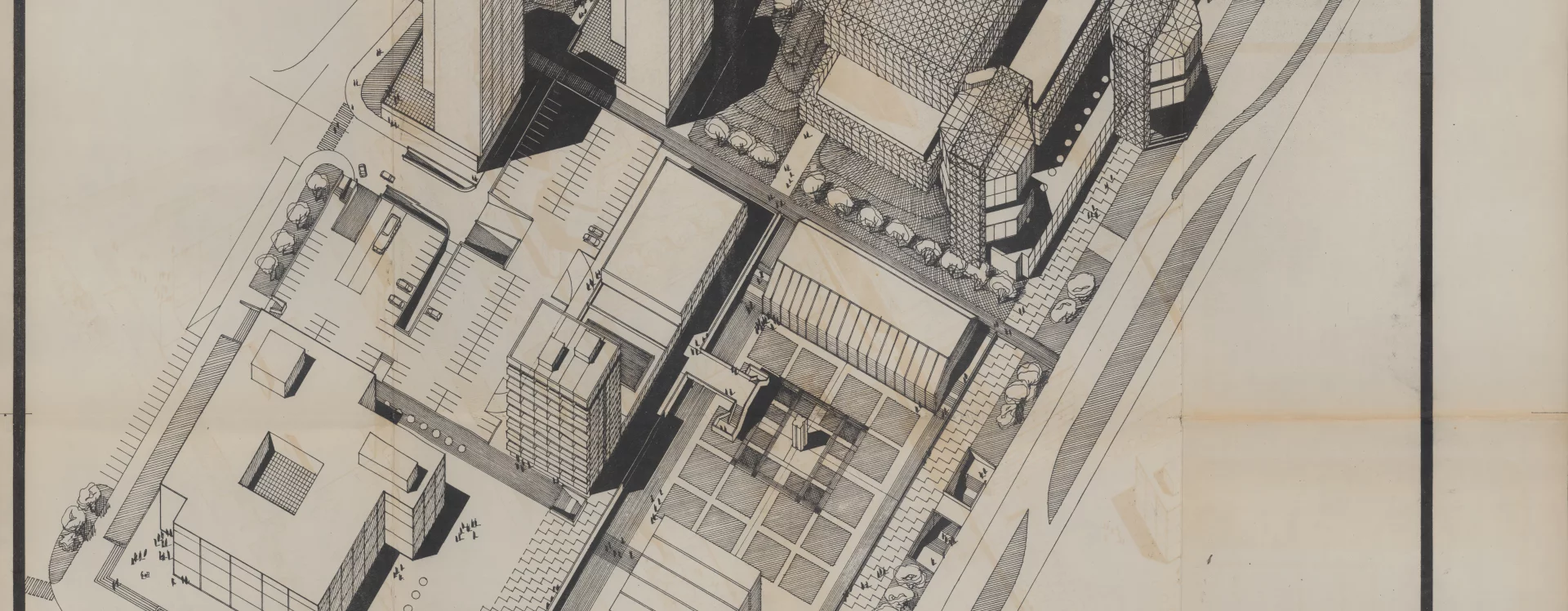
When designing the square, Fišer, Eisenreich, and Malátek—unlike their colleagues at Pardubice’s Stavoprojekt—did not seek to create visual landmarks for distant panoramic views. They viewed this tendency as misguided, running counter to the desired creation of “a complete and harmonious sense of the square.” They prepared several variants of the design. In each of them, in addition to the transit hub, they considered the construction of a hotel with a conference hall as a solution to the city’s long-standing pressing need. They also planned for parking areas, apartment buildings, a movie theater, and a shopping arcade.
In doing so, they challenged Miloš Návesník’s earlier concept (1968) by confidently placing the transit hub at the site southeast of the intersection with Sukova Street—a location Návesník had recommended for the construction of an opera house and cultural center. They sought to achieve several objectives. First and foremost, it was a practical solution, as utility lines intersected at that particular construction site. Moreover, the transit control center was a project that was actually being planned, whereas the cultural center was a distant dream. Above all, however, placing the exchange in a key area of the square was intended to reflect the transformation of society: “If churches were once the ideological symbols of cities, today it is precisely administrative buildings—and among them, in particular, telecommunications facilities—that must take over the function of churches in the ideological sphere and become the semiotic symbols of our time,” argued Jindřich Malátek, the philosophizing member of the design team.
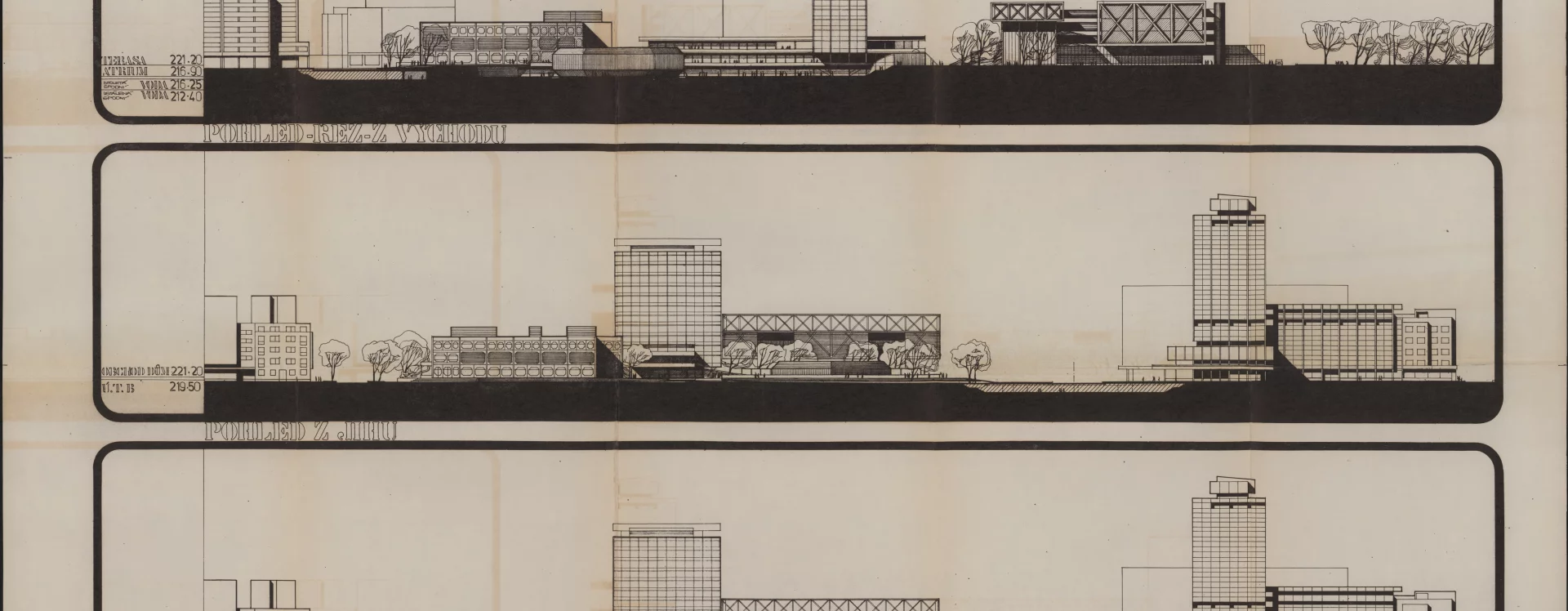
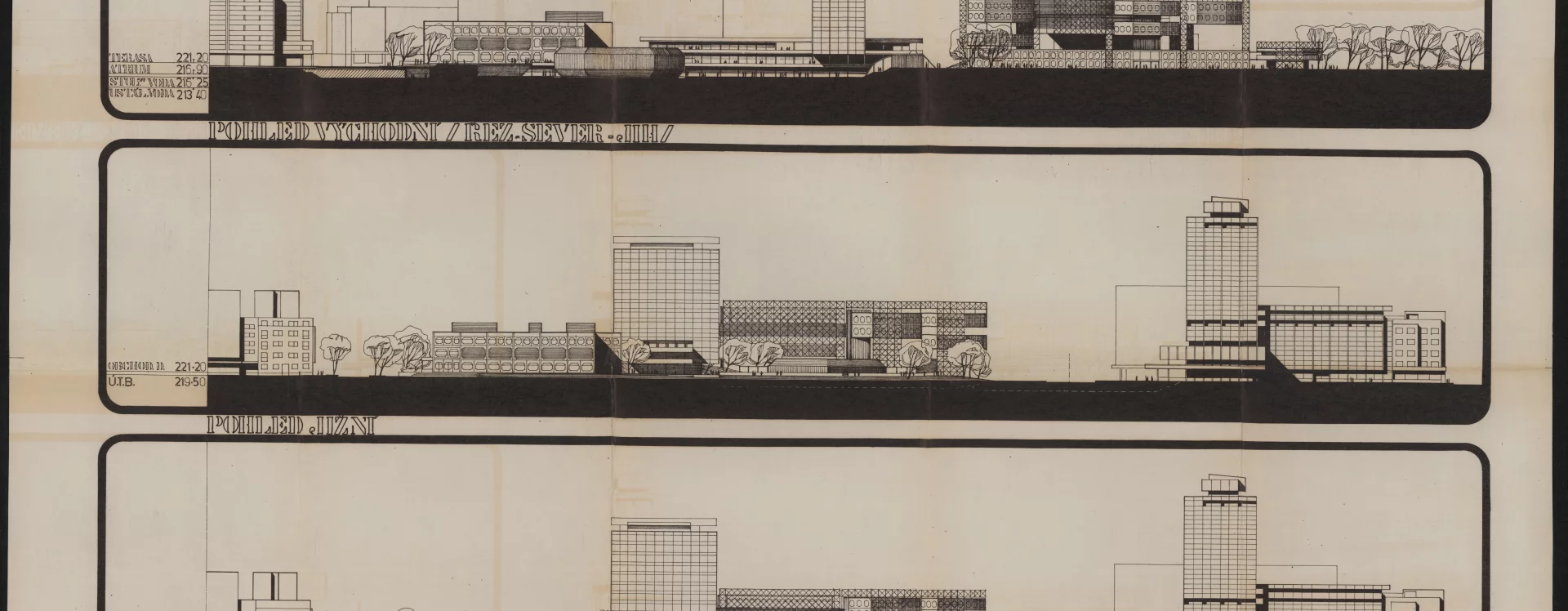
They designed the switchboard itself as a high-tech structure in two versions. The first variant took the form of an agglomeration of cubes and hexagonal prisms connected by a truss structure and suspended in the air in a style reminiscent of Prague. It was an exercise that, with its radical conception, approached utopian architecture of an almost abstract nature. Closer to realization was a more restrained design composed of several blocks. Both designs share a number of common elements with other contemporary projects by the architects (typical examples include the hexagonal windows on the metal cladding).
The radical nature of the exchange building’s design and the breadth of the concept far exceeded the investor’s capabilities. Furthermore, in the fall of 1976, the construction site was finally designated in a more northerly location closer to the banks of the Elbe River, though always with an awareness of the intended exchange building’s significance for the square. The final realized form, however, is another story. Even half a century later, the designs by the Fišer–Eisenreich–Malátek team for Pardubice still spark the imagination: how might these buildings, had they been built, have survived the recent wave of iconoclasm that claimed many monuments of the socialist era? And above all: does the development of today’s Masaryk Square, in light of the authors’ systematic consideration of the urban context of the commissioned power plant, offer comparable quality?
JI
Literature
Irena Lehkoživová. ATÚ – Automatické telefonní ústředny. Společnost, technologie, architektura. Praha, 2024. p. 139, 162–163, 167.
Sources
Muzeum umění Olomouc.
Státní okresní archiv Pardubice, Městský národní výbor Pardubice.