The Cechner family's chapel tomb is a remarkable example of an architect turning to Antiquity for inspiration at the turn of the twentieth century. The tomb was commissioned by Marie Cechnerová as a family mausoleum from architect Antonín Cechner, but it remains unknown whether she was his mother or his daughter.
Antonín Cechner was an interesting figure. After a stint in Josef Mocker's workshop during the completion of St. Vitus Cathedral, he began to focus on the restoration and documentation of historic monuments. He wrote a number of influential treatises, served as editor of Architektonický obzor magazine, and contributed to Otto's Encyclopedia. He also left a significant mark as a teacher. His main significance, however, lies in his progressive approach to monument care, which favored the preservation of as much of the original material as possible, instead of replacing it with new parts that seek to imitate the object's age. On this point, he diverged from his teacher Josef Mocker.
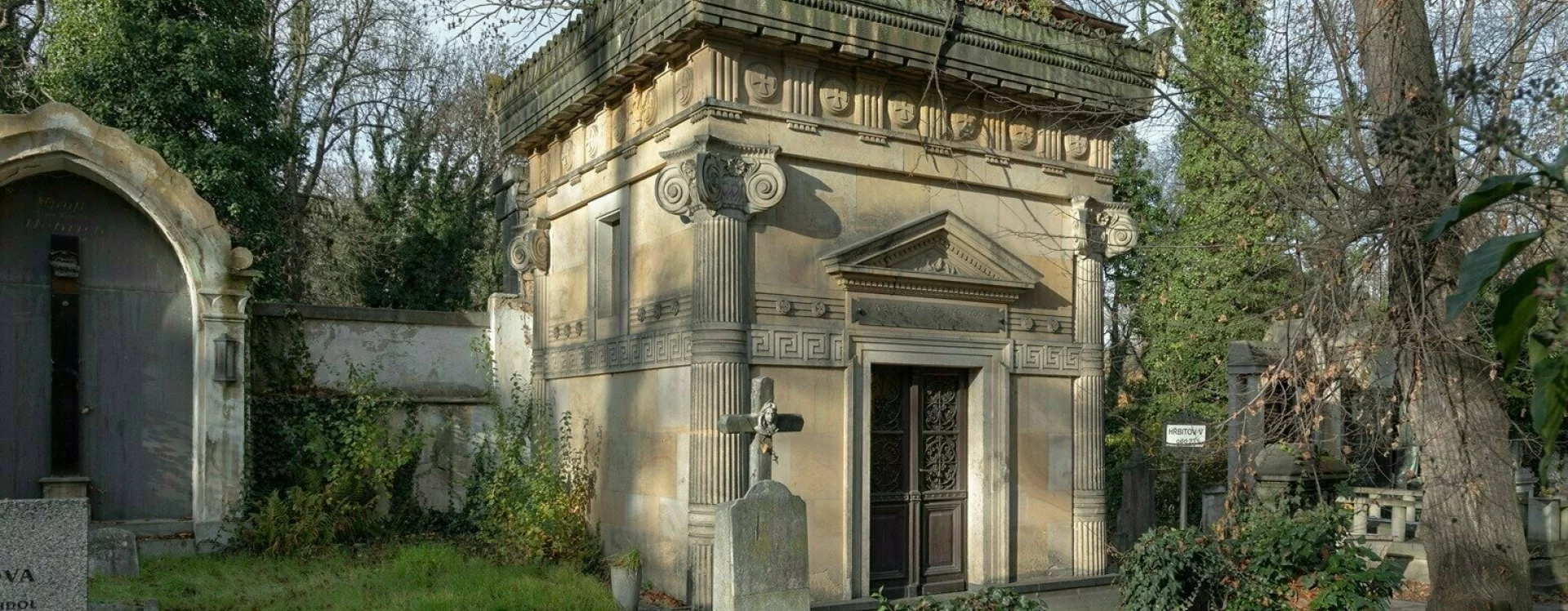
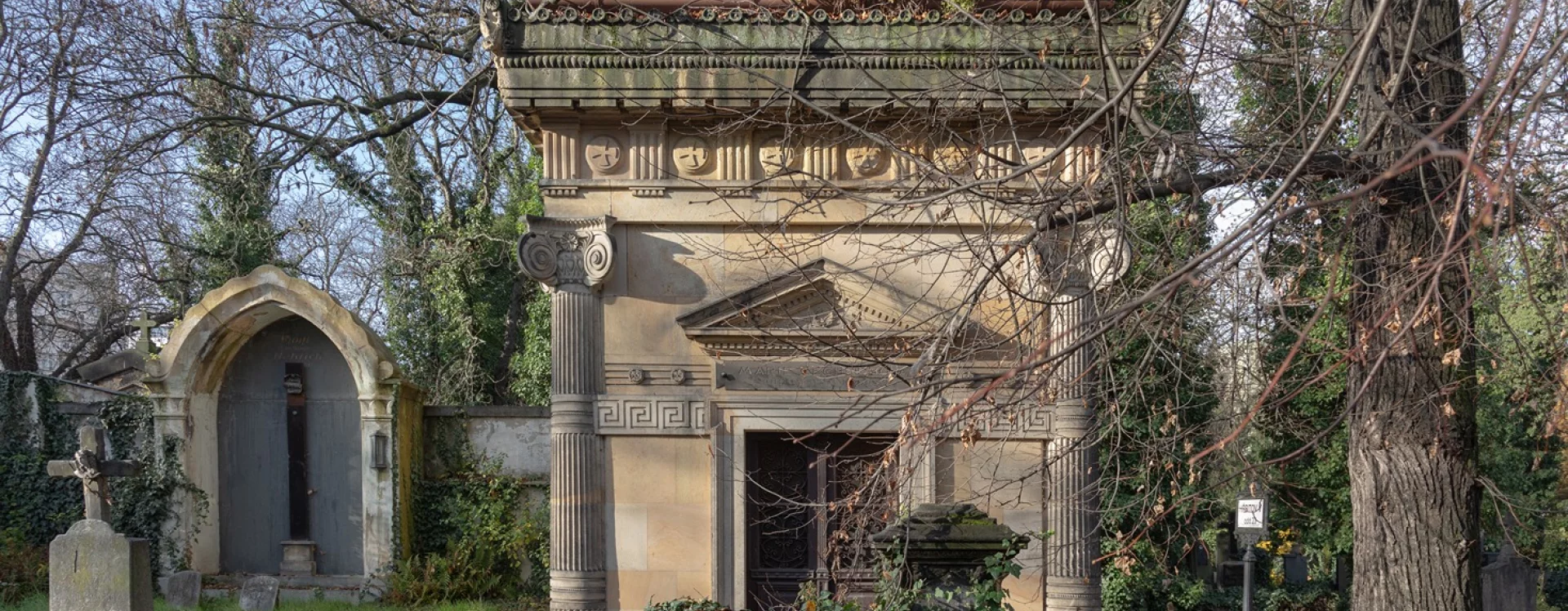
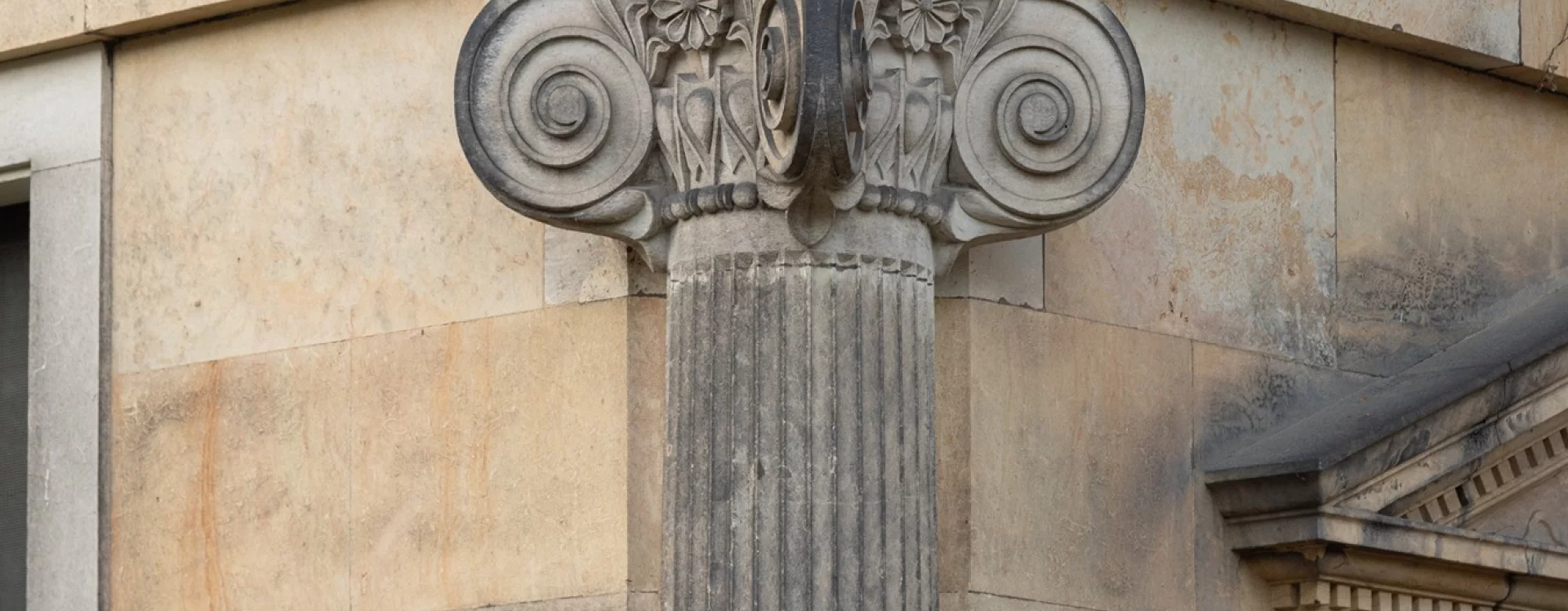
Although Cechner approached his family tomb as a self-contained classical temple on a square ground plan, he worked loosely with his references to classical architecture and applied a large dose of inventiveness. The structure's exterior is adorned with four Ionic columns with two rows of rings on their shafts, on top of which rests an entablature decorated with triglyphs and metopes bearing Greek crosses. Another cross sits atop the now-metal roof. The facade is further decorated with a band of meanders and rosettes. Above the entrance are the inscription Marie Cechnerová, for herself and her parents and a triangular pediment with a relief of a laurel wreath symbolizing the triumph of Christian faith over death and the hope for eternal life. Inside the tomb are an underground burial chamber and a private aboveground chapel with an altar bearing a Latin cross underneath a triumphal arch. A narrow stairway along the north wall leads to the underground crypt.
The sandstone and granite structure was built by the leading stonemasonry firm of Pupp & Škarka. The company, which was headquartered on today's Olšany Square, worked for such architects as Jan Kotěra, Josef Fanta, and Alois Dryák. Besides Antonín Cechner himself, the tomb also holds the remains of his wife Zdeňka (née Kvapilová, the sister of Jaroslav Kvapil, who wrote the libretto for Dvořák's opera Rusalka) and other members of the family.
Also at Olšany, Cechner designed a tomb for his close friend, the botanist Ladislav Čelakovský. His funerary works outside of Prague are found mainly in places associated with his teaching activities. In Pilsen, where he taught technical drawing at the local secondary school, he designed a tomb for the industrialist Emil Ritter von Škoda, and in Hořice, where he taught at the renowned stonemasonry school, he contributed to the design of a monumental Neorenaissance cemetery gate.
Vladislava Holzapfelová, 2025
Antonín Cechner was an interesting figure. After a stint in Josef Mocker's workshop during the completion of St. Vitus Cathedral, he began to focus on the restoration and documentation of historic monuments. He wrote a number of influential treatises, served as editor of Architektonický obzor magazine, and contributed to Otto's Encyclopedia. He also left a significant mark as a teacher. His main significance, however, lies in his progressive approach to monument care, which favored the preservation of as much of the original material as possible, instead of replacing it with new parts that seek to imitate the object's age. On this point, he diverged from his teacher Josef Mocker.
Although Cechner approached his family tomb as a self-contained classical temple on a square ground plan, he worked loosely with his references to classical architecture and applied a large dose of inventiveness. The structure's exterior is adorned with four Ionic columns with two rows of rings on their shafts, on top of which rests an entablature decorated with triglyphs and metopes bearing Greek crosses. Another cross sits atop the now-metal roof. The facade is further decorated with a band of meanders and rosettes. Above the entrance are the inscription Marie Cechnerová, for herself and her parents and a triangular pediment with a relief of a laurel wreath symbolizing the triumph of Christian faith over death and the hope for eternal life. Inside the tomb are an underground burial chamber and a private aboveground chapel with an altar bearing a Latin cross underneath a triumphal arch. A narrow stairway along the north wall leads to the underground crypt.
The sandstone and granite structure was built by the leading stonemasonry firm of Pupp & Škarka. The company, which was headquartered on today's Olšany Square, worked for such architects as Jan Kotěra, Josef Fanta, and Alois Dryák. Besides Antonín Cechner himself, the tomb also holds the remains of his wife Zdeňka (née Kvapilová, the sister of Jaroslav Kvapil, who wrote the libretto for Dvořák's opera Rusalka) and other members of the family.
Also at Olšany, Cechner designed a tomb for his close friend, the botanist Ladislav Čelakovský. His funerary works outside of Prague are found mainly in places associated with his teaching activities. In Pilsen, where he taught technical drawing at the local secondary school, he designed a tomb for the industrialist Emil Ritter von Škoda, and in Hořice, where he taught at the renowned stonemasonry school, he contributed to the design of a monumental Neorenaissance cemetery gate.
Vladislava Holzapfelová, 2025
Literature
Roman Prahl. Umění náhrobku v českých zemích let 1780-1830. Praha, 2004, s. 27.
Pavel Vlček. Encyklopedie architektů, stavitelů, zedníků a kameníků v Čechách. Praha, 2004, s. 111.
Miloslav Trnka. O spříznění architekta Antonína Cechnera s rodinou Kvapilů, Rodopisná revue, XVI., č. 16, 1, 2014. 2014, s. 10.