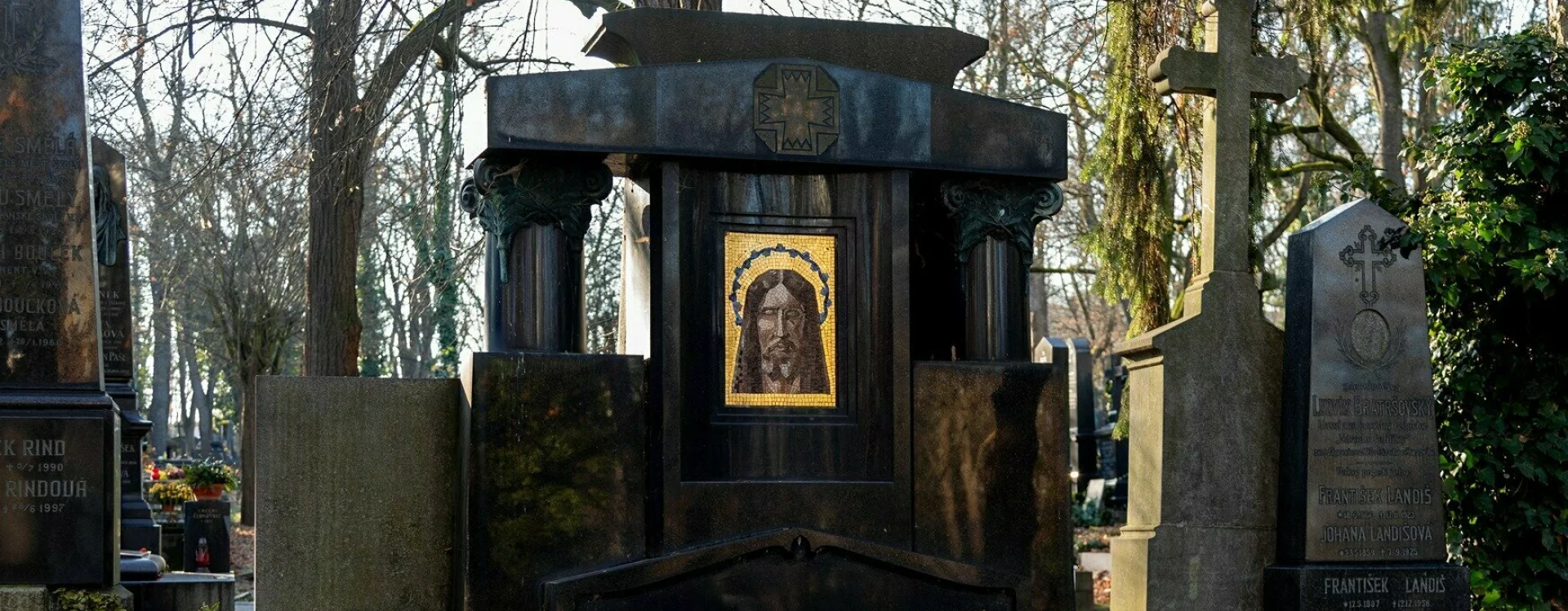
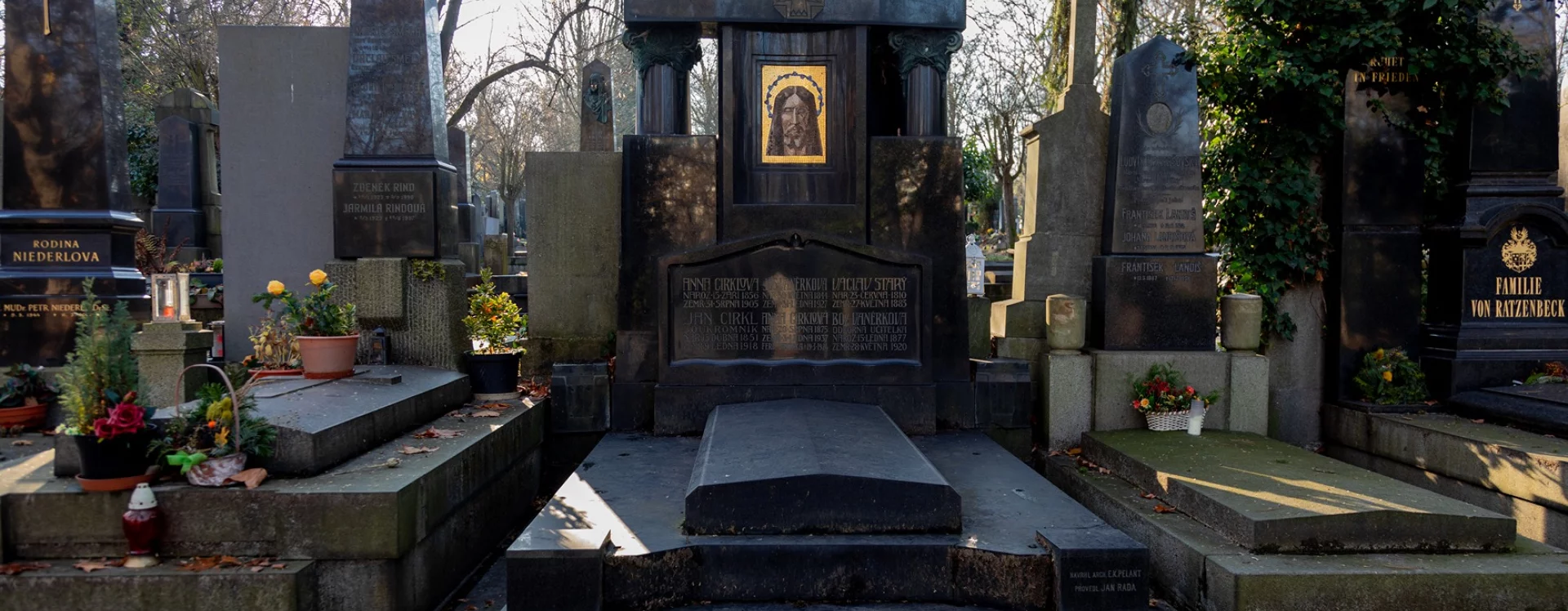
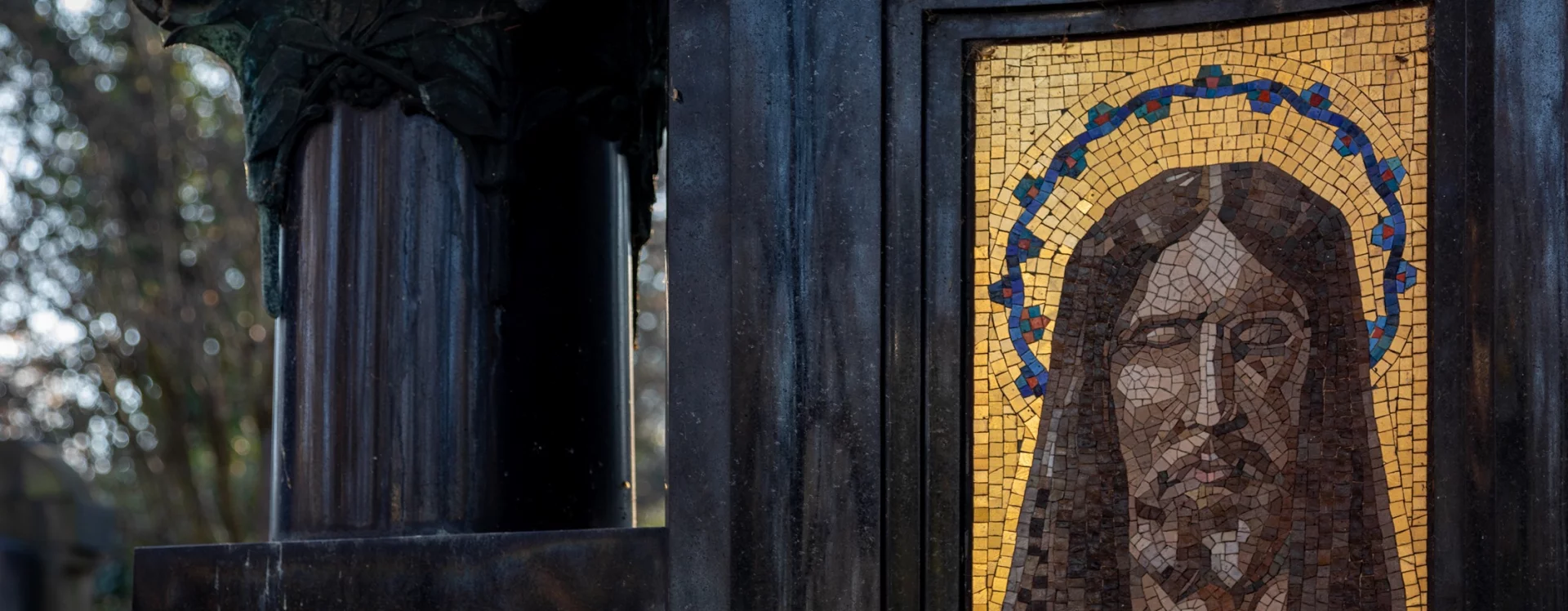
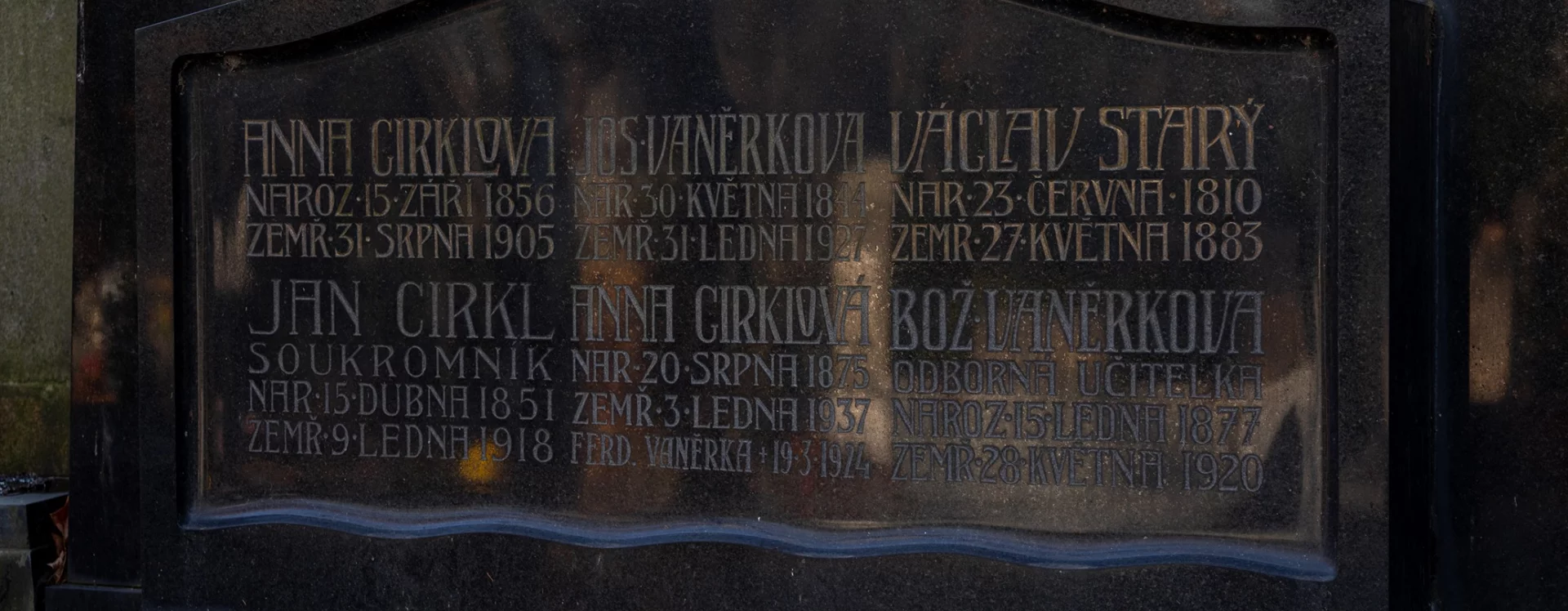
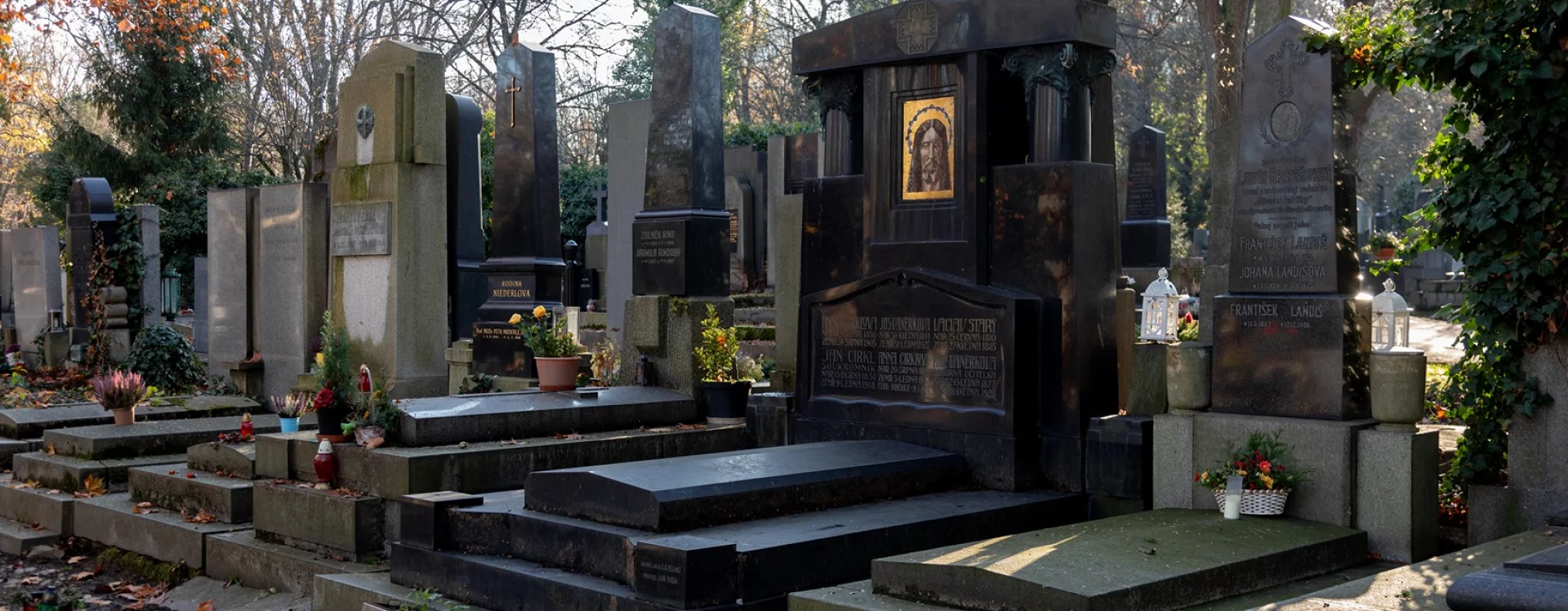
In the early twentieth century, a Sunday stroll after mass often included a cemetery visit, during which the city's middle classes could show off not only their fine clothing but also their imposing tombs and mausoleums. The visually appealing Art Nouveau style, with its graceful curves and natural motifs, was especially popular in this "hallowed field." One example is the polished black gabrodiorite grave of the Cirkl family, prominently located along one of Olšany's main pathways. The monument consists of a large black granite ledger and a three-part stele, its central panel adorned by a mosaic of the face of Jesus Christ with a crown of thorns, the symbol of his suffering and martyrdom, set against a golden background that contrasts with the monument's otherwise dark color. The stele's side panels feature a pair of columns with Ionic capitals, covered with bronze Art Nouveau plant ornament, that hold up an architrave with a Greek cross. The inscription panel topped by a triangular pediment contains gilded lettering in a typical Art Nouveau style, arranged in three columns. As a whole, the monument is an eclectic combination of motifs from Antiquity (a reflection of the period's classicist tendencies) with elements of the then-contemporary Art Nouveau – here in its floral form.
The crypt apparently dates to the year 1905, when Anna Cirklová, first wife of the Prague-based purveyor of smoked meats Jan Cirkl, was buried there. In 1918, her husband's remains were interred here as well. Their daughter Kamila (1883–1965), a prominent figure in Prague's cultural circles at the turn of the twentieth century, was the wife of the psychiatrist and neurologist Antonín Heveroch. The couple were an important link between Prague's leading physicians and the city's creative community. One example is Jan Kotěra, who enjoyed sketching Kamila and whose excellent drawings are preserved in the graphics collection of the National Gallery Prague. Kotěra also designed stylish furniture for the Heveroch household, today held in the collection of the Museum of Decorative Arts in Prague, to which Kamila donated numerous objects late in life. As a young woman, she also inspired the sculptor Stanislav Sucharda. The Heverochs were buried in the Vinohrady cemetery, where their crypt is decorated with a red Slivenec marble statue of Psyche by Jaroslav Horejec.
The monument for the Cirkl crypt was designed by the architect Emanuel Pelant, who had studied under Jan Kotěra at Prague's School of Applied Arts (Kotěra's influence is evident in Pelant's funerary works). Pelant worked as a designer, furniture maker, draftsman, and teacher in Vsetín and Valašské Meziříčí, where he contributed to the interior design of a church for the Evangelical Church of Czech Brethren. The stonework for the Cirkl-Starý crypt was done by Jan Rada (1849–1916), who was a leading master in this field at Olšany. He and his wife, the widow of stonemason Václav Státník, took over her late husband's firm, where their sons and their grandson, the architect and stonemason Jan, continued the stonemasonry tradition. In fact, the younger Jan collaborated on many of the most distinguished grave monuments at Olšany. Pelant's and Rada's names are signed on the frame of this monument.