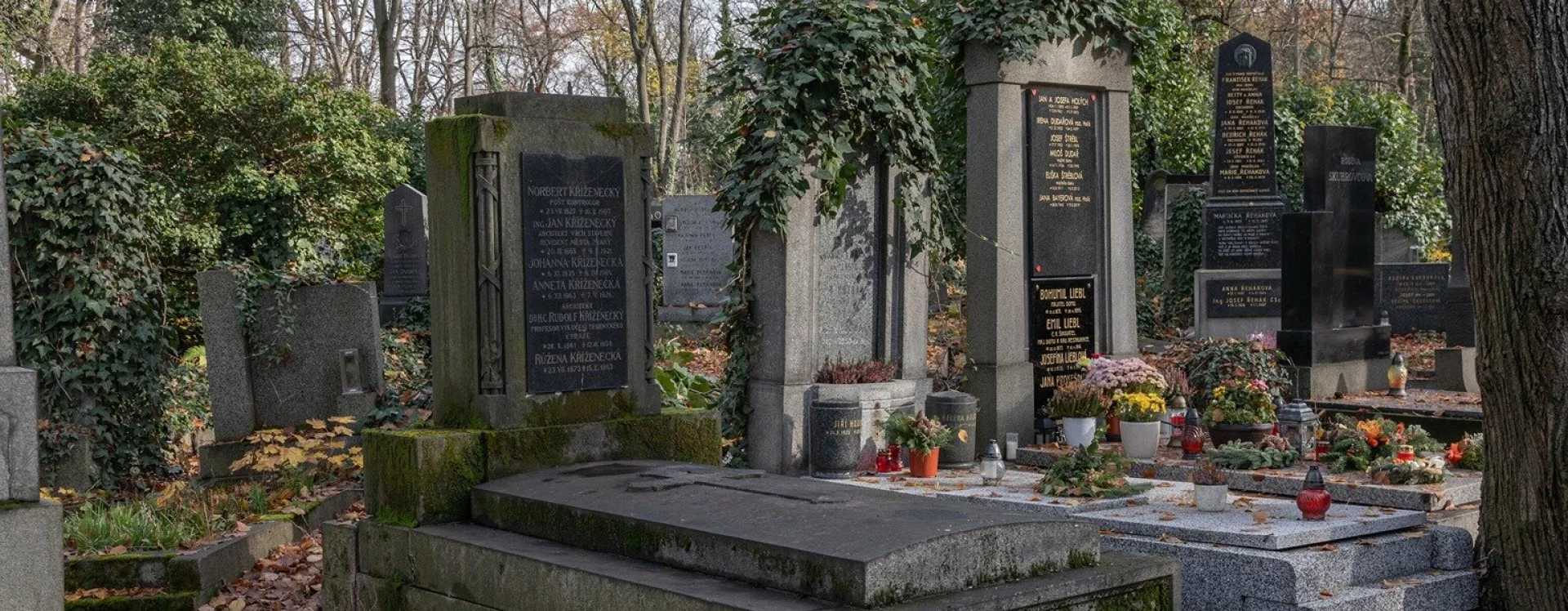
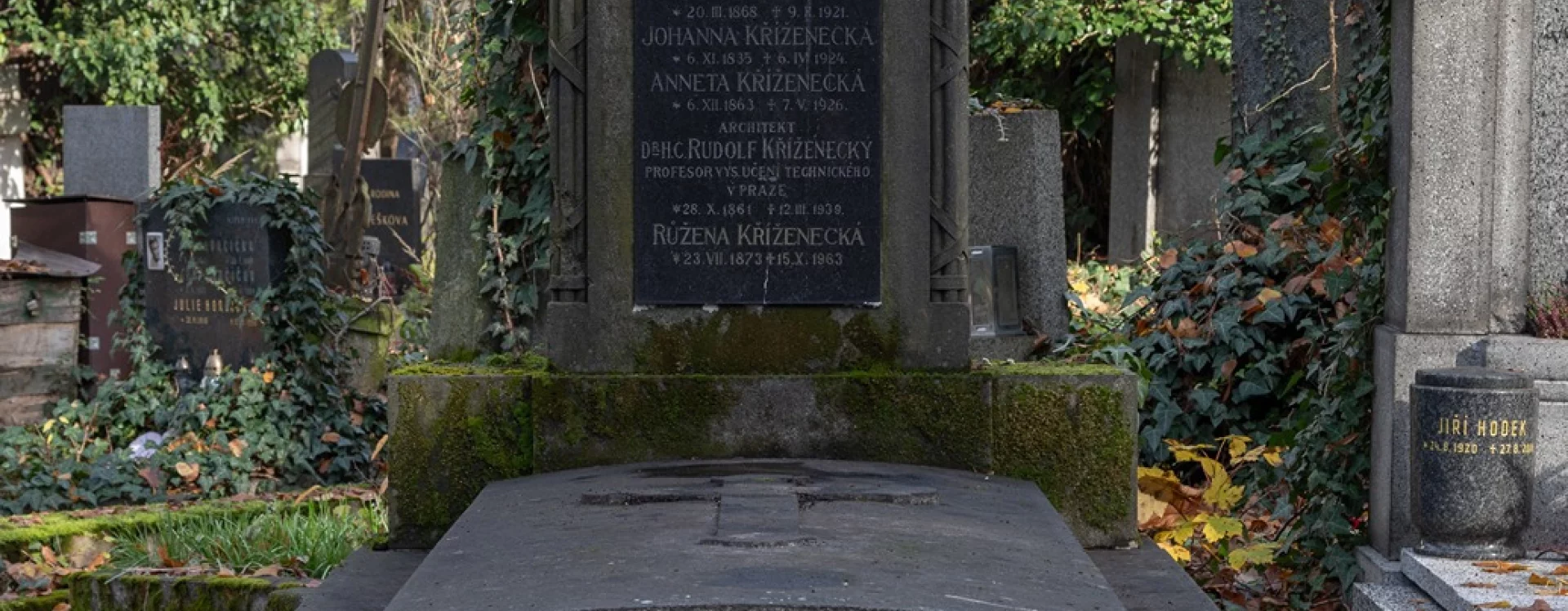
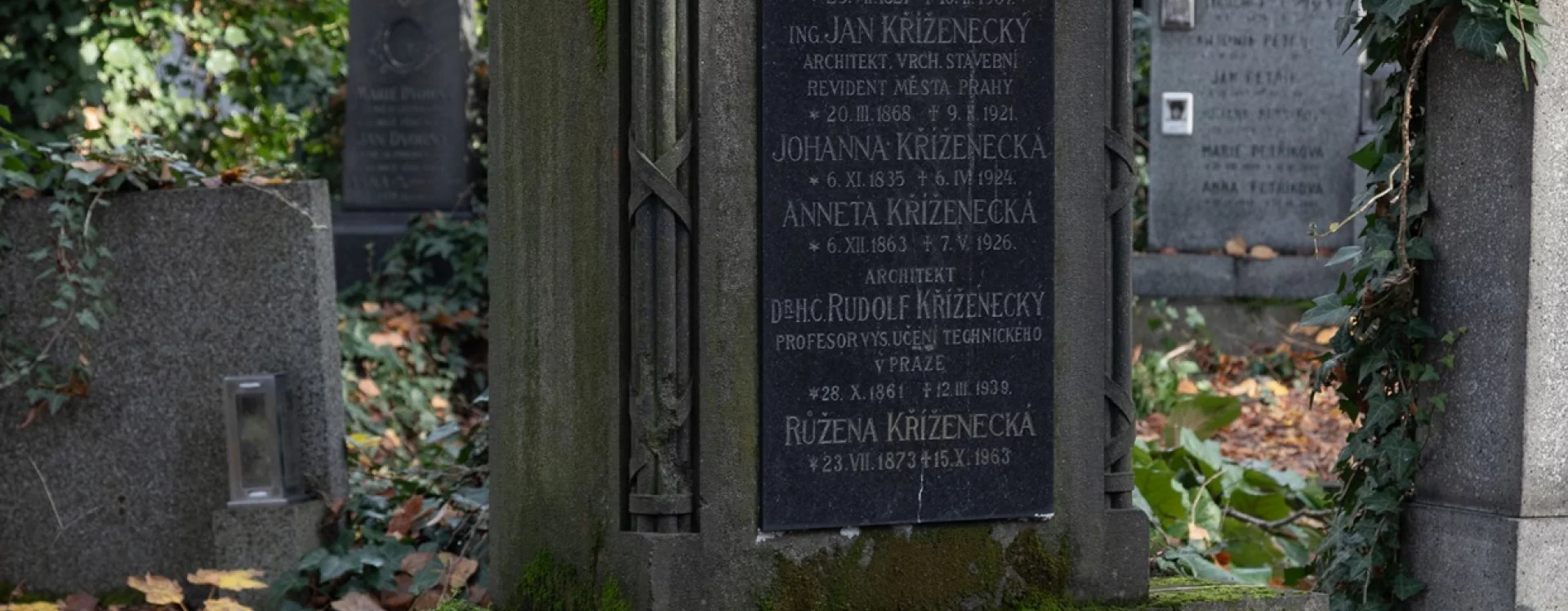
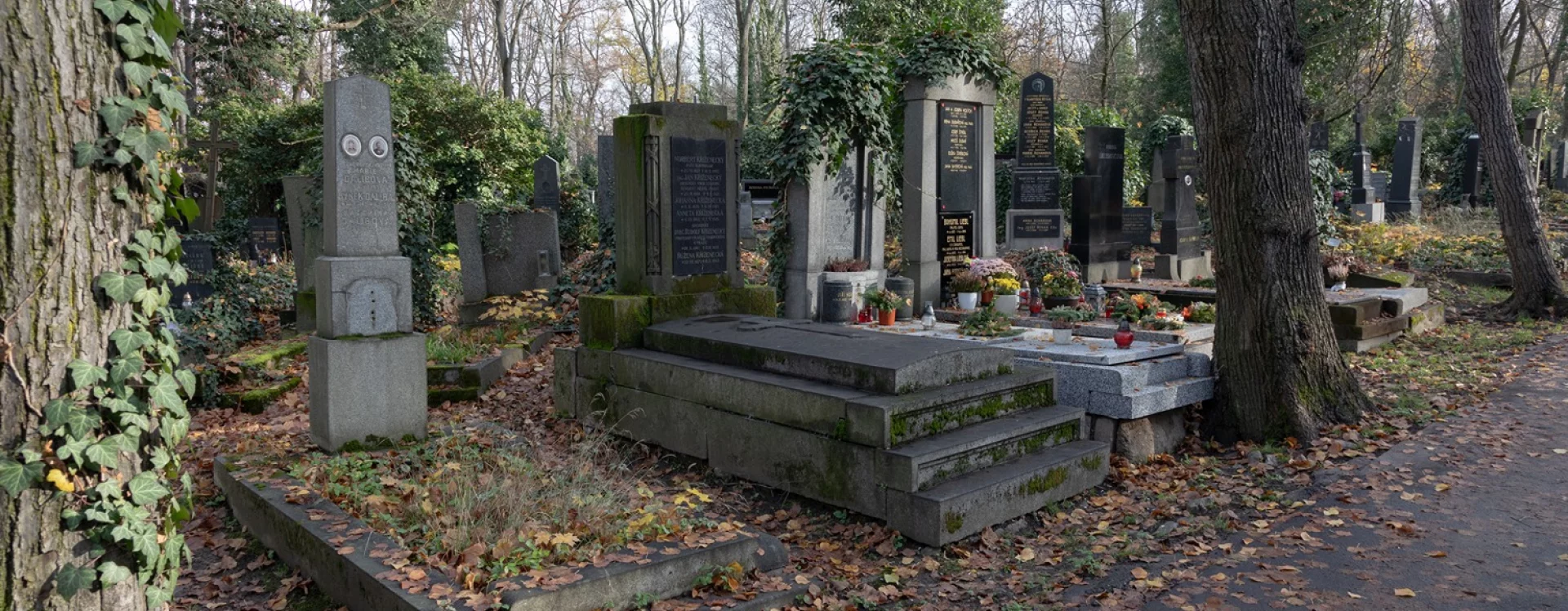
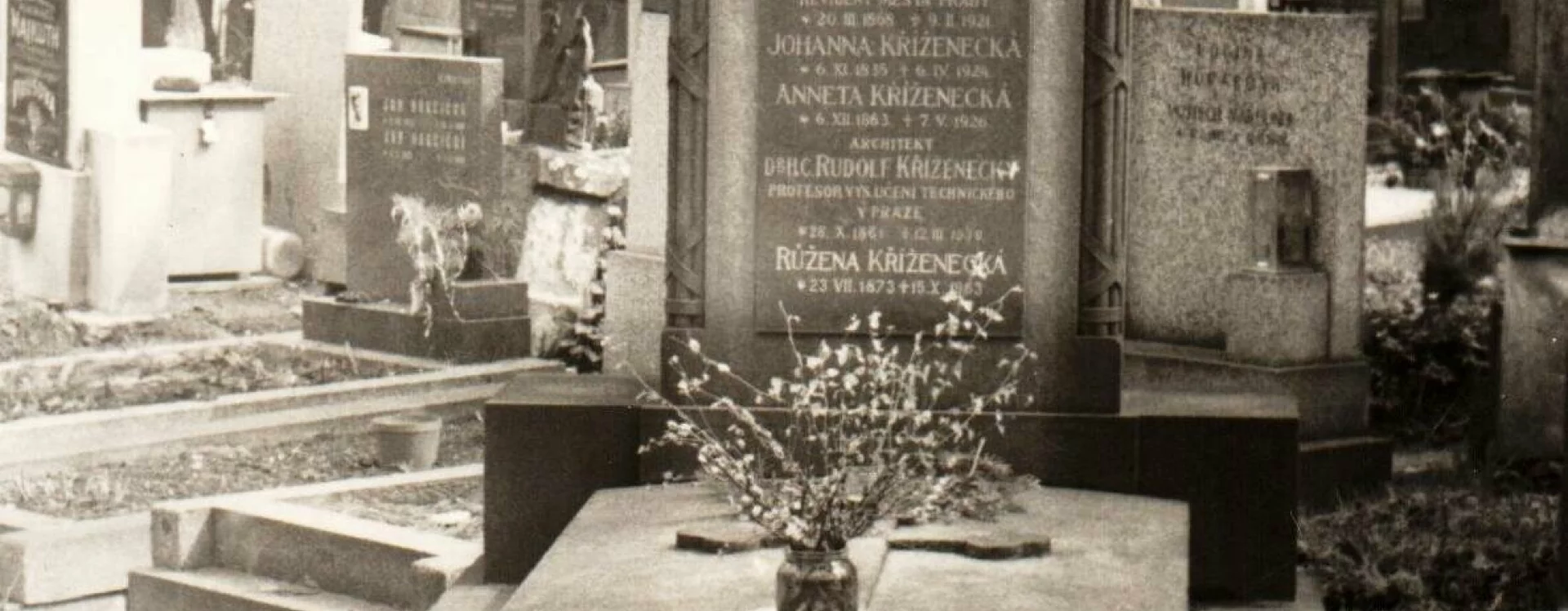
The Kříženecký crypt is the final resting place of numerous members of this family, including the brothers Jan and Rudolf, two leading figures in Czech artistic and technical history who literally moved society forward into the twentieth century. The elder brother Rudolf (1861–1939) was an important architect and the owner of a successful Prague building firm focused mainly on Neobaroque architecture (examples include today's Podolí Maternity Hospital). In addition to his architectural practice, he also distinguished himself in the sciences and academia, publishing several studies on Baroque architecture, lecturing at the Academy of Fine Arts in Prague, and serving as rector of Czech Technical University. His younger brother Jan (1868–1921) was also an architect, but his main passion was photography and film, and he collaborated with his brother by photographing his buildings. He was also hired by the Prague City Archives to document old and historically valuable buildings and streets before their demolition during the redevelopment of part of Prague's Old Town. As one of the first Czech directors and cinematographers, Jan also made a name for himself as a pioneering figure in cinema. In this field, he shot several short documentary and feature films, which he first presented at the 1898 Exhibition of Architecture and Engineering in Prague's Stromovka Park. This year is considered the beginning of Czech cinema, making Bohemia one of the the first countries in the world where filmmaking began.
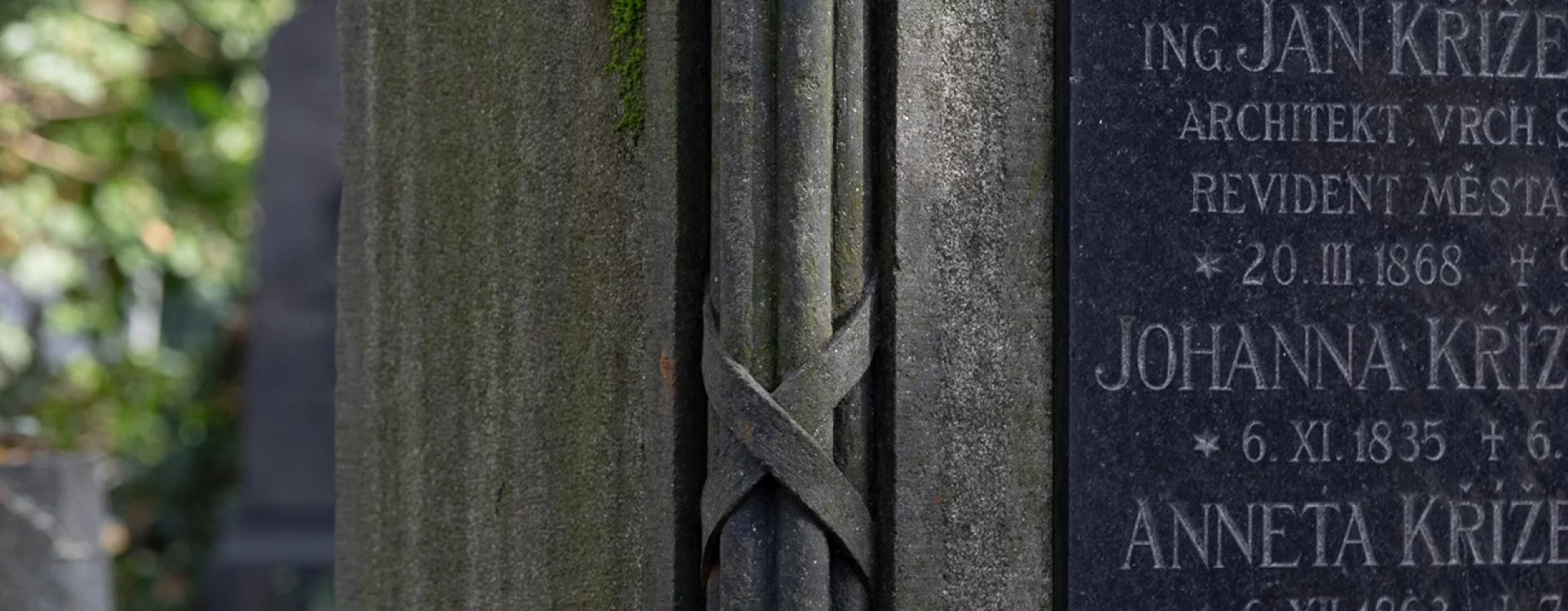
The monument for the family crypt at Olšany was built in 1911 according to plans by Rudolf himself. His by no means ostentatious design consists of a stepped ledger with a symbol of the cross and a stele with an inscription panel made of polished black granite. On the stele's margins are a pair of reliefs: so-called fasces, or lictor's bundles – a symbol whose history reaches back to the ancient Etruscans but which has remained popular throughout history. Wooden rods bound together using leather straps originally symbolized royal power and justice, and in the Roman era they represented legal authority. Their popularity continued into the time of the American War of Independence and the French Revolution. In the Czech lands, they are associated with the legend of the three sons of Duke Svatopluk I of Great Moravia, and in the nineteenth century the fasces was a widely-used symbol of national unity, solidarity, and justice. During the First World War it appeared on the flag of the Czechoslovak National Council, and to this day it can be found on the scepter of Charles University's Faculty of Law. On this particular gravestone, it may also be interpreted as a symbol of family solidarity and mutual support. Another decorative element adorning the stele was a bronze bowl resting on three lion's feet. This depiction of an ancient sacrificial vessel, in which burned a flame as a symbol of eternal life, was stolen at some unknown date, with only the three metal supports remaining.
A decade later, Rudolf Kříženecký designed another grave monument at Olšany, this one for the crypt of Julius Grégr, which is decidedly more monumental and decorative than his own family's grave.
Vladislava Holzapfelová, 2025
The monument for the family crypt at Olšany was built in 1911 according to plans by Rudolf himself. His by no means ostentatious design consists of a stepped ledger with a symbol of the cross and a stele with an inscription panel made of polished black granite. On the stele's margins are a pair of reliefs: so-called fasces, or lictor's bundles – a symbol whose history reaches back to the ancient Etruscans but which has remained popular throughout history. Wooden rods bound together using leather straps originally symbolized royal power and justice, and in the Roman era they represented legal authority. Their popularity continued into the time of the American War of Independence and the French Revolution. In the Czech lands, they are associated with the legend of the three sons of Duke Svatopluk I of Great Moravia, and in the nineteenth century the fasces was a widely-used symbol of national unity, solidarity, and justice. During the First World War it appeared on the flag of the Czechoslovak National Council, and to this day it can be found on the scepter of Charles University's Faculty of Law. On this particular gravestone, it may also be interpreted as a symbol of family solidarity and mutual support. Another decorative element adorning the stele was a bronze bowl resting on three lion's feet. This depiction of an ancient sacrificial vessel, in which burned a flame as a symbol of eternal life, was stolen at some unknown date, with only the three metal supports remaining.
A decade later, Rudolf Kříženecký designed another grave monument at Olšany, this one for the crypt of Julius Grégr, which is decidedly more monumental and decorative than his own family's grave.
Vladislava Holzapfelová, 2025
Literature
Pavel Vlček (a kol.). Umělecké památky Prahy. Staré Město - Josefov. Praha, 1996, s. 98.
Roman Prahl. Umění náhrobku v českých zemích let 1780-1830. Praha, 2004, s. 182.
James Hall. Slovník námětů a symbolů ve výtvarném umění. Praha, 2008, s. 135.
Jiří Anger (ed.). Digitální Kříženecký, Nový život prvních českých filmů. Praha, 2024.