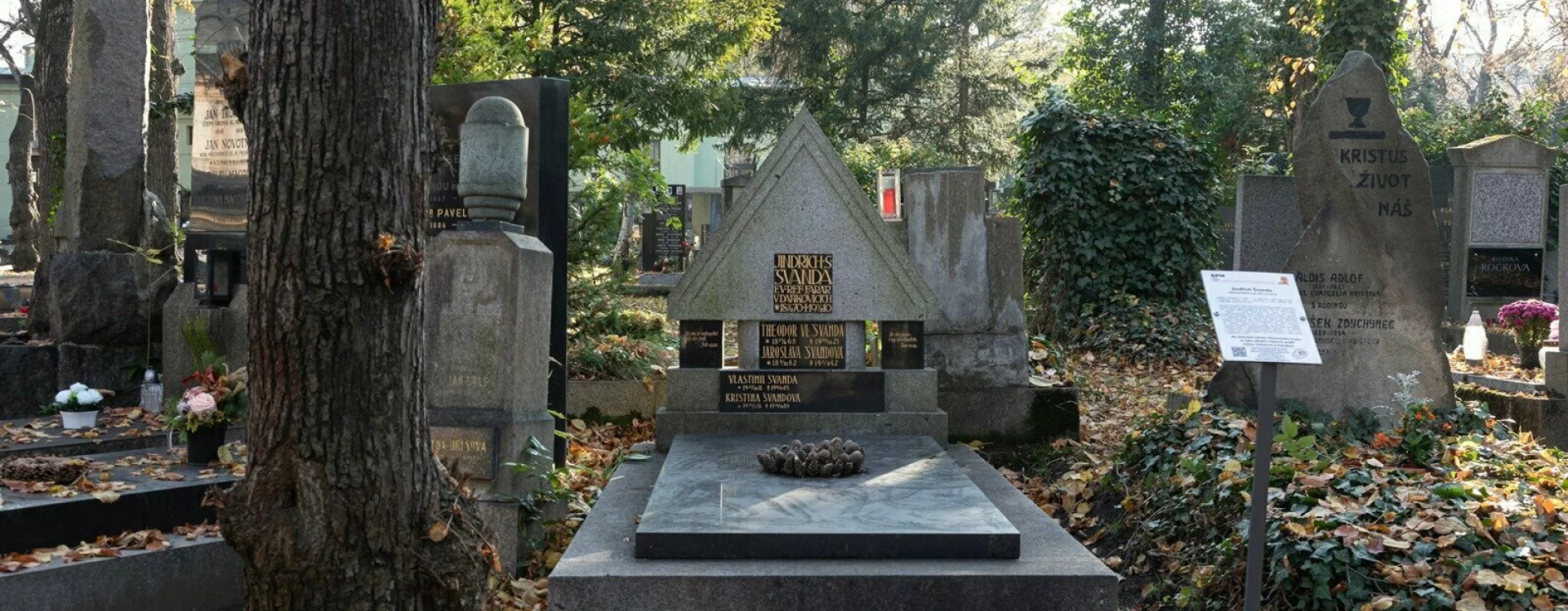
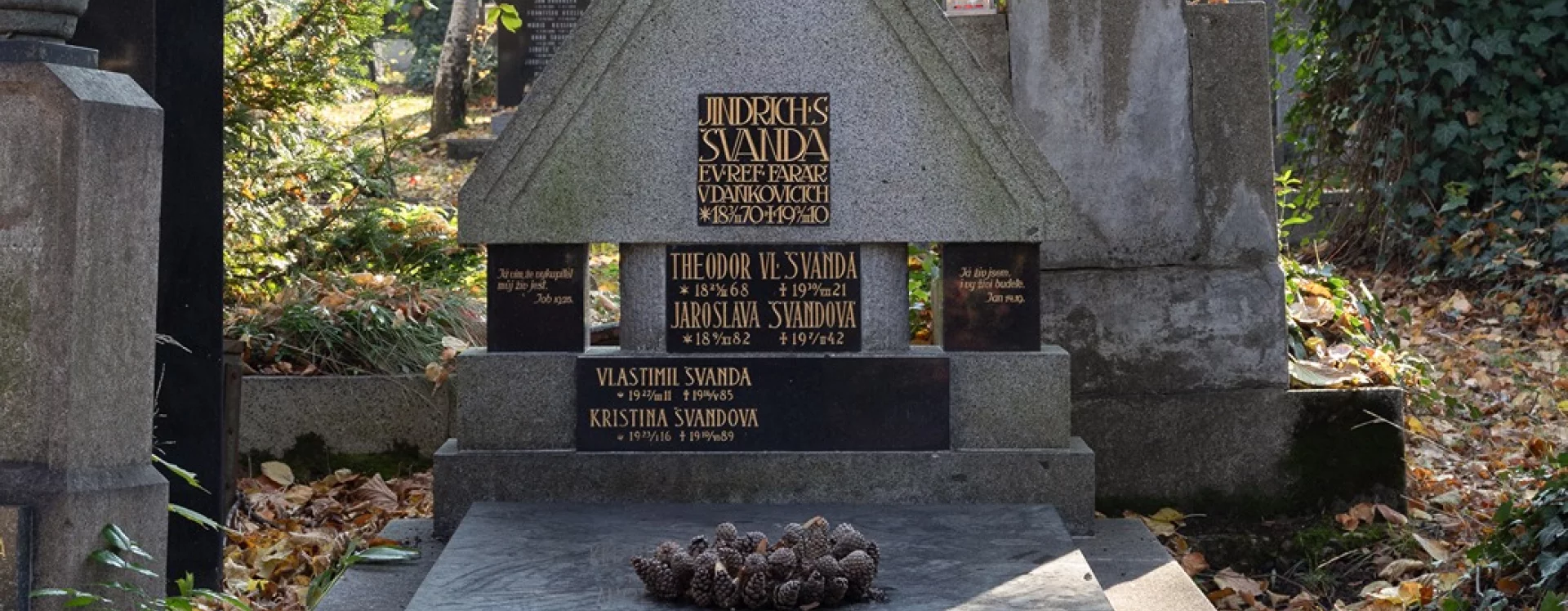
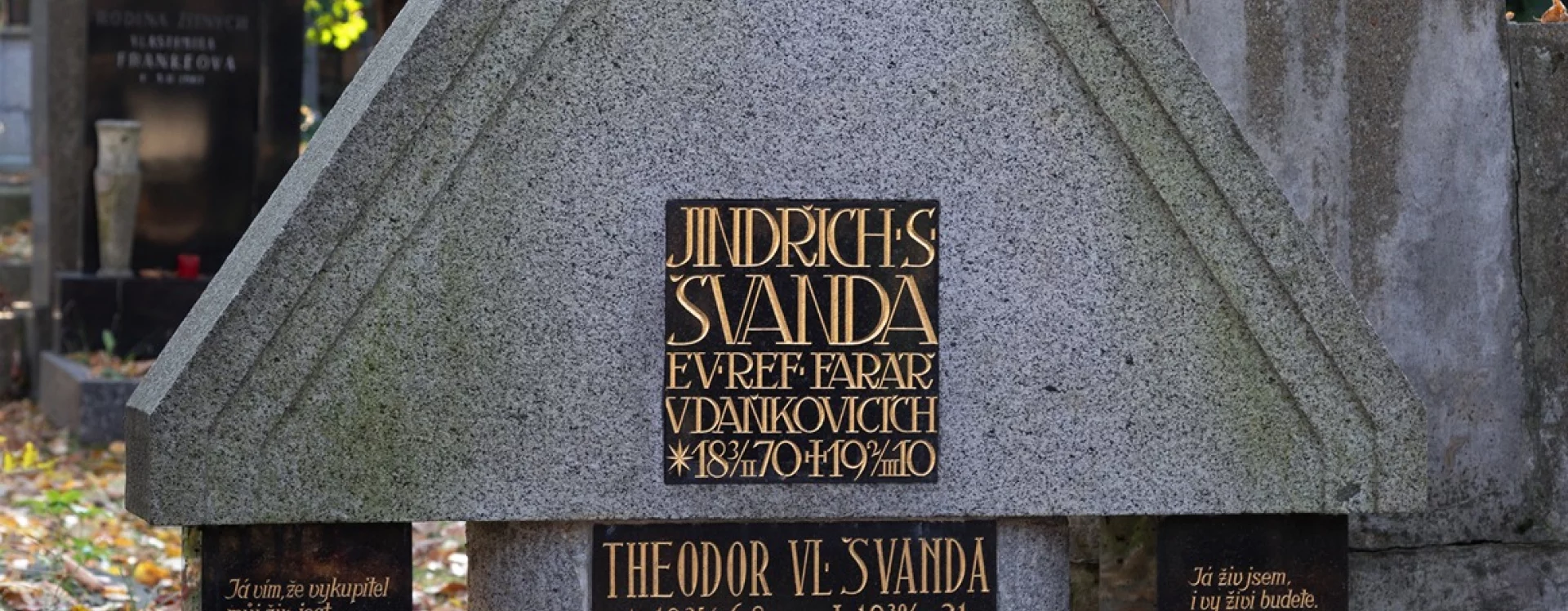
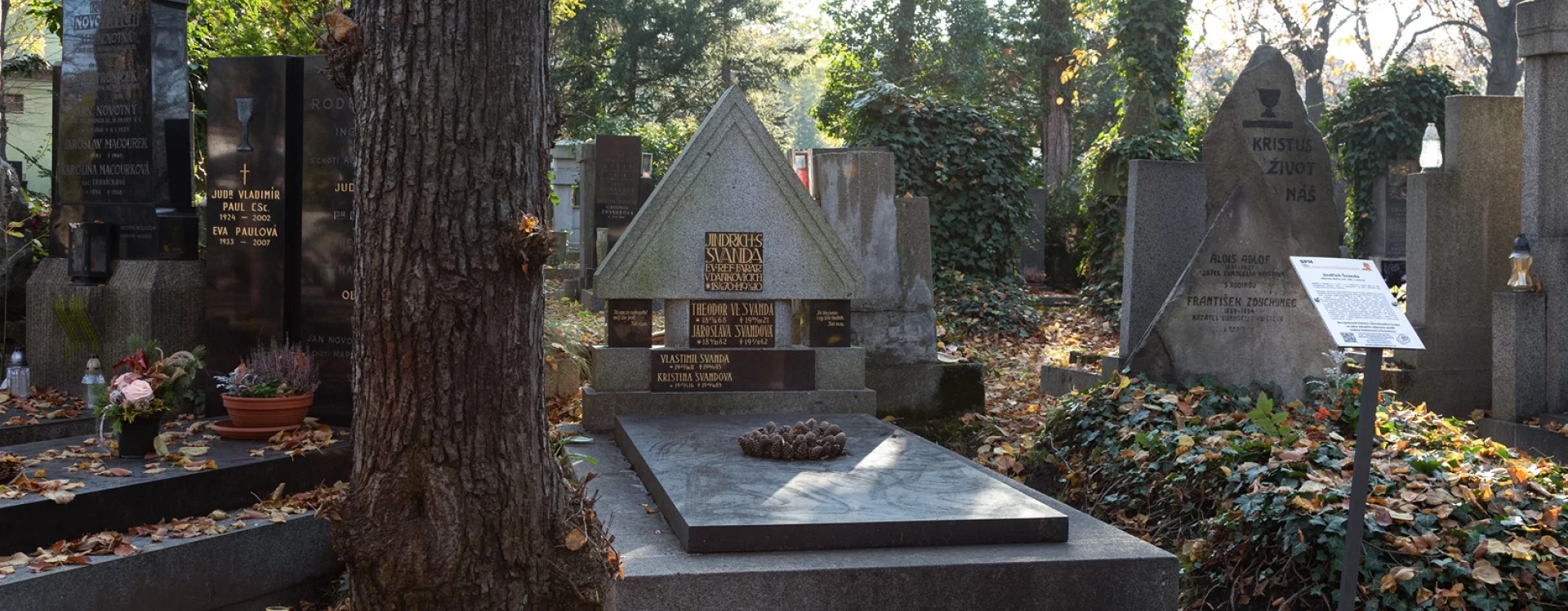
From 1905 to 1909, Jindřich S. Švanda was the first pastor of the newly founded Protestant congregation in Daňkovice. During his tenure, in 1908 the village built a new parish house next to the church that has preserved its austere appearance to this day. Švanda apparently enjoyed great popularity, for in 1907 the congregation in Jimramov elected him as their administrator as well. However, he fell seriously ill in November 1909 and never recovered. He died in the sanatorium of the Protestant diaconia in Prague at just forty years of age and was buried two days later, on 4 March 1910, in Prague's Olšany cemeteries. The church's leadership also paid its respects to the deceased, with Senior Josef Dobeš donating 800 crowns to the Daňkovice congregation on behalf of the Seniorate to help cover the costs associated with the pastor's treatment and subsequent funeral.
The gravestone was one of the first solo projects by architect Vilém Kvasnička (1885–1969), who had studied under Jan Kotěra at Prague's School of Applied Arts and who was employed at the studio of Ladislav Skřivánek when he drafted this work. That same year, he designed another grave marker for the cemetery in Vršovice. His work at Olšany is a simple, almost Protestantically ascetic yet stylistically pure design, with a triangular stele resembling a Greek tympanum and whose light color contrasts with the dark, centrally placed plaques with golden inscriptions. The inscriptions on the dark lateral blocks, whose color similarly contrasts with the triangular stele and physically separate it from the spartan plinth, were apparently added at a later date, as were the plaques on the plinth. The equilateral triangle that dominates the entire composition symbolizes the basic Christian concept of the Holy Trinity, meaning God the Father, God the Son, and the Holy Spirit.
The gravestone, made of honed Mrákotín granite and polished black Swedish granite, was produced by the stonemason Ferdinand Palouš (1857–1922), a graduate of the master stonemasonry curse in Hořice. In 1886, Palouš founded a successful stonemasonry business with storerooms and workshops at Flora near the Olšany cemeteries and also in Prague's Letná and Maniny neighborhoods. He also owned granite quarries near Prague and travertine quarries in Lúčky, Slovakia. Other funerary works of his can be found at cemeteries in Vinohrady, Krč, and Malvazinky. The signature F. Palouš, Praha VII is engraved on the bottom edge of the monument.
Older sources mistakenly ascribed the grave marker to the architect Jan Kotěra, perhaps because it shows the influence of Kvasnička's teacher.