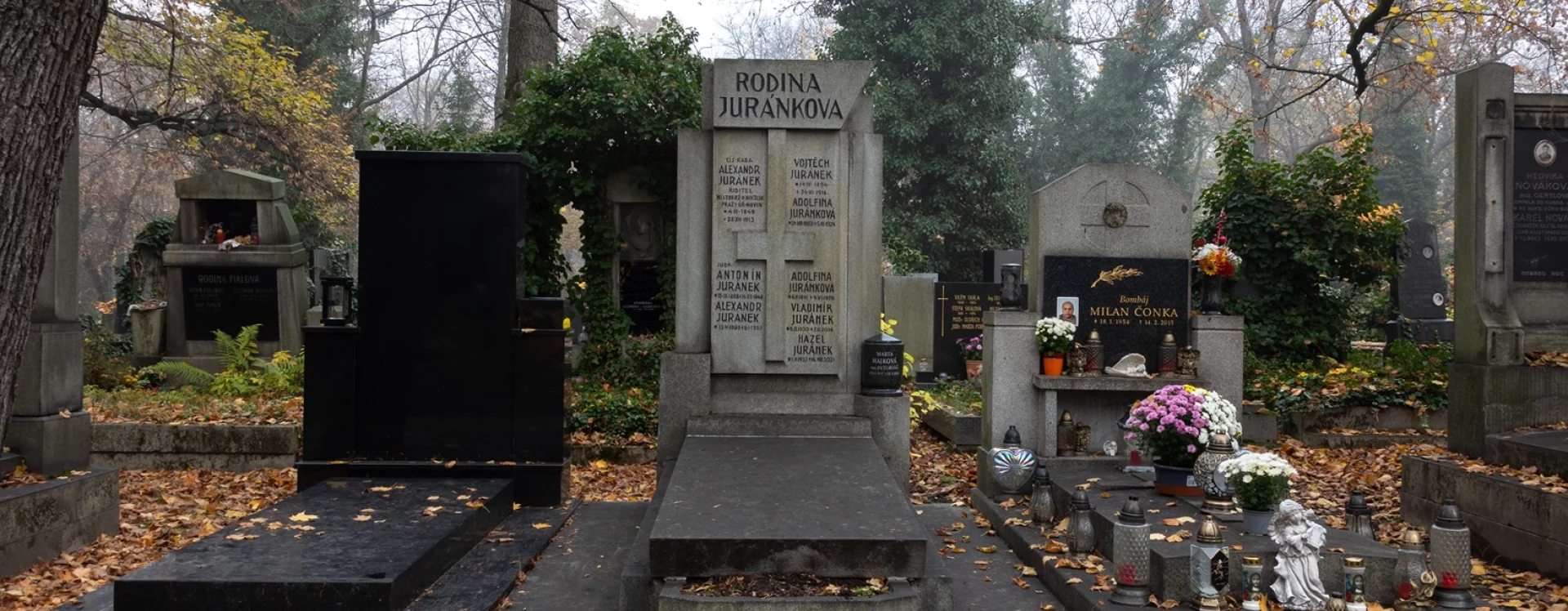
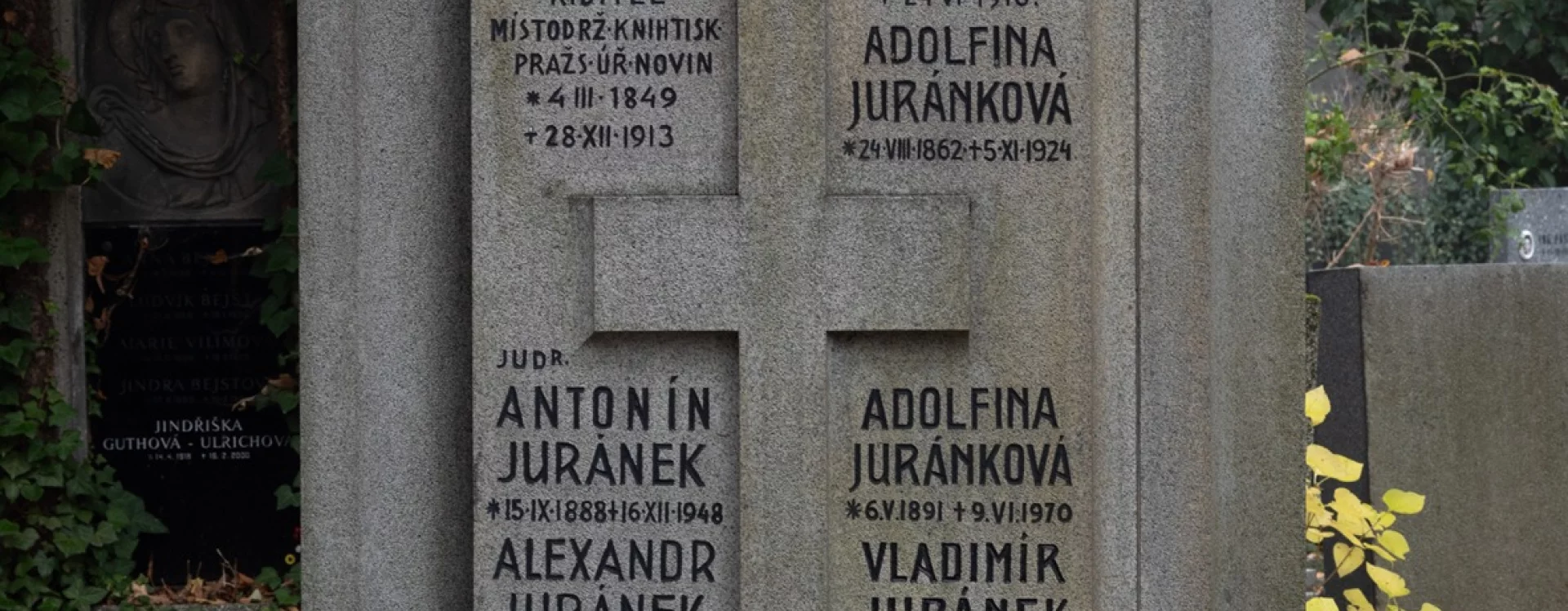
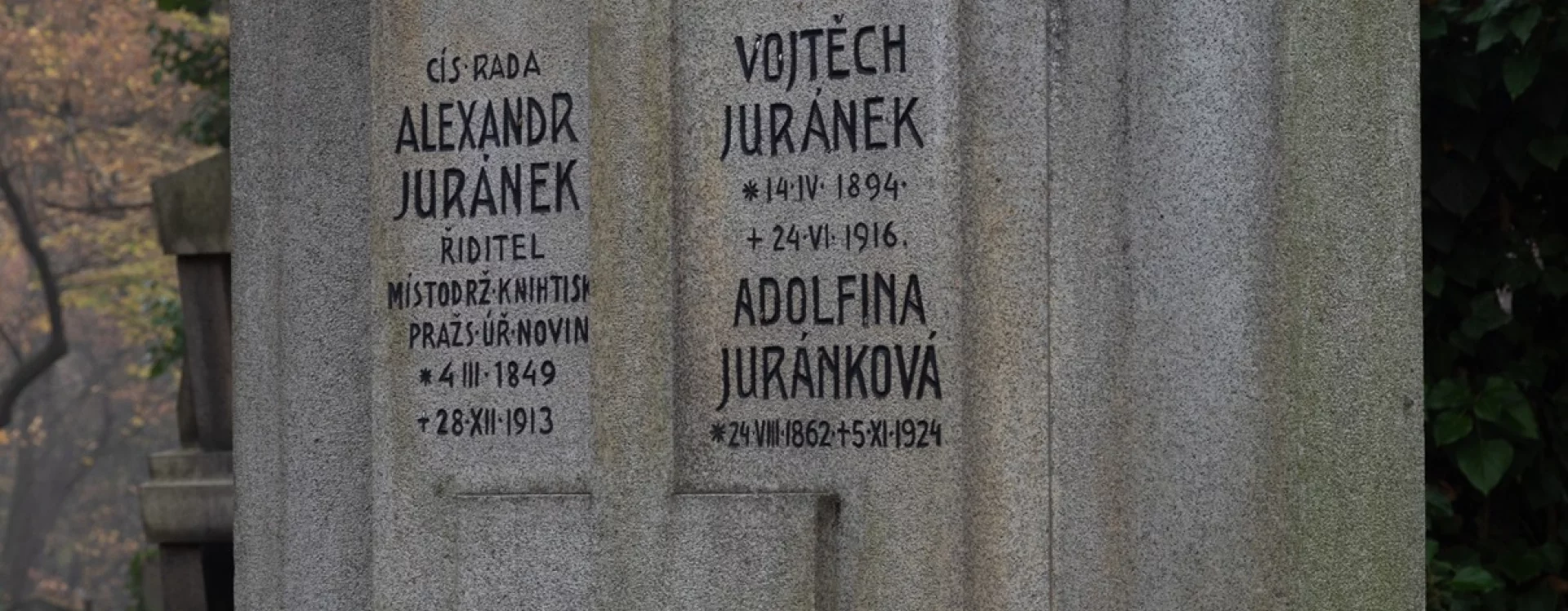
Adolfina Juránková commissioned a grave monument for her husband Alexandr Juránek, imperial councilor and director of the Governor's Printing House, in the year of his passing. The firm she hired, Jan Rada & Son, Machine Working of Marble and Granite, Žižkov 17, drew up plans, built an underground crypt, and fitted it with granite kerbstones and a ledger. The building permit application is dated 30 December 1913. Who subsequently invited Pavel Janák to design the grave monument remains unknown, although we can speculate that the prominent Czech art historian, theorist, critic, and writer Václav Vilém Štech (1885–1974), who was married to the Juráneks' daughter Alexandra (†1971), may have played a role. Štech was employed as an expert assistant to the director of the Prague City Museum, and he would undoubtedly have been familiar with Prague's cultural scene. By this time, Pavel Janák was already known not just as a leading representative of the innovative Cubist style in architecture, but also for his funerary projects such as a widely acclaimed though unrealized 1902 crematorium design for the Olšany Cemeteries, Cubist grave monuments for the painter Felix Jenewein in Kutná Hora (1912) and for Otto Gutfreund's father in Dvůr Králové (1913), and an unrealized design for a columbarium at Olšany (1912–1913).
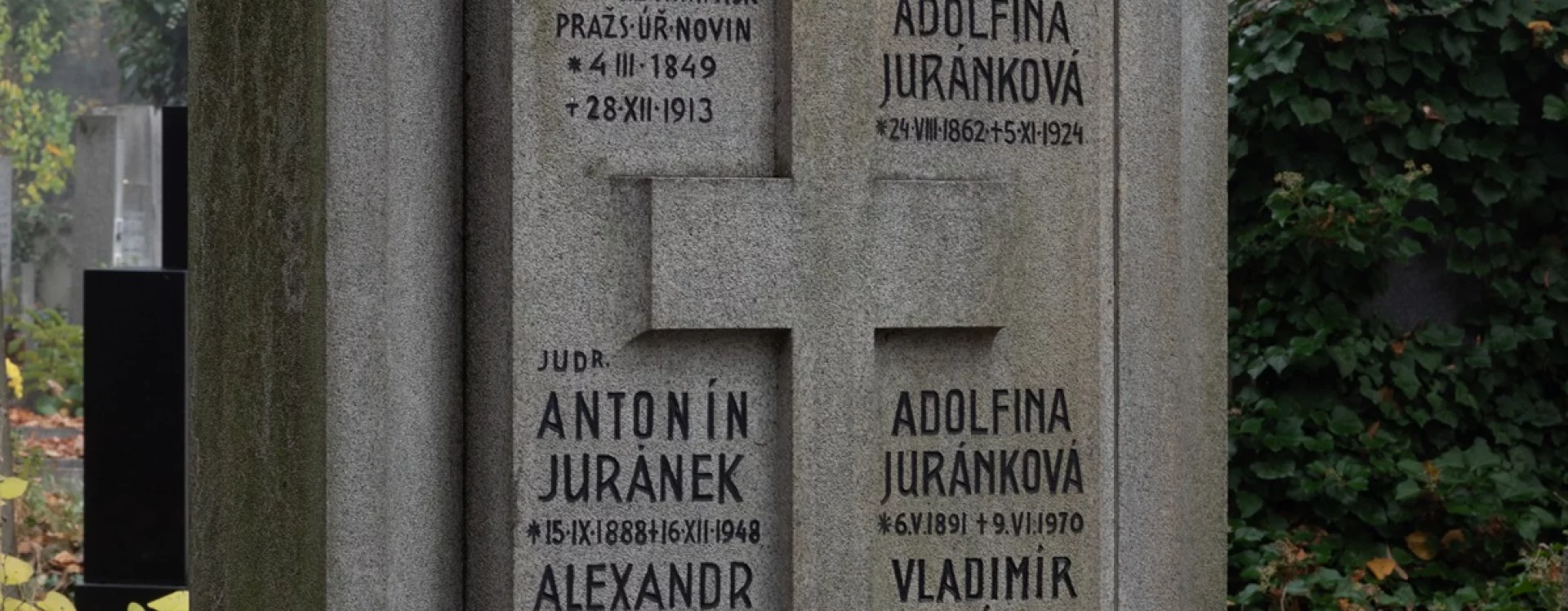
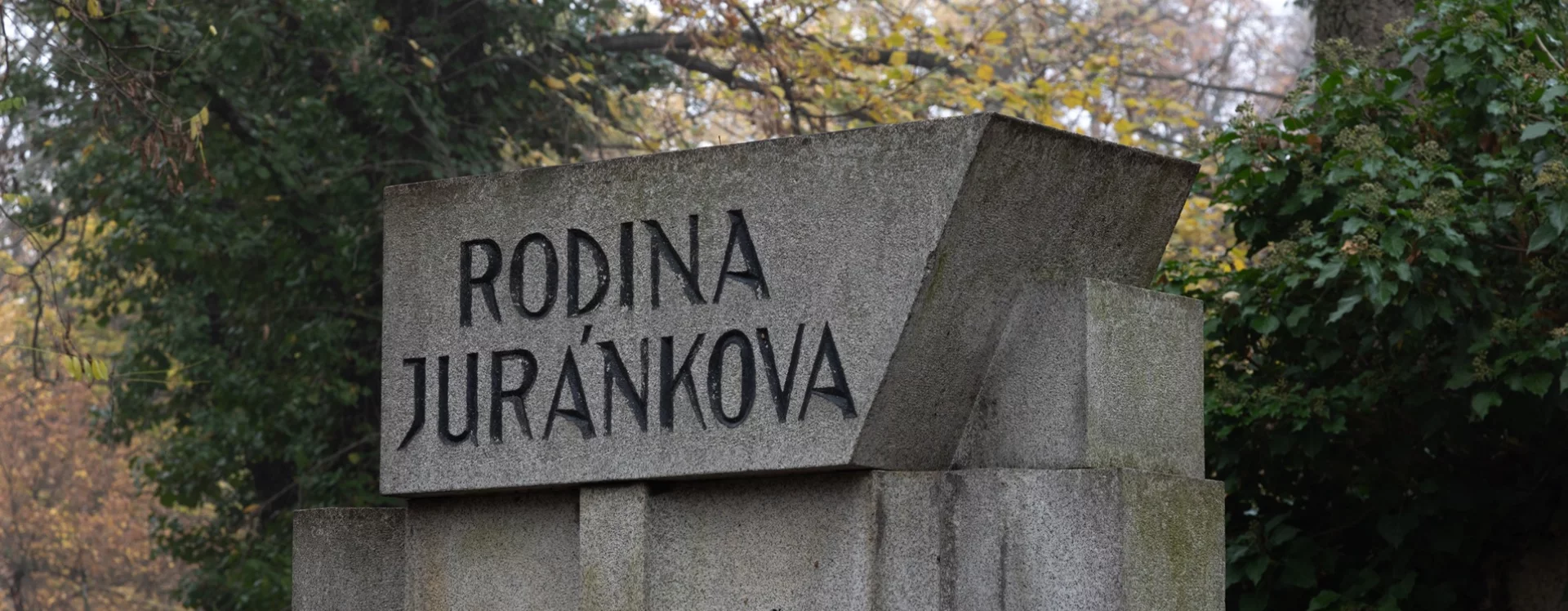
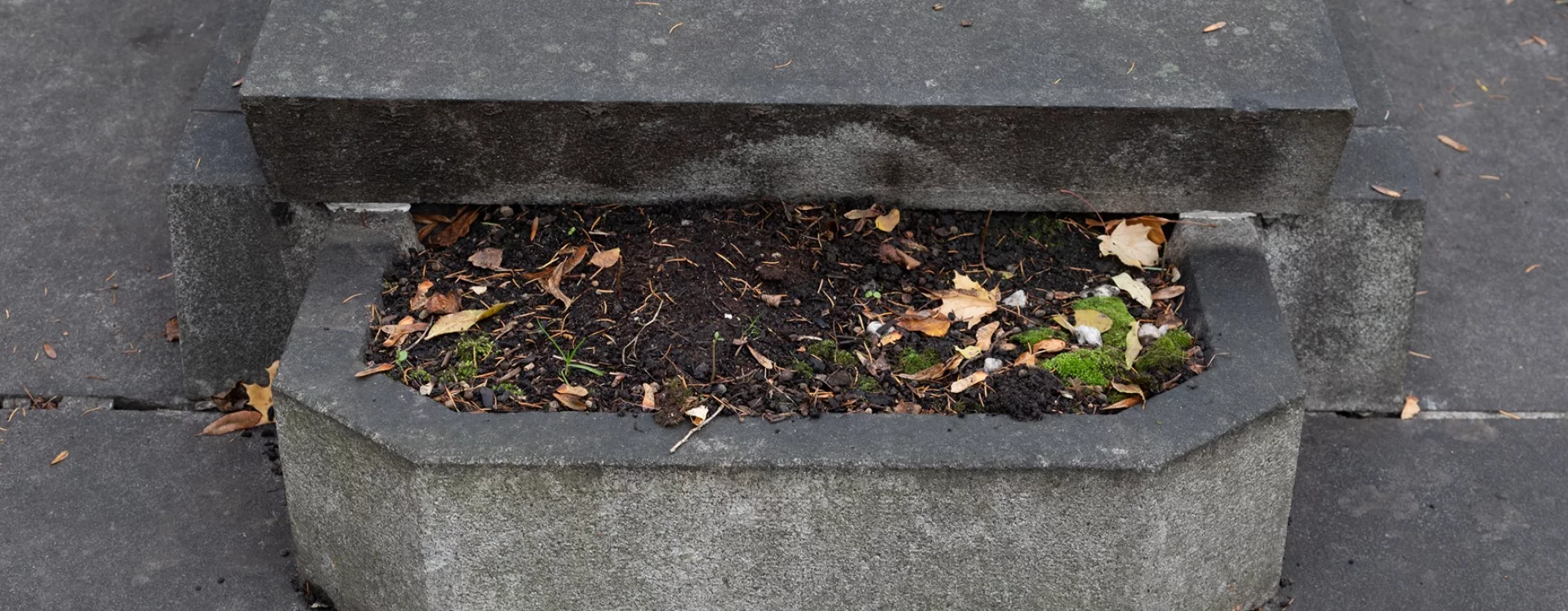
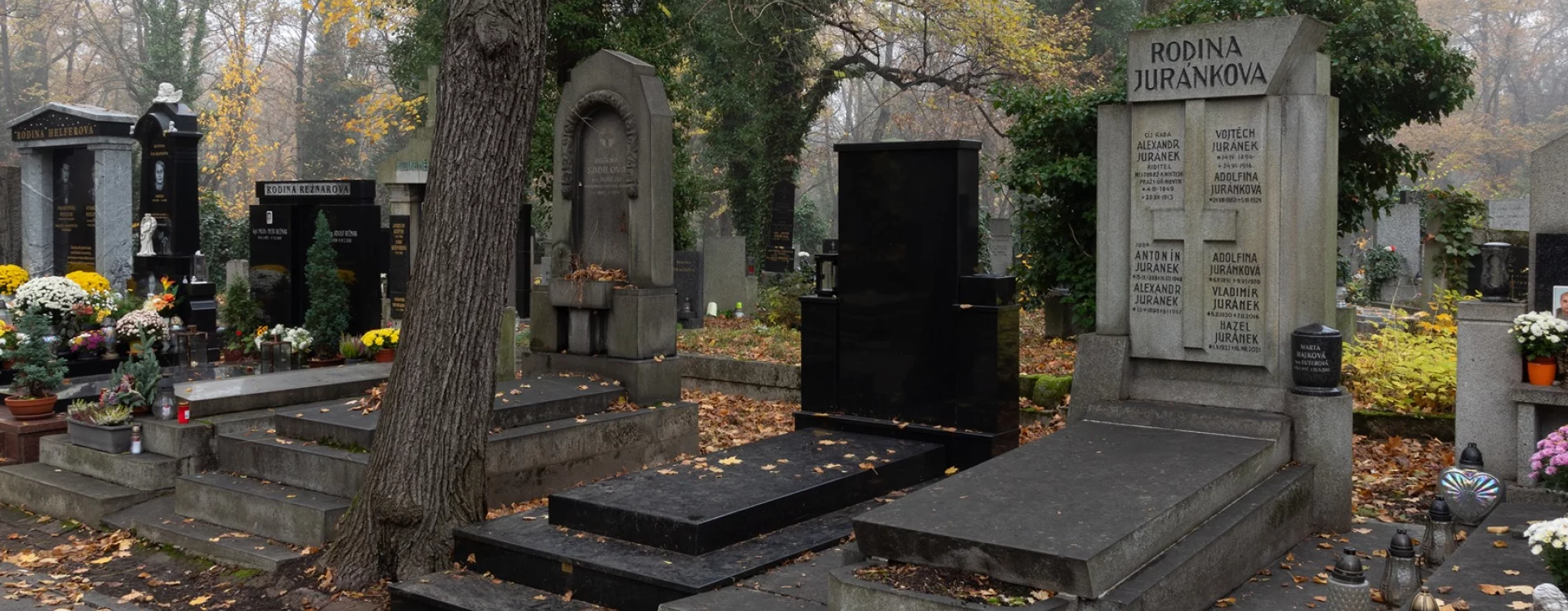
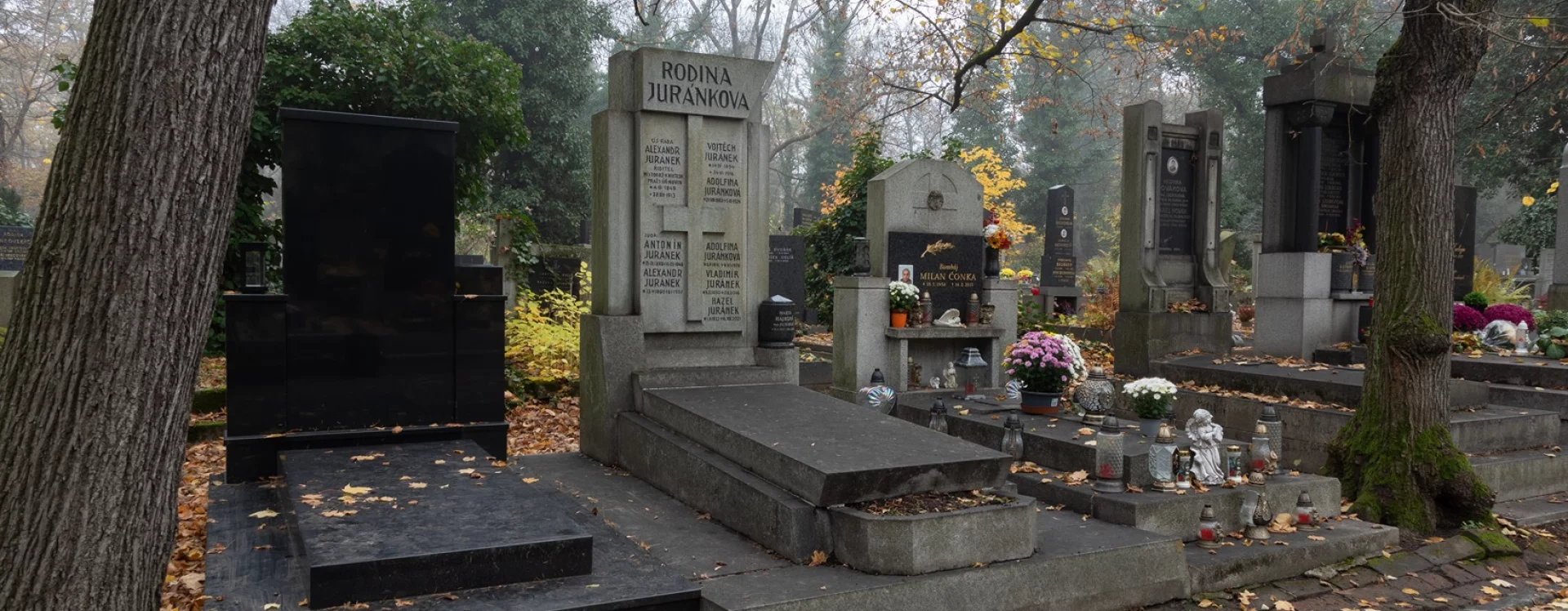
A known sketch for the Juránek family crypt (labeled The Malinek Family) is dated 1914, as is a period photograph showing the completed monument – which has a significantly looser relation to Cubism than the aforementioned purely Cubist monuments. In terms of composition, it works primarily with the contrast between the broad stone grave bed, expanded through the use of massive kerbstones, and the vertical gravestone characterized by an asymmetrical arrangement of variously shaped volumes: angular surfaces, beveled edges, and the innovative use of cylinders, including "negative" (meaning concave) cylindrical shapes. The central space is dominated by a stylized relief cross that, more than a religious symbol, acts as a compositional keystone that also divides the surface of the stele into four inscription fields. At the foot of the grave bed is a stone jardinière; such places for planting live plants appear in several of Janák's designs (theoretical sketches as well as realized works) repeatedly. The monument is made of bush-hammered Bohemian granite.
The grave has been excellently maintained and preserved. The only alteration from its original state has been the replacement of the lantern on the low cylindrical plinth on the right side of the stele by a stone urn.
Literature
Norbert Kiesling. Pavel Janák. Řevnice, 2011. s. 7.
Vendula Hnídková. Architekt Pavel Janák a idea kremační. In: Jiří Roháček (ed.), Epigraphica & Sepulcralia III. Praha, 2011. s. 91–102.
Sources
Archiv HPS, archiv pražských hřbitovů, složka Juránek IX, 12, 36.
Vladislava Holzapfelová, Funerální umění na vybraných pražských hřbitovech 1850–1950 (disertační práce), Ústav dějin křesťanského umění KTF UK, Praha 2016.
Václav Vilém Štech. Available from: https://cs.isabart.org/person/5742 [accessed 29. 5. 2025]
To byl pan profesor V. V. Štech. Available from: https://www.bkovarikova.cz/zapisnik/2010/to-byl-pan-profesor-vvstech-/ [accessed 29. 5. 2025]