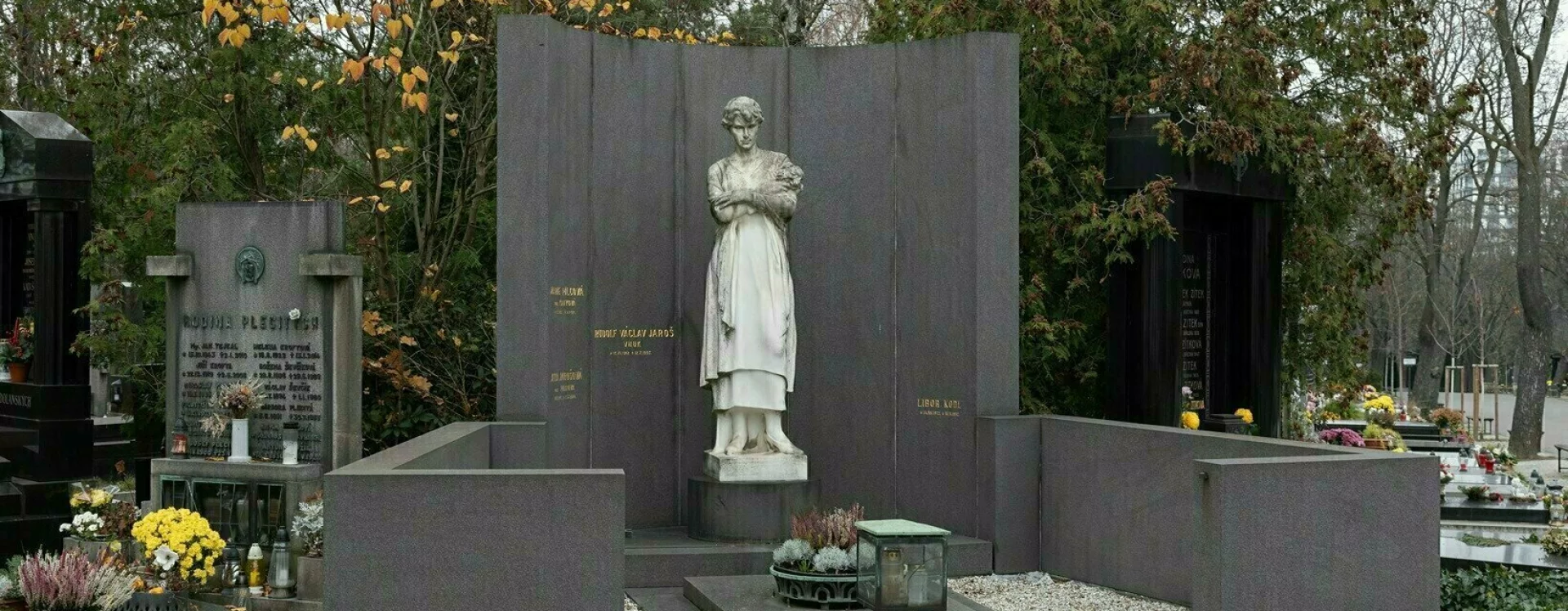
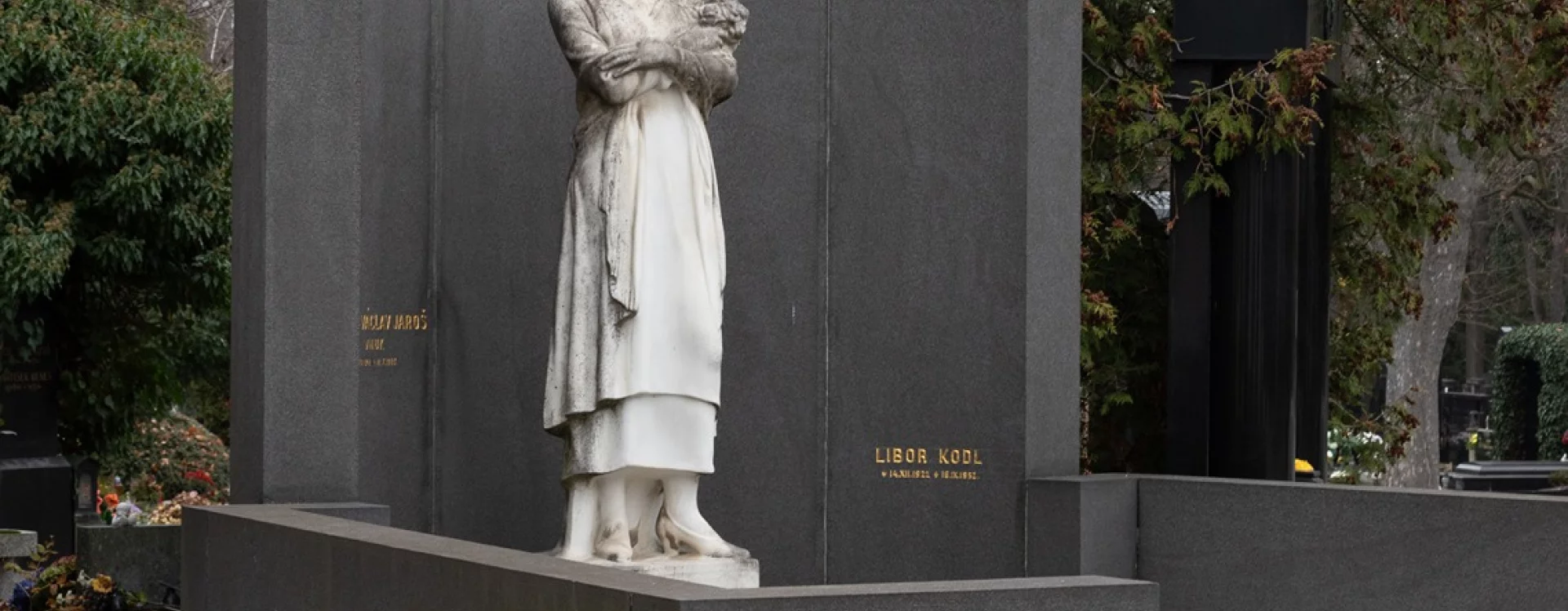
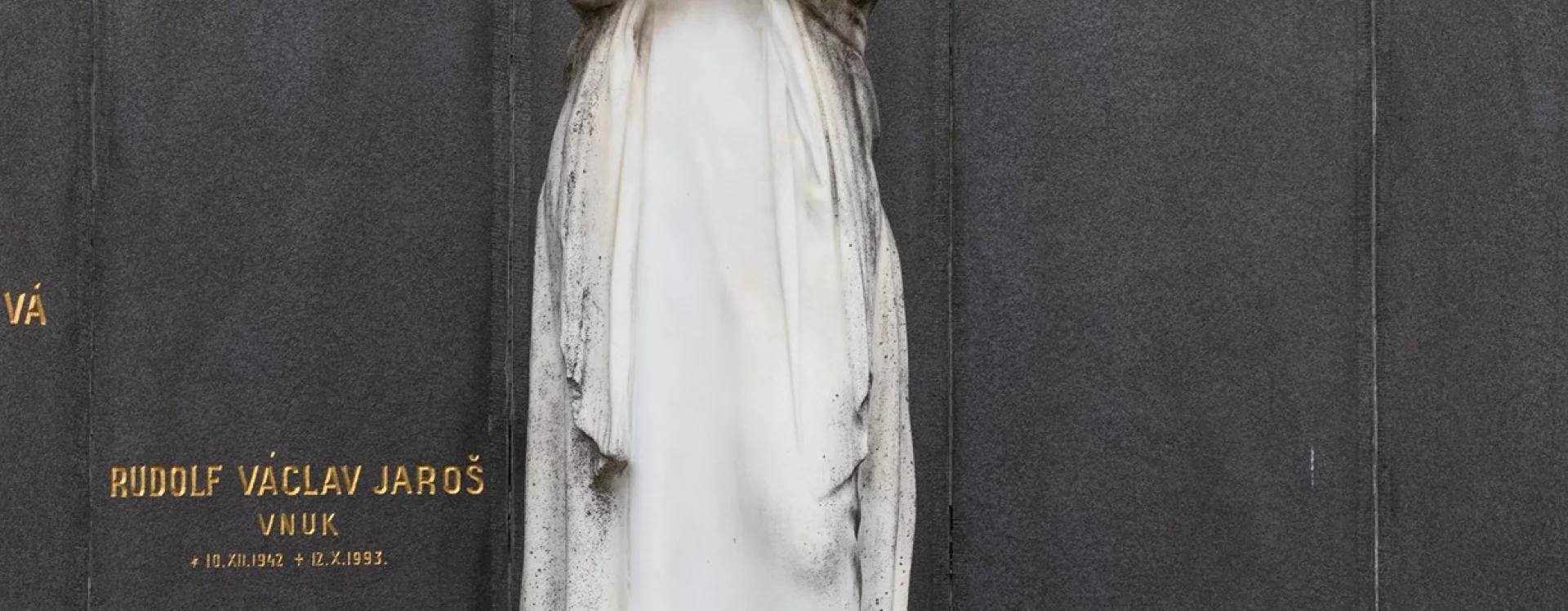
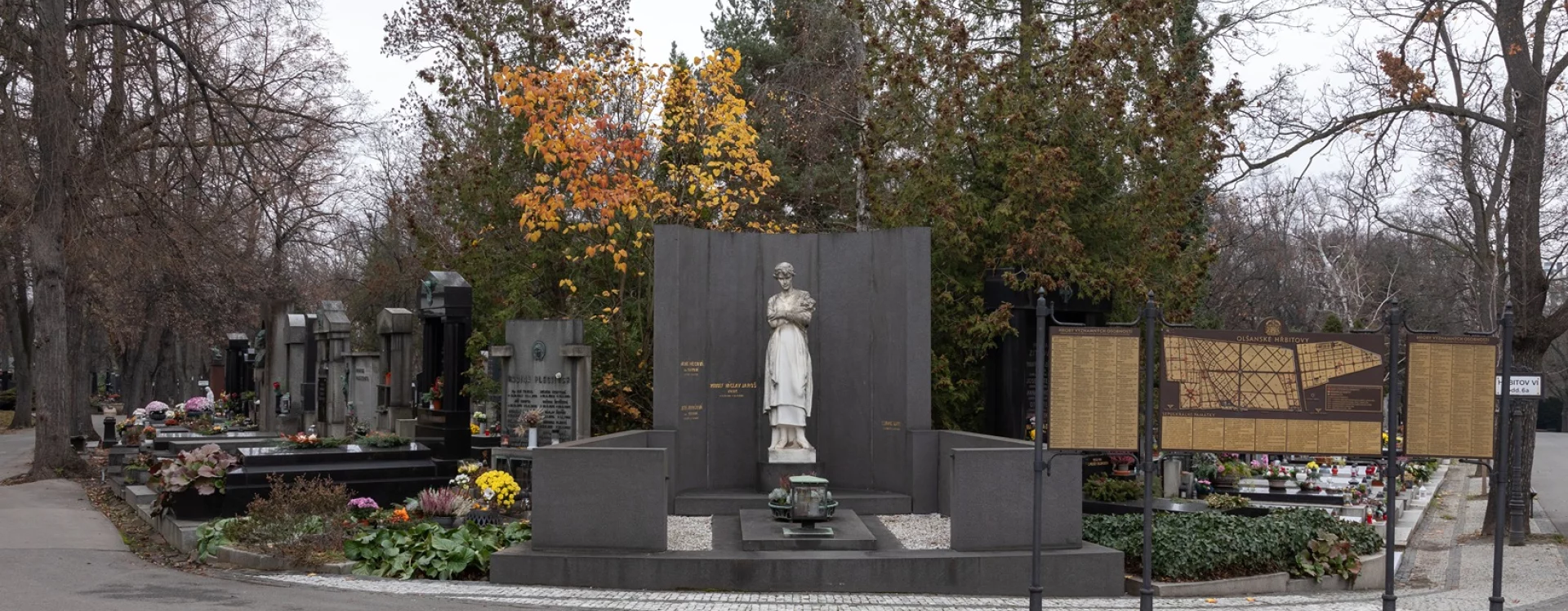
For the crypt of his wife Marie, who died at just thirty years of age, the architect Václav Pilc chose a prominent location right by the cemetery's main gate. The memorial, designed and built in 1927, consists of dark granite blocks standing on a concrete foundation. Its elegant symmetrical composition is dominated by a sculpture of a life-sized statue of a young modern woman with short hair and dress, carved from white Carrara marble. The sculptor, family friend Jakub Obrovský, undoubtedly modeled the sculpture after the deceased, whom he probably knew well, for he and the academic painter Oldřich Blažíček were witnesses at Marie and Václav Pilc's wedding on 18 November 1916. Other works by Obrovský can be found at Vyšehrad Cemetery, among them a realistic bronze semi-figure decorating the grave of Svatopluk Čech.
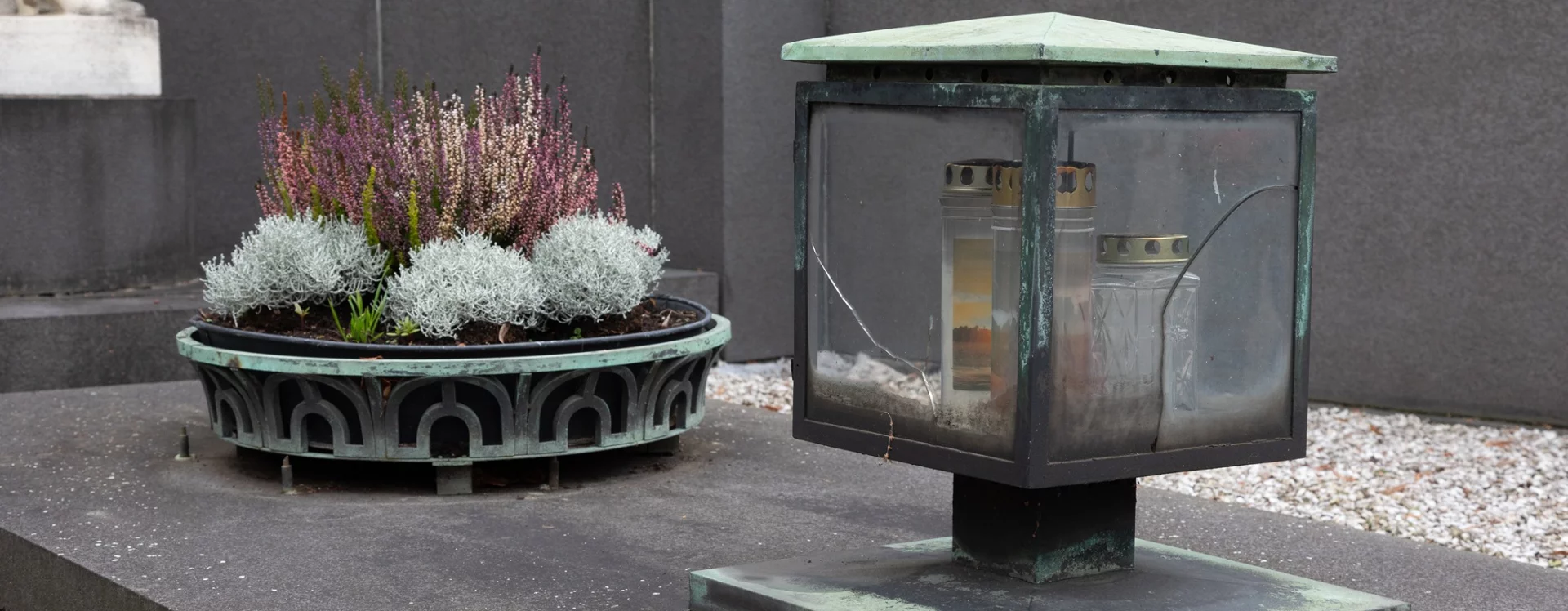
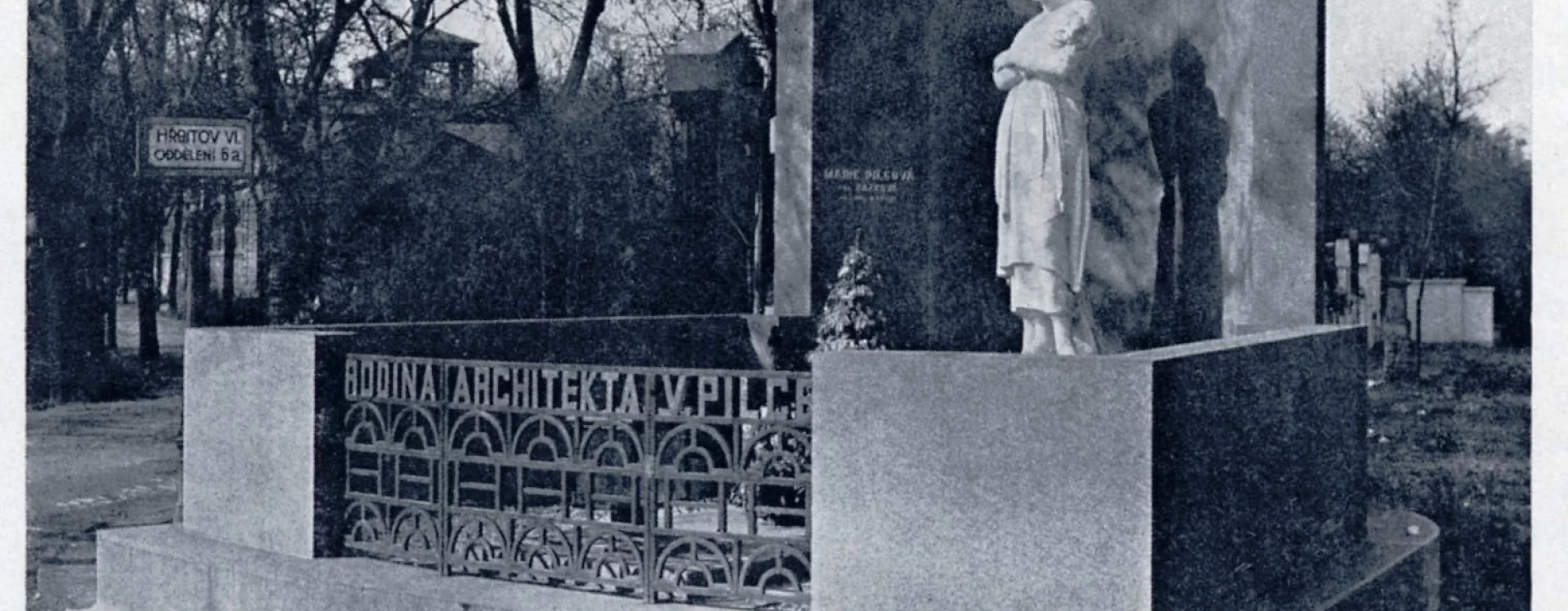
The white female figure contrasts with the dark geometric architecture of the semi-circular stele and the low walls that fence in the plot. The slightly rounded shape of the monument feels like an embrace, an intimate place of mourning. Of the original bronze decorative elements, a rectangular lantern and oval jardinière have survived. A 1927 photograph shows a metal gate with geometric ornamentation and the inscription FAMILY OF ARCHITECT V. PILC enclosing the space of the monument, but it has unfortunately disappeared.
The entire monument was designed by Pilc's friend, the architect Josef Gočár, who created works of funerary architecture at other Prague cemeteries as well, including three examples at Olšany. Gočár actively collaborated with sculptors on all these commissions. In this case, the sculptural design was realized by the stonemason Ludvík Šalda, who left a bronze calling card on the crypt. There are at least thirty signed works by Šalda at the Olšany cemeteries.
The client, the architect Václav Pilc (1891–1958), studied architecture at the Czech technical college in Prague. His best known work is the AXA Palace on Prague's Na Poříčí Street, built by Pilc's construction company in 1930–1932. Pilc had his architecture studio in the attic of this multipurpose building, which he owned along with his second wife, the athlete, fitness instructor, and author of women's fitness books Běla Friedländerová (1900–1965). Among other things, Friedländerová made sure that the AXA Palace included a modern swimming pool with a diving board.
Václav Pilc himself was never buried in his family crypt. Following the AXA Palace's nationalization in 1948, he emigrated to Austria, where he died ten years later. He is buried in Mödling near Vienna.