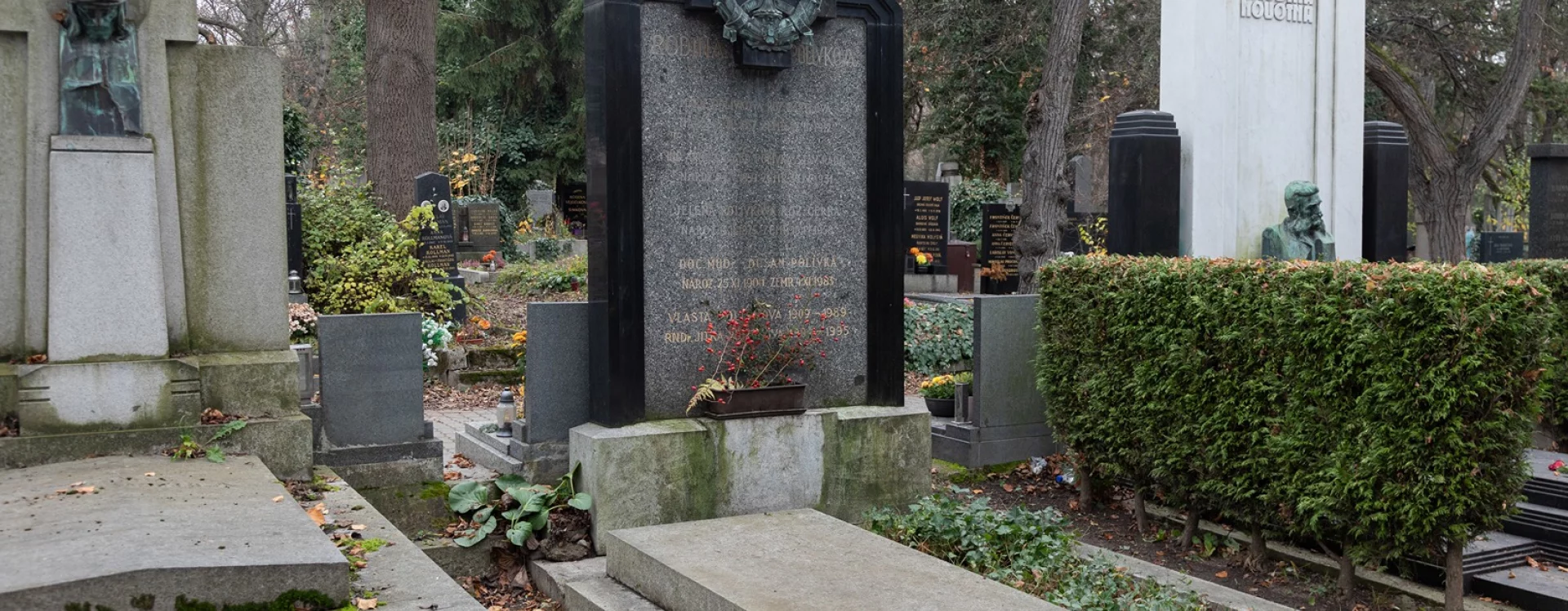
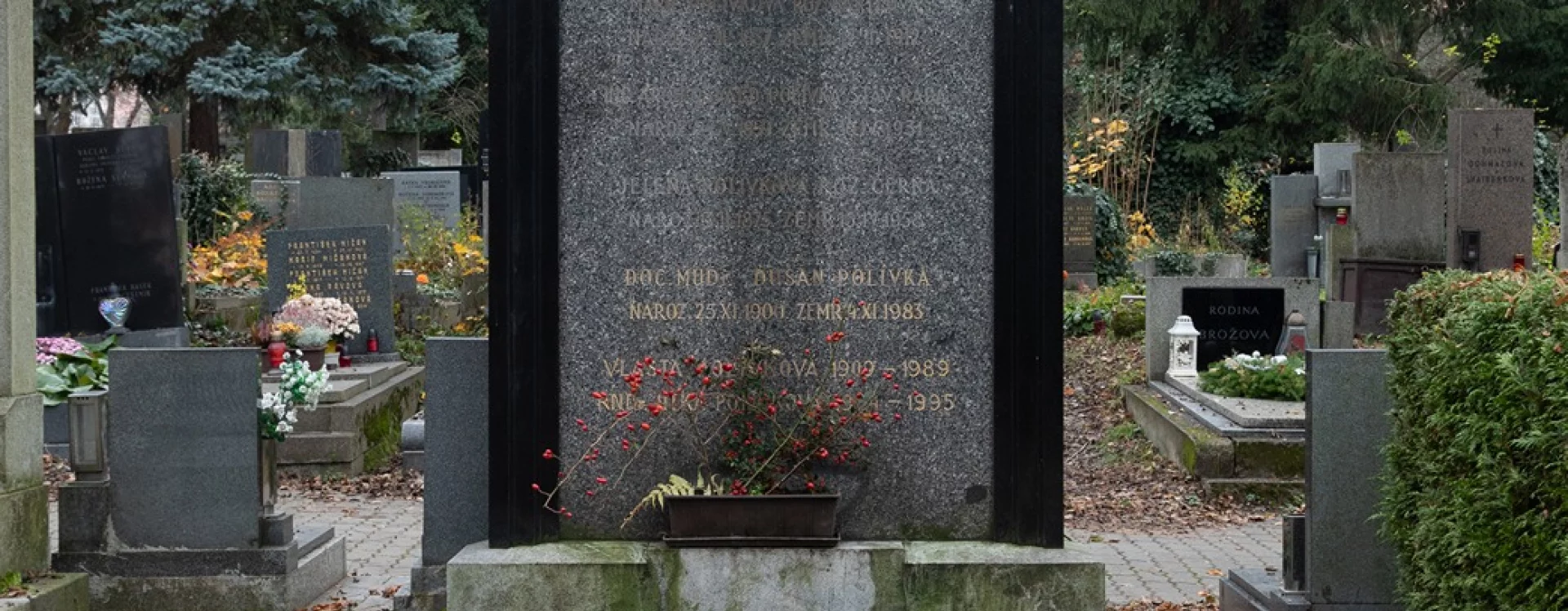
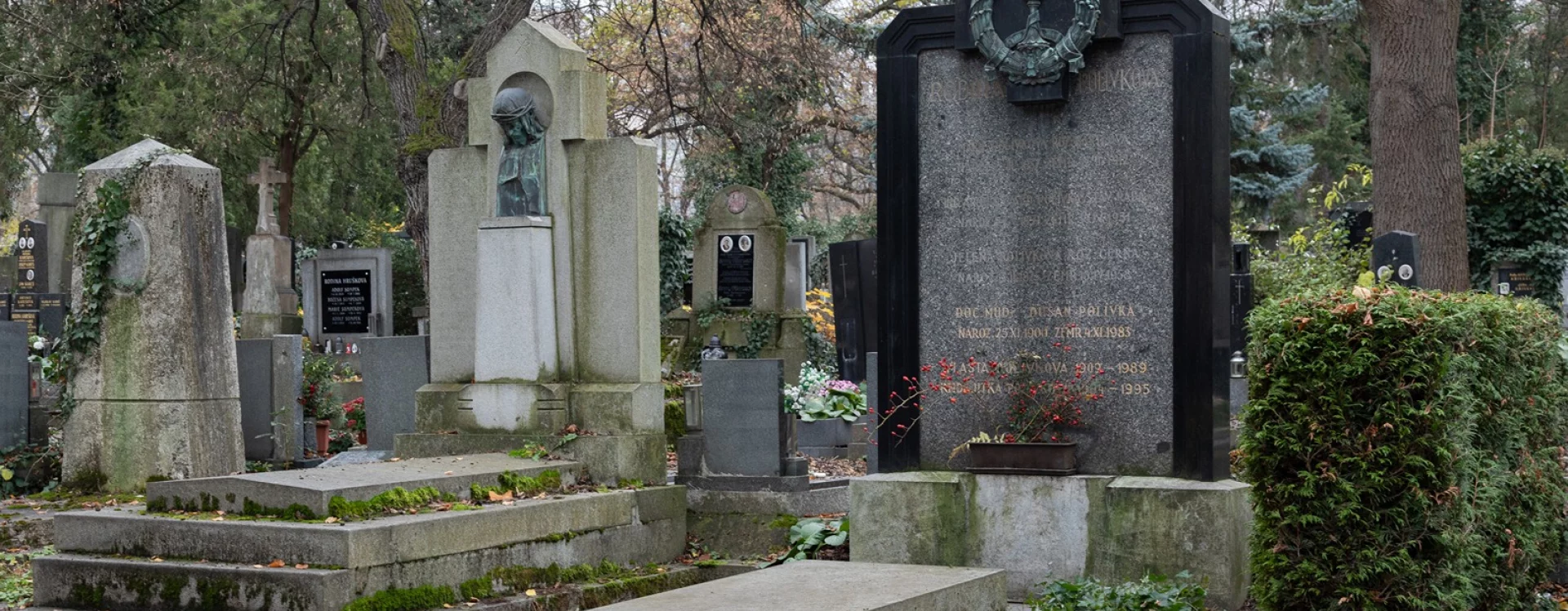
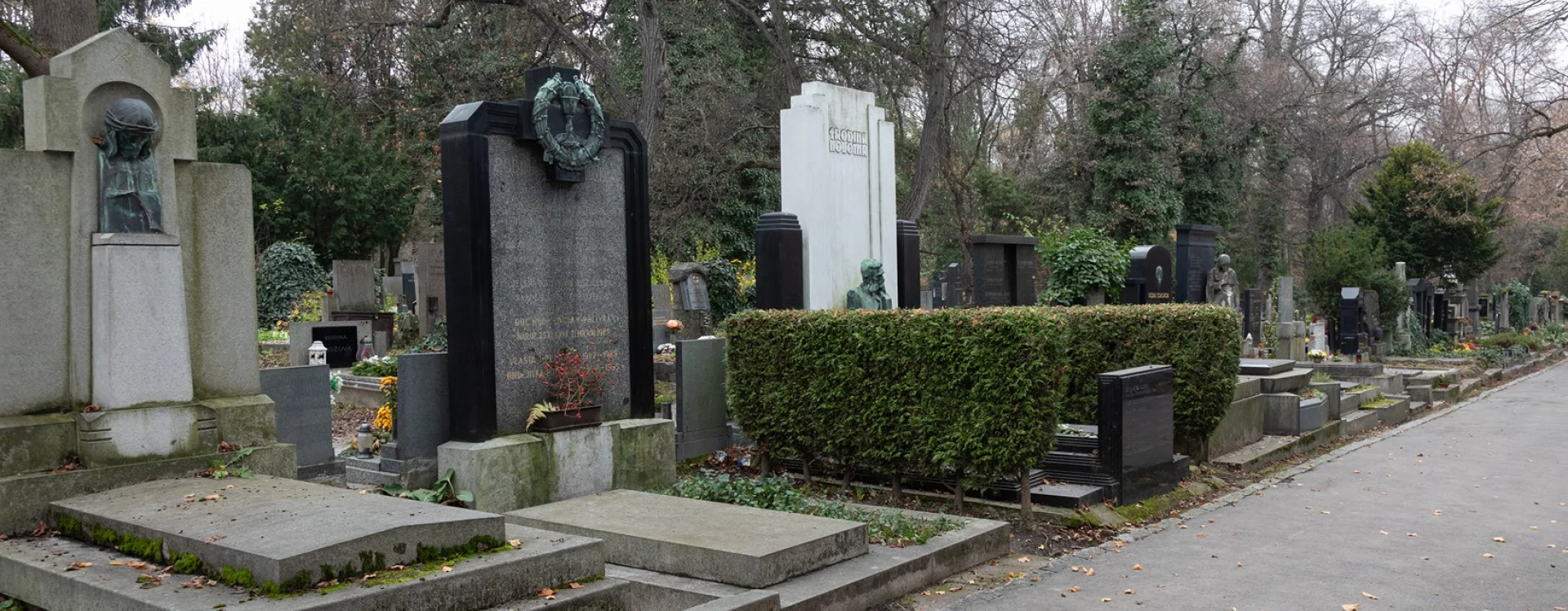
The family grave of the Prague architect Osvald Polívka is an example of funerary architecture influenced by geometric modernism. Polívka, a pioneering figure of the Prague Secession, chose a surprisingly unostentatious and austere design devoid of any excess decorativeness or artistic-sculptural elements. The monument, built in response to the death of Polívka's mother, was realized during the difficult wartime years by the much sought-after stonemasonry firm of the architect Jan Víšek, in collaboration with the builder Josef Vacek.
The former royal and imperial building councilor Osvald Polívka was a member of the generation of architects that had been shaped by the historicist era. A student of and later assistant to Josef Zítek, he initially worked in the late Neorenaissance and Neobaroque styles, which in the late 1890s he began to inventively combine with elements of the emerging Secessionist (Art Nouveau) style. His designs stand out for the use of unconventional and often fantastical decorative elements. Especially around the turn of the century, Polívka enjoyed great renown and earned highly prestigious commissions. Some of his best known works are the Land Bank on Na Příkopě Street, the Prague Municipal Insurance Company on Old Town Square, and the Topič Palace and the Prague Insurance Company on Národní Třída. But the project that earned him the greatest attention was undoubtedly the Municipal House, designed in cooperation with Antonín Balšánek – a building whose supposed "artistic pomposity" was strongly criticized by the emerging generation of modernists headed by Jan Kotěra and the members of the Mánes Association of Architects. Although Polívka sought to move away from ornamentation over the subsequent decades and experimented with various forms of Neoclassicism and modernism (e.g., the U Nováků retail building on the corner of Vodičkova and V Jámě Streets), he never shook the label of "tasteless decorator," ceased to work almost completely in old age, and was nearly forgotten when he died in 1931.
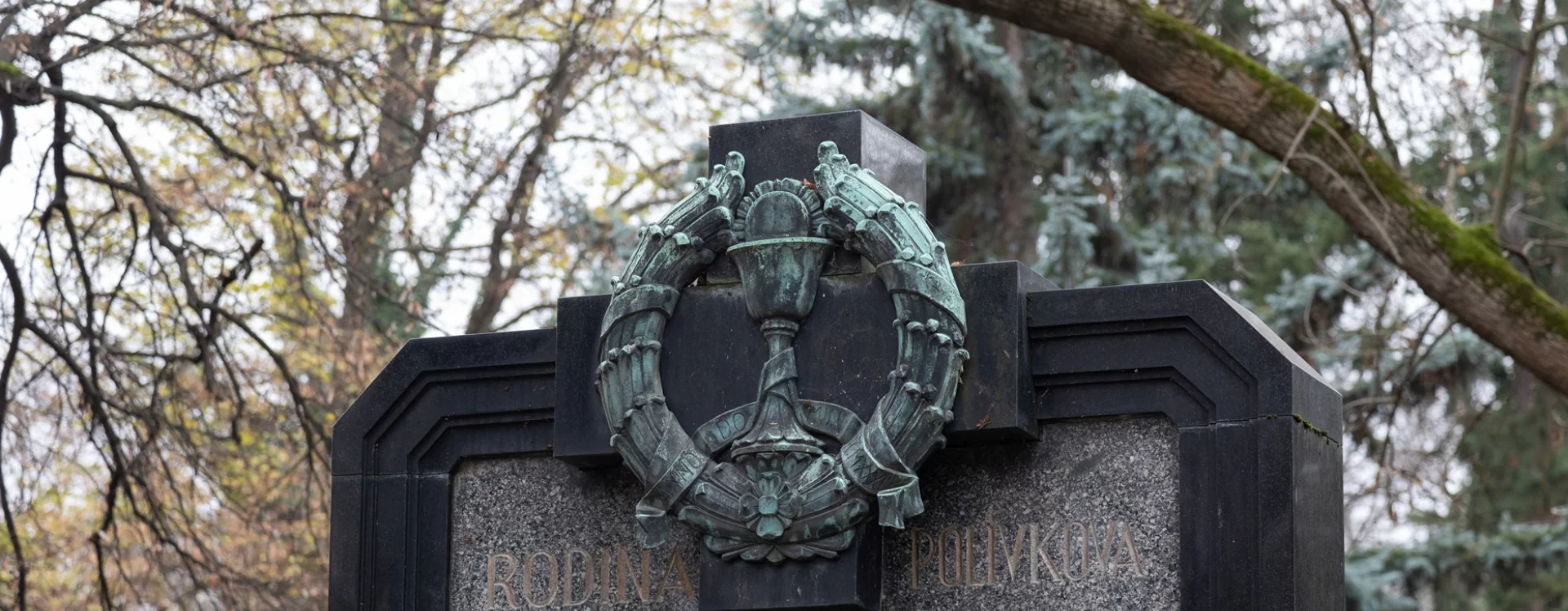
The grave monument, which sits atop an underground crypt, consists of a granite gravestone in the form of a simple rectangular stele on a massive rectangular plinth, with a low, flat stone ledger abutted by a strip of greenery. The gravestone is distinguished by its beveled upper corners and in particular by the modernist right-angled border done in a contrasting darker color. At top center is the traditional motif of a stone Greek cross, later complemented by the addition of a copper sculpture of a stylized wreath with a chalice and the holy host – references to to the Protestant church. The date, written in Roman numerals on a metal ribbon, corresponds to the year of Polívka's death. Besides the aforementioned dark frame, the influence of geometric modernism is also visible in the asymmetrical placement of the ledger stone, which is located not at the center of the grave bed but has been shifted to the left, with the right part of the plot given over to a narrow strip of greenery – an irregular arrangement that contrasts with the strict symmetry of the stele.
The grave originally featured a low decorative metal fence and a jardinière at the center of the rectangular plinth. The jardinière was stolen at some point over the intervening years, though it has since been replaced by a replica.
The grave also holds the remains of other family members, including those of Polívka's son Dušan (1900–1983), a doctor and university teacher who was the head of Pilsen University Hospital's orthopedics department in 1945–1971.
Osvald Polívka's only other known funerary work can be found at Olšany as well. Realized in 1906, the family crypt of the Prague entrepreneur and merchant Josef Novák differs from the grave discussed here in its monumentality and use of details in the style of floral Art Nouveau.
Literature
Zdeněk Lukeš, Rudolf Pošva. Neznámý Osvald Polívka. Pokus o rehabilitaci díla pražského architekta přelomu století,. In: Staletá Praha 1988, č. 18. p. , s. 193–207.
Zdeněk Lukeš. Skrytá krása detailu. Pražské stavby Osvalda Polívky. 1891–1922. Praha, 2021.
Jana Tischerová. Pražské hřbitovy, pohřebiště a sepulkrální památky. Praha, 2023. s. 38.