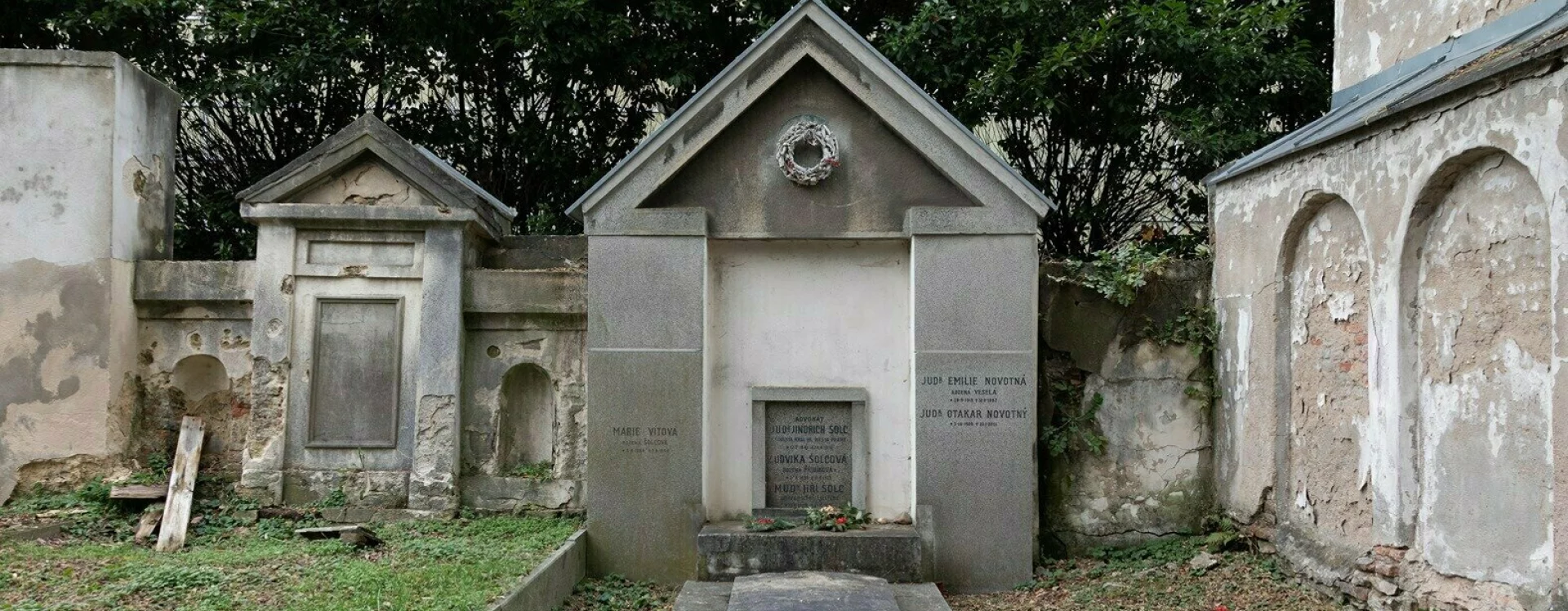
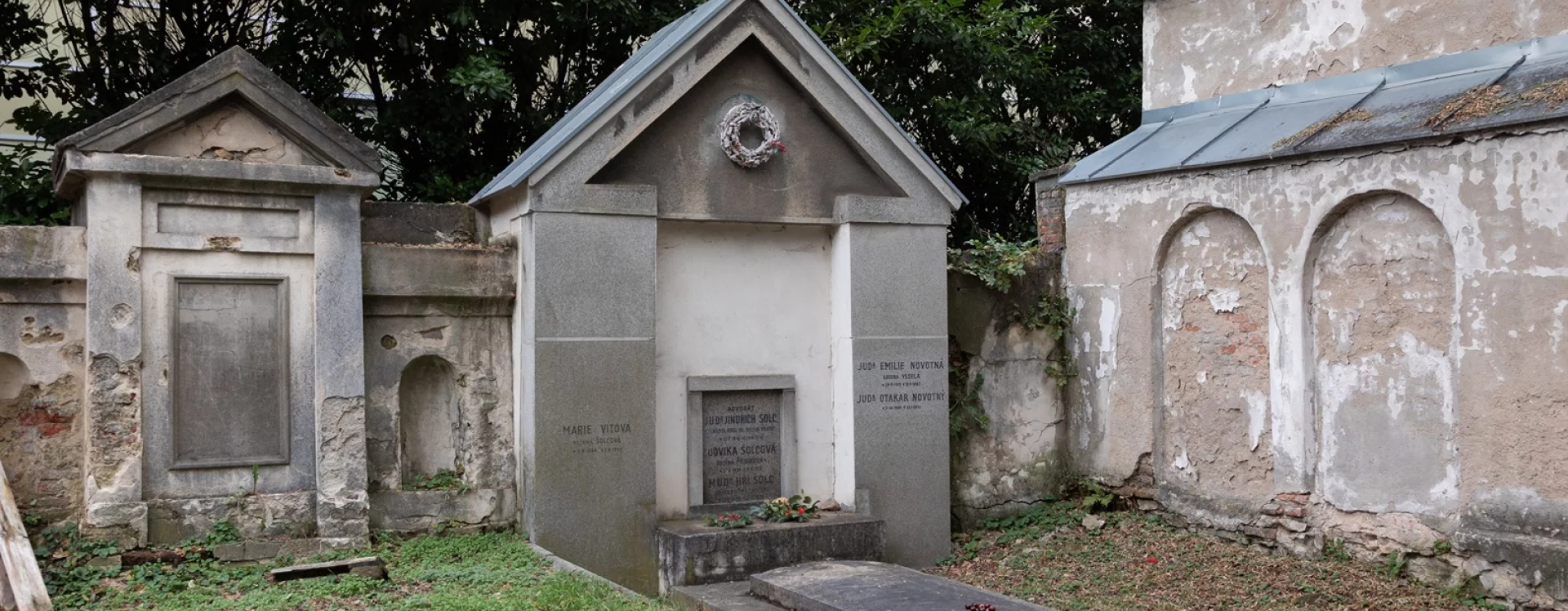
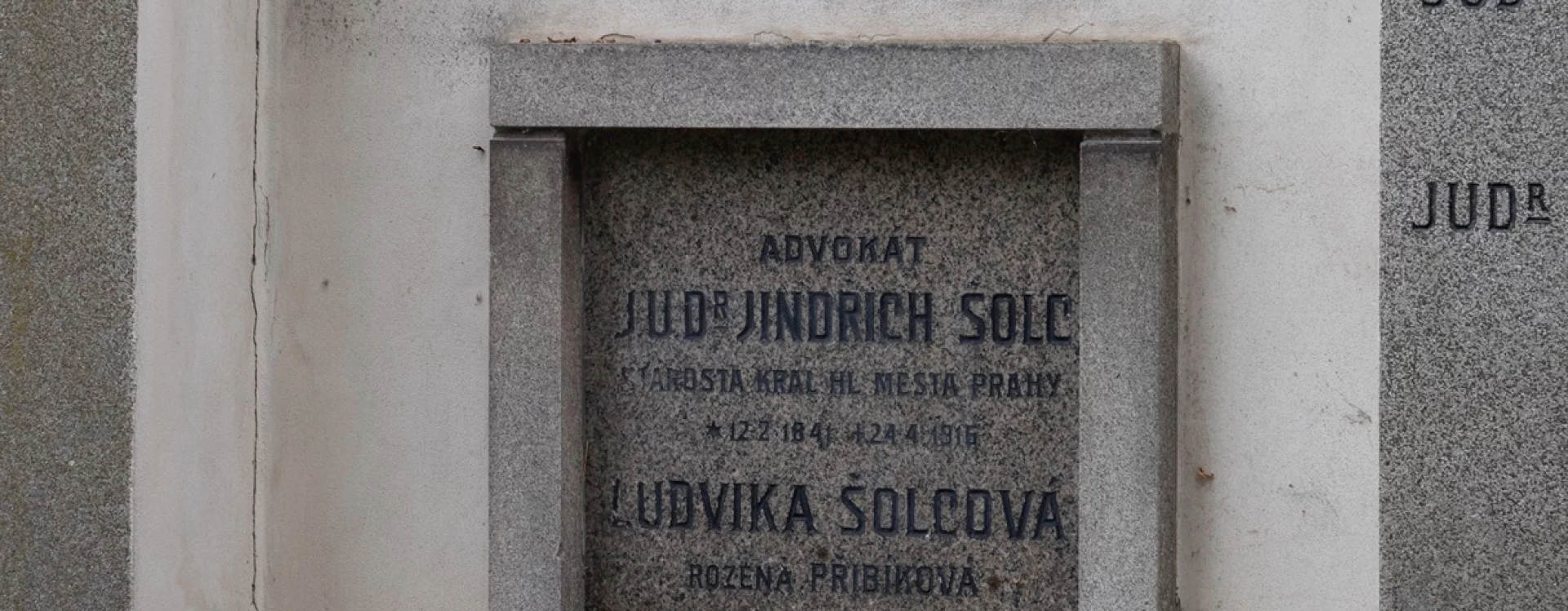
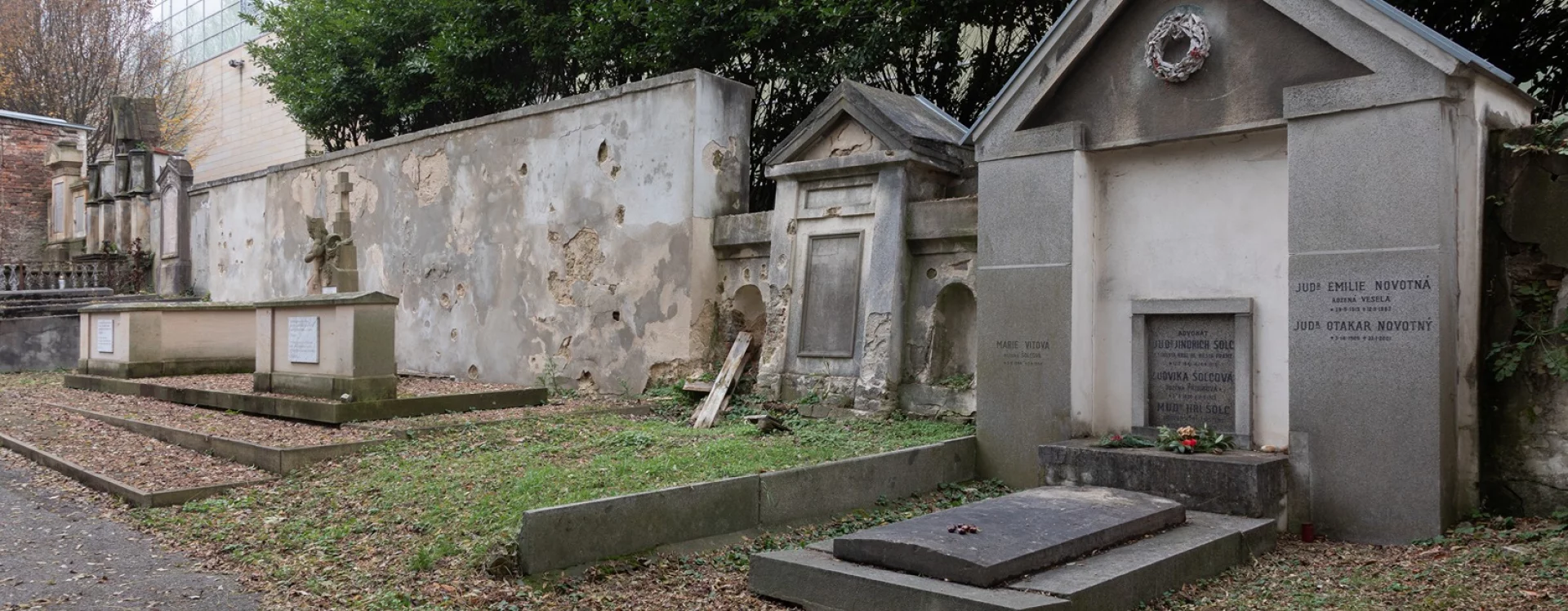
This architecturally valuable grave monument commemorates the attorney Jindřich Šolc, who served as a member of the Bohemian Diet and also, in 1887–1893, as mayor of Prague. In his youth, he was actively engaged in literature like his cousin, the poet Václav Šolc. During his time as mayor, Prague experienced rapid development on all fronts, but he also had to deal with ethnic tensions and contemporary issues such as equal rights and universal suffrage. As a former mayor, the costs of his funeral were carried by the city. Similarly, Prague's town council voted to purchase his grave plot along the western cemetery wall and to present it to his widow and their sons, one of whom is buried here as well: Dr. Jiří Šolc, a docent at the Hlava Pathological Institute and lecturer at Charles University's Faculty of Medicine.
The first part of the grave to be constructed, in 1917, was the underground crypt topped by a granite ledger. This part of the project was designed and realized by the company of Ferdinand Palouš. The application for a building permit is dated 17 October 1917.
The gravestone is of a simple design resembling a building's facade with gable, at the center of which there originally was a bronze relief medallion with a portrait of Jindřich Šolc (since stolen). The design may have been inspired by classical church architecture, or perhaps by an archetypal facade of a house – a human dwelling. Church facades are commonly used in funerary architecture, while the reference to a simple home may have been meant to symbolize the fact that, as mayor, Šolc was in charge of the city – a "home for the people."
The work's exact dating remains unknown. There are no plans in Pavel Janák's catalogue of works, nor do we know of any other plans or drawings. Janák is listed as its author in several secondary sources, including a catalogue for an Otto Gutfreund exhibition at the National Gallery in late 1995 and early 1996. Stylistically, the grave marker corresponds to Janák's other designs from the 1920s (both larger and smaller monument architecture), which are characterized by a volumetric Purism with Neoclassical features. We may deduct that it was created sometime after the year 1923, when both Jiří Šolc and his mother Ludvika, who is also buried here, passed away. Moreover, there is a direct connection to the cemetery in the town of Sobotka, where a monument was built in 1926–1927 according to plans known to have been drafted by Janák. This monument, which is dedicated to prominent natives of Sobotka buried elsewhere, features several portrait medallions, including one of Jindřich Šolc that closely resembles the one stolen from his grave at Olšany. All six of these medallions were fashioned by the sculptor Karel Pokorný (1891–1962). Otto Gutfreund's authorship of the Olšany medallion is supported by the fact that he did an older portrait medallion of Šolc for Hlávka Bridge, by his prior collaboration with Pavel Janák, and by a recollection on the part of Otakar Novotný (albeit uncertain and shared many years after the fact, in 1990) published in a 1995 catalogue by the National Gallery in Prague. Novotný was Jindřich Šolc's grandson – the son of Helena Šolcová and the architect Otakar Novotný, a friend of Otto Gutfreund.
Literature
Norbert Kiesling. Pavel Janák. Řevnice, 2011. s. 73, 164–171.
Miloš Szabo. Pražské hřbitovy. Olšanské hřbitovy IV.. Praha, 2012. s. 340, 341.
Medailony na Hlávkově mostě v Praze. In: Národní listy. Praha, 1912. s. 5.
Sources
Archiv HPS, archiv pražských hřbitovů, složka Šolc IV, 14, 58.
Vladislava Holzapfelová, Funerální umění na vybraných pražských hřbitovech 1850–1950 (disertační práce), Ústav dějin křesťanského umění KTF UK, Praha 2016, s. 122.
Otto Gutfreund (kat. výst.), Národní galerie Praha, 1995, s. 194.
JUDr. Jindřich Štolc. Available from: https://web.archive.org/web/20131010131402/http:/www.praha.eu/jnp/cz/home/volene_organy/primator/stali_v_cele/judr_jindrich_stolc.html [accessed 26. 5. 2025]
Pomník soboteckých rodáků. Available from: https://pamatkovykatalog.cz/pomnik-soboteckych-rodaku-782075 [accessed 27. 5. 2025]
Náhrobek pražského primátora JUDr. Jindřicha Šolce s portrétním medailonem na Olšanských hřbitovech v Praze. Available from: http://www.publicart.gavu.cz/nahrobek-prazskeho-primatora-judr-jindricha-solce-s-portretnim-medailonem-na-olsanskych-hrbitovech-v-praze/ [accessed 27. 5. 2025]
Medailon Jindřicha Šolce na Hlávkově mostu v Praze. Available from: http://www.publicart.gavu.cz/medailon-jindricha-solce-na-hlavkove-mostu-v-praze/ [accessed 27. 5. 2025]
File:Jindrich Solc hrob detail.jpg. Available from: https://commons.wikimedia.org/wiki/File:Jindrich_Solc_hrob_detail.jpg [accessed 27. 5. 2025]
Hlávkův most. Available from: https://pamatkovykatalog.cz/hlavkuv-most-14213638 [accessed 27. 5. 2025]