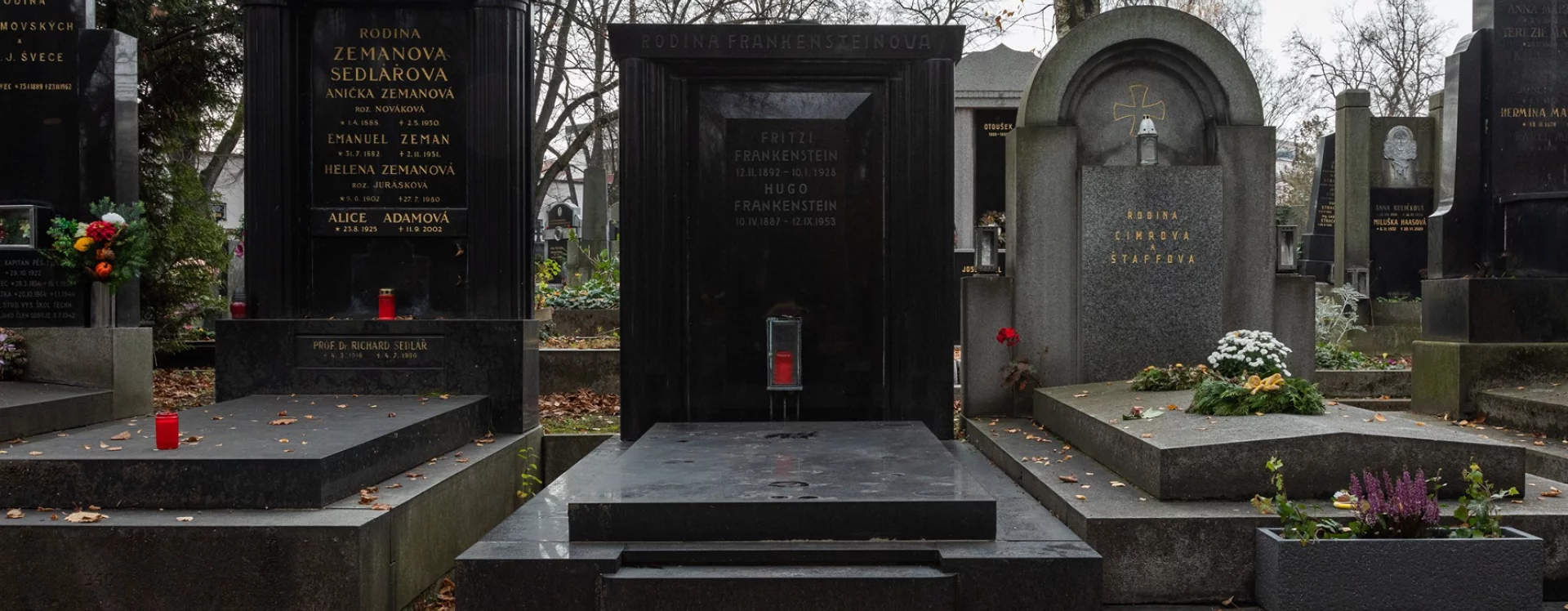
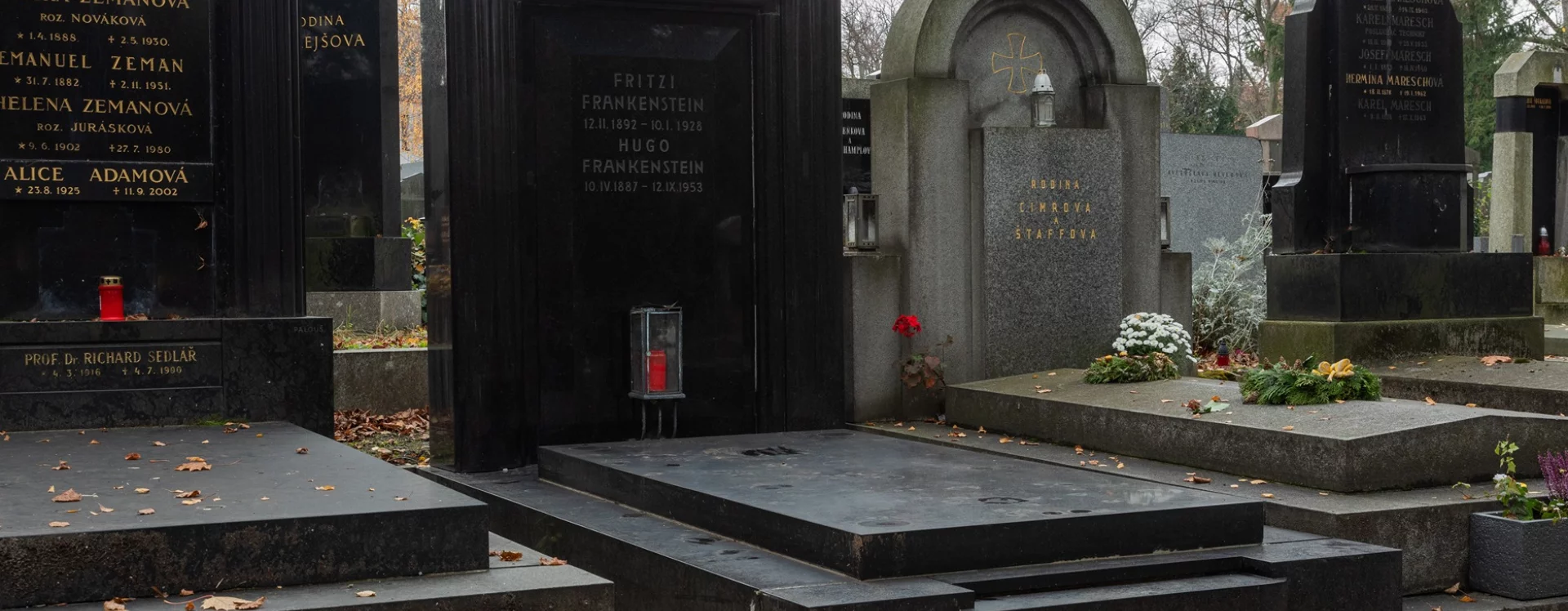
The monument decorating the Frankenstein family crypt is a remarkable example of interwar funerary architecture, which, in the spirit of Purism, broke away completely from all decorativeness or sentiment associated with reverence for the dead. It was commissioned from the architect Paul Albert Kopetzky in 1929 by Hugo Frankenstein, general manager of the Czecho-Moravian Discount Bank, who had it built for his family.
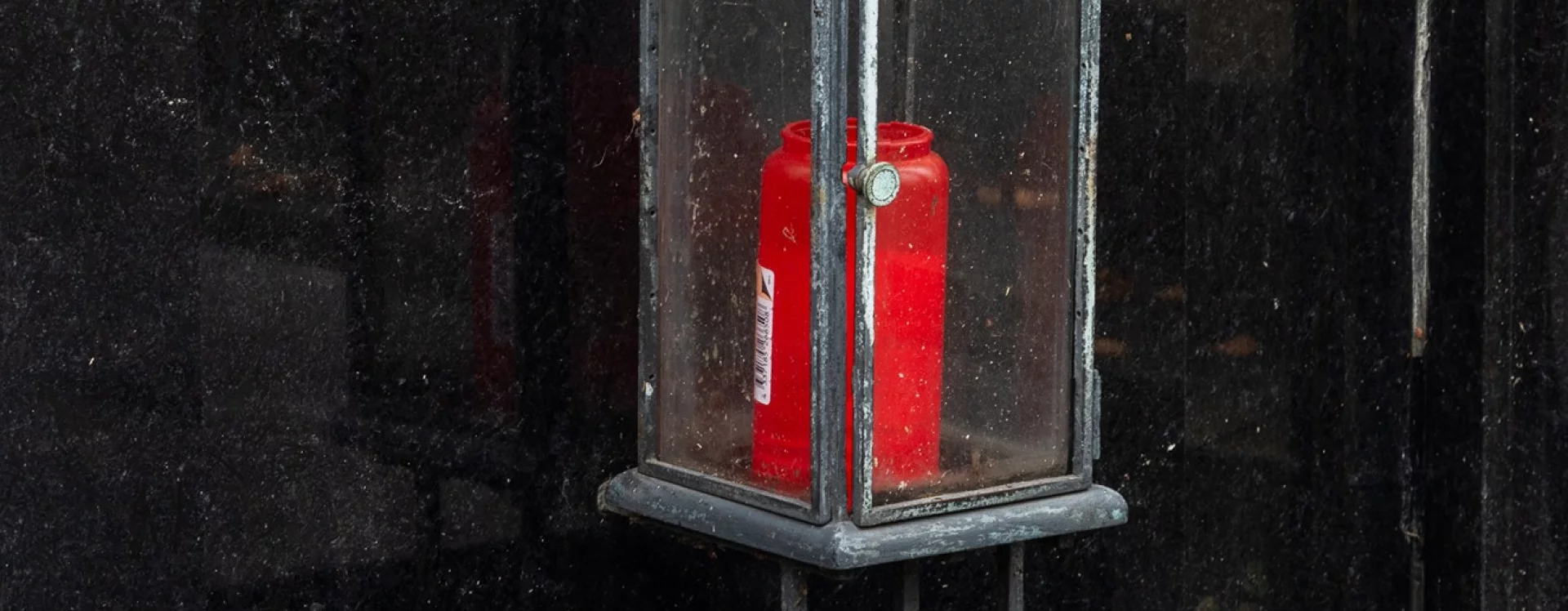
Paul Albert Kopetzky (1885–1944), a student of Jan Kotěra, went through several stylistic periods in his career, including Art Nouveau, Cubism, and Functionalism. He also wrote essays and did design work, but he had the greatest impact in the field of funerary architecture. His largest number of works are at Žižkov's New Jewish Cemetery, where he designed many grave memorials of high quality as well as the cemetery's Functionalist gatehouse. Two of his works can be found at Olšany as well: a 1927 urn gravestone for the Dušek and Brand families and the monument for the Frankenstein family crypt from two years later, the latter a smooth stone ledger and a tall stele of polished black granite resembling a kind of portal or doorway to the hereafter. Despite (or, better said, because of) the fact that the architect rejected the use of ornamentation and focused solely on producing a clear geometric form, this small structure makes an exceptional aesthetic as well as spiritual impact. The lower part of the stele is decorated only with a simple lantern.
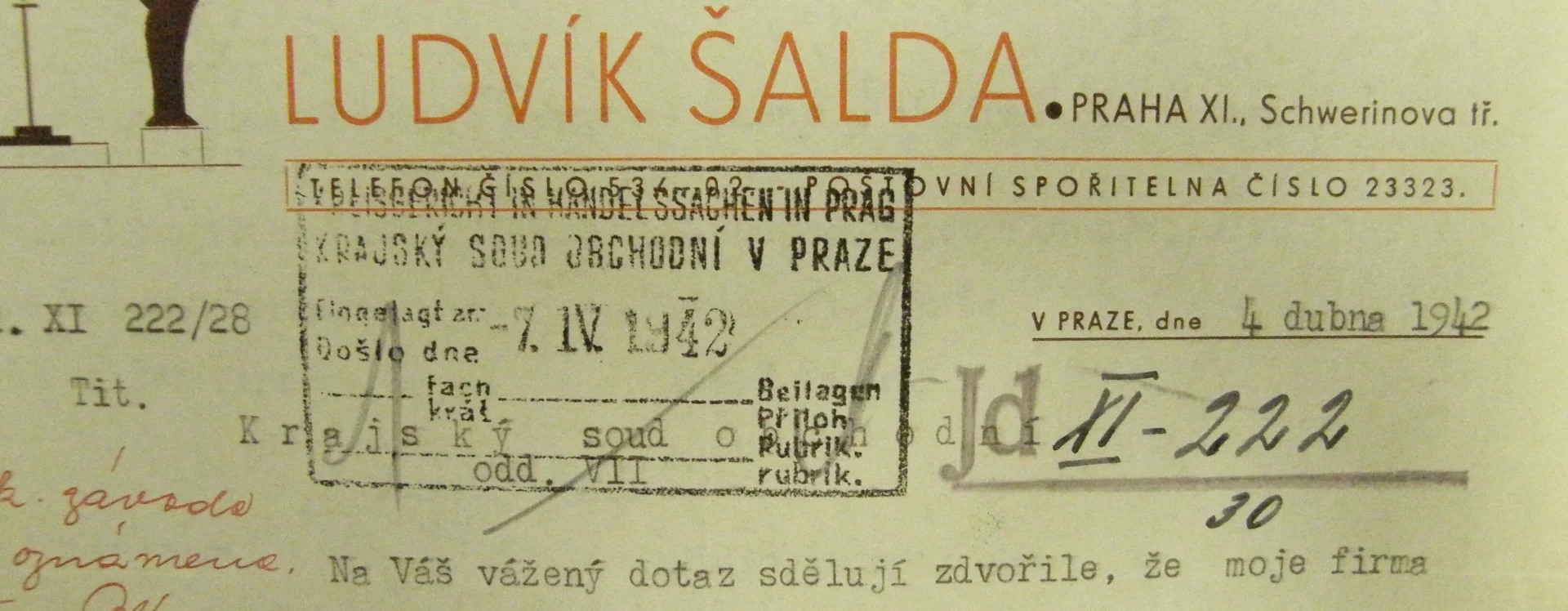
Archival records show that Hugo Frankenstein initially contacted the renowned stonemasonry firm of Jan Rada & Son, but the project was ultimately realized by the equally venerable company of Ludvík Šalda. This firm, founded in 1847 and active for over a century until its post-1948 nationalization, owned its own quarries (granite, syenite, light and pink marble) and, besides working on countless funerary commissions, also contributed to the most prestigious architectural projects of the day, including the completion of St. Vitus Cathedral, the construction of Slavín at Vyšehrad Cemetery, and the Museum of Decorative Arts in Prague. Artists with whom the Šalda firm collaborated included such names as Stanislav Sucharda, Josef Gočár, and Pavel Janák.
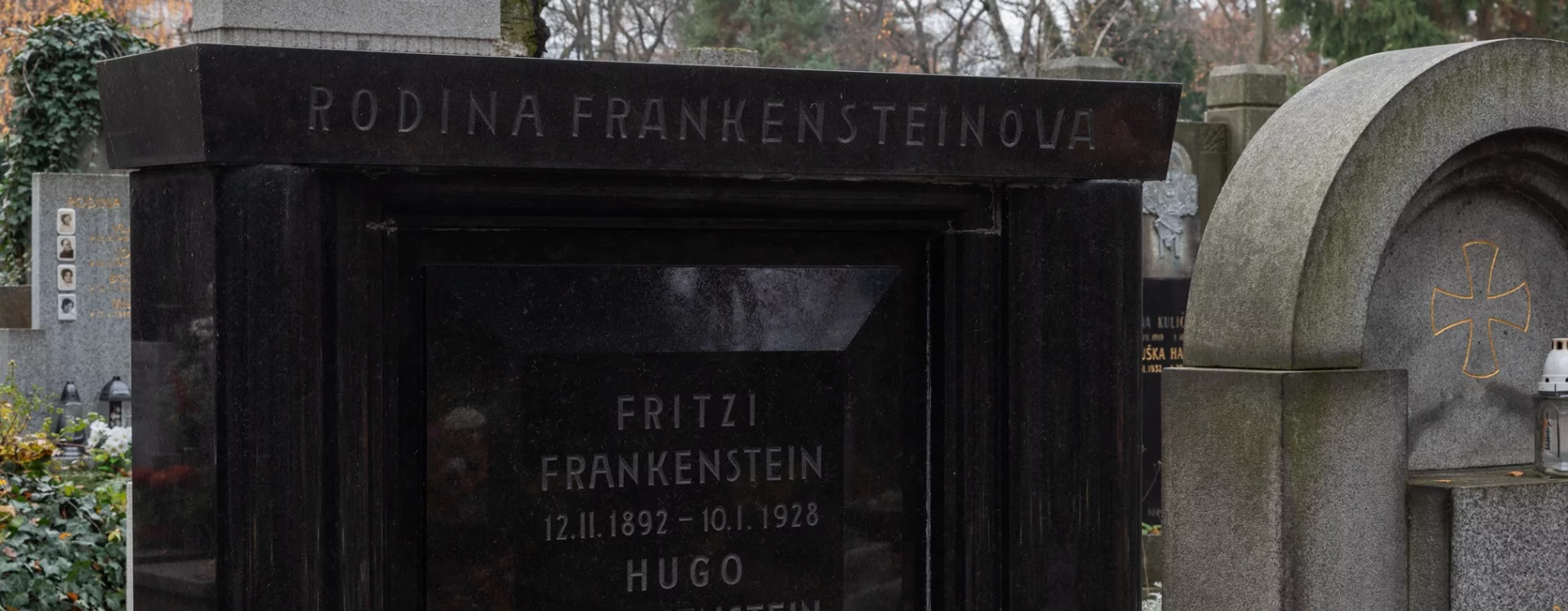
The inscription at the top of the Frankenstein family's gravestone initially read Familie Frankenstein in German, but in 1947 Hugo Frankenstein – most likely in response to anti-German sentiments stirred by the horrors of the Second World War – had it removed and replaced with a Czech inscription. Five years later, he himself was laid to rest here.
Vladislava Holzapfelová, 2025
Paul Albert Kopetzky (1885–1944), a student of Jan Kotěra, went through several stylistic periods in his career, including Art Nouveau, Cubism, and Functionalism. He also wrote essays and did design work, but he had the greatest impact in the field of funerary architecture. His largest number of works are at Žižkov's New Jewish Cemetery, where he designed many grave memorials of high quality as well as the cemetery's Functionalist gatehouse. Two of his works can be found at Olšany as well: a 1927 urn gravestone for the Dušek and Brand families and the monument for the Frankenstein family crypt from two years later, the latter a smooth stone ledger and a tall stele of polished black granite resembling a kind of portal or doorway to the hereafter. Despite (or, better said, because of) the fact that the architect rejected the use of ornamentation and focused solely on producing a clear geometric form, this small structure makes an exceptional aesthetic as well as spiritual impact. The lower part of the stele is decorated only with a simple lantern.
Archival records show that Hugo Frankenstein initially contacted the renowned stonemasonry firm of Jan Rada & Son, but the project was ultimately realized by the equally venerable company of Ludvík Šalda. This firm, founded in 1847 and active for over a century until its post-1948 nationalization, owned its own quarries (granite, syenite, light and pink marble) and, besides working on countless funerary commissions, also contributed to the most prestigious architectural projects of the day, including the completion of St. Vitus Cathedral, the construction of Slavín at Vyšehrad Cemetery, and the Museum of Decorative Arts in Prague. Artists with whom the Šalda firm collaborated included such names as Stanislav Sucharda, Josef Gočár, and Pavel Janák.
The inscription at the top of the Frankenstein family's gravestone initially read Familie Frankenstein in German, but in 1947 Hugo Frankenstein – most likely in response to anti-German sentiments stirred by the horrors of the Second World War – had it removed and replaced with a Czech inscription. Five years later, he himself was laid to rest here.
Vladislava Holzapfelová, 2025
Literature
Zdeněk Lukeš. Splátka dluhu: Praha a její německy hovořící architekti 1900-1938. Praha, 2002, s. 98.
Drahomíra Březinová, Barbora Schulmannová. Umělecky cenné hrobky na Novém židovském hřbitově č. 3. In: Kámen, XVI, 2010. 2010, s. 66-68.
Jana Tischerová. Pražské hřbitovy, pohřebiště a sepulkrální památky. Praha, 2023, s. 111.