The monument dedicated to Karel Havlíček Borovský is one of the most interesting examples of Neorenaissance funerary architecture at Olšany. The poet, politician, and journalist Borovský (1821–1856) was a leading figure of the Czech National Revival and is considered the founding father of modern Czech journalism. He was not afraid to criticize various ills of society, the church, or the Habsburg monarchy, as a result of which he was exiled to Brixen in Tirol from 1851 to 1855. A year after his return home he died in Prague, where the Czech nation mourned him as a national hero and martyr and organized an unprecedented funeral at Olšany that grew into a massive anti-Habsburg protest. According to a popular but historically disproven legend, Božena Němcová placed a crown of thorns on his coffin.
When he was buried here in 1856, his grave was marked by just a provisional plaque inscribed with the words "Karel Havlíček and his spouse Julie." In 1867, the Svatobor association hired the architect Josef Zítek, author of the National Theatre in Prague, to design a funerary monument, which was finally installed in 1870 after the association spent the intervening years constantly reminding the famous architect to complete his plans. As with Zítek's "Golden Chapel," the sculptural decoration was commissioned from Bohuslav Schnirch.
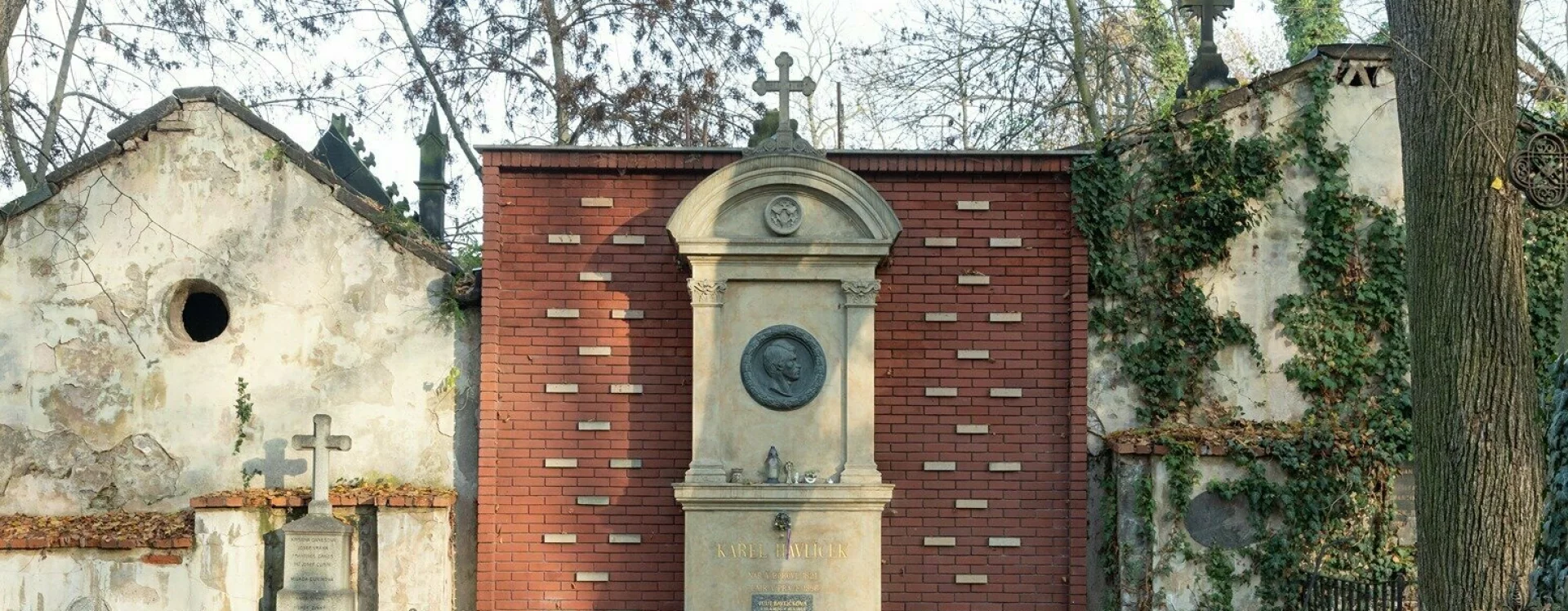
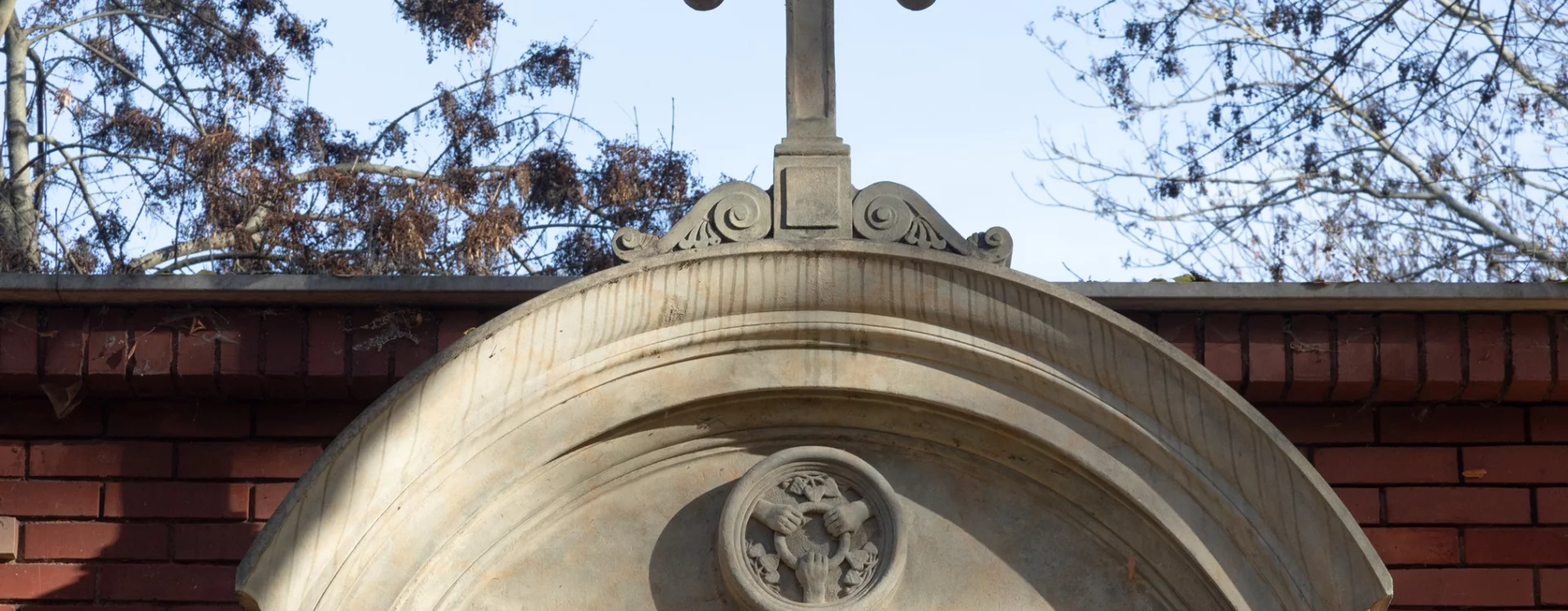
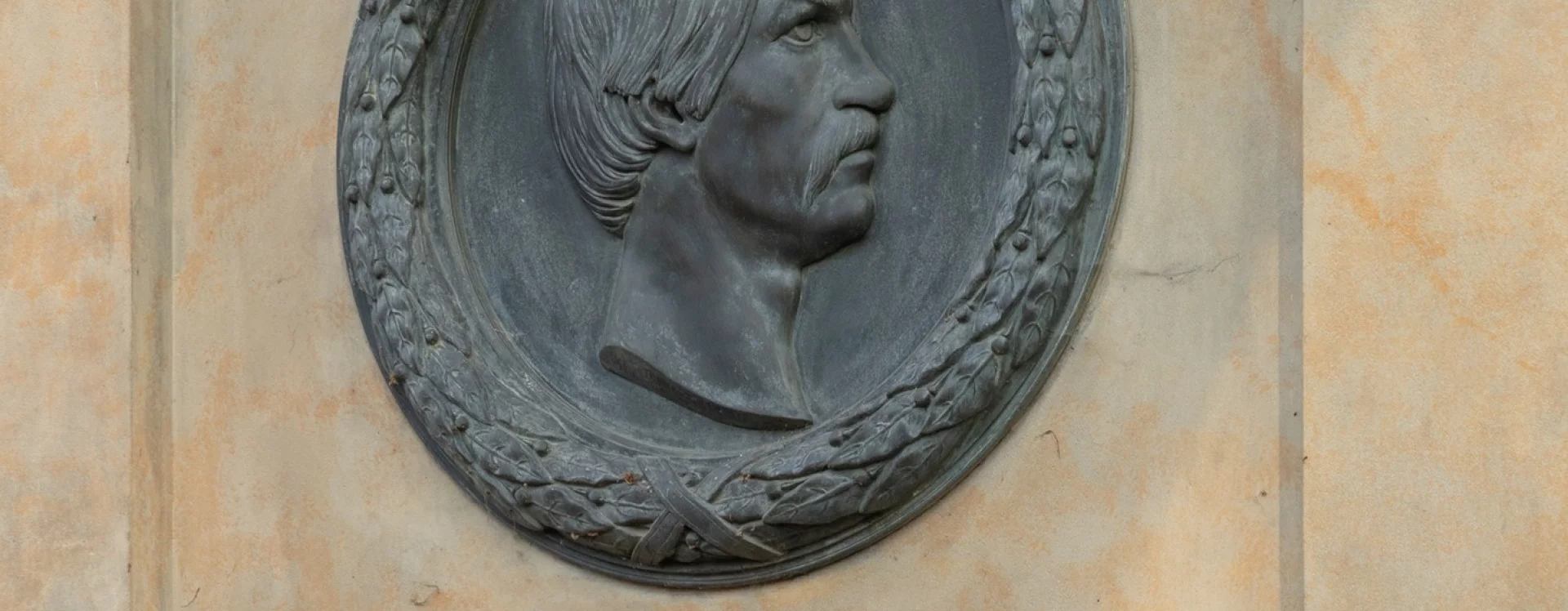
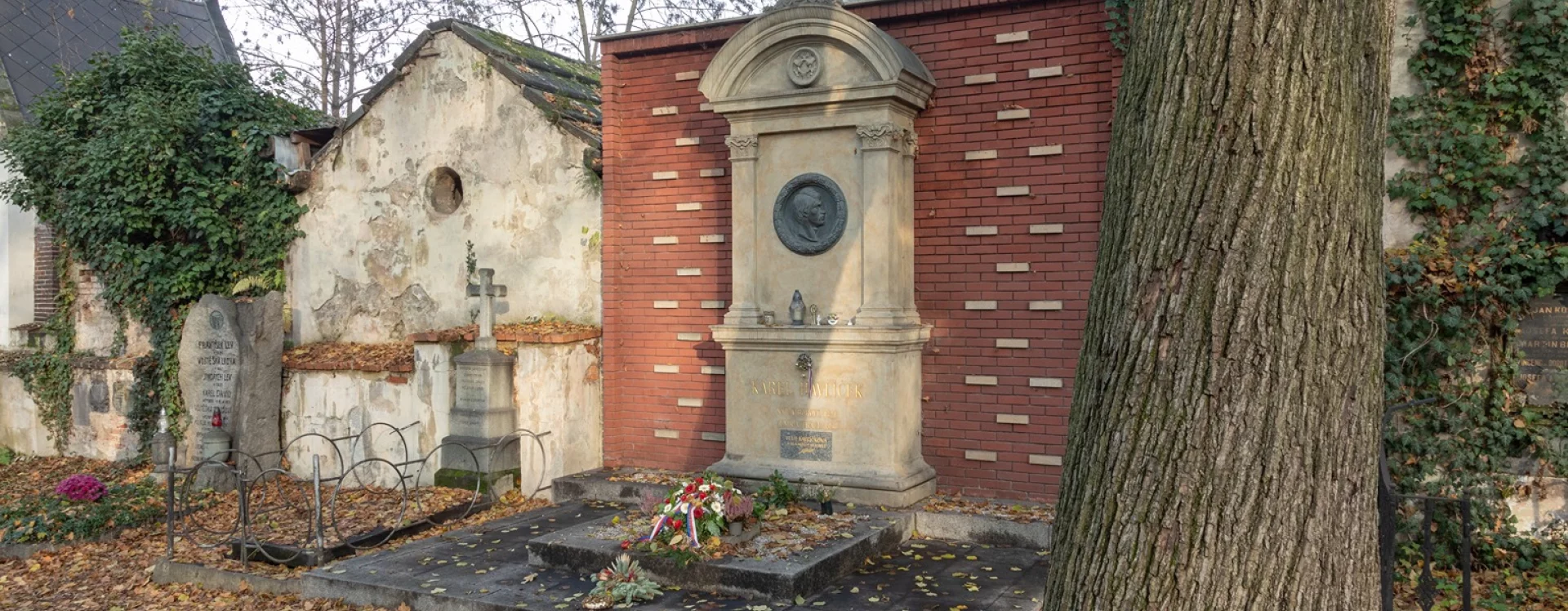
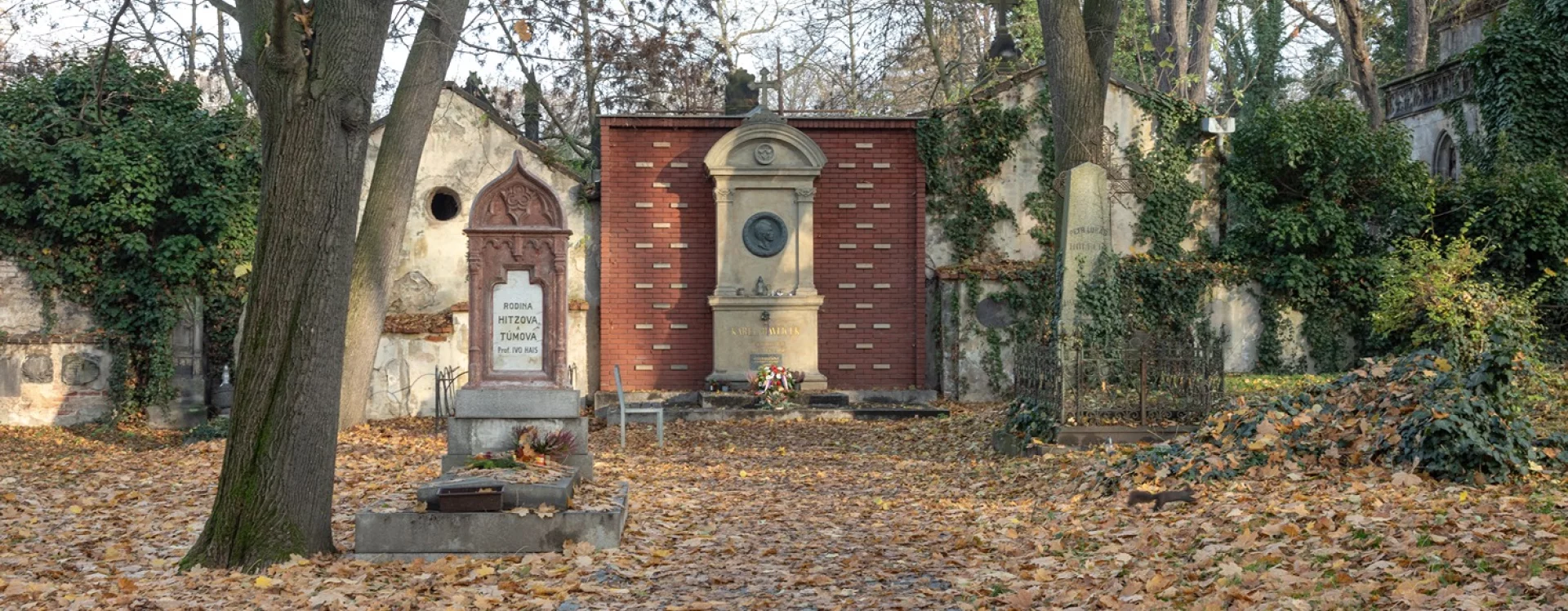
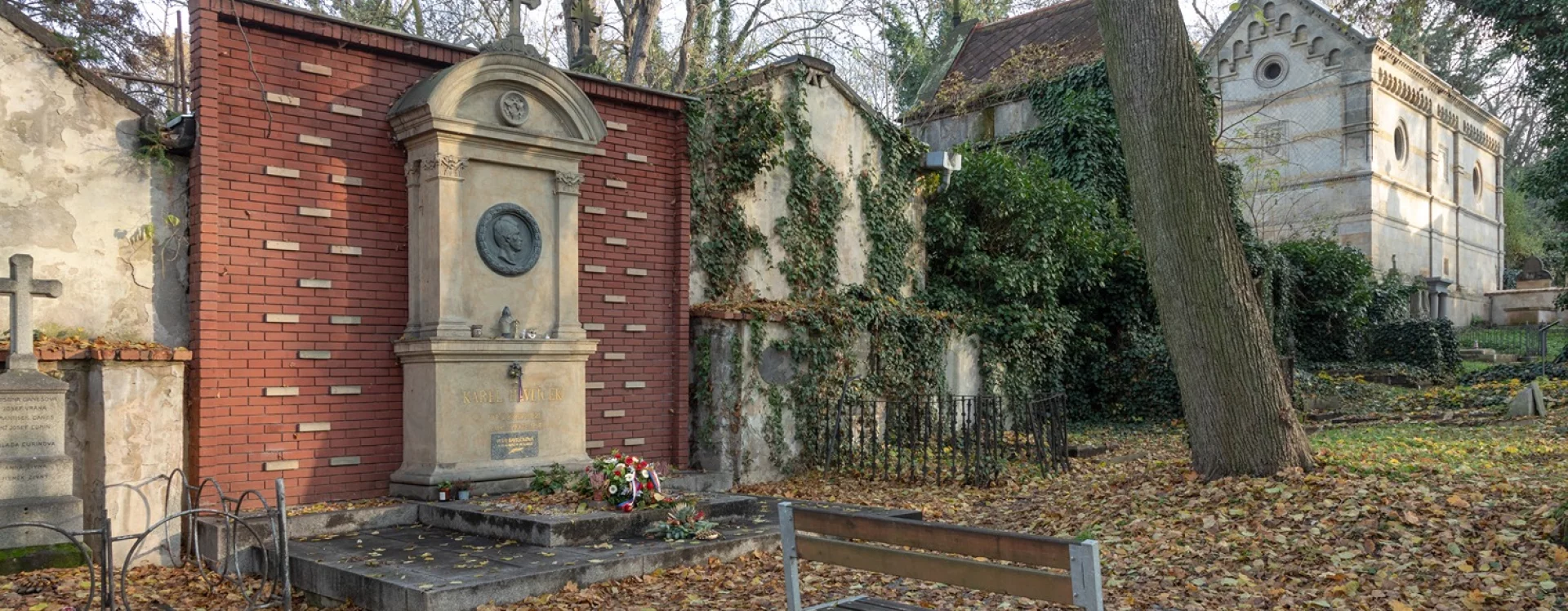
The crypt is covered by a large square slab, on top of which stands a tall stele made of Nehvizdy sandstone – a pedestal, a central panel featuring a likeness of the deceased, and an arched pediment crowned by a cloverleaf cross on top. Steles with pilasters or columns holding up pediments and resembling a portal or a gateway to the afterlife were a relatively popular type of Neorenaissance funerary architecture. Schnirch created a portrait of Havlíček on a bronze medallion decorated with a laurel wreath. He is depicted in profile with his typically unyielding expression and sharply defined features. In the funerary arts, laurel wreaths are used to honor important figures and to symbolize the resurrection of Christ and his triumph over death. The central section is flanked by two pilasters with Composite capitals adorned with acanthus and lime leaves. The latter are a reference to the Czech national tree as a symbol of the national revival. Lime leaves also decorate the emblem of the Svatobor association on the pediment: three hands holding a circle (the symbol of perfection and the eternal circle of life and death) accompanied by the slogan "Pomáhej! Osvěcuj! Pamatuj!" (Help! Enlighten! Remember!) The association's mission was to support Czech-language authors and to look after them posthumously by given them dignified graves, monuments, and memorial plaques. Besides building Havlíček's funerary monument, in 1925 Svatobor also succeeded in placing a memorial plaque on the house where he had lived in Brixen. The association is still active today, and its main activity is to administer Vyšehrad Cemetery.
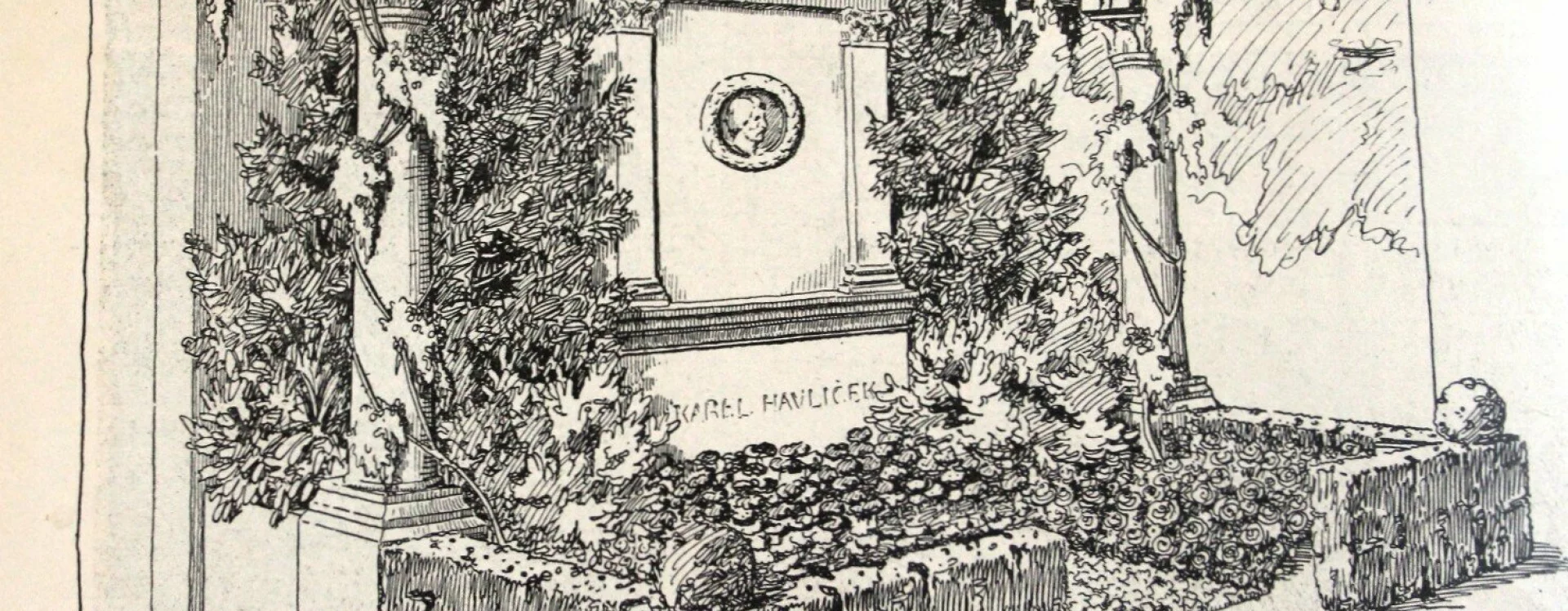
Ideas for further embellishing the grave marker first appeared in the early nineteenth century, either by adding a wall or through landscaping. Unrealized proposals include a Neorenaissance addition by the architect Prskavec and landscape architect J. Vaněk's proposal to expand the greenery around the crypt.
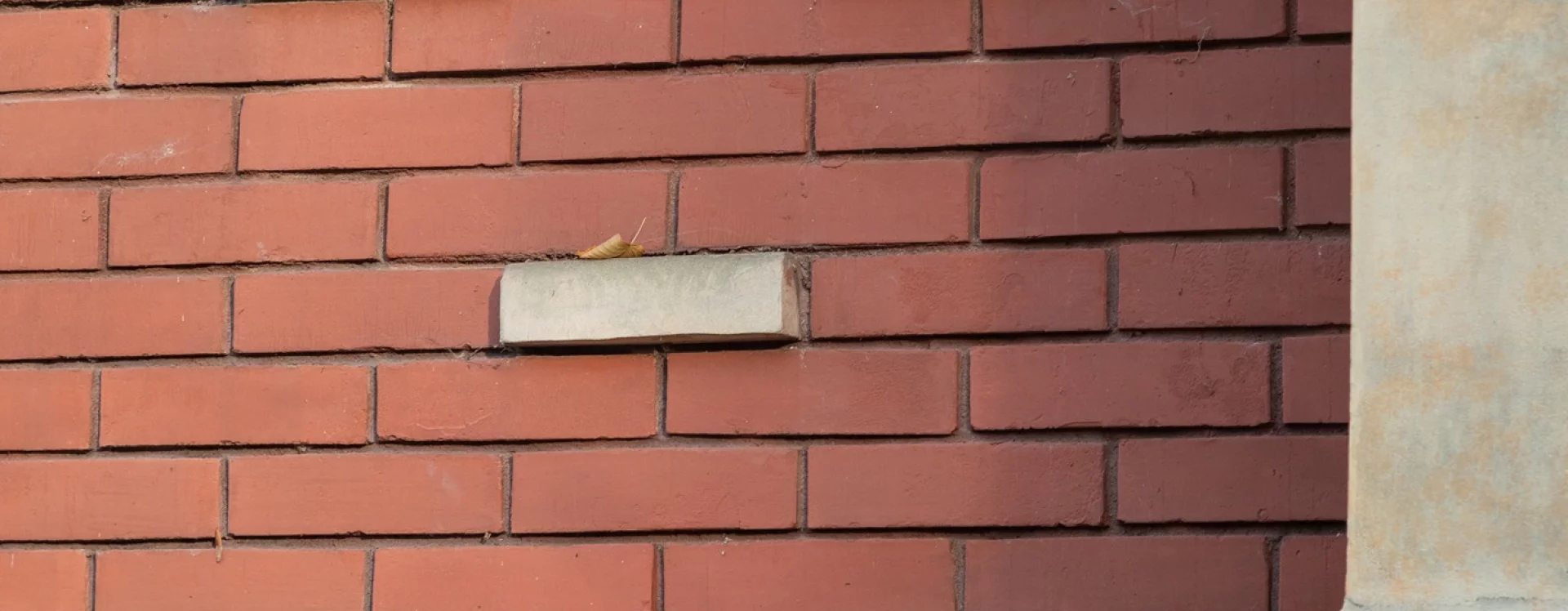
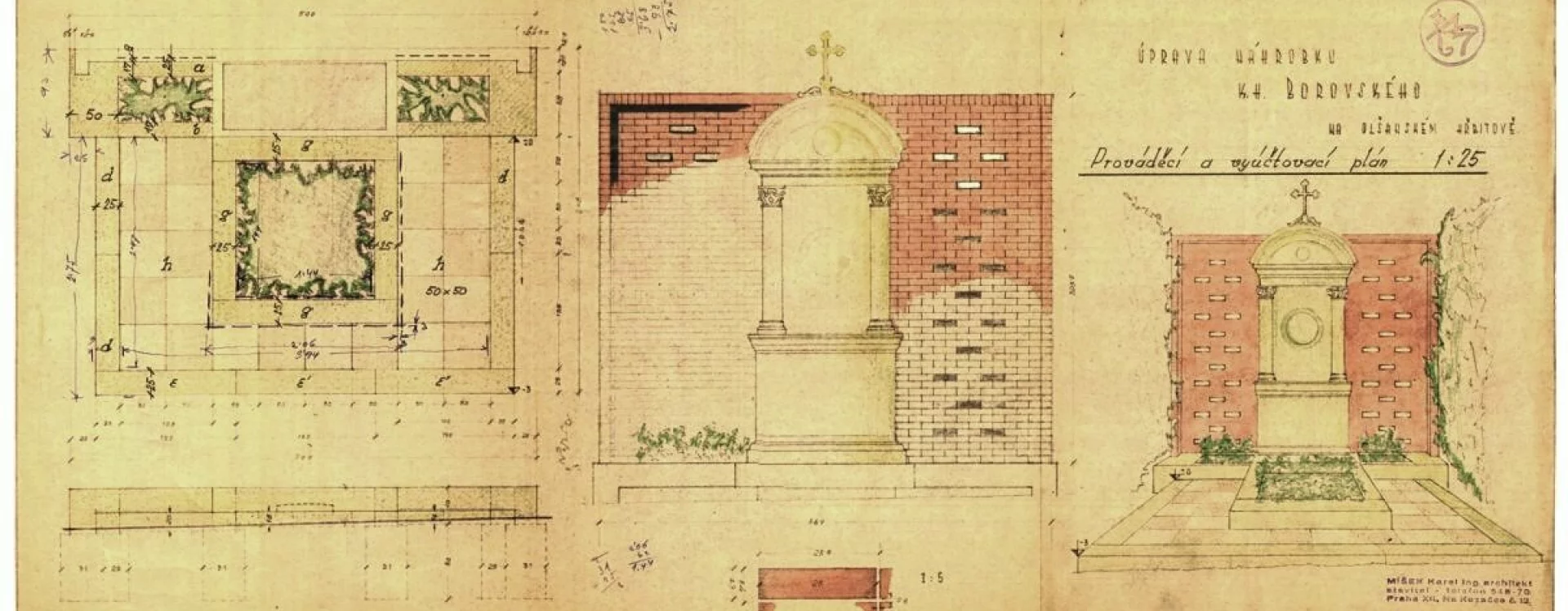
A relatively significant alteration was eventually undertaken in 1949, when a wall of red fair-faced bricks interspersed with white stones was built behind the grave according to plans by the architect Karel Míšek. The wall bears a striking strikingly resemblance to the facade of the nearby Church of the Sacred Heart by Jože Plečnik. It is not known, however, whether Míšek was directly influenced by Plečnik or was referencing his work.
The monument's most recent renovation was in 2014, when it was adopted by the town of Havlíčkův Brod.
Vladislava Holzapfelová, 2025
When he was buried here in 1856, his grave was marked by just a provisional plaque inscribed with the words "Karel Havlíček and his spouse Julie." In 1867, the Svatobor association hired the architect Josef Zítek, author of the National Theatre in Prague, to design a funerary monument, which was finally installed in 1870 after the association spent the intervening years constantly reminding the famous architect to complete his plans. As with Zítek's "Golden Chapel," the sculptural decoration was commissioned from Bohuslav Schnirch.
The crypt is covered by a large square slab, on top of which stands a tall stele made of Nehvizdy sandstone – a pedestal, a central panel featuring a likeness of the deceased, and an arched pediment crowned by a cloverleaf cross on top. Steles with pilasters or columns holding up pediments and resembling a portal or a gateway to the afterlife were a relatively popular type of Neorenaissance funerary architecture. Schnirch created a portrait of Havlíček on a bronze medallion decorated with a laurel wreath. He is depicted in profile with his typically unyielding expression and sharply defined features. In the funerary arts, laurel wreaths are used to honor important figures and to symbolize the resurrection of Christ and his triumph over death. The central section is flanked by two pilasters with Composite capitals adorned with acanthus and lime leaves. The latter are a reference to the Czech national tree as a symbol of the national revival. Lime leaves also decorate the emblem of the Svatobor association on the pediment: three hands holding a circle (the symbol of perfection and the eternal circle of life and death) accompanied by the slogan "Pomáhej! Osvěcuj! Pamatuj!" (Help! Enlighten! Remember!) The association's mission was to support Czech-language authors and to look after them posthumously by given them dignified graves, monuments, and memorial plaques. Besides building Havlíček's funerary monument, in 1925 Svatobor also succeeded in placing a memorial plaque on the house where he had lived in Brixen. The association is still active today, and its main activity is to administer Vyšehrad Cemetery.
Ideas for further embellishing the grave marker first appeared in the early nineteenth century, either by adding a wall or through landscaping. Unrealized proposals include a Neorenaissance addition by the architect Prskavec and landscape architect J. Vaněk's proposal to expand the greenery around the crypt.
A relatively significant alteration was eventually undertaken in 1949, when a wall of red fair-faced bricks interspersed with white stones was built behind the grave according to plans by the architect Karel Míšek. The wall bears a striking strikingly resemblance to the facade of the nearby Church of the Sacred Heart by Jože Plečnik. It is not known, however, whether Míšek was directly influenced by Plečnik or was referencing his work.
The monument's most recent renovation was in 2014, when it was adopted by the town of Havlíčkův Brod.
Vladislava Holzapfelová, 2025
Literature
Antonín Matějček. Národní divadlo a jeho tvůrci. Praha, 1953, s. 89.
Josef Šnejdar (a kol.). Národní divadlo. Praha, 1983, s. 33.
Vladimír Macura. Český sen. Praha, 1998, s. 119–128.
Jeronym Lány. Malostranský hřbitov v Košířích. Praha, 2001, s. 40.
Alios Vanoušek‒Vojtěch Grametbauer a kol.. Olšany, jak je neznáme. Praha, 2004, s. 33.
Gabriela Kalinová‒ Adam Hnojil a kol.. Malostranský hřbitov, historie a současnost. Praha, 2016, s. 120.
Jana Tischerová. Pražské hřbitovy, pohřebiště a sepulkrální památky. Praha, 2023, s. 94.