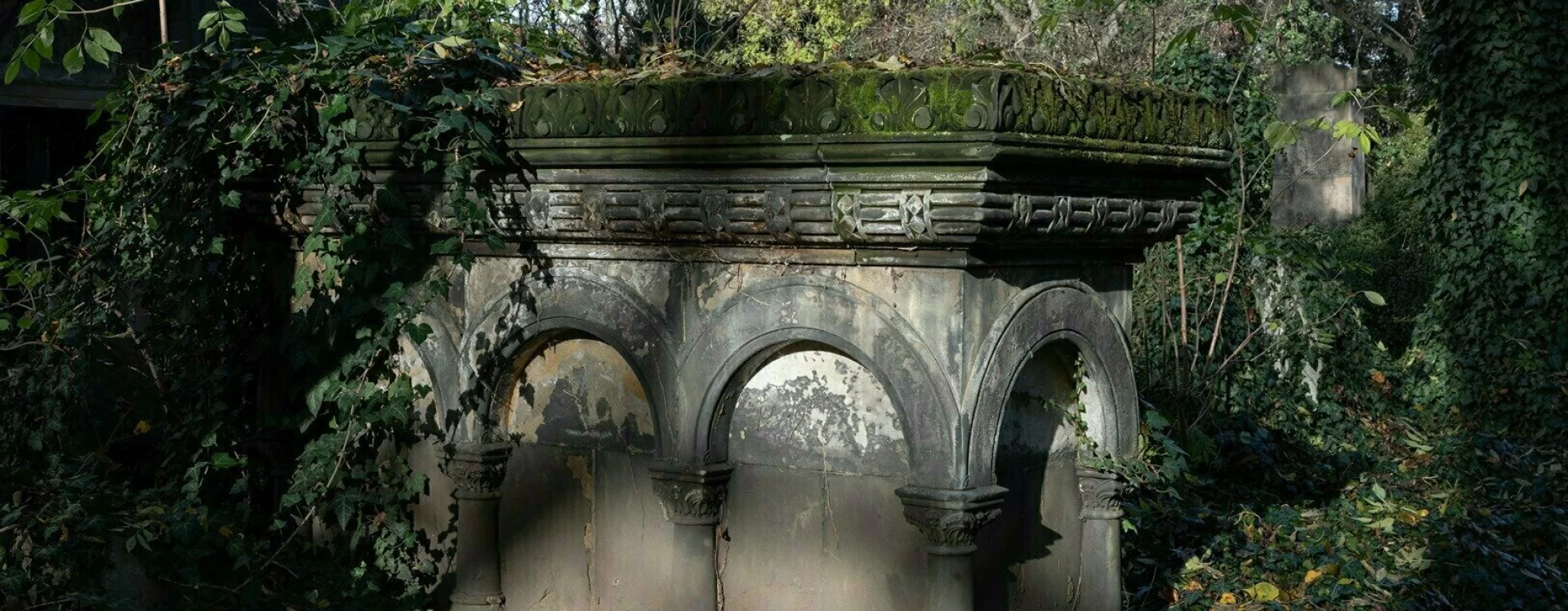
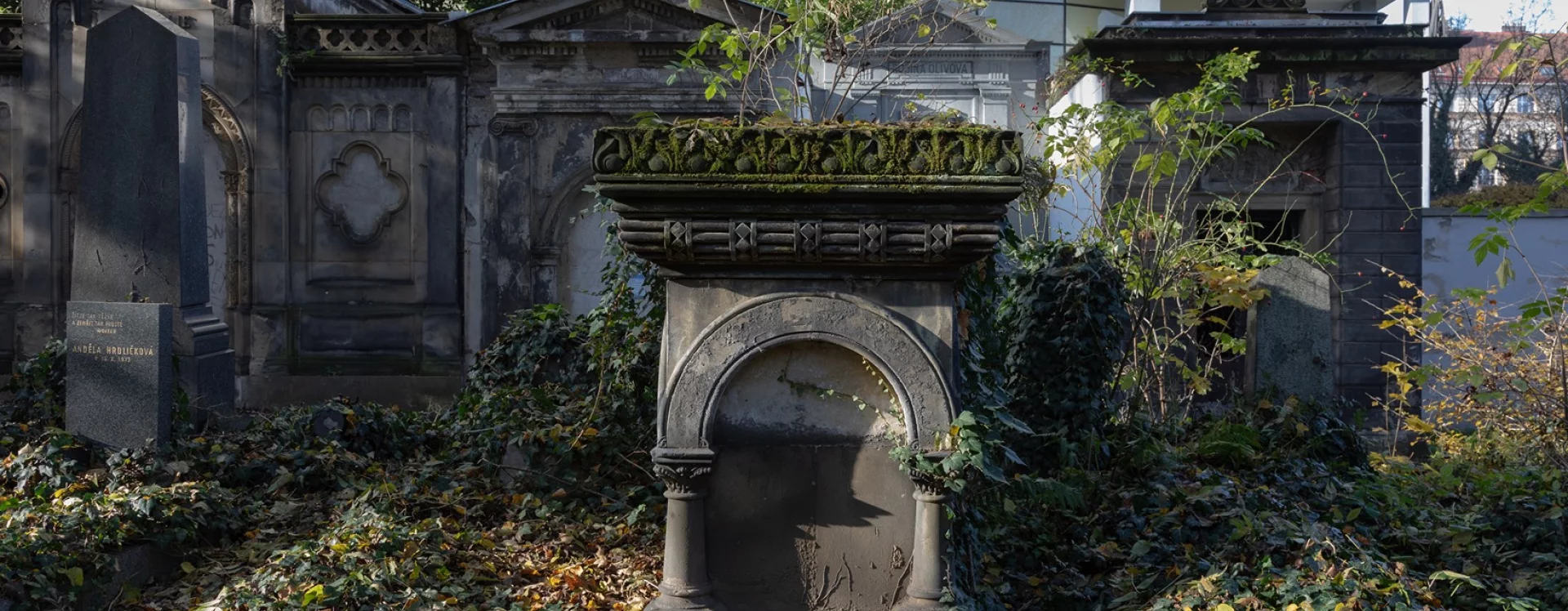
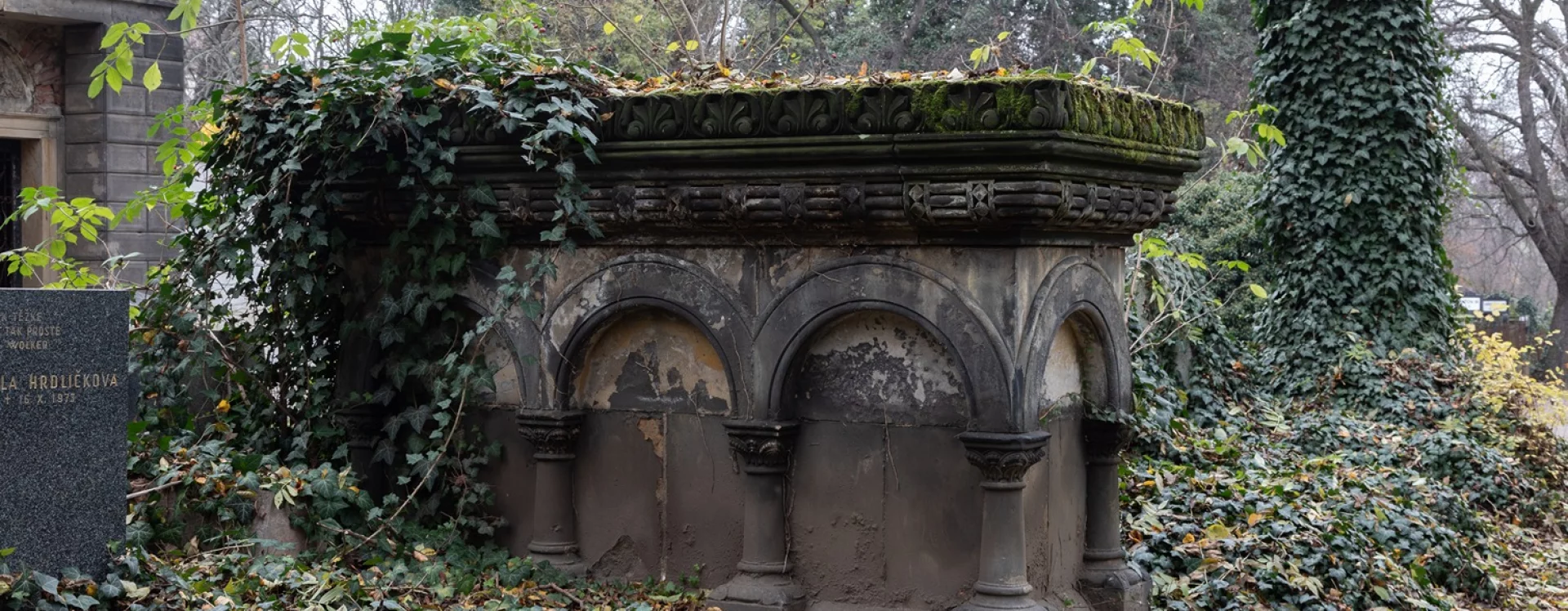
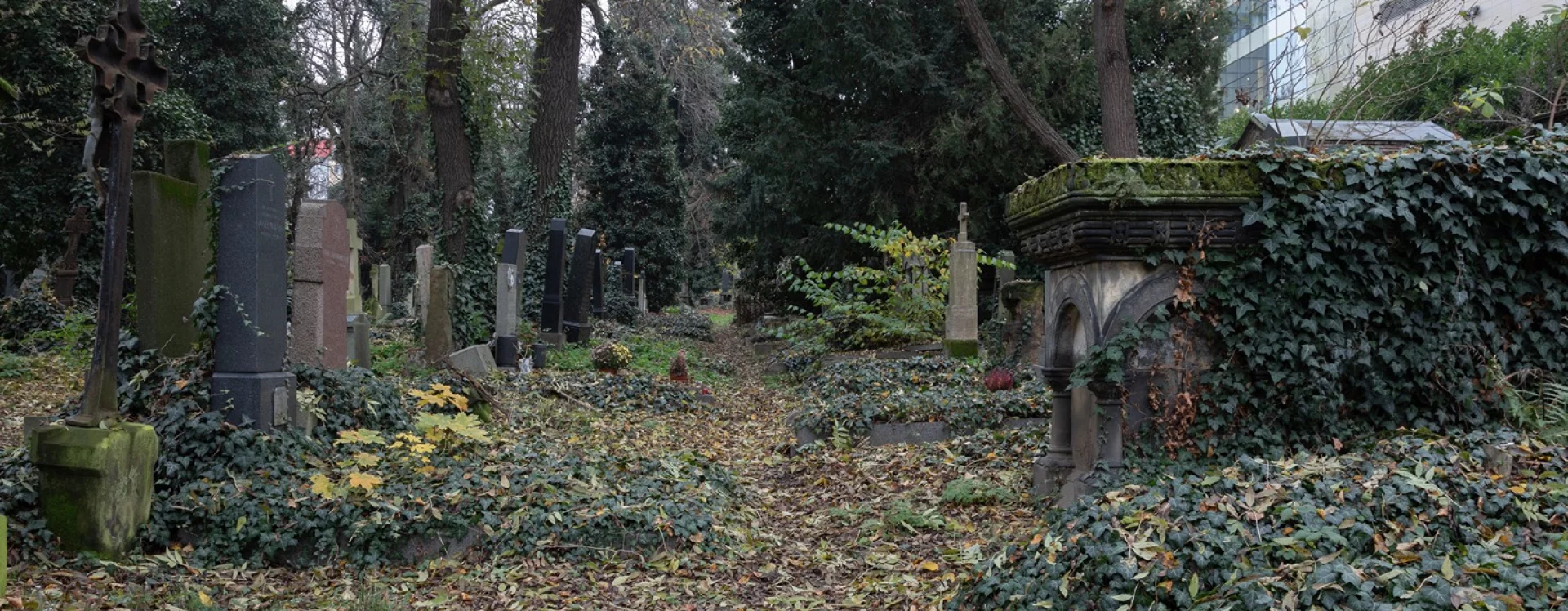
This never-used decorative tumba in the historicist style in Cemetery IV is the work of one of the era's most distinctive architects, Vojtěch Ignác Ullmann (1822–1897), who probably designed it and commissioned its creation. Ullmann designed many of the projects that helped to transform Prague into a modern metropolis, but a fateful turning point in his career came with the competition for the National Theatre, when the jury gave preference to the younger Josef Zítek. Ironically, several of Ullmann's projects had been built in the theater's immediate surroundings: the Provisional Theatre, the Lažanský Palace (today home to FAMU and Café Slavia), and today's Academy of Sciences, originally the Czech Savings Bank – noteworthy for its Neorenaissance exterior and its beautiful interior spaces with sculptural decoration by J. V. Myslbek. In terms of funerary works, Ullmann contributed significantly to the monumental double chapel tomb for the Lanna and Schebek families at Olšany, whose main architect was his brother-in-law Antonín Barvitius. The two worked on many projects together, they shared a similar sensibility, and both were fundamentally influenced by study tours of Italy.
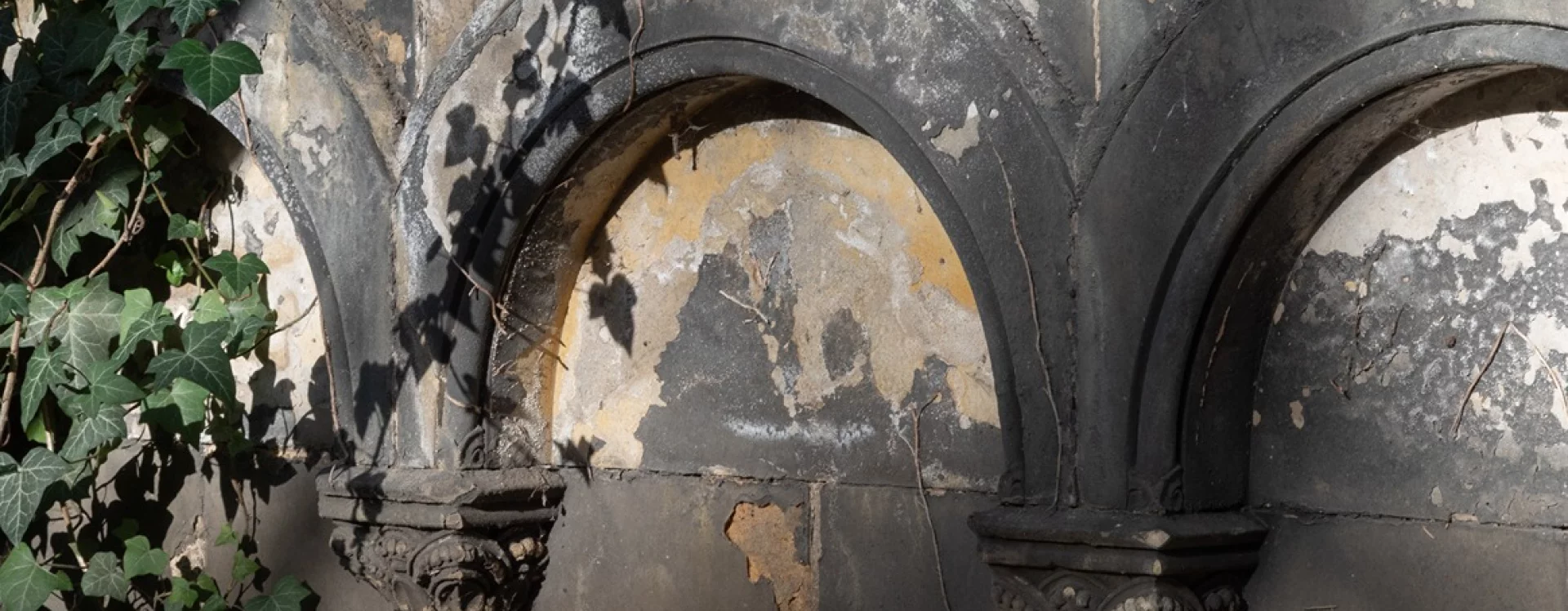
A tumba is a type of chest tomb or sarcophagus, a reference to Greek (derived from Egyptian) and later ancient Roman coffins. It generally does not contain the remains of the deceased, serving instead as a symbolic decoration of the place of final repose. This type of grave marker can be found repeatedly in eras that looked back to Antiquity for inspiration. It has remained somewhat uncommon in Bohemia, except perhaps in relation to royal or aristocratic graves. At Olšany one such sarcophagus can be found in the abolished Cemetery I (ca. 1830), and an even older example is the monument to the Russian officers who fell in the battle of 1813 (now in the Second Municipal Cemetery). The most ornate sarcophagus at Olšany, set on top of a massive plinth in the center of Cemetery IV, was designed by the architect Gutensohn for the Čermák family of physicians. It may well have inspired Ullmann's own grave marker – at least in the choice of this type, for the decorations are of his own design. Its dominant feature is a blind arcade of semicircular arches resting atop small columns with ornamental capitals and bases identical to the kind Ullmann used for the nearby grave of František Ladislav Čelakovský. The small sandstone structure is crowned by a palmette frieze.
When Ullmann also failed to win the competitions for the Rudolfinum and the National Museum, he withdrew into seclusion. He spent his final years at the chateau in Dubenec and with his daughter in nearby Příbram, where he died on 17 September 1897 and where he was also buried. Since he had leased the burial plot at Olšany "for the duration of the cemetery's existence" (as enabled by the burial laws of the time), the grave will forever remain empty.