


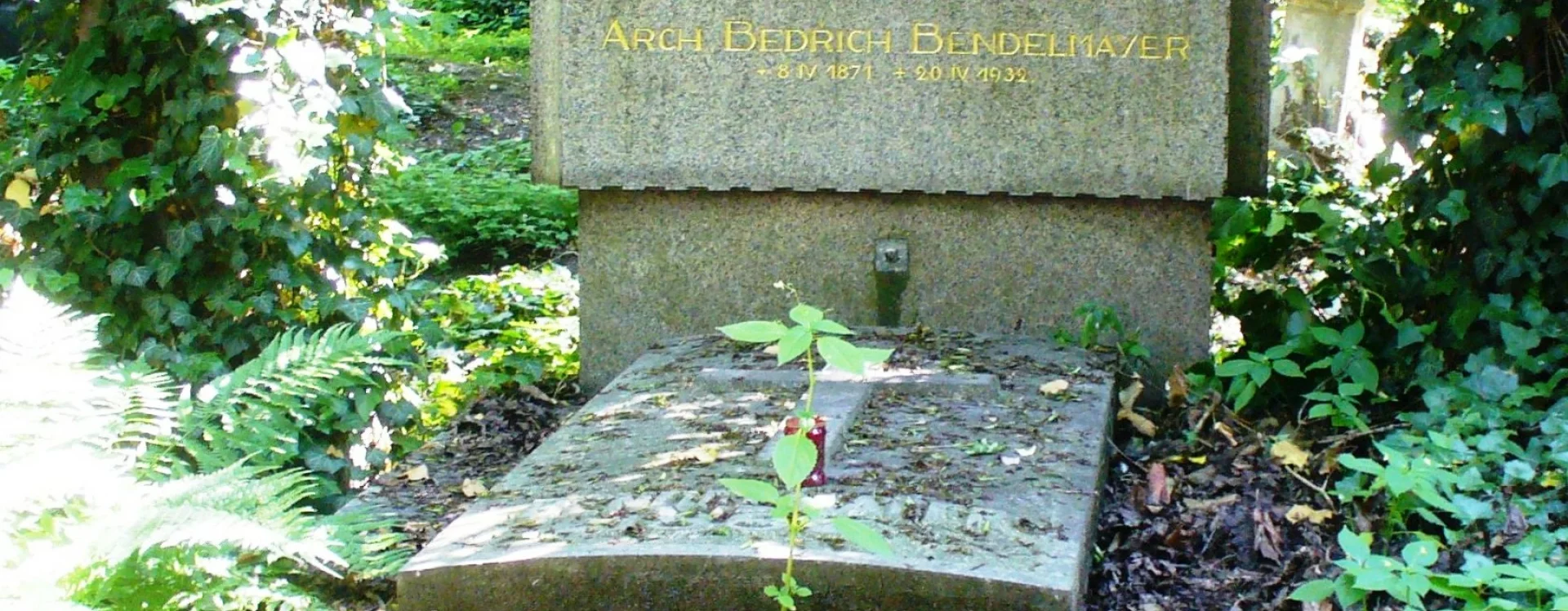
The Bendelmayer family grave feels monumental and modest at the same time, an impression resulting from the contrast between the original family grave from the nineteenth century and the modern, aesthetically refined stele added at a later date. The monument thus combines tradition with a modern architectural vocabulary.
The grave monument’s authorship cannot be confirmed by any source materials, but it is quite probably the work of Bedřich Bendelmayer. It was made after the death of his sixteen-year-old son Jan in 1929, and is dedicated to him. The inscription panel includes the names of other members of the family as well, including that of Bedřich Bendelmayer himself, who was buried here in 1932.
As an architect, Bendelmayer responded sensitively to the social and cultural changes of the late nineteenth and early twentieth centuries, masterfully transitioning from decorative Art Nouveau to geometric modernism and, around 1920, the stricter Neoclassicism – two styles in which he left a significant mark on Czech architecture. Strongly influenced by his teacher Friedrich Ohmann (1858–1927), Bendelmayer made inventive use of classical, Baroque, and Neoclassical influences, which he transmuted into a modern Art Nouveau language. His oeuvre thus perfectly illustrates the evolution of the Art Nouveau (Secession) style in the Czech lands. After initially making use of rich floral and geometric motifs, as with the Hotel U arcivévody Štěpána (today the Grandhotel Evropa, 1903–1905; co-authors: Quido Bělský, Bohumil Hübschmann, Jan Letzel, Alois Dryák), he later transitioned to a stricter geometric modernism (shopping and rental buildings on Anglická Street and Ve Smečkách Street, 1911–1913). His Palác Hvězda (Melantrich, 1911–1913) on Wenceslas Square is an example of Late Art Nouveau architecture. At the time, Bendelmayer’s buildings were considered radical. František Xaver Harlas (1865–1947) described the U Prašné brány apartment building, one of the first Art Nouveau projects in downtown Prague, as an “arrogantly repulsive neighbor” of the Neogothic Powder Tower and accused its author of “lacking artistic taste.” His critique is thus a perfect illustration of the era’s conflict between tradition and modernism. After the First World War, Bendelmayer abandoned Art Nouveau decorativism entirely and began to work in the spirit of monumental, sober Neoclassicism, a style which he applied to his public commissions in particular, among them the Czech Industrial Bank (1927–1933) on Na Příkopě Street.
The monument for the Bendelmayer family crypt is of a simple volumetric composition without excess ornamentation. Its visual impact derives from its balanced proportions and purity of form. The design consists of a massive stone block with three steps leading up to a tumba in the form of a rectangular slab with a sloping lid, plus a vertical stele with a semicircular top and a relief of a stylized golden cross inside a circle. Projecting from the front of the stele is an inscription panel with ornamentally indented borders and gilded carved lettering. The surface of the granite is finely dressed, with sharp edges and clear traces of manual working. The modernist part of the monument thus reflects first-rate stonemasonry work.
Hana Lamatová, 2025