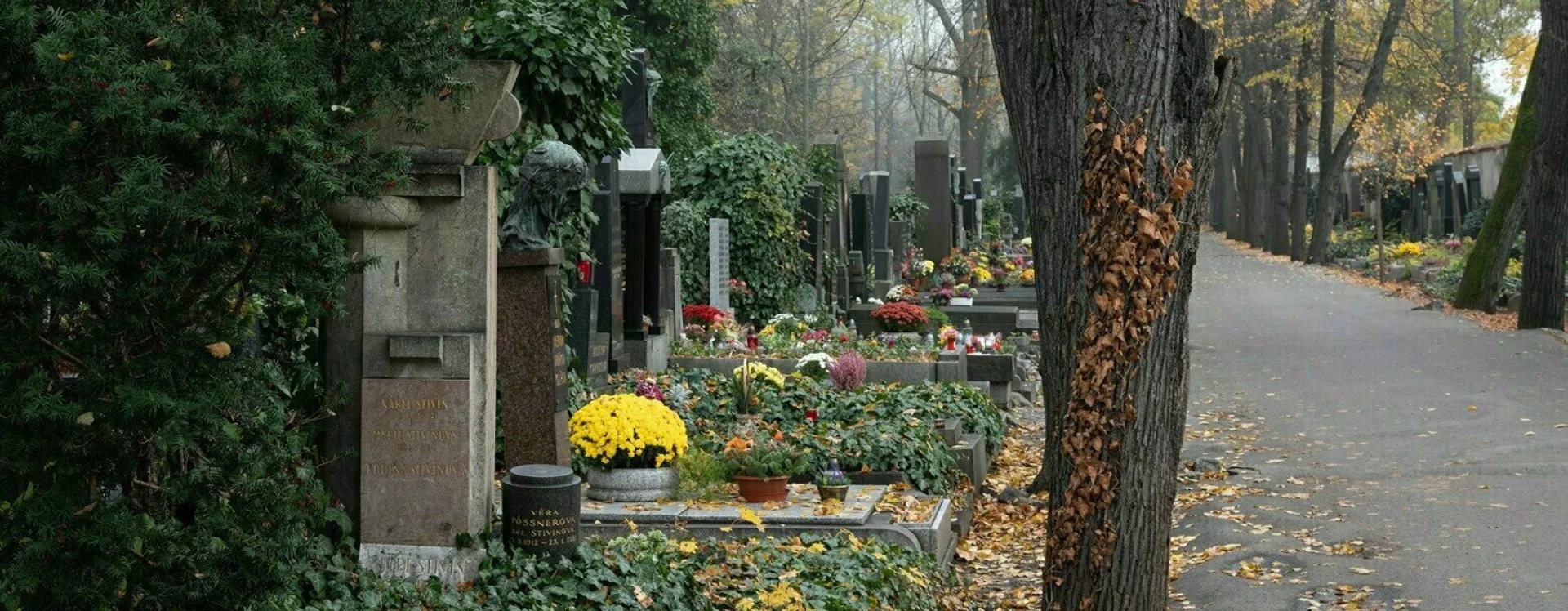
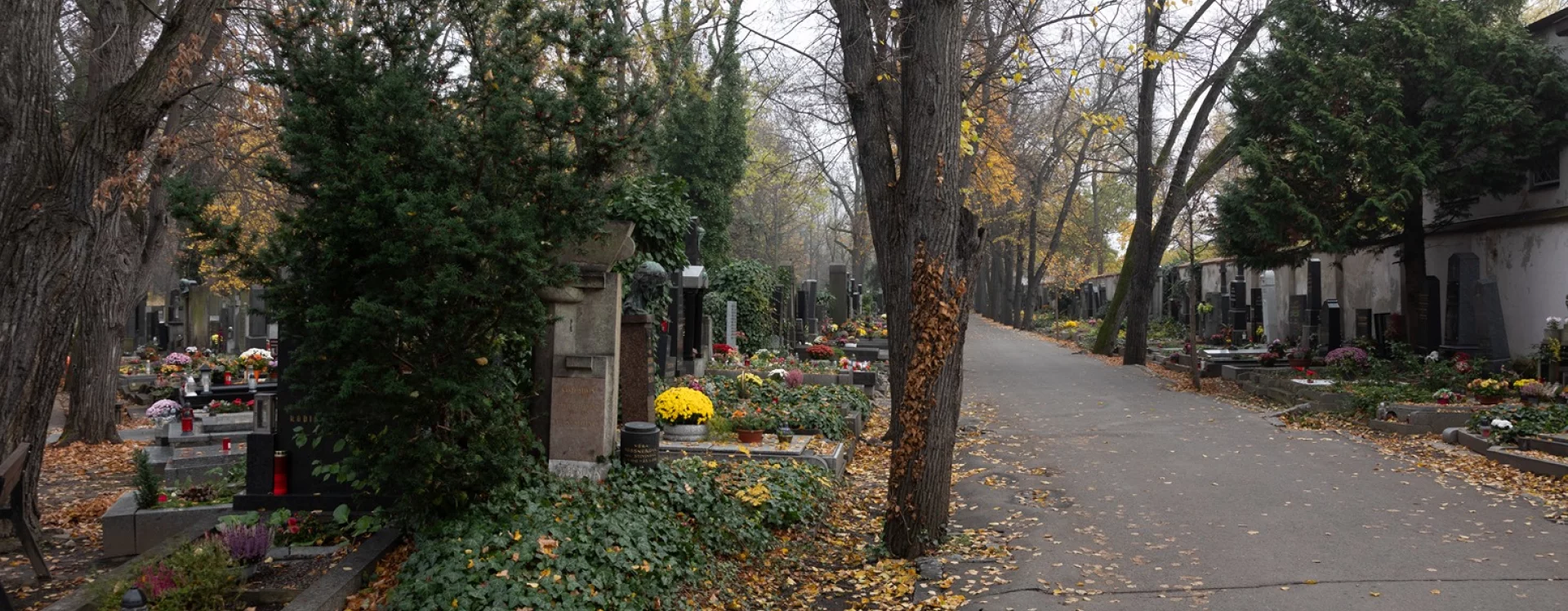
The circumstances under which the design for Karel Stivín's grave monument came about are not known. Pavel Janák was actively serving in the Austro-Hungarian army from February 1915 until the end of the war, although he was assigned unarmed duties after being injured in October 1915. It thus is possible that he worked with Josef Gočár on his visits to Prague. More importantly, as evidenced by his journal writings and sketches he may have used this time to consider his future direction in architecture. Many of Janák's drawings from this era are studies for various graves and monuments. A 1918 sketch shows Karel Stivín's grave monument realized that same year – although, as can be seen from a period photograph, in a slightly altered form.
The Prague builder Karel Stivín acquired a construction license in 1907. When he married in 1909, he was listed as a building official of the municipal building office in Prague. He is known to have designed and built the geometric Art Nouveau townhouse at Mickiewiczova Street 237/9 in Prague-Hradčany (1911).
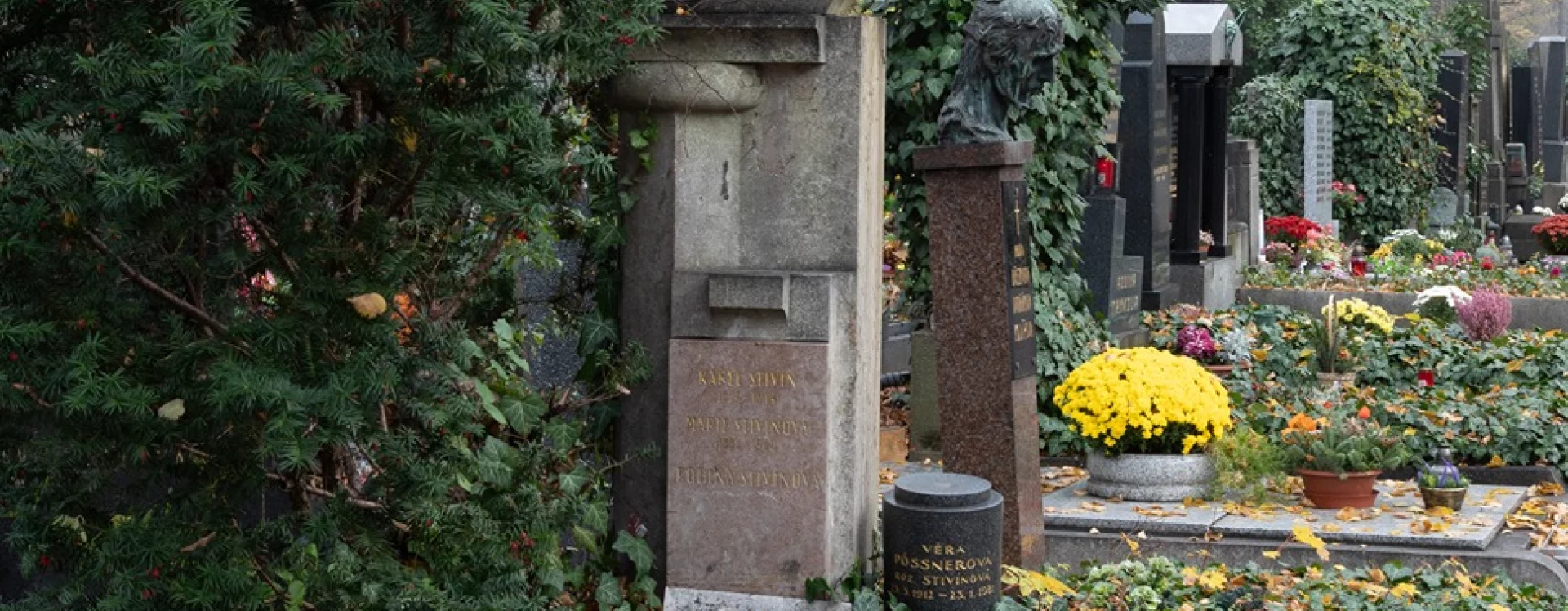
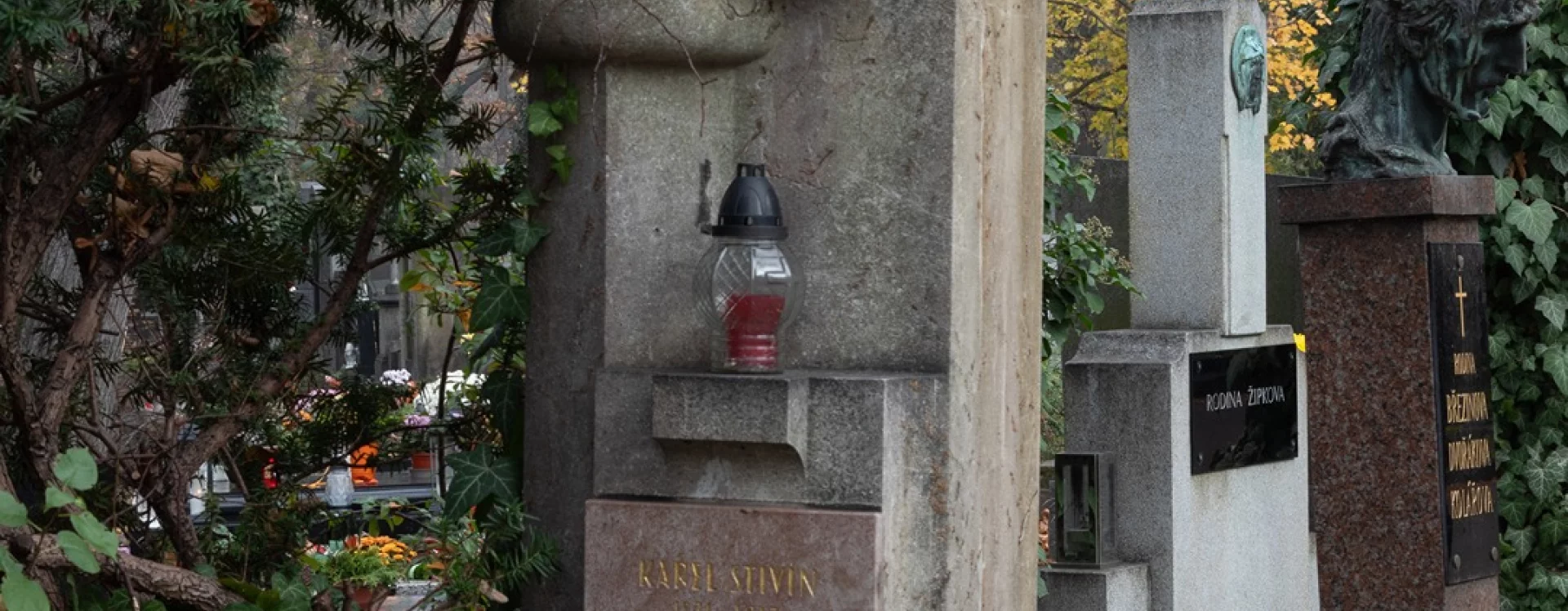
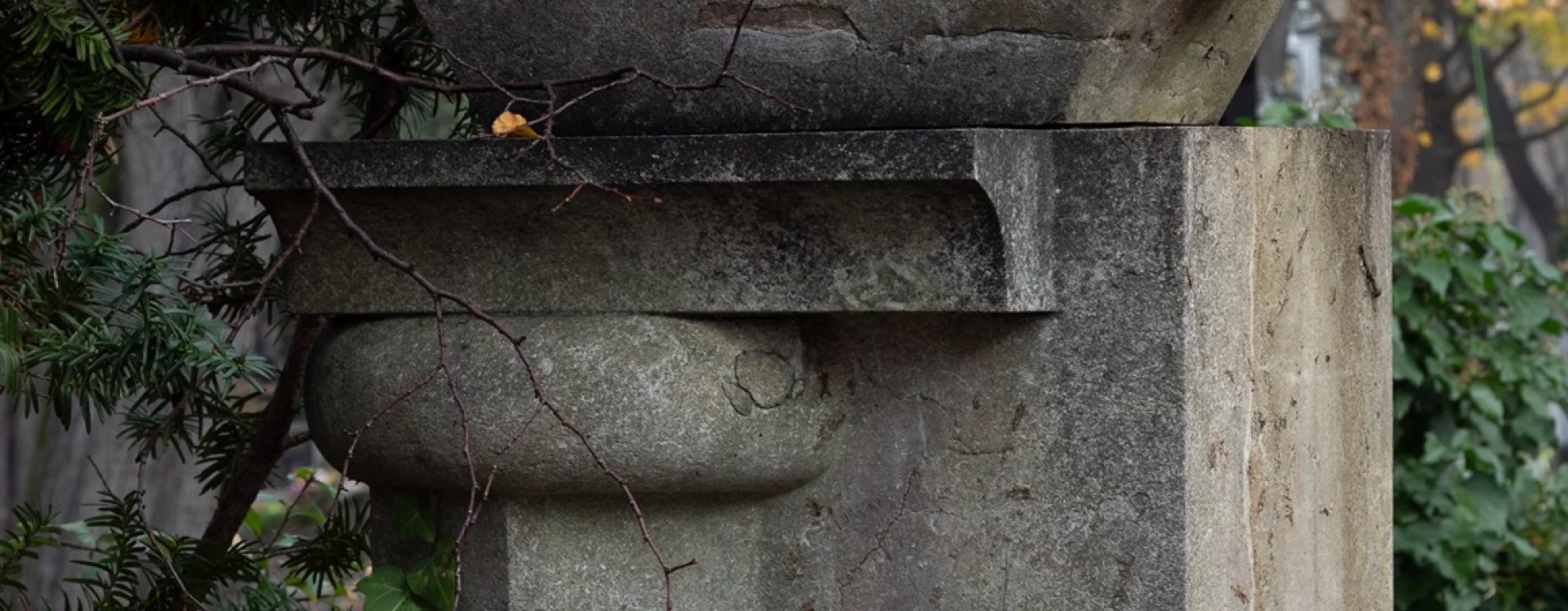
The design for Stivín's grave is evidence of Janák's gradual transition from Cubism toward the National Style. The grave is located on a prestigious corner plot facing the main gate. Instead of being architecturally rendered, the grave bed consists of a simple layer of soil originally planted with decorative hedges along the edges. At the head of the grave is a stone stele that, in terms of composition, still tends toward a Cubist deconstruction of volumes. It is essentially a loose arrangement of overlapping and interlocking architectural elements, meaning the rectangular stele itself (inspired by a Dorian half-column with a cushion capital holding up a cove-shaped cornice) and a lower, flat pilaster used as an inscription plaque that is similarly topped by a short piece of cavetto molding. Janák's choice of architectural elements was undoubtedly made with a view to the deceased's building profession. A surviving sketch of a more radically Purist design even shows a builder's square in place of the pilaster.
On top of the stele is a stone bowl with semicircular handles – a jardinière in the shape of a pyramid stood upside-down on its beveled tip that, in terms of form, recalls some of Janák's designs for porcelain cups.
The original inscription tablet with Cubist-inspired lettering has been covered by a new plaque. In more recent years, a stone urn was placed to the right of the stele; unfortunately, its dark color and polished surface do not match the original monument. It is not known when or why the stele's sculptural form was altered and the fluted half-column was reworked into a diagonally set pilaster.
Literature
Norbert Kiesling. Pavel Janák. Řevnice, 2011. s. 28–32, 73, 164.
Pavel Vlček, Pavel Zahradník et al.. Encyklopedie architektů, stavitelů, zedníků a kameníků v Čechách. Praha, 2023. s. 859.
Vendula Hnídková. Architekt Pavel Janák a idea kremační. In: Jiří Roháček (ed.), Epigraphica & Sepulcralia III. Praha, 2011. s. 91–102.
Sources
Archiv HPS, archiv pražských hřbitovů, složka Stivín IX, 2, 1.
Vladislava Holzapfelová, Funerální umění na vybraných pražských hřbitovech 1850–1950 (disertační práce), Ústav dějin křesťanského umění KTF UK, Praha 2016, s. 121n.