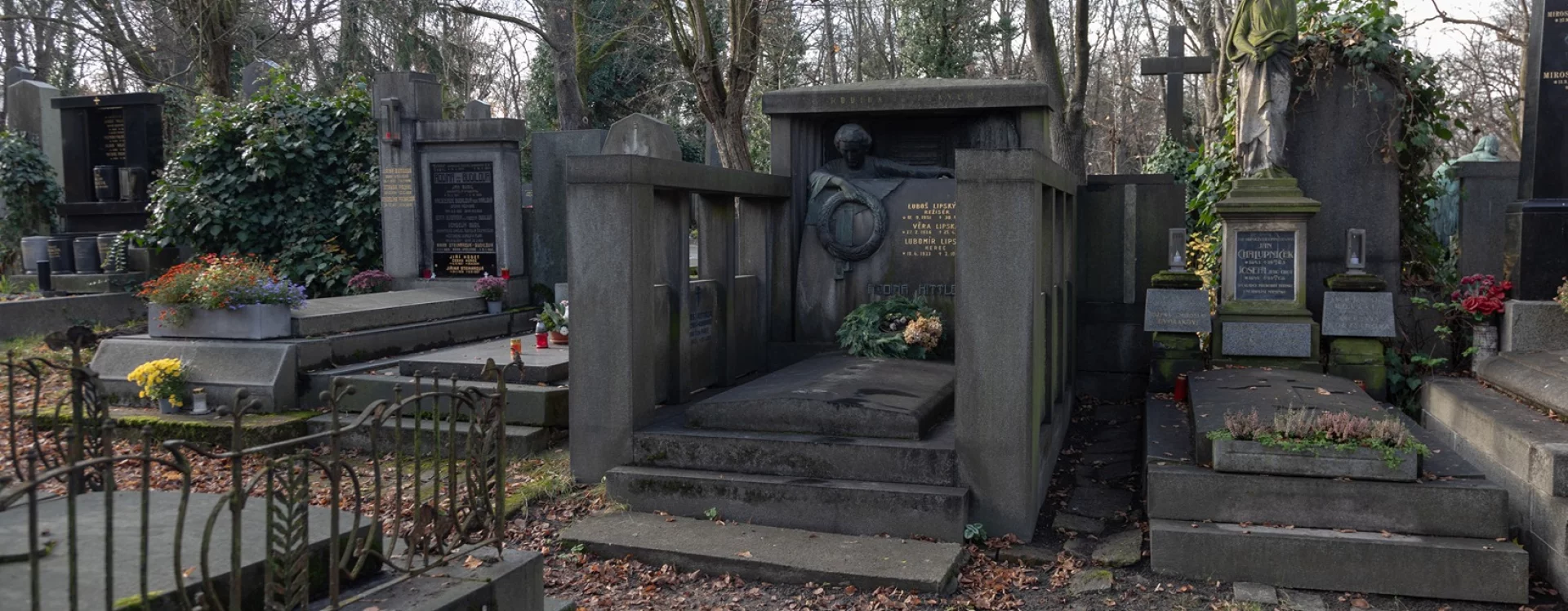
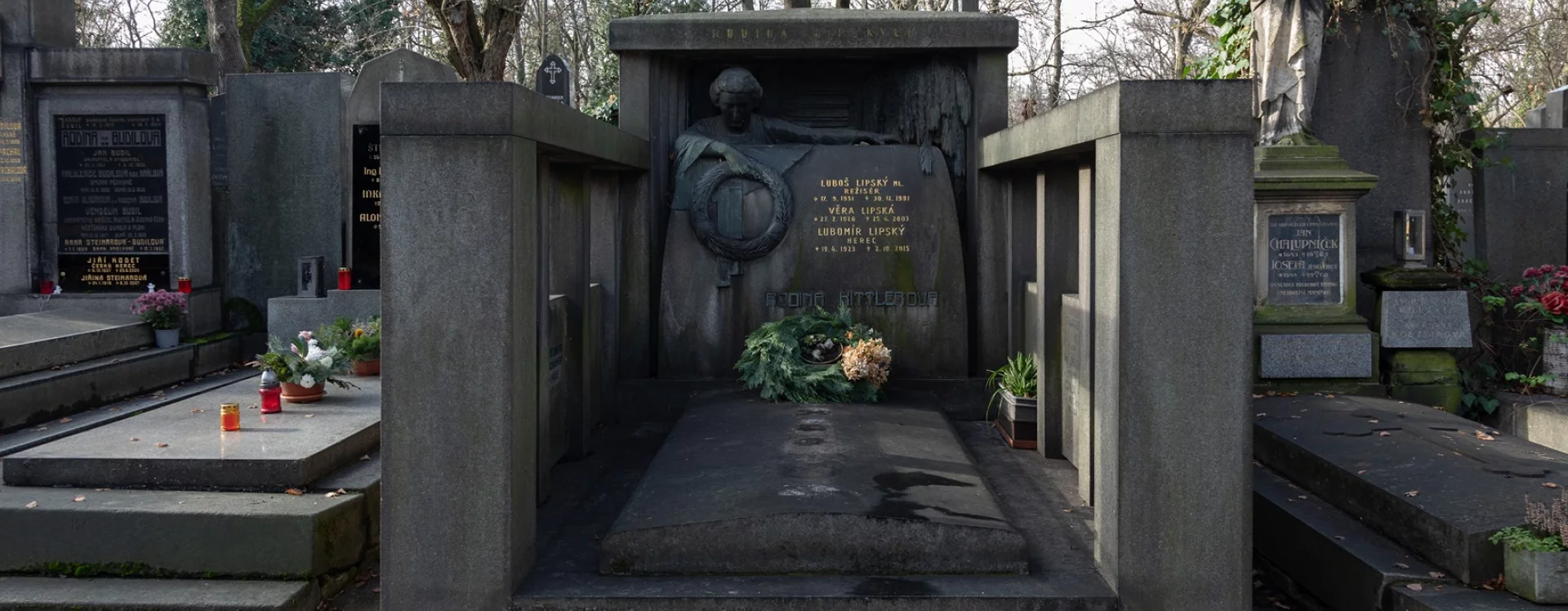
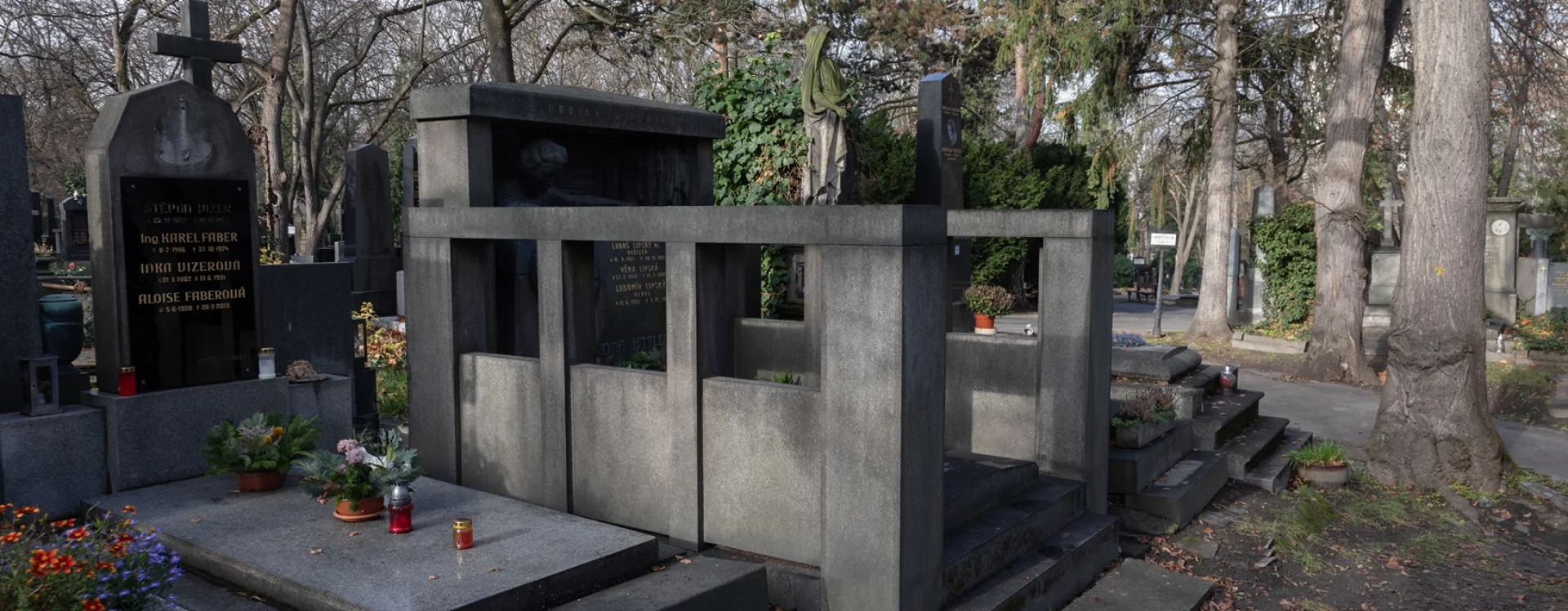
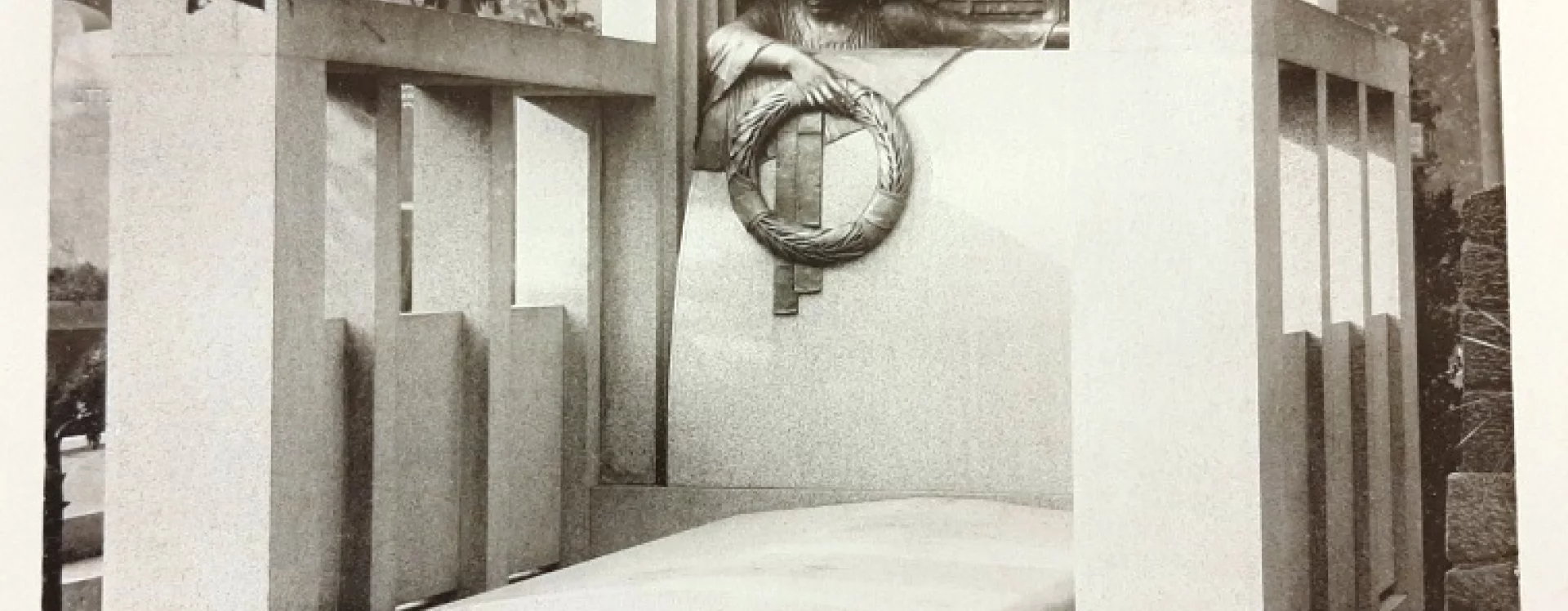
This grave monument was built by the wholesale merchant Franz Johan Brandeis (1875–1937) in 1908 after the death of his wife Karla Matylda (1871–1908). It was designed by the architect Bohumil Hübschmann (1878–1961) and executed in light gray granite by the stonemason František Kadeřábek.
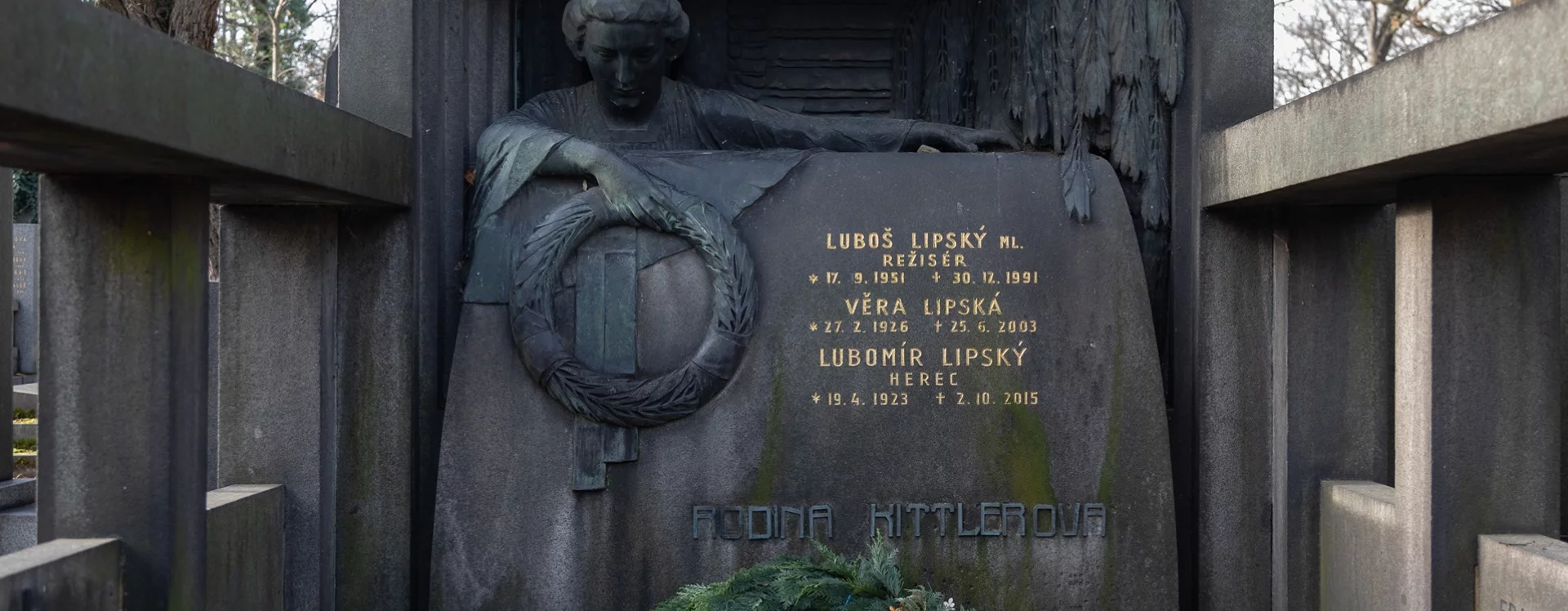
Using highly modern means, the Neoclassical design's colonnade suggestively alludes to the motif of a temple while also evoking a sense of intimacy in the semi-enclosed space above the simple ledger. This arrangement forms a kind of stone bed in front of a "window into the hereafter," through which gazes a mourning figure: a bronze statue of a woman leaning against the stele and looking down upon the crypt, her right hand holding a laurel wreath over flowing drapery. For this decorative element, the Dejvice sculptor Jaroslav Jindřích Vorel (1874–1936) drew on timeless symbolism: as a funerary symbol in Europe and elsewhere, the wreath is ascribed magical powers by virtue of its circular form signifying perfection and immortality. The floral decoration behind the female sculpture in the form of luxuriant bronze foliage reflects typical Art Nouveau themes while also contrasting with the refined simplicity of the architecture. The motif of a temple of death (or perhaps a celebration of life after death) is further emphasized by the classicist roof.
Hübschmann designed the grave in 1908, when he was already working independently in his own studio. At the time, he was also drafting plans for the Pavilion of Foodstuffs and Comestibles for the Jubilee Exhibition in Prague. The sculptor Vorel studied under professors Klouček and Myslbek at the School of Applied Arts and subsequently gained practical experience in the studios of Sucharda and Maudr. He mainly did restoration work and specialized in figural decorations for the facades of public and private buildings in Prague and elsewhere. He became acquainted with Oriental motifs while working on the palace of King Menelik of Ethiopia. The lower part of the monument was done by the stonemason Jan Rada, while the crypt's underground masonry was by the master mason František Jaroš. The stonemason-sculptor František Kadeřábek (1876–1940), who took on the task of realizing the prestigious aboveground parts, owned a company in Smíchov. Among other things, he collaborated with František Bílek on monuments for Václav Beneš Třebízský and Viktor Nečas and also did the monument of journalist A. P. Veselý. His work can be found above all at Žižkov's New Jewish Cemetery. Many of the monuments were made using granite from Kadeřábek's quarry at Chlum near Sedlčany.
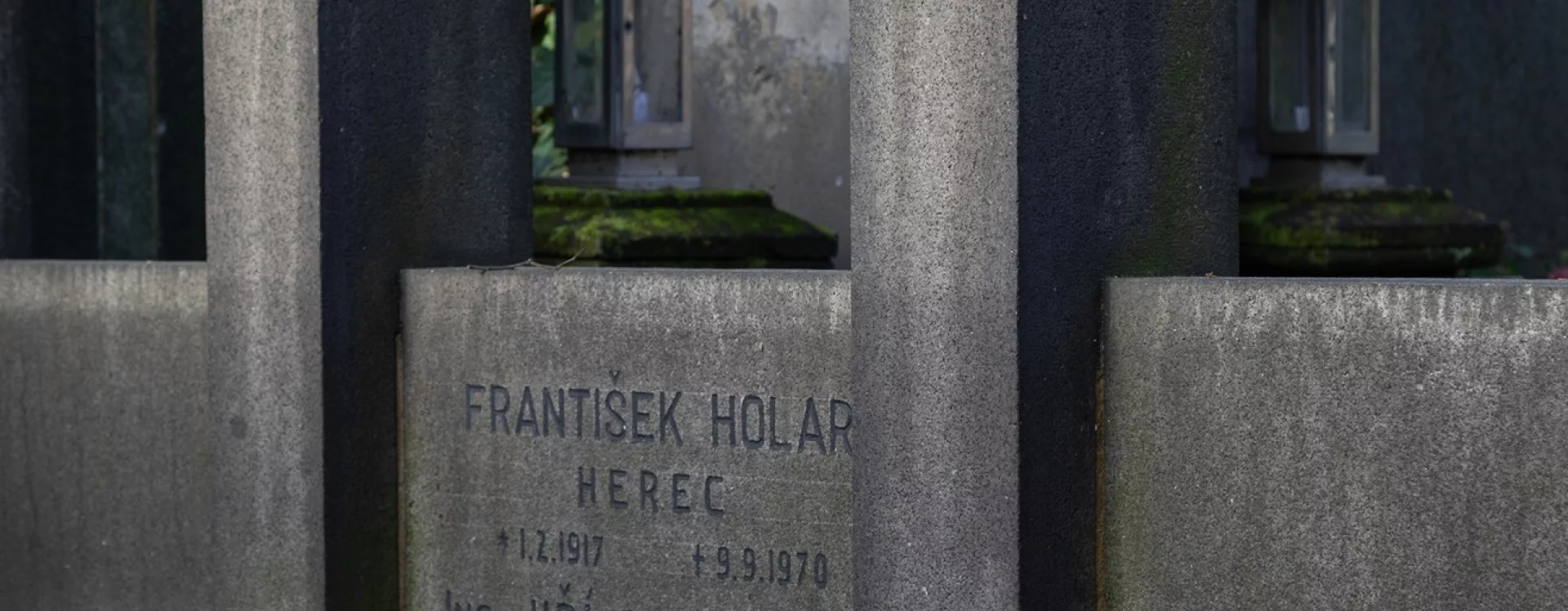
In the late 1950s, the crypt passed into the possession of a family of actors. Buried here are the actor František Holar (1917–1970) and his wife, the actress and director Sonja (née Kittlerová, 1924–1994), sister of Věra Lipská. At the front of the stele are the names of members of the family of Lubomír Lipský, a beloved actor at the Prague Municipal Theatres. The first name is that of his tragically deceased son, followed by his wife and then Lipský himself.
The lower bronze inscription reading RODINA KITTLEROVA (Kittler Family) imitates the style of the original inscriptions of the Brandeis family.
Anna Oplatková – Kateřina Lopatová, 2025
Using highly modern means, the Neoclassical design's colonnade suggestively alludes to the motif of a temple while also evoking a sense of intimacy in the semi-enclosed space above the simple ledger. This arrangement forms a kind of stone bed in front of a "window into the hereafter," through which gazes a mourning figure: a bronze statue of a woman leaning against the stele and looking down upon the crypt, her right hand holding a laurel wreath over flowing drapery. For this decorative element, the Dejvice sculptor Jaroslav Jindřích Vorel (1874–1936) drew on timeless symbolism: as a funerary symbol in Europe and elsewhere, the wreath is ascribed magical powers by virtue of its circular form signifying perfection and immortality. The floral decoration behind the female sculpture in the form of luxuriant bronze foliage reflects typical Art Nouveau themes while also contrasting with the refined simplicity of the architecture. The motif of a temple of death (or perhaps a celebration of life after death) is further emphasized by the classicist roof.
Hübschmann designed the grave in 1908, when he was already working independently in his own studio. At the time, he was also drafting plans for the Pavilion of Foodstuffs and Comestibles for the Jubilee Exhibition in Prague. The sculptor Vorel studied under professors Klouček and Myslbek at the School of Applied Arts and subsequently gained practical experience in the studios of Sucharda and Maudr. He mainly did restoration work and specialized in figural decorations for the facades of public and private buildings in Prague and elsewhere. He became acquainted with Oriental motifs while working on the palace of King Menelik of Ethiopia. The lower part of the monument was done by the stonemason Jan Rada, while the crypt's underground masonry was by the master mason František Jaroš. The stonemason-sculptor František Kadeřábek (1876–1940), who took on the task of realizing the prestigious aboveground parts, owned a company in Smíchov. Among other things, he collaborated with František Bílek on monuments for Václav Beneš Třebízský and Viktor Nečas and also did the monument of journalist A. P. Veselý. His work can be found above all at Žižkov's New Jewish Cemetery. Many of the monuments were made using granite from Kadeřábek's quarry at Chlum near Sedlčany.
In the late 1950s, the crypt passed into the possession of a family of actors. Buried here are the actor František Holar (1917–1970) and his wife, the actress and director Sonja (née Kittlerová, 1924–1994), sister of Věra Lipská. At the front of the stele are the names of members of the family of Lubomír Lipský, a beloved actor at the Prague Municipal Theatres. The first name is that of his tragically deceased son, followed by his wife and then Lipský himself.
The lower bronze inscription reading RODINA KITTLEROVA (Kittler Family) imitates the style of the original inscriptions of the Brandeis family.
Anna Oplatková – Kateřina Lopatová, 2025
Literature
Kunstleriche Grabdenkmale, Moderne architektur & Plastik von Friedhofen und Kirchen in Oesterreich Ungarn, serie 7. Wien. 1905, s. 211.
František Sekanina ed.. Album representantů všech odborů veřejného života československého. Praha, 1927, s. 976.
Rostislav Švácha. Od moderny k funkcionalismu. Praha, 1985, s. 166.
Anděla Horová ed.. Nová encyklopedie výtvarného umění, Dodatky. Praha, 2000, s. 833.
Jakub Potůček ed.. Osobnosti a památky Prahy 10. Praha, 2014, s. 10, 30.
Pavel Vlček, Pavel Zahradník a kolektiv. Encyklopedie architektů, stavitelů, zedníků a kameníků v Čechách, 2. rozšířené vydání. Praha, 2023, s. 340-341.
Jana Tischerová. Pražské hřbitovy, pohřebiště a sepulkrální památky. Praha, 2023, s. 73, 100, 591, 594.