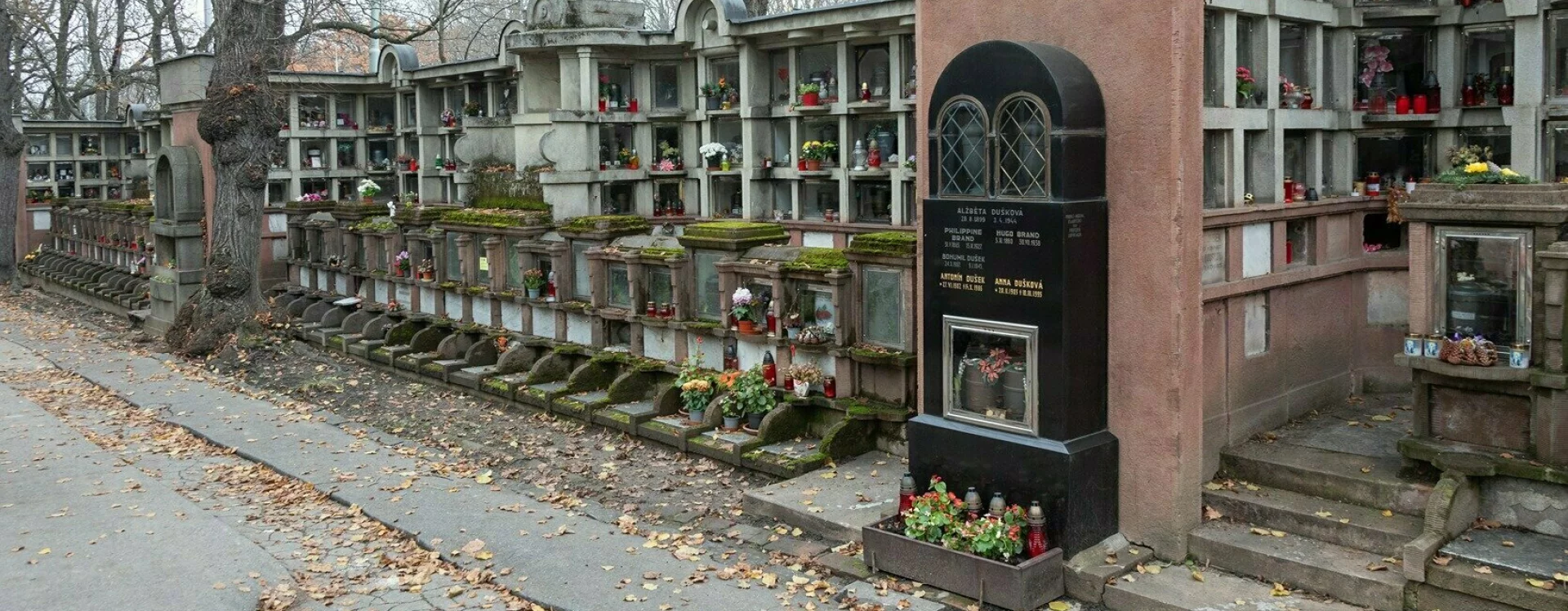
At Olšany, we can find two remarkable works by the important, though today somewhat forgotten, architect Paul Albert Kopetzky: the grave marker of the Frankenstein family (IX, 1, 339) and the urn gravestone of the Dušek and Brand families. For both of these funerary commissions, Kopetzky collaborated with the stonemasonry company of Ludvík Šalda. Voth were made in the second half of the 1920s, and both were for clients from Prague's Jewish community. Besides being evidence of the high level of assimilation of local Jews, they thus also reflect the significant changes in burial practice that occurred with the advent of the modern era and the establishment of an independent Czechoslovak Republic. Burial practices had long been determined by the Catholic Church, with banned cremations and only allowed members of the Catholic faith to be buried in its cemeteries. The first change came in the late nineteenth century, when Olšany was expanded to include areas for non-Catholics. The legalization of cremation after Czechoslovak independence had an enormous impact of the evolution of the funerary arts. This new era saw the construction of crematoria, columbaria, and urn gardens.
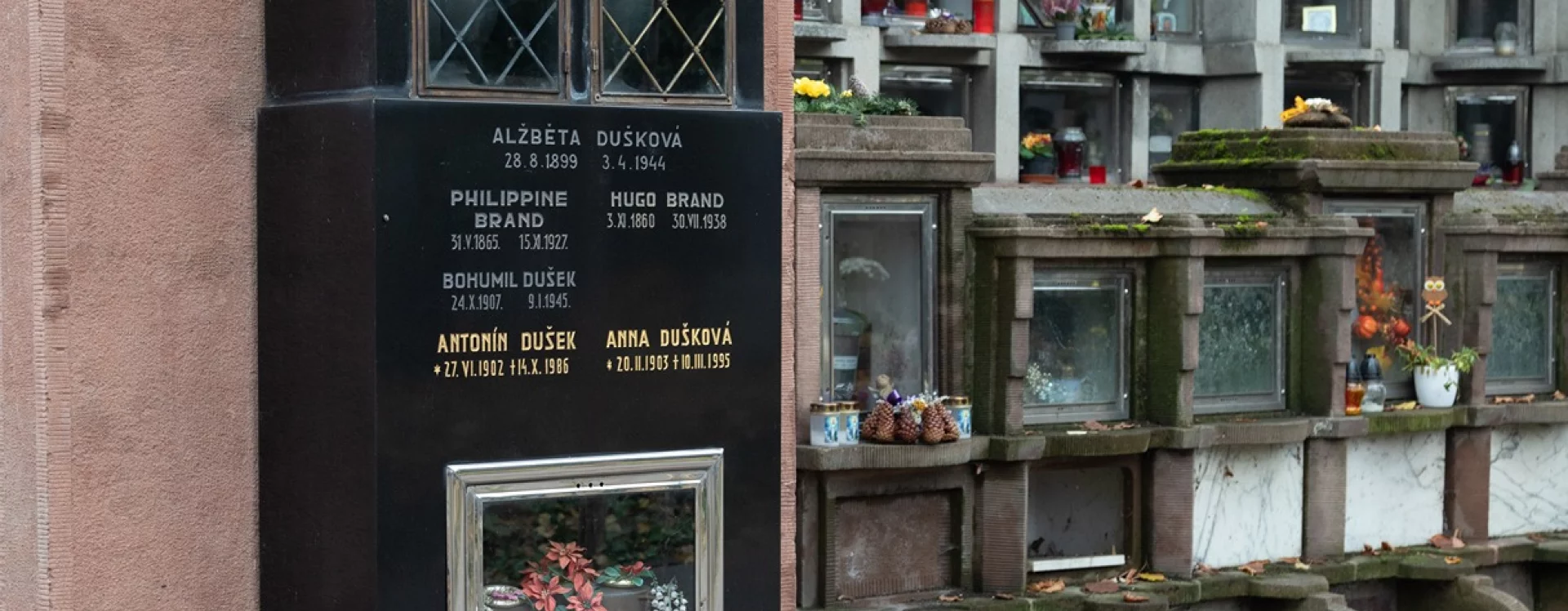
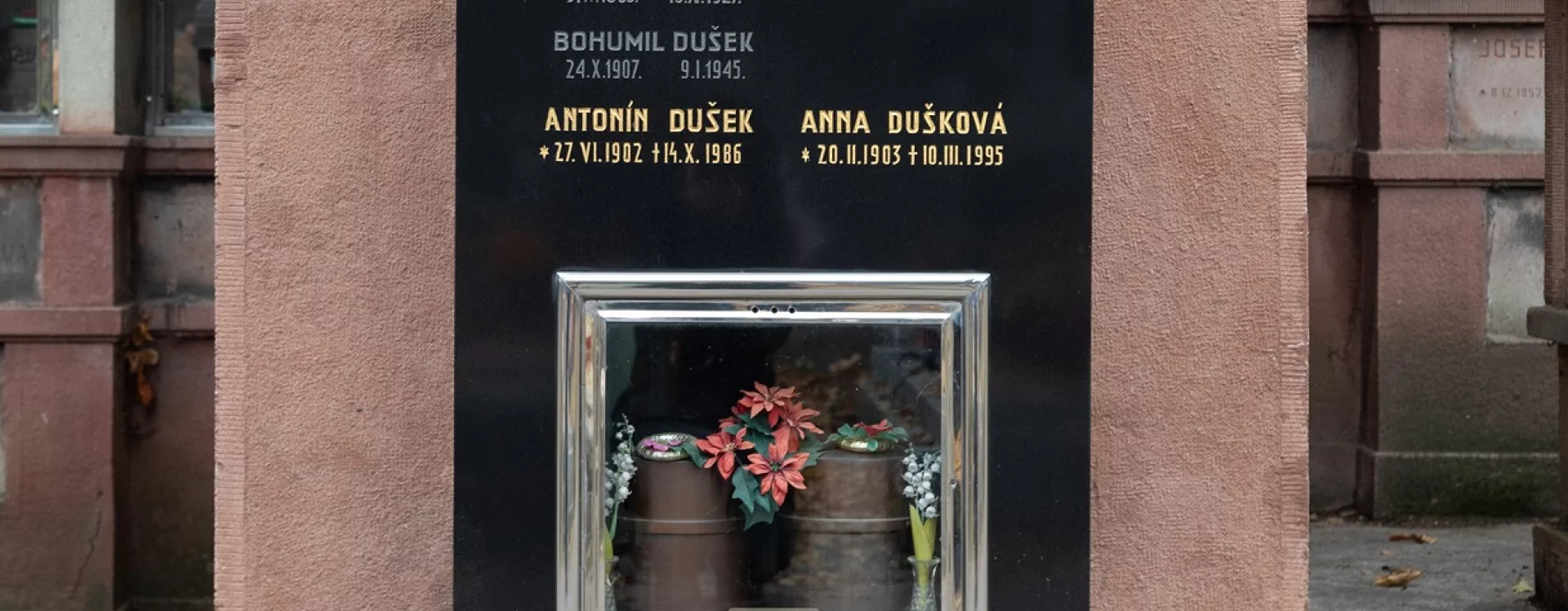
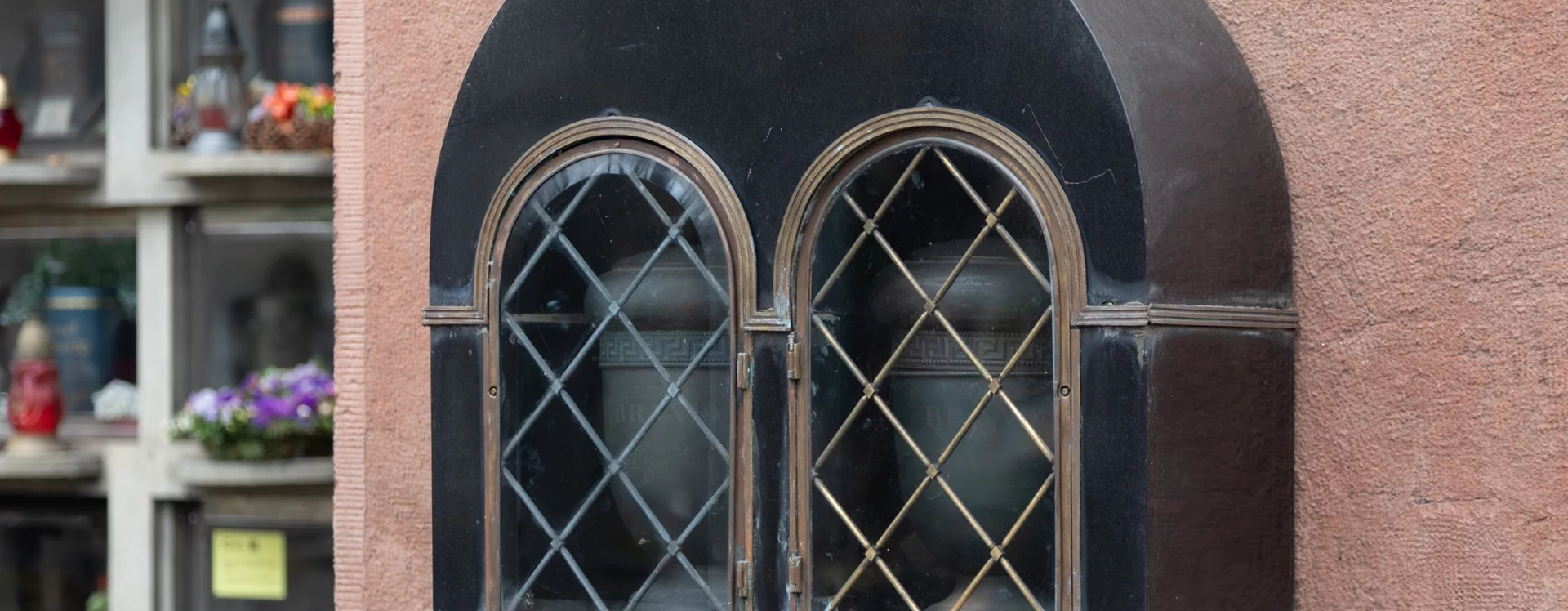
In this regard, the Olšany cemeteries are home to a number of absolutely unique monuments, first and foremost the massive columbarium built in the early 1920s in the National Style. Besides numerous compartments for the placement of urns, it also offered prominent locations for the placement of urn gravestones, one example being the grave marker of the Dušek and Brand families, which Kopetzky designed as a tall, elegant, rounded stele made of polished black stone. At the top of this structure is room for two urns, separated from the exterior by two small windows with diagonal grates. The window design brings to mind stained glass and thus evokes associations with religious architecture. The bronze urns inside are decorated with an undulating band. Above the base of the stele is another, probably more recent, rectangular compartment for urns.
A student of Jan Kotěra, the architect Paul Albert Kopetzky (1885–1944) worked in a number of different styles during his career, ranging from Art Nouveau and Cubism all the way to Functionalism. He also worked as a writer and designer. But he left his greatest mark in the field of funerary architecture. The largest number of his works can be found at Olšany's New Jewish Cemetery, where he designed numerous valuable funerary monuments and the Functionalist guardhouse.
The stonemasonry work for the gravestone was performed by the Ludvík Šalda company, which had a century-long history, owned quarries for various types of stone, and besides gravestones also worked on important projects such as the decorative elements of Slavín at Vyšehrad and the completion of St. Vitus Cathedral.
Vladislava Holzapfelová, 2025
In this regard, the Olšany cemeteries are home to a number of absolutely unique monuments, first and foremost the massive columbarium built in the early 1920s in the National Style. Besides numerous compartments for the placement of urns, it also offered prominent locations for the placement of urn gravestones, one example being the grave marker of the Dušek and Brand families, which Kopetzky designed as a tall, elegant, rounded stele made of polished black stone. At the top of this structure is room for two urns, separated from the exterior by two small windows with diagonal grates. The window design brings to mind stained glass and thus evokes associations with religious architecture. The bronze urns inside are decorated with an undulating band. Above the base of the stele is another, probably more recent, rectangular compartment for urns.
A student of Jan Kotěra, the architect Paul Albert Kopetzky (1885–1944) worked in a number of different styles during his career, ranging from Art Nouveau and Cubism all the way to Functionalism. He also worked as a writer and designer. But he left his greatest mark in the field of funerary architecture. The largest number of his works can be found at Olšany's New Jewish Cemetery, where he designed numerous valuable funerary monuments and the Functionalist guardhouse.
The stonemasonry work for the gravestone was performed by the Ludvík Šalda company, which had a century-long history, owned quarries for various types of stone, and besides gravestones also worked on important projects such as the decorative elements of Slavín at Vyšehrad and the completion of St. Vitus Cathedral.
Vladislava Holzapfelová, 2025
Literature
Zdeněk Lukeš. Splátka dluhu: Praha a její německy hovořící architekti 1900-1938. Praha, 2002, s. 98-99.
Drahomíra Březinová‒Barbora Schulmannová. Umělecky cenné hrobky na Novém židovském hřbitově Kámen, XVI, 2010, č. 3. 2010, s. 66-68.
Markéta Svobodová. Krematorium v procesu sekularizace českých zemí 20. století. Praha, 2013.
Jana Tischerová. Pražské hřbitovy, pohřebiště a sepulkrální památky. Praha, 2023, s. 111.