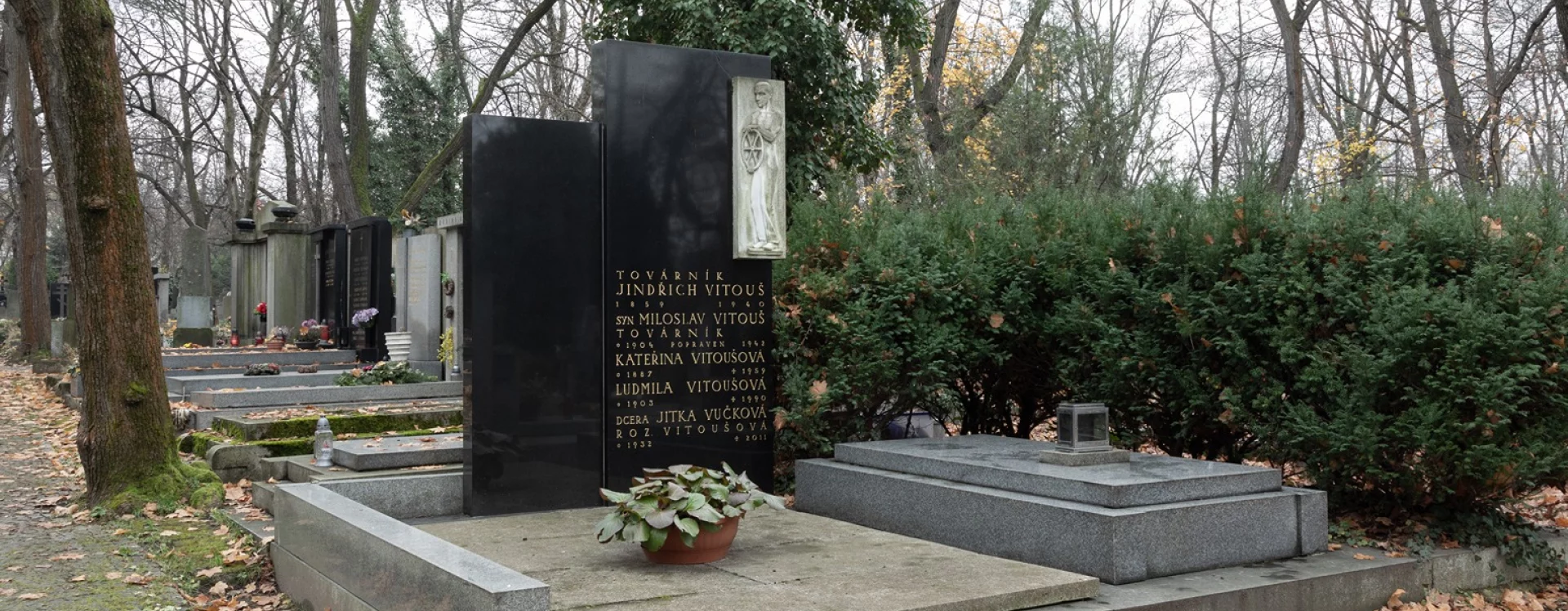
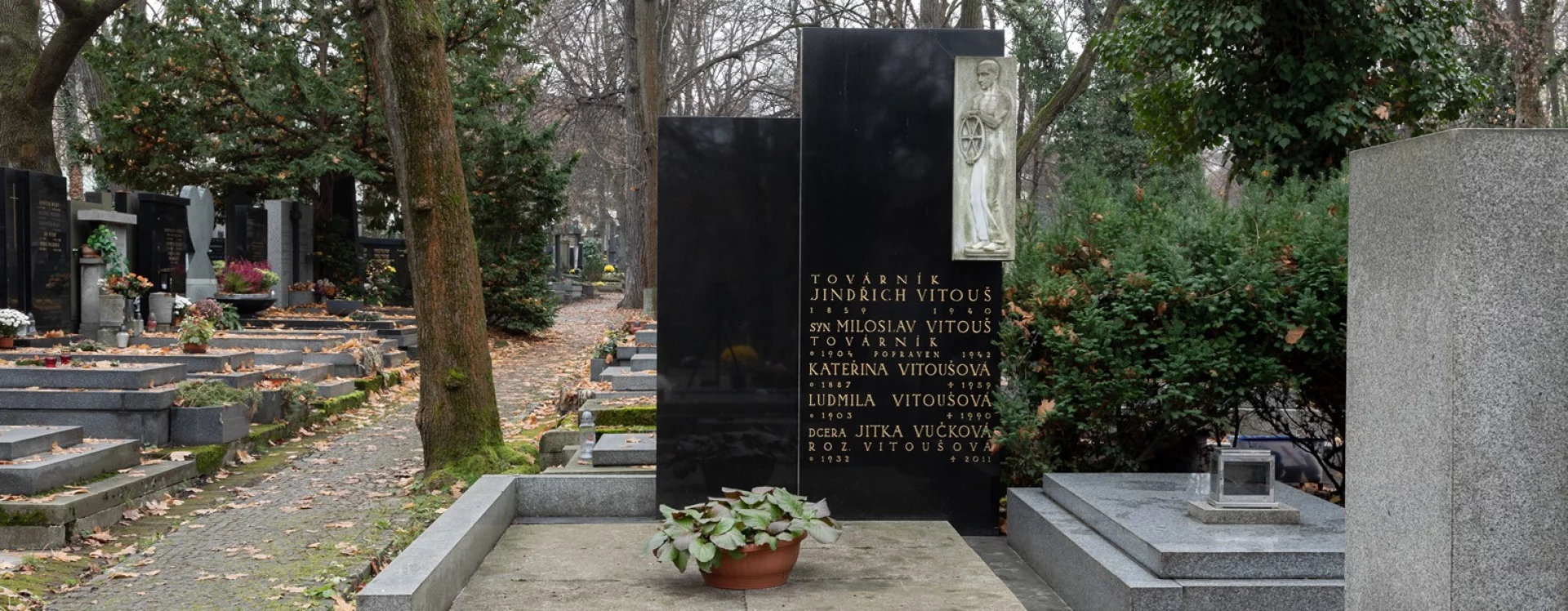
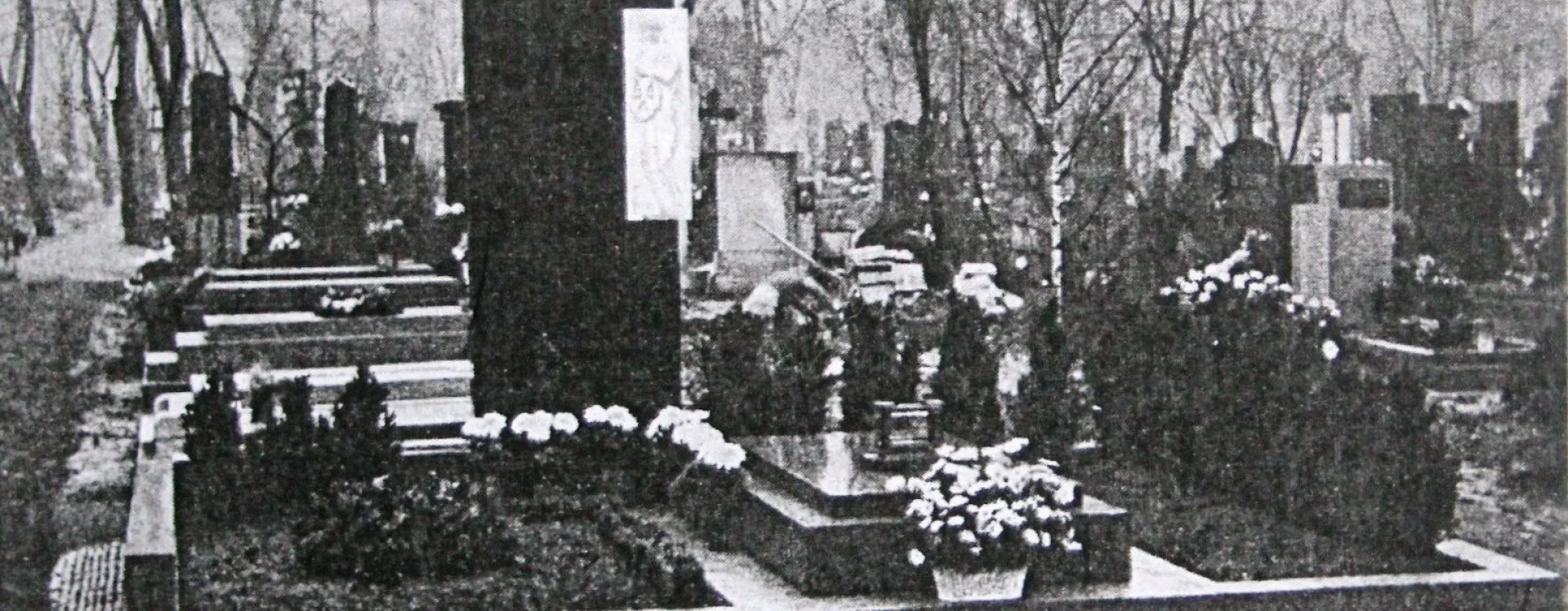
The grave marker for the Vitouš family is a textbook example of the work of architect and sculptor Blahomír Podpěra, whose firm specializing in funerary works consistently delivered top-quality results in terms of not only architectural design but also sculptural working and craftsmanship. The monument, which possesses typically Functionalist features applied to sepulchral architecture, bears the signature style of its designer. Podpěra's work is characterized by the playfulness and fantasy with which he articulates the surfaces of the ledger stone and the steles. He leaves open spaces and arranges the horizontal and vertical volumes on top of one another, subsequently embellishing them with harmonizing sculptural accents. He often combines differently colored materials – in particular granite and syenite contrasted with white marble or sandstone. For the decorative elements, he usually collaborated with two important, though today largely forgotten, women sculptors: his sister Blažena Borovičková-Podpěrová and his wife Františka Podpěrová-Bělská, the latter of whom designed the sculptural decoration for this particular monument.
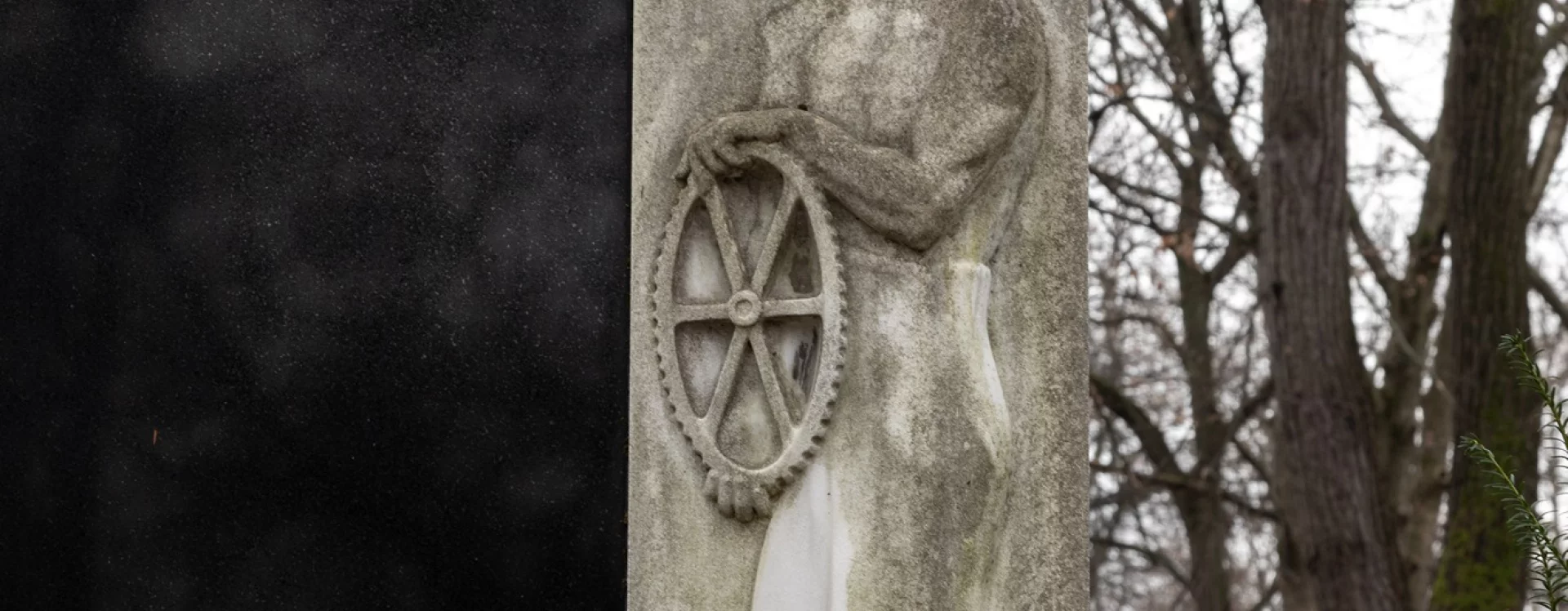
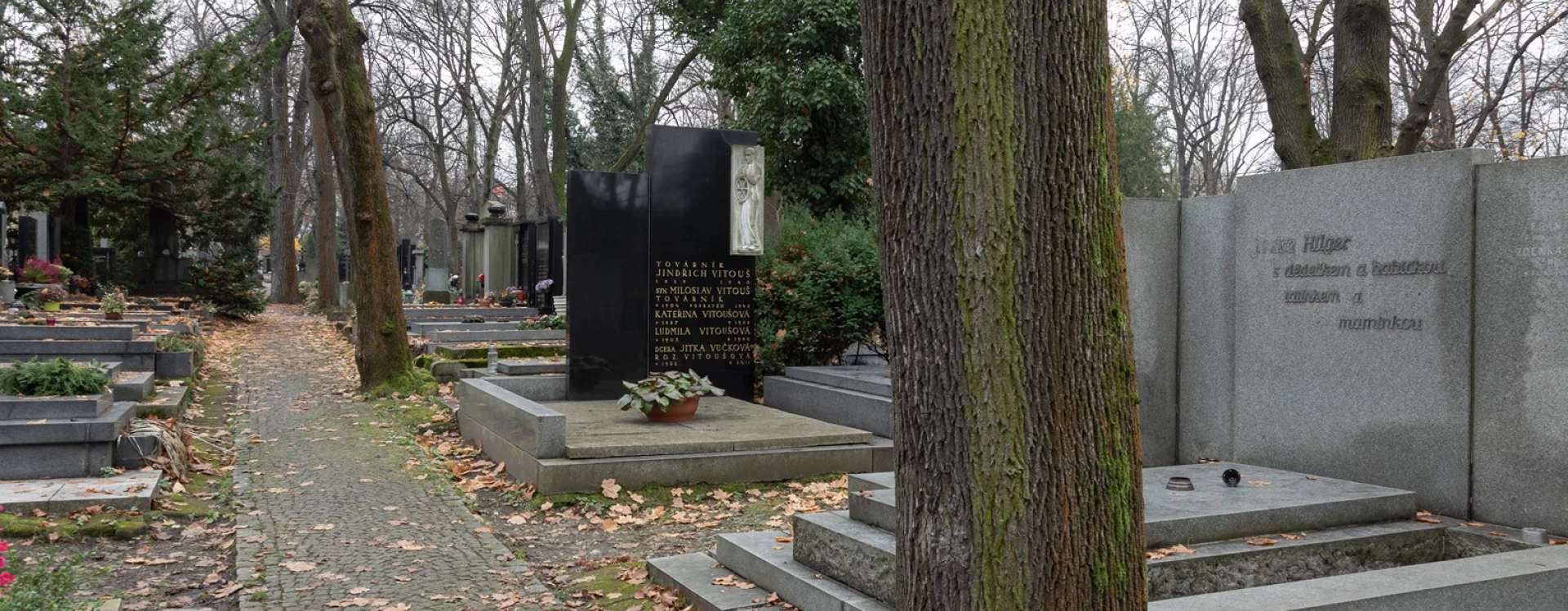
Commissioned by the family of factory owner Jindřich Vitouš after his death in 1940, the grave consists of an extensive square plot enclosed by a low wall, a strikingly articulated granite slab asymmetrically placed between two differently sized areas originally planted with greenery, and a tall stele similarly unexpectedly placed off-center. The ledger stone, wall, and stele were carved from Požáry and Swedish granite. The stele is decorated with a small relief made of white stone, which creates a perfect experience of contrasting materials. The entire composition reflects Podpěra's ability to take an original and playful approach to each of his commissions. The relief of a man holding a cogwheel is somewhat uncharacteristic for his funerary work, however. His architecture was more typically accompanied by sculptural decorations depicting orans or mourning female figures of a highly delicate, even ethereal character, clad in almost imperceptible drapery. The male figure holding a piece of machinery here clearly refers to the deceased and symbolizes the industrialist family's entrepreneurial activities.
Also buried here is Jindřich Vitouš's son Miloslav. A member of the resistance associated with the outlawed Sokol organization, he was executed by the Nazis at the Kobylisy shooting range on 6 June 1942 after the assassination of Reinhard Heydrich.
The grassy area in front of the stele was subsequently covered with stone slabs and the surface of the stele itself enlarged, but no written information about these later alterations has been preserved. Located nearby is another monument by Podpěra – this one for the family of the industrialist Vít Šulc (†1939). It, too, features an impressive combination of three types of stone and is adorned with a relief of a grieving woman.
Vladislava Holzapfelová, 2025
Commissioned by the family of factory owner Jindřich Vitouš after his death in 1940, the grave consists of an extensive square plot enclosed by a low wall, a strikingly articulated granite slab asymmetrically placed between two differently sized areas originally planted with greenery, and a tall stele similarly unexpectedly placed off-center. The ledger stone, wall, and stele were carved from Požáry and Swedish granite. The stele is decorated with a small relief made of white stone, which creates a perfect experience of contrasting materials. The entire composition reflects Podpěra's ability to take an original and playful approach to each of his commissions. The relief of a man holding a cogwheel is somewhat uncharacteristic for his funerary work, however. His architecture was more typically accompanied by sculptural decorations depicting orans or mourning female figures of a highly delicate, even ethereal character, clad in almost imperceptible drapery. The male figure holding a piece of machinery here clearly refers to the deceased and symbolizes the industrialist family's entrepreneurial activities.
Also buried here is Jindřich Vitouš's son Miloslav. A member of the resistance associated with the outlawed Sokol organization, he was executed by the Nazis at the Kobylisy shooting range on 6 June 1942 after the assassination of Reinhard Heydrich.
The grassy area in front of the stele was subsequently covered with stone slabs and the surface of the stele itself enlarged, but no written information about these later alterations has been preserved. Located nearby is another monument by Podpěra – this one for the family of the industrialist Vít Šulc (†1939). It, too, features an impressive combination of three types of stone and is adorned with a relief of a grieving woman.
Vladislava Holzapfelová, 2025
Literature
Hrobka rodiny Vitoušovy není v poskytnutém dokumentu zahrnuta v sekci Literatura.. nan.