Paradoxically, the life and work of one of Litomyšl's most active building constructors of the late 19th century to the mid 1920s, Antonín Beba, remains relatively unknown to the present day. He was a member of a local family of builders – the Bebas, which had a long tradition in the business. Antonín's great-grandfather Jan Jiří was especially famous as a bricklayer's foreman in the services of the Valdstein-Vartembergs during the Bartoque period. Modification work to house No 61, the so-called Panský dům in today's Smetana Square, is just one of his many achievements.
Antonín Beba's buildings and numerous sketches or designs for architecture competitions are proof of his endeavours to react to almost all architecture styles of the time – from Neo-Romantic through Neo-Renaissance to Neo-Baroque – the latter being especially close to his heart, possibly a consequence of his great-grandfather's work. Beba's designs for the architecture competition for Smetana House (in cooperation with the Viennese architect Richard Esriel) between 1900 and 1901 could be considered his most significant design. The magnificent Neo-Baroque building with its mansard roof has a hint of Viennese-palace architecture about it. However, it would have hardly fitted well into the small-town architecture of Litomyšl.
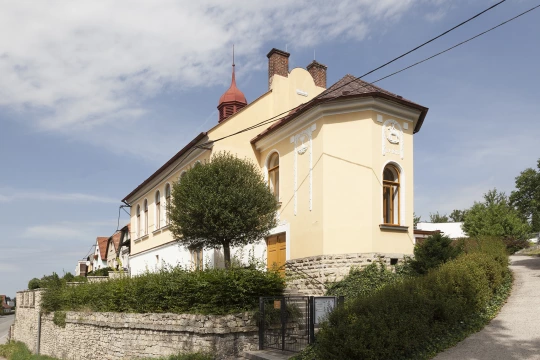
Beba's remarkable 1920 sketch of the town cinema, which portrays the building as a “picturesque” timber-framed building with a pronounced mansard roof, proves that he had an affinity towards folk architecture and “distinctive” architecture. In fact, he could quite easily have been influenced by the English Art and Crafts movement. The villa “Týnča”, built opposite Litomyšl railway station in 1906, is a fitting example of this tendency.
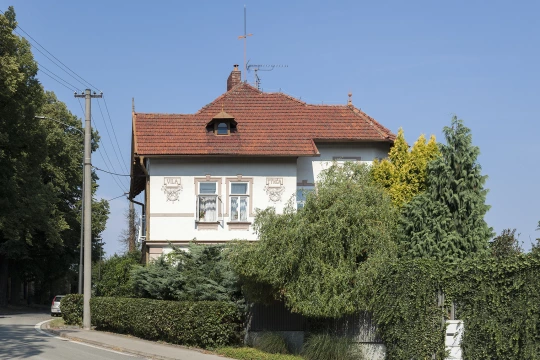
Antonín Beba, from mid 1924 a senior partner in the construction company Maizl and Beba Junior, had his office in house No 42 in the town square. In 1924, the ownership of his own Neo-Baroque villa at Bernardka, built 1895-1896, was transferred to the Agriculture Health Insurance Agency and, subsequently, to the District Health Insurance Agency; later, during the 1960s, it was completely rebuilt (02-404).
Literature
- Jaroslav Jan Gloser . Litomyšl. Městem krok za krokem. Praha, 2005, p. 144, 146, 171, 189, 204, 348.
- Pavel Zahradník. heslo Béba, Antonín. In: Pavel Vlček (ed.), Encyklopedie architektů, stavitelů, zedníků a kameníků v Čechách. Praha, 2004, p. 50.
- František Lašek. Litomyšl v dějinách a výtvarném umění. Litomyšl, 1946.
- František Lašek. Oživené litomyšlské paměti. Kulturně historické črty z druhé polovice 19. stol.. Litomyšl, 1940, p. 133.
Prameny
- Miloš Vacek, Kapitulní kostel Povýšení sv. Kříže v Litomyšli, diplomová práce, Ústav dějin křesťanského umění FF UK, Praha 2010..
- SOkA Svitavy, MSK, sign. KR–21, Kronika města Litomyšle II, 1924–1928, s. 47, 61..