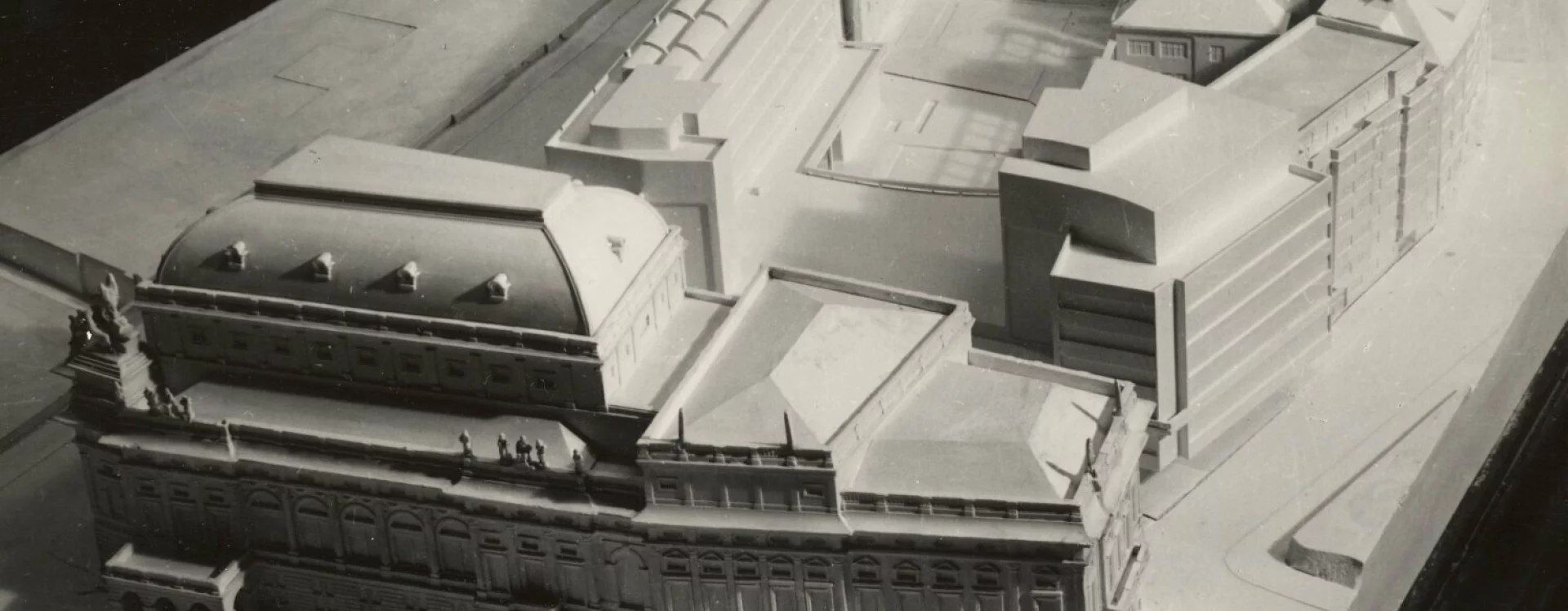
The issue of architectural and urban design of the space in the vicinity of the National Theatre was one of the most sensitive tasks of Czech architecture in the 20th century. The idea of using the plot of land near Národní třída for theatrical or cultural purposes had been emerging since the beginning of the century and had repeatedly returned in competitions and studies by various authors. In the public competition announced in 1958, the emphasis was placed on creating a complex of new buildings including the experimental stage of the National Theatre, administrative and operational facilities and public functions oriented towards Národní třída. The assignment also included a permanent connection of the new area with the historic theatre building. From the large number of competition proposals, concepts were gradually selected that sought to reveal and emphasize the mass of Zítek's Theatre as a key city monument. In the 1962 competition, conceived as a comparative showcase of various approaches, the winning design was Bohuslav Fuchs's design, created in collaboration with Kamil Fuchs, Mojmír Korvas and Alena Korvasová (née Fuchsová). According to Zdeněk Kudělka, the team of designers designed it " with the knowledge that a new building, located in the close vicinity of a culturally and historically important object, cannot attract excessive attention and that it should, without suppressing its own architectural values, rather underline its significance ." The new building was designed in a setback position relative to the Voršilka Monastery and its main facade was conceived as a light steel structure with glass filling, in which Zítek's National Theatre building is reflected.
The second phase of the competition in 1964 confirmed the Fuchs family team as the winner again. The subsequent study, prepared by Bohuslav Fuchs and his son Kamil, followed the line of the neighboring monastery, creating a free space in front of the new building, allowing a wide opening of views of the main facade of the theater. The overall solution was characterized by extraordinary sensitivity to the historical, urban and symbolic context of the place and an effort to combine them with the principles of modern architecture.
According to Kudělka, the designers “were guided by the conviction that the new building should not be connected to the monastery and form a whole with it, but rather that it should, in accordance with its functional affiliation to the National Theatre, be related to its architectural layout. Therefore, in their work, they inserted the new façade behind the façade of the monastery building and designed it as a light steel structure filled with glass. In terms of material and area, it appeared to be a manifestation of contemporary opinion, but in terms of the rhythm of the vertical and horizontal division and the use of sculptural decoration, it corresponded to the system of the theatre façade. The main view from Národní třída to the theatre, enriched by the pushing in of the new building, was to encounter through it a soft, non-violent transition to the mass of the theatre, which, on the other hand, interfered with the new, northern façade with a permanent mirror reflection. This most recent expression of the architect was also characterised by an extraordinary sensitivity that was able to combine a number of historical, functional and other givens with an effort to re-establish contact with tendencies of contemporary global architectural development. ”
Work on the project was interrupted after the death of Bohuslav Fuchs in 1972. The following year, Kamil Fuchs renounced the copyright, which subsequently passed to SÚPRMO. Kamil Fuchs noted the following in his diary: "This year, the matter of the National Theatre in Prague revived, and it was decided to begin design work for the new building. After heavy consideration and discussions, I decided to give up further work on this project, given the conditions set by both the investor and the general designer (otherwise it would have meant moving to Prague and interrupting all other ongoing projects). Further work on this project was entrusted to the previously unknown architect Kupka from SURPMO Prague, who developed an amended concept. I do not yet know whether my decision was correct given the importance of this work, but it would have been extremely demanding in terms of health and time. " Subsequently, in 1973, architect Pavel Kupka (SÚPRMO) was commissioned to develop a volumetric study for the completion of the National Theatre. The final implementation of the completion of the National Theatre was ultimately entrusted to Karel Prager, whose New Stage was completed symbolically for the centenary of the ceremonial opening of the National Theatre in November 1983.
The completion of the area around the National Theatre was Bohuslav Fuchs' most prestigious commission, it could have been a symbolic end to his lifelong architectural work; his own photo album also symbolically ends with a picture of him (together with his son Kamil) looking across the Vltava River at the main Czech theatre stage.
Lucie Valdhansová
Literature
Iloš Crhonek. Architekt Bohuslav Fuchs. Celoživotní dílo. Brno, Petrov, 1995. p. 188, 178–179.
CHATRNÝ, Jindřich. KYRC, Filip. VALDHANSOVÁ, Lucie. "Nový svět" Kamila Fuchse. Brno, Muzeum města Brna, 2025. p. 24–27. ISBN 978-80-88631-26-2.
anonym. Rekonstrukce a dostavba Národního divadla v Praze. In: Architektura ČSR. č. 4. p. 155.
Nová scéna Národního divadla. Available from: Nová scéna Národního divadla [accessed 9. 10. 2025]