Bohuslav Fuchs, one of the most prominent architects in interwar Czechoslovakia, was born in Všechovice near Bystřice pod Hostýnem on 24 March 1895. After the outbreak of World War I he left for Prague, where he first made a living as a bricklayer, but was admitted to the Academy of Fine Arts by architect Jan Kotěra in 1916. He began work in the Architecture and Regulation Department of the Brno Building Authority in 1923 and later, in 1925, replaced Jindřich Kumpošt in the position of the city's chief architect. In 1926-27 he prepared a design for the "Tangenta" competition for urban regulation of the centre of Brno (in cooperation with Josef Peňáz and František Sklenář). He resigned from his position in the late 1920s and set up his own studio. His major functionalist works include the Zeman Café in Brno from 1925-26 and the Avion Hotel (1927). In the 1930s he designed the Masaryk Students' Home in Brno and the Green Frog thermal swimming pool for the Trenčianské Teplice Spa. Fuchs' preference for the organic line of functionalism is reflected in the Petrák villa in Brno. He and other members of his family set up the AKA, a company producing interior accessories and objects of arts, in 1932. The activity of this company as well as Fuchs' studio came to an end in 1948 as a consequence of the Communist takeover. He worked as the dean of the Faculty of Architecture and Civil Engineering in 1948-49, 1951-52 and 1955-58, but was eventually forced to leave. In the 1960s he devoted most of his time to urban planning. In this period he created his designs for Prague's transport system, the completion of Old Town Square in Prague and the surroundings of the National Theatre. He was conferred the title of National Artist in the more liberal atmosphere of 1968. The architect also contributed to International Congresses of Modern Architecture (CIAM), was a member of the International Committee for the Resolution of Problems in Contemporary Architecture (CIRPAC), the honorary chairman of the International Federation for Housing and Planning (IFHTP), the Hague, and a member of the Royal Institute of British Architects (RIBA). Bohuslav Fuchs passed away on 18 September 1972 in Brno, where he is also buried at the Central Cemetery.
Literature
- Jan Sedlák. Architekt Bohuslav Fuchs 1895–1972 (kat. výst.). Brno, 1995.
- Zdeněk Rossmann. Architekt Bohuslav Fuchs 1919–1929. Bâle, 1930.
- Iloš Crhonek. Architekt Bohuslav Fuchs. Celoživotní dílo. Brno, Petrov, 1995.
- František Kalivoda. Architektonické dílo Bohuslava Fuchse v Brně. Brno, 1967.
- Zdeněk Kudělka. Bohuslav Fuchs. Praha, NČSVU, 1966.
- Kubinszky Mihály. Bohuslav Fuchs. Budapest, 1977.
- Rostislav Švácha. 1985. sv. 6, p. 4–7.
- Zdeněk Kudělka. Bohuslav Fuchs a Brno. In: Architektura ČSSR. 1965, roč. XXIV. p. 250–257.
- Vladimír Šlapeta. 1973, roč. 13. sv. 5, p. 40–41.
- Jan Sapák. Bohuslav Fuchs. Architekt der tschechischen Avantgarde. Salzburg – Wien, 2010.
- Zdeněk Kudělka. 1964.
- Pocta Bohuslavu Fuchsovi: Sborník referátů z mezinárodní vědecké konference v Brně. In: Jan Sedlák (ed.), Pocta Bohuslavu Fuchsovi: Sborník referátů z mezinárodní vědecké konference v Brně. Brno, 1995.
- Jan Sedlák, Jaromír Sedlák. Brno, 2009.
- Lenka Kudělková. Brno, Petrov, 1995.
- Emanuel Hruška. 1972, roč. 32. p. 248.
- Jan Sedlák, Jaromír Sedlák. Brno, 2009.
- Marcela Macharáčková. AKA. Užité umění 30. a 40. let v Brně. Brno, 1990.
 Masaryk's cottage in Šerlich
 Klostermann's cottage in Modrava
 Residential house of writer Jakub Deml
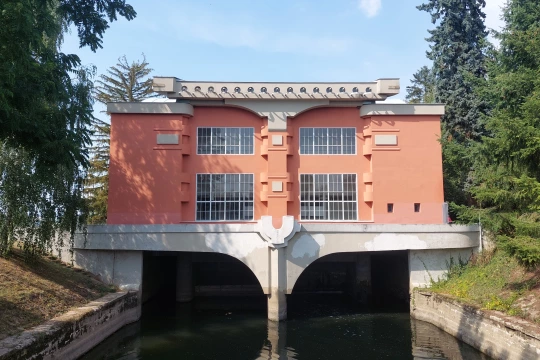 Hydroelectric power plant in the settlement of Háj
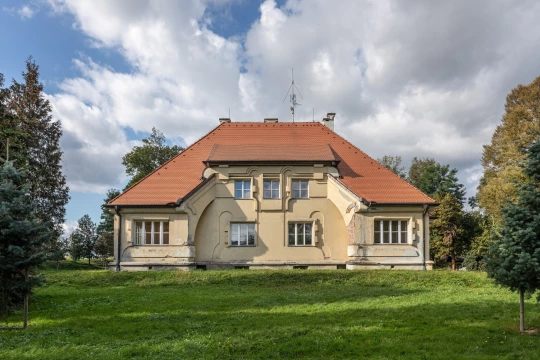 Ellen and Karel Plhák's family house in Háj u Mohelnice
 Building of the Sokol in Bystřice pod Hostýnem
 Administrative building of the Tauber company in Bystřice pod Hostýnem
 House for the poor in Bystřice pod Hostýnem
 Vladimír Šindler's family house in Korouhev
 Cemetery in Všechovice