Milan Babuška was born in Dubí near Kladno on 20 November 1880 but spent his childhood in Unhošť near Prague. In 1903, he enrolled to study architecture at the Czech Technical University in Prague and, thanks to his musical talent, he also studied the violin. After graduating from the Faculty of Architecture, where his professors were Josef Schulz, Adolf Libescher and other conservative architects, he became a professor at the secondary technical school in Jaroměř. At the same time, he began to take part in architectural competitions. After World War I, he was a professor at the First State Technical School in Prague between 1919 and 1923. His first success came in the competition for at the girls’ school in Jaroměř in 1911. In 1920, Babuška’s alternative designs won the first to third prize in the competition for the savings bank in Německý Brod. In 1921–1922, Babuška won the competition for the Sokol gym in Hradec Králové, which was not built until the end of the decade; in 1922–1924, he designed the grammar school in Rychnov nad Kněžnou. After success in the competition for the Sokol gym in Hradec Králové, he participated in competitions for Sokol gyms in Roudnice nad Labem, Náchod and Opava. The Sokol gym in Roudnice nad Labem was built between 1929 and 1930, the Sokol gym in Náchod in 1930. In Náchod, Babuška also designed the local post office. Besides Sokol gyms and savings banks, he also focused on school buildings: he participated in competitions for the boys’ and girls’ school in Strakonice, the girls’ school in Turnov, a school in Unhošť, a town school in Rataje nad Sázavou, Police nad Metují and in other towns. His projects of schools often won awards. Milan Babuška also designed a school in Hevlín near Znojmo, built between 1926 and 1927 and the Czech school in Dolní Bludovice in the district of Frýdek-Místek.
Babuška also designed urban units: he participated in the competition for the regulatory plan of Kyjov and the development of Sokolský ostrov (Sokol Island) in České Budějovice. His most important city project was probably the complex of (technical and agricultural) museum buildings in Prague–Letná designed in 1935–1937 and built between 1937 and 1940.
Between 1923 and 1926, and in 1936, Babuška worked on the design of the spa buildings in Velichovka; he also designed spa buildings in Jáchymov.
Moreover, Milan Babuška designed renovations and extensions, for example, to the house no. 104 in the Lesser Town, the adaptation of the Jenerálka farmhouse no. 2308 in Dejvice, etc. He also designed military and industrial buildings, such ironworks industrial buildings in Podbrezová and the complex of buildings for the Masaryk underground mine in Břešťany near Most. In 1937, he designed buildings for the military airport near Trenčín [1].
Architect Milan Babuška had a wide register of styles. In the 1920s, he designed decorative or even historicist forms, but his designs and projects followed the latest architectural principles of purism as well. While his first design of the Sokol gym in Hradec Králové had a factory looks, combining smooth surfaces of the façade and unplastered brickwork, the post office in Náchod had rather forms of monumental architecture. His later projects of museum buildings in Letná prove that Babuška was an architect who was aware of the principles of avant-garde, but did not give up on the artistic laying out of mass and composition of the façade.
LZL
Notes
[1] Comp. www.ntm.cz/cs/heslar/milan-babuska, accessed on 15. 1. 2019
Literature
- Prokop Toman. Nový slovník československých výtvarných umělců. Praha, 1947.
- Prokop Toman. Dodatky ke slovníku československých výtvarných umělců. Praha, 1955.
- Prokop Toman. Dodatky ke slovníku československých výtvarných umělců. Praha, 1955.
- Rostislav Švácha. Od moderny k funkcionalismu. Proměny pražské architektury první poloviny dvacátého století. Praha, 1994.
- Encyklopedie architektů, stavitelů, zedníků a kameníků v Čechách. Praha, 2004. autoři hesla Pavel Vlček a Jiří Hilmera.
- Pavel Vlček. Encyklopedie architektů, stavitelů, zedníků a kameníků v Čechách. Praha, 2023. autor hesla Pavel Vlček.
Objekty autora v ostatních architektonických manuálech
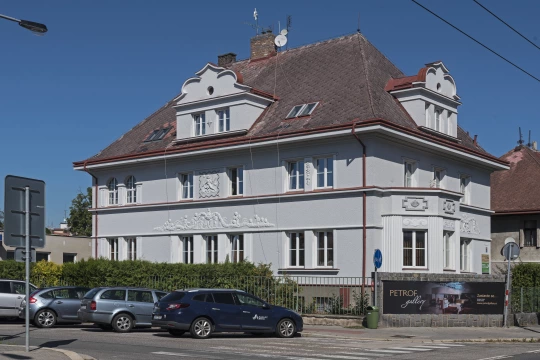 Mr and Ms Nepasický’ VillaKrálovéhradecký architektonický manuál
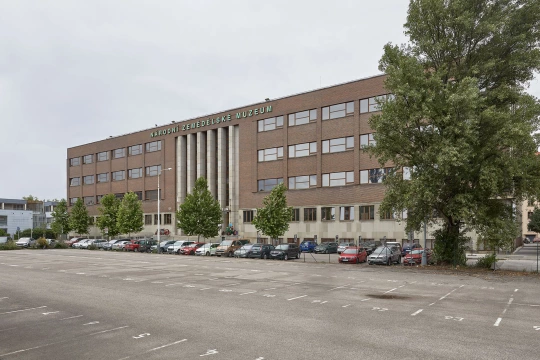 National Museum of AgricultureUmělecké památky Prahy
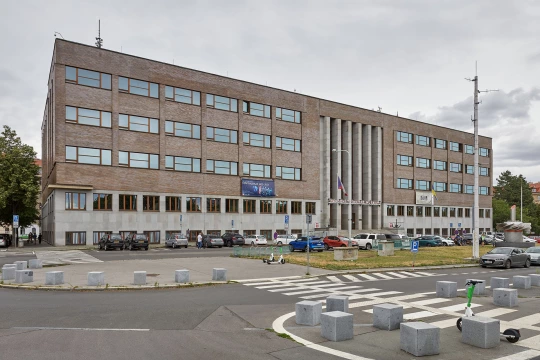 National Technical MuseumUmělecké památky Prahy
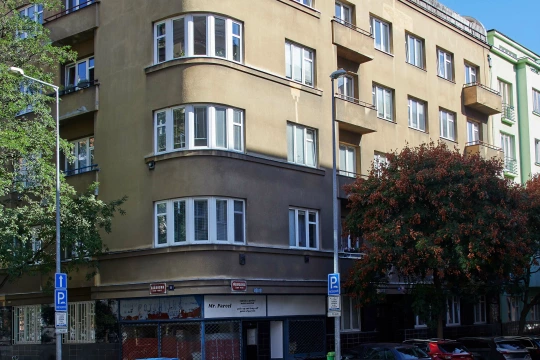 Tenement building No. 1858Umělecké památky Prahy
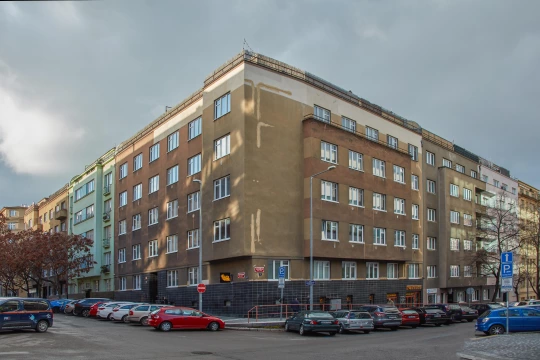 Tenement building No. 1919Umělecké památky Prahy
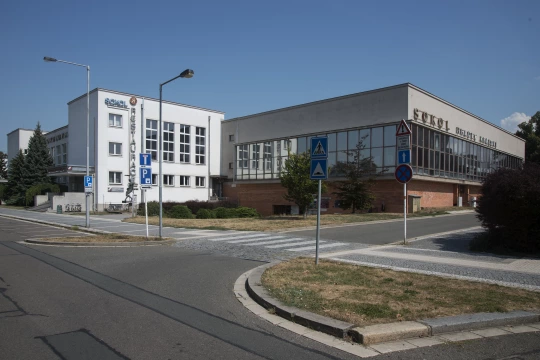 The Sokol GymKrálovéhradecký architektonický manuál