

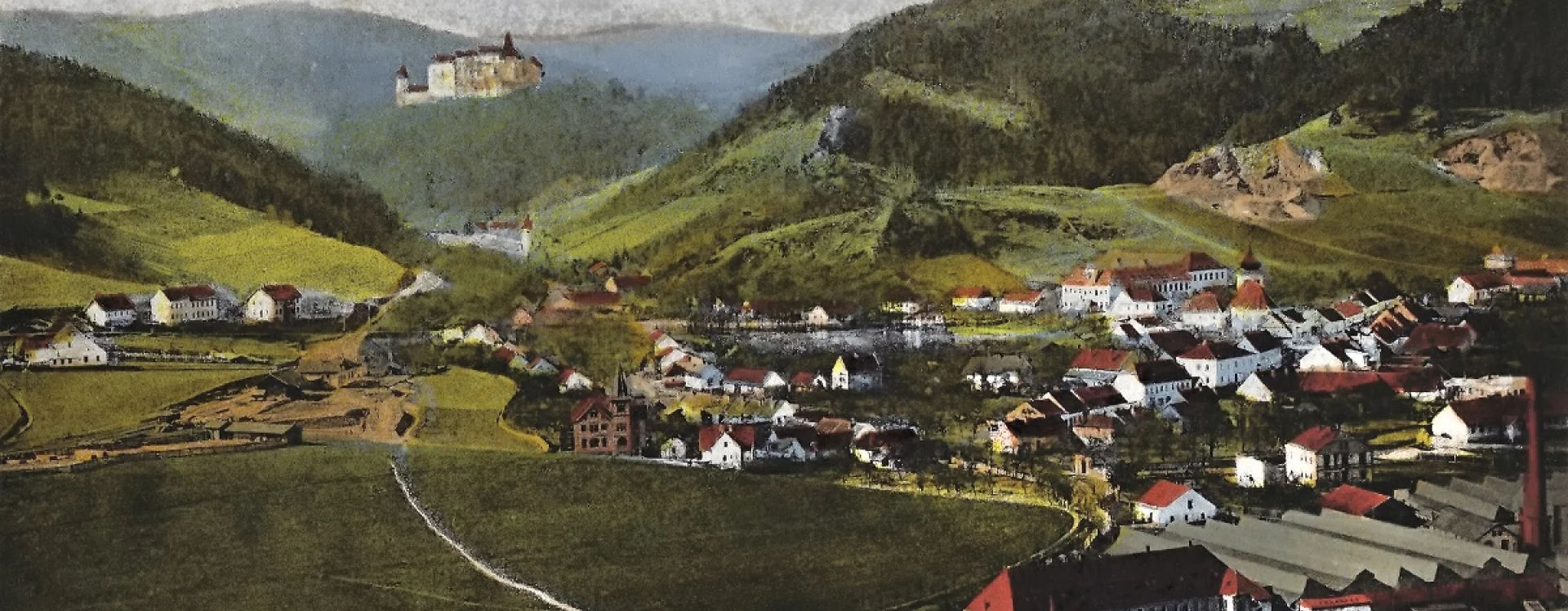
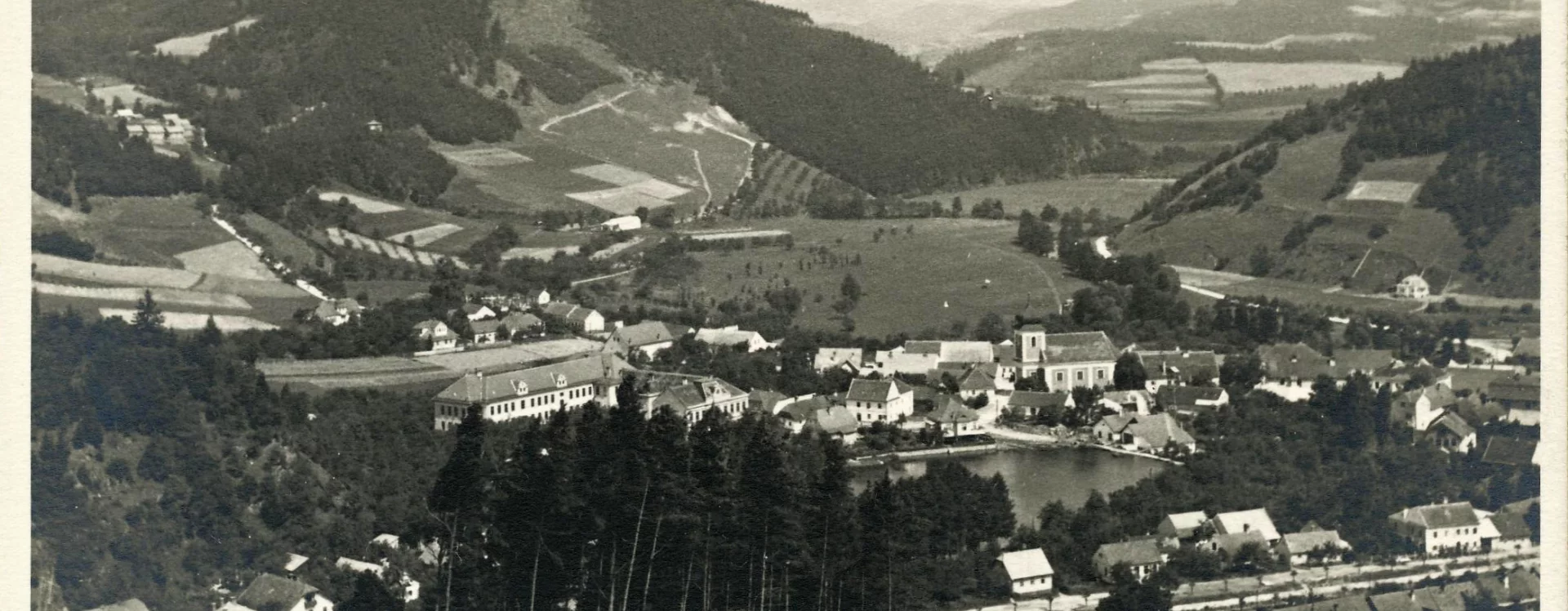

With the growing importance of Nedvědice after the establishment of the railway between Tišnov and Nové Město, the town expanded considerably in various directions. A number of new houses were also built near the railway station along the road to Tišnov. The house was built by Jan Čermák, a tenant of the Pernštejn restaurant, who, in the times of the pre-war boom of the Austro-Hungarian monarchy, saw the property mainly as an investment. He himself lived with his family in Pernštejn, while he rented out the large house to new or temporary residents of Nedvědice from the better-off classes. In 1921, the house was occupied by the commander of the local gendarmerie station, Leonard Bařina, with his family and two assigned colleagues, constable Jan Pavelka and a probationary gendarme Antonín Vejmelka. The house was built on a newly created terrace, inserted into the rather steep slope above the station in 1912. The simple two-storey building with a half-hipped roof and an outbuilding and outbuildings in the courtyard was built on a regular rectangular plan. There are five window bays on the street frontage, and two offset window bays with two attic windows in the top of the side elevation, topped by a capped gable. The entrance to the house is from the courtyard. The house with a roof resting on projecting beams is particularly interesting for its stucco decorations. The side façade is complemented by a large louvred frame into which a pair of lozenges are inserted on the axis, penetrating between the windows to the roof. Approximately halfway through the first floor windows, a profiled cordon cornice runs the length of the façade. The most obvious feature is the stucco frames between the ground and first floor windows, in which a diamond is inserted. The solution, based on the expressive means of the Geometric Art Nouveau style, which originated in Vienna around 1900, is largely reminiscent of the facades of the townhouses, whose simple but distinctive decoration represented a transitional style between Art Nouveau and Modernism. The forms of this 'urban' architecture are quite unique in Nedvědice. It is likely that they were introduced here by Dominik Beránek, a mason from Letonice near Bučovice. This patriotic businessman, involved in the Matica školy, for example, moved to Nedvědice before 1910 and carried out an unclear number of architectural projects here. After the establishment of the Republic he moved to Doubravník, where he subsequently worked as a master mason. The house with the preserved decorations is an example of the usual building production after 1900 before the advent of modern architectural forms, which, however, were manifested in Nedvědice at the same time.