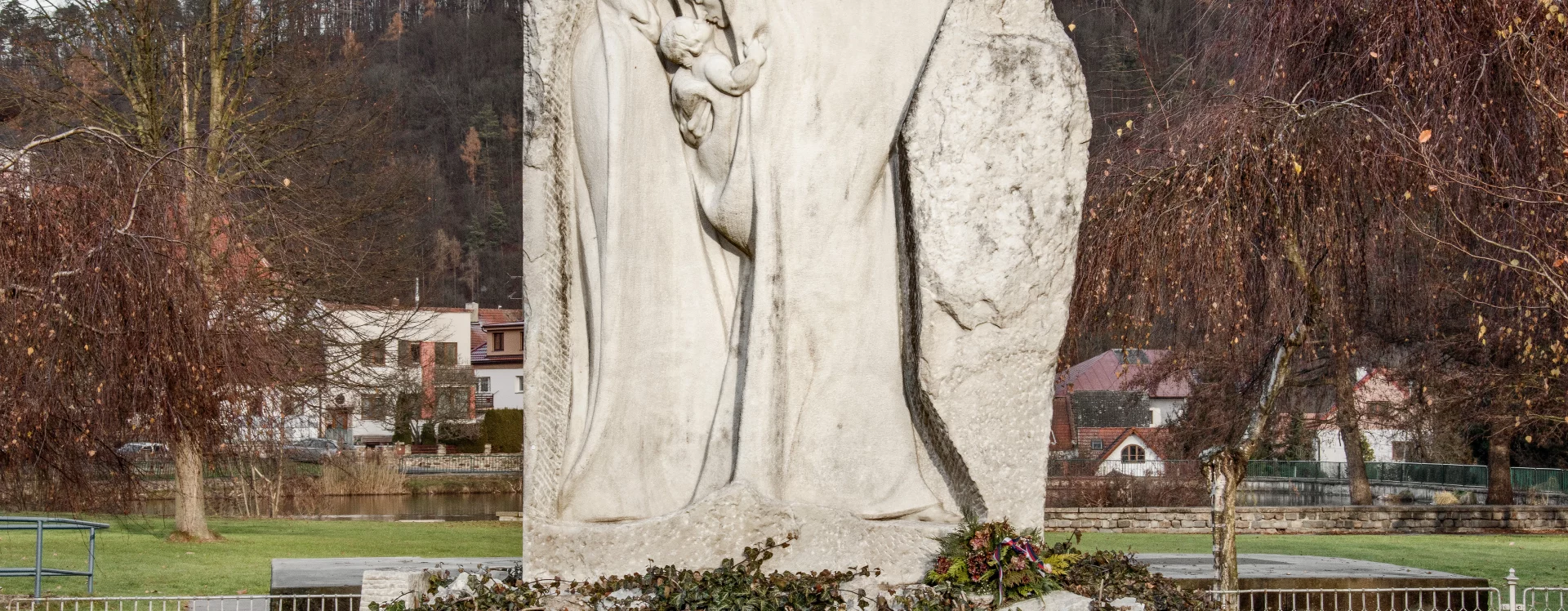
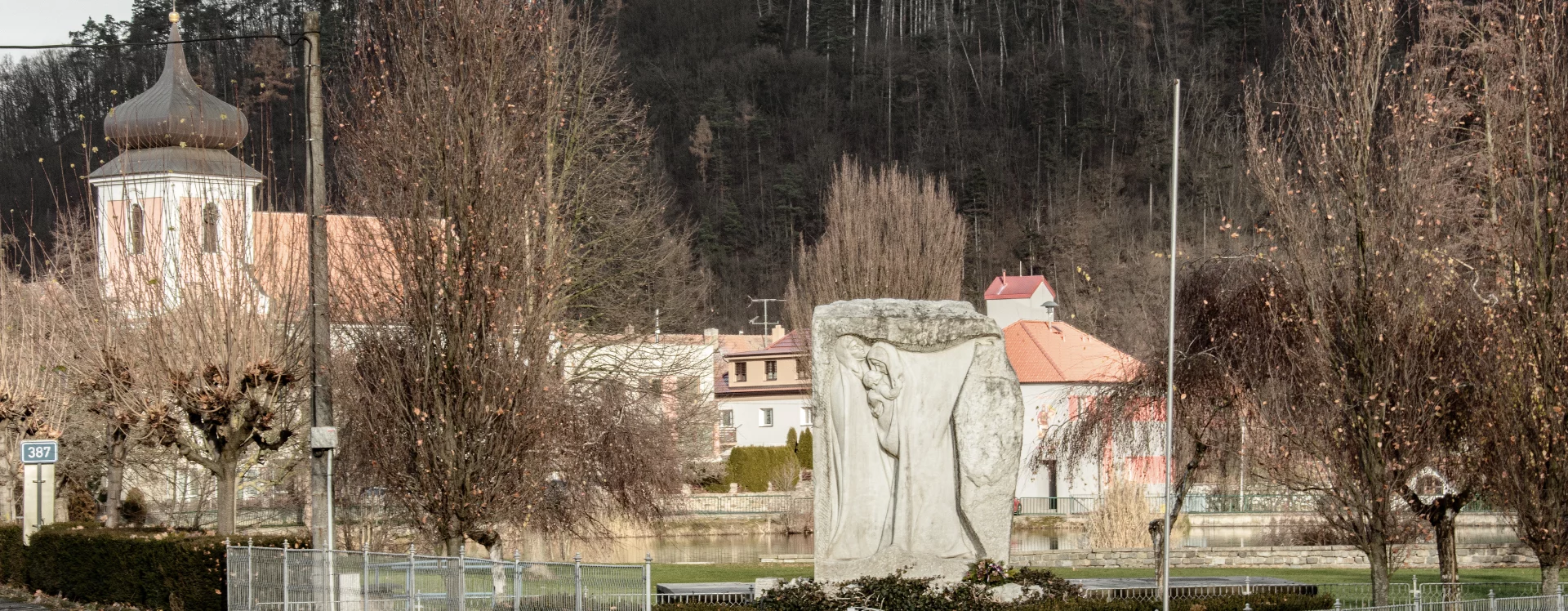
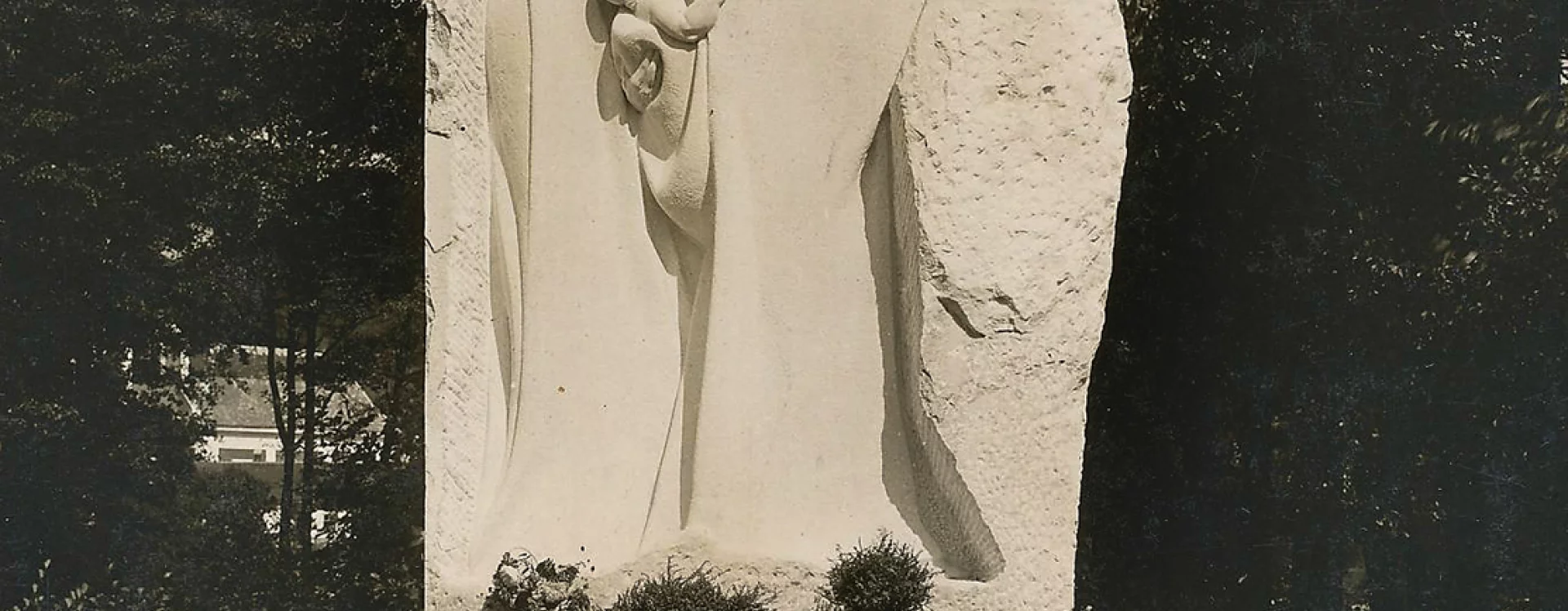
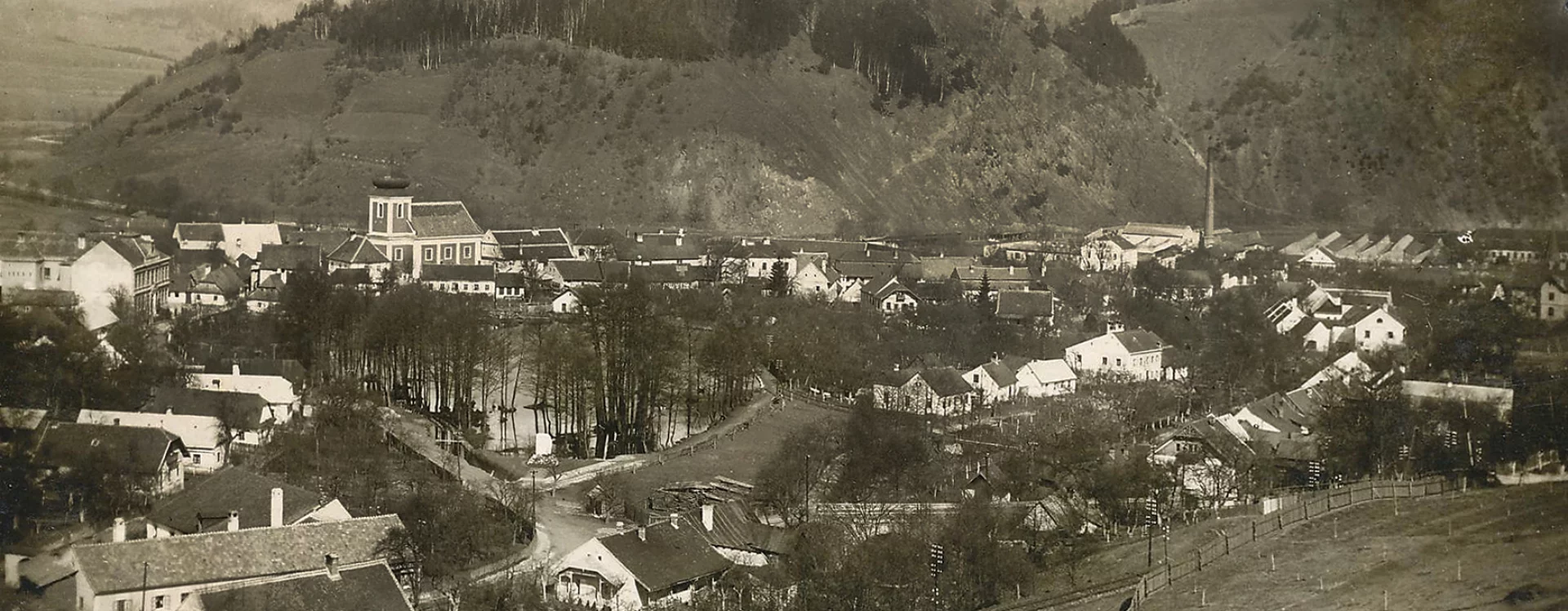
After the establishment of the Czechoslovak Republic in 1918, monuments commemorating the fallen soldiers who fought in the legions were established not only in the capital cities but also in small villages. In Nedvědice, it was dedicated to the memory of forty-one fallen local citizens and was erected in 1925. The municipal council chose the area near the crossroads by the former municipal pond for its location. Josef Axmann, a sculptor and medallist based in Brno, graduated from the professional sculpture and stonework school in Hořice and then from the Academy of Fine Arts in Prague. He was a versatile artist, devoted to figurative sculpture commissions, designed memorial plaques and reliefs for architecture, and also participated in the conservation and restoration of sculptures. Like others of his contemporaries, he had personal experience of the Eastern Front. The unveiling of the monument took place on Sunday, 25 May 1925. The ceremony was attended by a delegation from the provincial military command in Brno, legionnaires, members of the Sokol and firemen. A solemn speech was delivered by the representatives of the Czechoslovak Legionary Community, Josef Greif from Prague and Josef Kudela from Brno. The monument was made of marble from the Nedvědice mines, donated by the municipality. A neoclassical figurative relief rises from the roughly carved monumental block of stone on the facing side, depicting a pair of female figures, wrapped in long slashes, mourning widows of men killed at the front. One of the women embraces a child in her arms and points into the distance with her left hand, forming a graceful curve. The names of the fallen have been carved on the smooth side wall. The monument was set on an artificial canopy lined with stones and its surroundings were landscaped. After the Nazi occupation of Czechoslovakia in 1945, it was supplemented by a marble plaque with the names of the victims of the Second World War. Axmann's other sculptural works related to the commemoration of the victims of the First World War were created in the vicinity of Brno, such as a figural memorial with a monumental statue of a legionary in Křtiny, in collaboration with the architect Valentin Hrdlička he realized a monument for Milonice in 1927, and he took part in a competition for the erection of a monument in Tišnov. The idea, form and material of Nedvědický's work are completely out of line with Axmann's other works and the conventional concept of contemporary war memorials in Czechoslovakia. During the construction of a prefabricated grocery store in the immediate vicinity of the memorial, the park surroundings of the memorial were newly landscaped. In 1970, the local national committee commissioned the Brno architect Václav Vacek to design the park. Trees, ornamental shrubs and perennials for planting were supplied by the school farm in Lednice and the Bratislava City Services Horticulture. The monument became a tourist destination and an important artistic monument in the interwar period: "Among the monuments in Nedvědice, we cannot omit the beautiful monument dedicated to the fallen in the World War. The memorial to the famous memorial of St. Nedvědín, which is dedicated to the memory of the dead. The sculptor Axmann had a huge boulder of white marble excavated from the municipal quarry and symbolically immortalised the human pain in an artistic concept." (J. Pokorný, Nedvědice and Pernštejn, Jas. Family Illustrated Non-Political Weekly 2, 1928, No. 33, 16 August, p. 4) In the guide to the town of Nedvědice it was referred to as "a precious work of art in memory of the fallen in the World War. Even larger towns cannot boast such beautiful figural symbolism." (Nedvědice pod Pernštejnem, Nedvědice pod Pernštejnem 1934, p. 5.)
Sources
Stavební archiv ÚMČ Prahy 3.
https://www.archiweb.cz/b/domov-pro-seniory-hagibor (vyhledáno 5. 9. 2023).