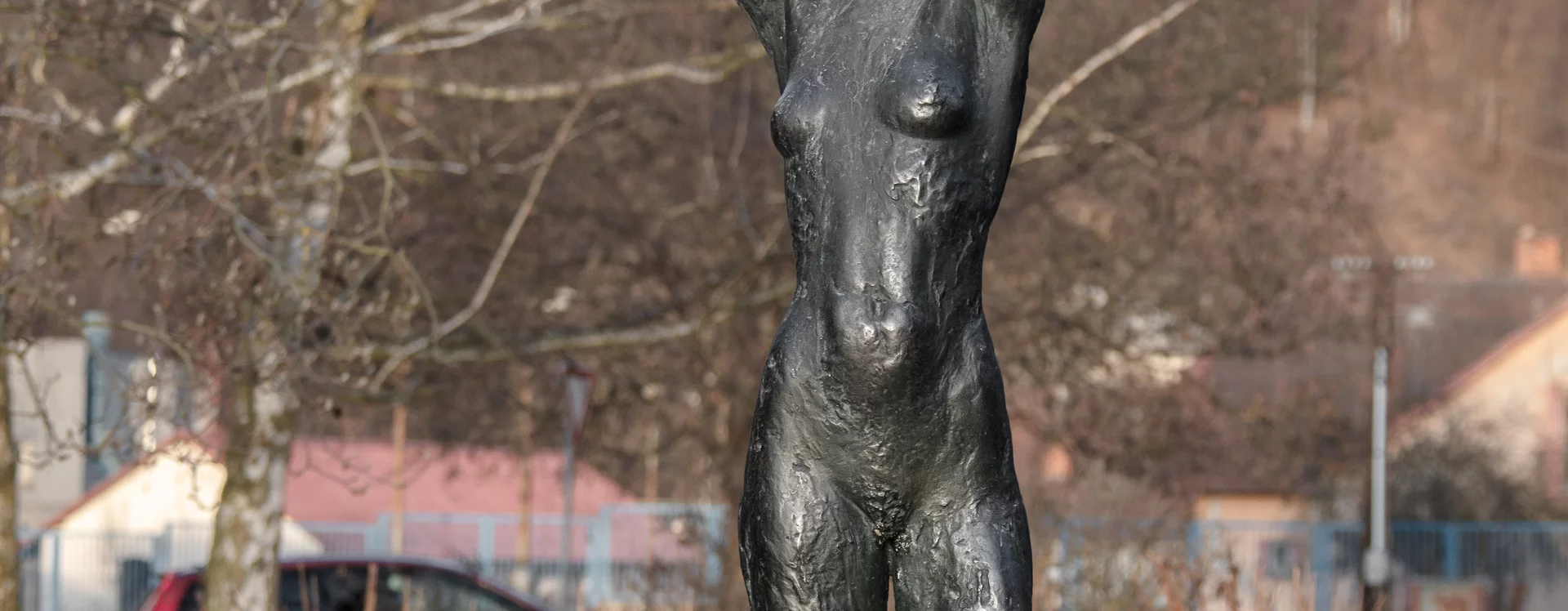
At the end of the normalisation period, the academic sculptor Zdeněk Řehořík created a bronze sculpture, Energy of Life, for the area of the Moravian Energy Plants in Nedvědice, which is now located in the park area in front of the shopping centre and is situated on a marble plinth with an organic shape. Zdeněk Řehořík graduated from the Prague Academy in 1980 and in the first half of the 1980s he belonged to the generation of young artists who debuted on the official art scene in Brno. His works were regularly exhibited at group shows of contemporary artists, for example in 1982 at the Brno House of Arts, in 1983 at a working symposium at the Brno Dam, or in 1984 in the Cross Corridor of the New Town Hall in Brno. In 1985, he had the opportunity to present his work at a solo exhibition at the Platýz Gallery in Prague, and two years later, Alena Gálová organised an exhibition of his work at the Young Gallery in Brno. In the second half of the 1980s he was an established artist who managed to obtain state commissions, which included memorial plaques and free sculptures for exteriors. He created the sculpture for Nedvědice in collaboration with the architect Jaroslav Dokoupil, probably as part of the modernisation and construction of the plant. The theme of the sculpture, Energy of Life, had a positive content appropriate to the time, partly corresponding to the name of the investor's industrial enterprise, which focused on the production of electrical equipment. Řehořík chose one of his recurring motifs, which was a female or girlish figure. He rendered the sculpture for Nedvědice as a realistic depiction of the female nude in motion, the slender figure is depicted in a slight contrapposto with her arms and head raised upwards, her hair casually styled in a ponytail. He created a similar, more intimate figurative sculpture with more stylized anatomy and proportions - a female nude standing on tiptoe with her arms outstretched - in 1987 for another large industrial complex, the First Brno Machine Works in Velké Bíteš. The statue, placed in front of the main building of the plant, had a generally peaceful theme. Similarly, the nude became a key motif in the sculpture Music, which Řehořík created after the Velvet Revolution for the park on Masaryk Square in Třebíč. He repeatedly returned to the depiction of the naked female body, especially in his plaster sculptures. The art critic Petr Nedoma reacted negatively to Řehořík's work inspired by the female figure, writing about "superficially erotic sculptures of naked girls in the most convincing form, where the inner message is a ghostly admiration of secondary sexual characteristics." The art historian Kaliopi Chamonikola has also questioned Řehořík's figurative work as "teetering on the borderline of academicism, banality, pornography and kitsch (...)", Brno, 1987, unpublished) On the contrary, Zdeněk Čubrda, one of the contemporary organizers of art exhibitions, defended Řehořík's realistic expression as a conscious return to materiality. The artist does not deny that he is concerned with expressing an exciting attraction, contrasting with the former depersonalization of the nude in the sculptural past." (Zdeněk Čubrda, Galerie Platýz: Zdeněk Řehořík - sculptures, Prague 1985, unpaginated) The theoretician and art critic Igor Zhoř also recommended that Zdeněk Řehořík continue to focus on the theme of the female figure and wished him to "take the message of trivial objecthood one inch further". The sculpture Energy of Life by Řehořík is an example of a realistically conceived work in public space from the period of normalisation. At the same time, it shows how socialist aesthetics used the female nude as a universal and content-empty motif that could express various ideological themes that were only given by the title of the work.
Sources
Stavební archiv ÚMČ Prahy 3.