Architect, urban planner, designer, draughtsman, and musician Erich Mendelsohn was born into a merchant family. He studied at the Technical University in Berlin-Charlottenburg and later at the Technical University in Munich under architect Theodor Fischer. After completing his studies, he worked briefly in his hometown of Allenstein (now Olsztyn, Poland), where he realised the still-preserved funeral hall at the Jewish cemetery. During the First World War, he served in the army. It was during this period that he produced his Expressionist drawings of visionary, utopian architecture – works later exhibited in a Berlin gallery, which brought him international acclaim. Soon afterwards, he became involved in the project for the astronomical observatory in Potsdam, where he applied these principles in the architectural form of the Einstein Tower.
Along with a number of leading architects, Mendelsohn became a member of the avant-garde group Novembergruppe, founded in 1918 (active until 1932). He soon established himself as one of the foremost representatives of avant-garde architecture in Weimar Germany. His work encompassed department stores, office and residential buildings, private houses, and villas. Although his early buildings were strongly Expressionist, he gradually adopted a more restrained architectural vocabulary, but he always retained a decidedly dynamic form. Because of his Jewish origin, Mendelsohn emigrated with his wife in early 1933, first to the Netherlands, then to Britain, from where he repeatedly travelled to Palestine. In 1939, he moved to Palestine permanently, leaving for the United States in 1941.
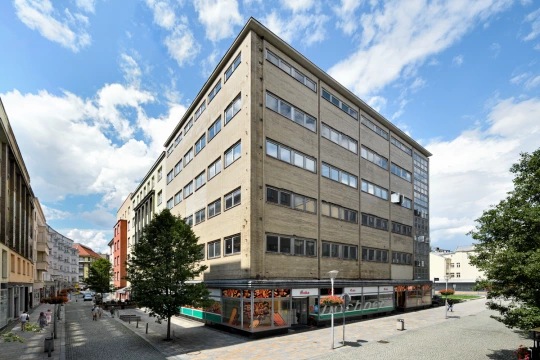
In his early work, Mendelsohn developed the Expressionist principles first articulated in his drawings. The most famous realisation from this period is the Einstein Tower near Berlin – an astronomical laboratory built in 1919–1921. His later work shifted towards Constructivism and an emotional sculptural Functionalism. Only a single building in the Czech lands was constructed according to plans from his office: the Bachner department store in Moravská Ostrava (Zámecká Street 1936/18), erected in 1932–1933. Although the building is a protected monument, its current condition is dire (with the ceramic façade peeling off) and does not reflect the building’s architectural significance.
In the interwar period, Mendelsohn completed numerous commissions not only in Berlin, but also in other parts of Germany and in what was then German (now Polish) Silesia. Notable examples include the Weichmann department store (1922) in Gliwice and the Petersdorf department store (1927–1928) in Wrocław. These buildings are protected monuments and, unlike the Ostrava realisation, remain in good condition.
One of Mendelsohn’s works – the Einstein Tower in Potsdam – is today inscribed on the UNESCO World Heritage List, and discussions are underway regarding the possible inscription of other buildings by Mendelsohn. The Bachner department store, despite being a listed building, is not among the candidates due to long-term neglect and a lack of interest from the owner and the wider public.
MSt
Výběr z dalšího díla
Completed projects:
Bachner Department Store, Zámecká Street 1936/18, Ostrava-Moravská Ostrava
Selected projects outside the Czech Republic:
Einstein Tower, Potsdam, Germany, 1920–1924 (World Heritage Site)
reconstruction of the “Berliner Tageblatt” printing house and office building, with Richard Neutra, Berlin, Germany, 1921–1923
Steinberg-Hermann & Co. hat factory, Luckenwalde, Germany, 1921–1923
Weichmann Silk Department Store, Gliwice, Silesia, Germany (now Poland), 1922
Krasnoje Znamja knitting factory, Leningrad (nocw St Petersburg), Soviet Union (now Russia), 1925
Schocken Department Store, Stuttgart, Germany, 1926–1928 (demolished)
Petersdorf Department Store, Wrocław, Germany (now Poland), 1927–1928
Woga complex with Universum cinema, Berlin, Germany, 1927–1931
Schocken Department Store, Chemnitz, Germany, 1928–1930 (converted into a museum)
Mendelsohn’s own villa, Berlin, Germany, 1928–1930
Headquarters of the Metalworkers’ Union, Berlin, Germany, 1928–1930
Columbushaus office building, Berlin, Germany, 1931–1932 (demolished)
De La Warr Pavilion, Bexhill-on-Sea, United Kingdom, with Serge Chermayeff, 1934–1935
Chaim Weizmann House, Rehovot, Palestine (now Israel), 1936–1937
House of Salman Schocken with library, Jerusalem, Palestine (now Israel), 1936–1937
Hadassah University Hospital, Jerusalem, Palestine (now Israel), 1936–1938
Hospital, Haifa, Palestine (now Israel), 1937
Maimonides Hospital, San Francisco, California, USA, 1946–1950
B’Nai Amoona Community Centre and Synagogue, St Louis, Missouri, USA, 1946–1950
Community Centre with Synagogue, Cleveland, Ohio, USA, 1946–1952
Mount Zion Community Centre, St. Paul, Minnesota, USA, 1950–1954
(List compiled from Bruno Zevi, Erich Mendelsohn. The Complete Works, Basel – Boston – Berlin, 1999.)
Literature
- Arnt Cobbers. Erich Mendelsohn: 1887-1953: the Analytical Visionary. Köln – London – Los Angeles, Taschen GmbH, 2007. ISBN 3822855952.
- Ita Heinze, Greenberg. Erich Mendelsohn … ze života / Biografisches. Ostrava, SPOK – spolek pro ostravskou kulturu, o. s., 2012. ISBN 978-80-87508-06-0.
- Erich Mendelsohn - Dynamik und Funktion. Realisierte Visionen eines kosmopolitischnen Architekten. Stuttgart – Berlin, 1999.
- Regina Stephan, Martin Strakoš, Tadeáš Goryczka, Jaroslav Němec. Erich Mendelsohn - Dynamika a funkce. Vize kosmopolitního architekta. Ostrava, GVUO, Spolek pro ostravskou kulturu, 2009. ISBN 978-80-85091-89-2.
- Regina Stephan, Martin Strakoš, Tadeáš Goryczka, Jaroslav Němec. Erich Mendelsohn - Dynamika a funkce. Vize kosmopolitního architekta. Ostrava, GVUO, Spolek pro ostravskou kulturu, 2009. ISBN 978-80-85091-89-2.
- Průvodce architekturou Ostravy. 2009. s. 176–177 a 400. ISBN 978-80-85034-54-7.
- Jindřich Vybíral. Zrození velkoměsta: Architektura v obraze Moravské Ostravy 1890–1938. Šlapanice, ERA, 2003. s. 157, 160–163. ISBN 80-86517-94-2.
- Bruno Zevi. Erich Mendelsohn. The Complete Works. Basel, Boston, Berlin, 1999.
- Erich Mendelsohn. Život a tvorba v datech. Available from: : https://bachner.cz/erich-mendelsohn [accessed 6. 8. 2025]