The architect and urbanist Jaroslav Rössler was born in Kladno into the family of the director of the local State General Craft School on the 14th of January 1886. He studied with Jan Kotěra at the Academy of Arts, Architecture and Design in Prague in the years 1906–1910, and then with Friedrich Ohmann at the Academy of Fine Arts in Vienna, where he also received the honorary Hansen Prize plaque from the hands of Hermann Helmer in 1910 and the Olbrich Prize a year later. He went on study trips to Germany, Italy, the Netherlands, Belgium and Sweden. In 1918, he joined the Czechoslovak Legions in Omsk, Russia. He was a member of the Prague Union of Creative Artists, for whom he designed the exhibition pavilion (known as “Nová Síň” today) on Voršilská Street in Prague’s New Town in the year 1934. He contributed his articles to professional periodicals (e.g. the essay Buildings of General Schools in Styl magazine in 1912) and published a monograph of his own works, Neue Architektur, where in the introduction he expressed his conviction that: “form is an indispensable part of every building work, just as its function and construction are”.
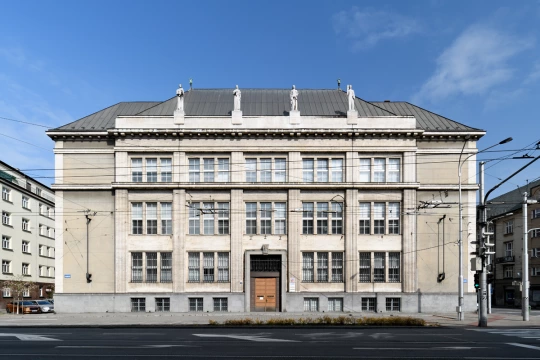
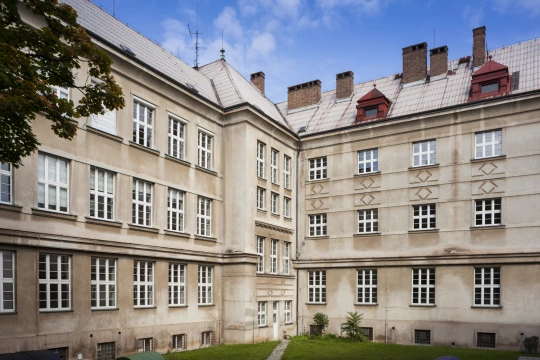
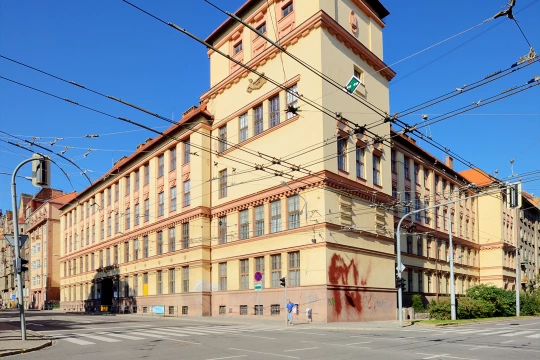
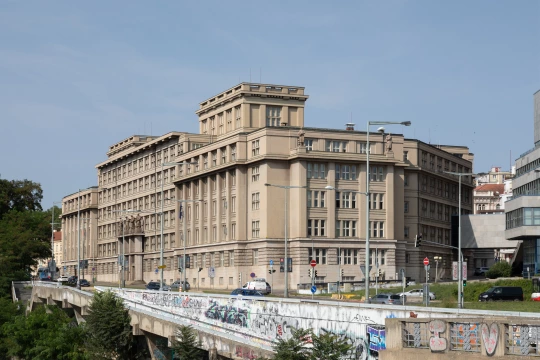
Rössler’s first projects of the 1910s are connected with his birthplace and show the influence of the Kotěra style of Modernism, be it the facades of the Municipal Theatre in Kladno, the house and printing workshop of Jaroslav Šnajdr, or the State Technical School. The last two buildings are characterised by a combination of burlap brick walls and plastered surfaces. Rössler also prepared plans for the development of the square in Kladno. However, he gradually shifted towards a classicising form of Modernism and Neo-Classicism – as manifested in the buildings of the Trade Academy in Brno (1920), and the Czechoslovak State Grammar School in Pilsen (C3–1736, 1923–1937). Towards the end of his architectural work, Rössler arrives at a Purist or even Functionalist expression in some of his buildings, e.g. in house no. 1813 in Prague–Dejvice, apartment house no. 480 in Puškin Square in Prague–Bubeneč, and in the building of the post and telegraph office in Prague–Libeň. Besides designing public buildings and residential houses, he also designed monuments, memorials and plaques, most of them connected with the First World War. During his creative career, he took part in a great many architecture competitions with varying degrees of success.
Jaroslav Rössler was awarded an honour For Outstanding Work in the year 1965. He died in Prague on the 27th of November 1964.
AŠ
Literature
- Jiří Hilmera. Praha, Academia, 2006. p. 651.
- Prokop Toman. Praha, Rudolf Ryšavý, 1950. p. 371.
- Prokop Toman. Praha, Rudolf Ryšavý, 1950. p. 371.
- Jiří Blaha, Bohumír Kozák. 1965, roč. XXIV. sv. 7, p. 467.