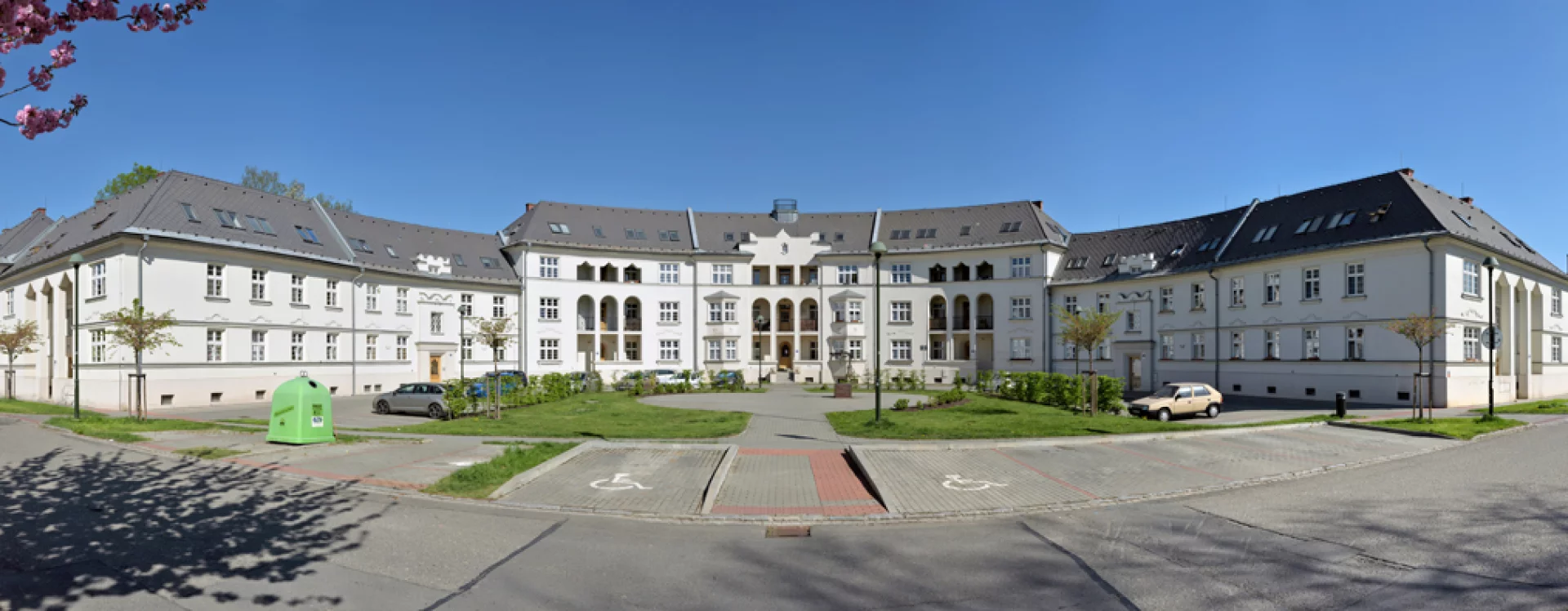
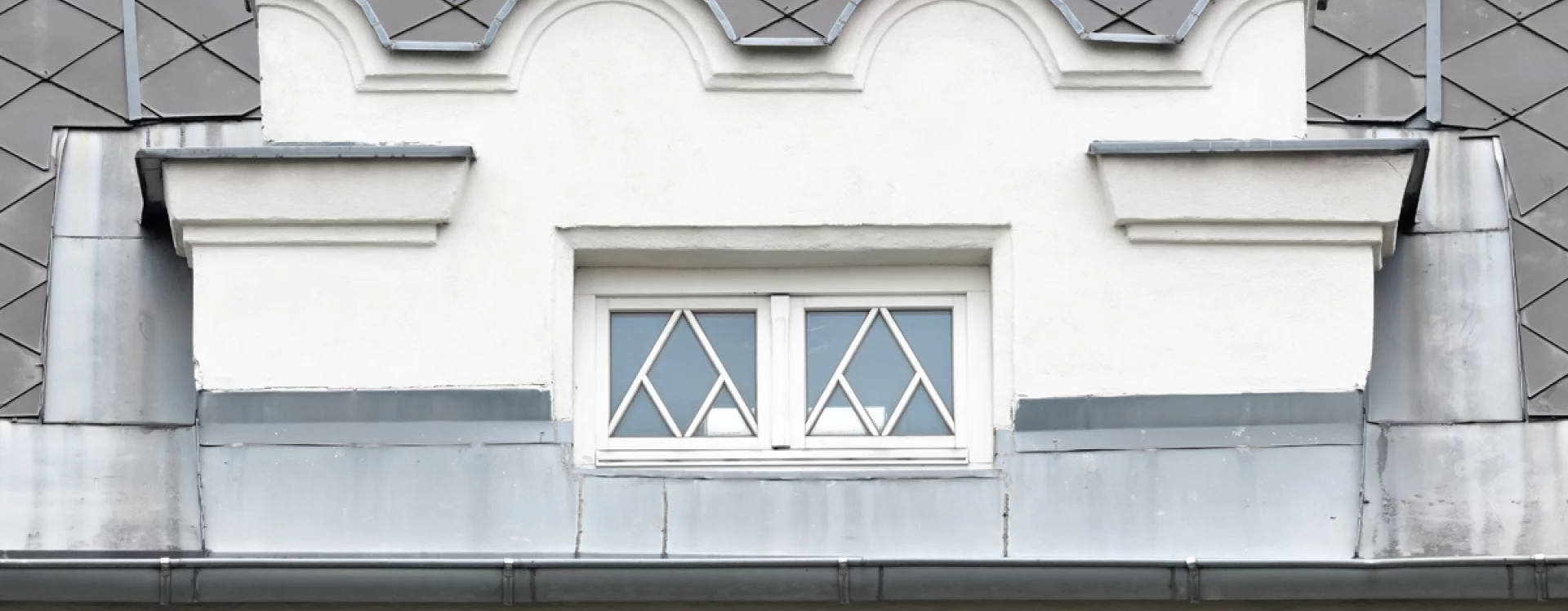
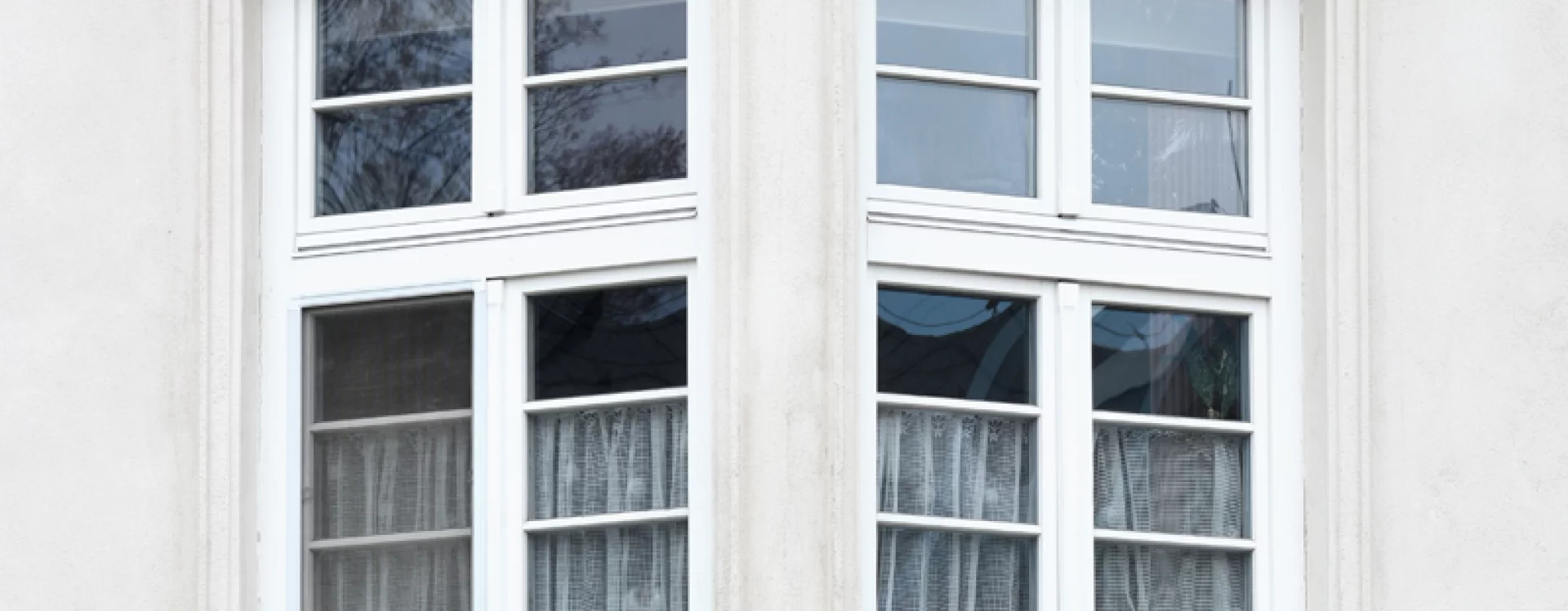

The architectural and urban significance of the second phase of the Jubilee Colony construction, designed by the Moravská Ostrava-based architect Ernst (Arnošt) Korner (1888–1966), is exemplified by the U-shaped block of residential buildings. Within this phase, a group of houses was constructed between Velflíkova and Letecká Streets, where a block-based layout was employed, continuing the development established in the earlier section of the colony between Velflíkova and Závodní streets.
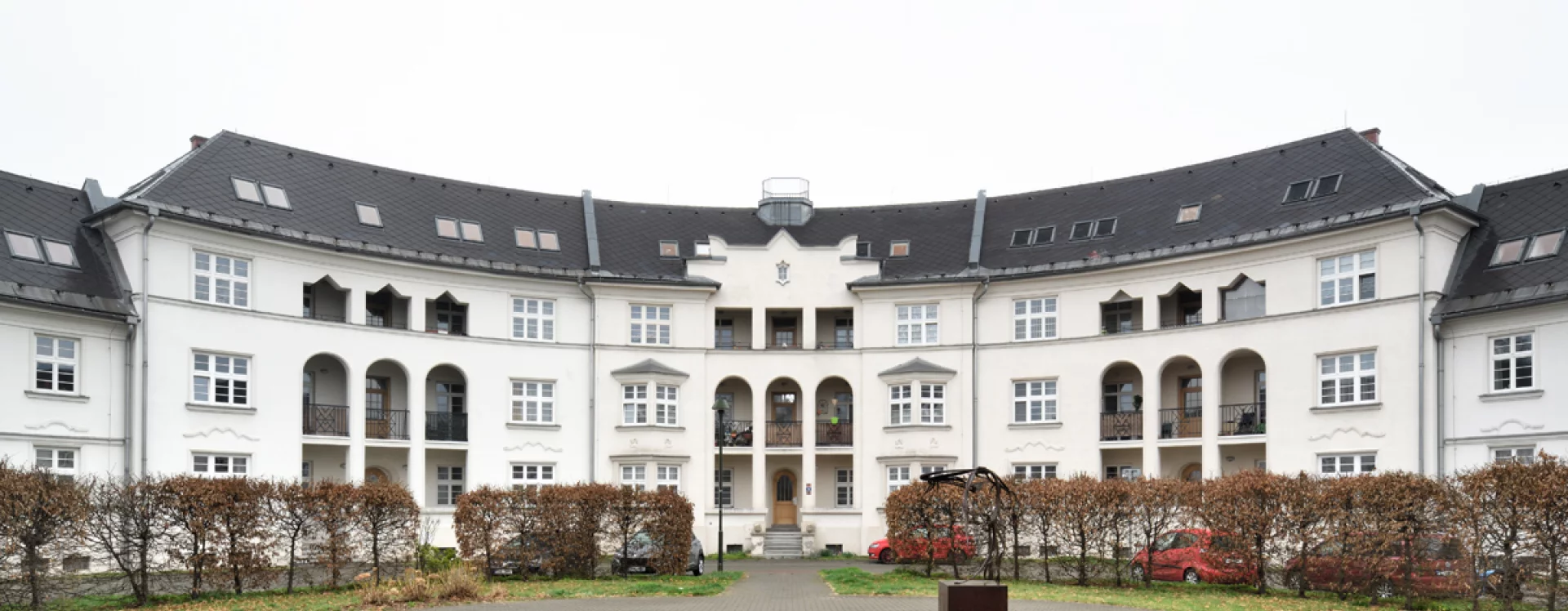
The U-shaped block consists of a three-storey residential building at Jubilejní Street 311/48, flanked by two further three-storey buildings (Jubilejní 310/46 and 312/50). These are followed, towards the main axis of Jubilejní Street, by two-storey terraced houses. Together, these buildings define a public space connected to Jubilejní Street, forming a landscaped square. The central building (no. 311/48) faces this space with a five-bay façade, its central three bays articulated as a two-storey recessed balcony. The ground-floor level of the balcony serves as an entrance vestibule, accessed through a centrally positioned doorway, from which a symmetrically aligned barrel-vaulted entrance leads into the corridor.
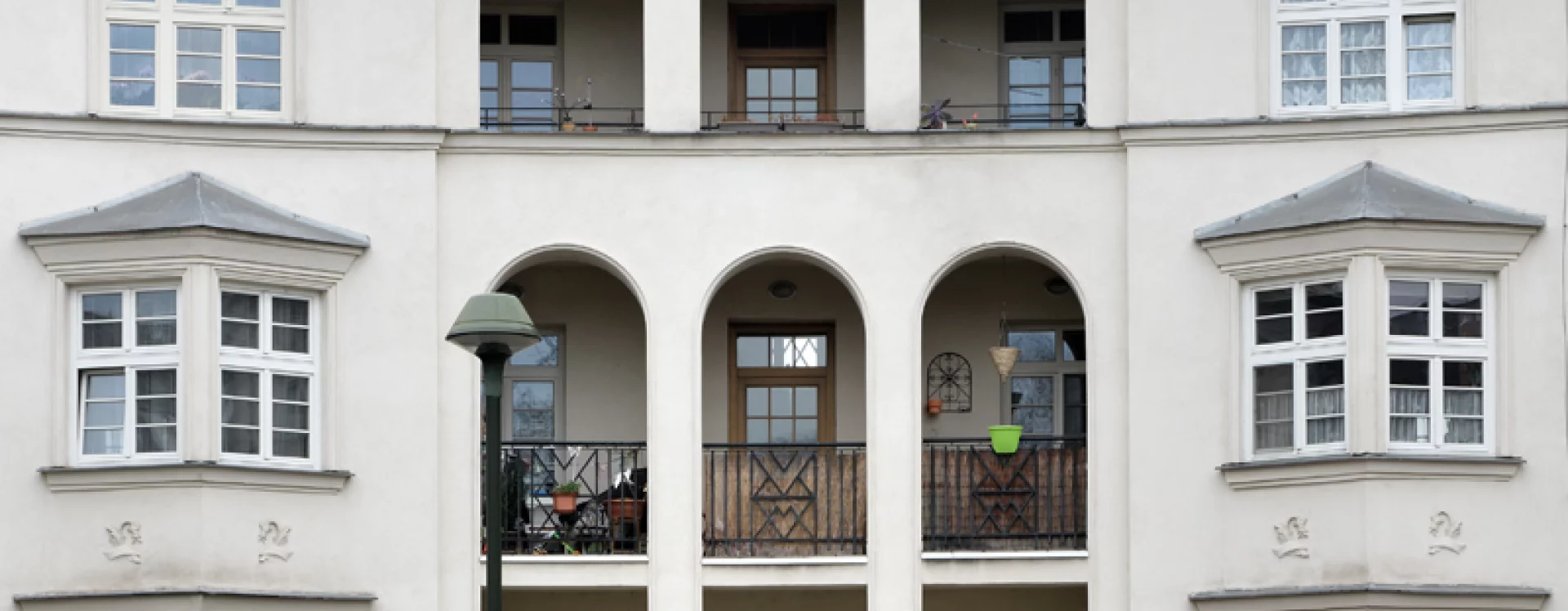
The upper-level recessed balcony features barrel vaults and metal railings forming a decorative motif derived from the letters V and W, referring to the Czech and German names of Vítkovice (Vítkovice / Witkowitz), the seat of the ironworks. While the first-floor balcony openings are arched, the second-floor balcony is formed by rectangular openings set on a continuous parapet cornice. Above them, the façade transitions into an attic gable with a small triangular pediment in the centre and stylised acroteria at the sides.
On either side of the balcony, the façade is completed by a single window bay articulated by polygonal bay windows on the ground and first floors, decorated with moulded window surrounds and parapet and lintel cornices. On the first floor, the ledges of the bays are further enriched with floral ornament. On the second floor, the side bays are defined by slightly rectangular triple windows with ventilators, framed by continuous ledges and crowning cornices. The crowning cornice is interrupted above the balcony, where the façade gives way to the attic gable.
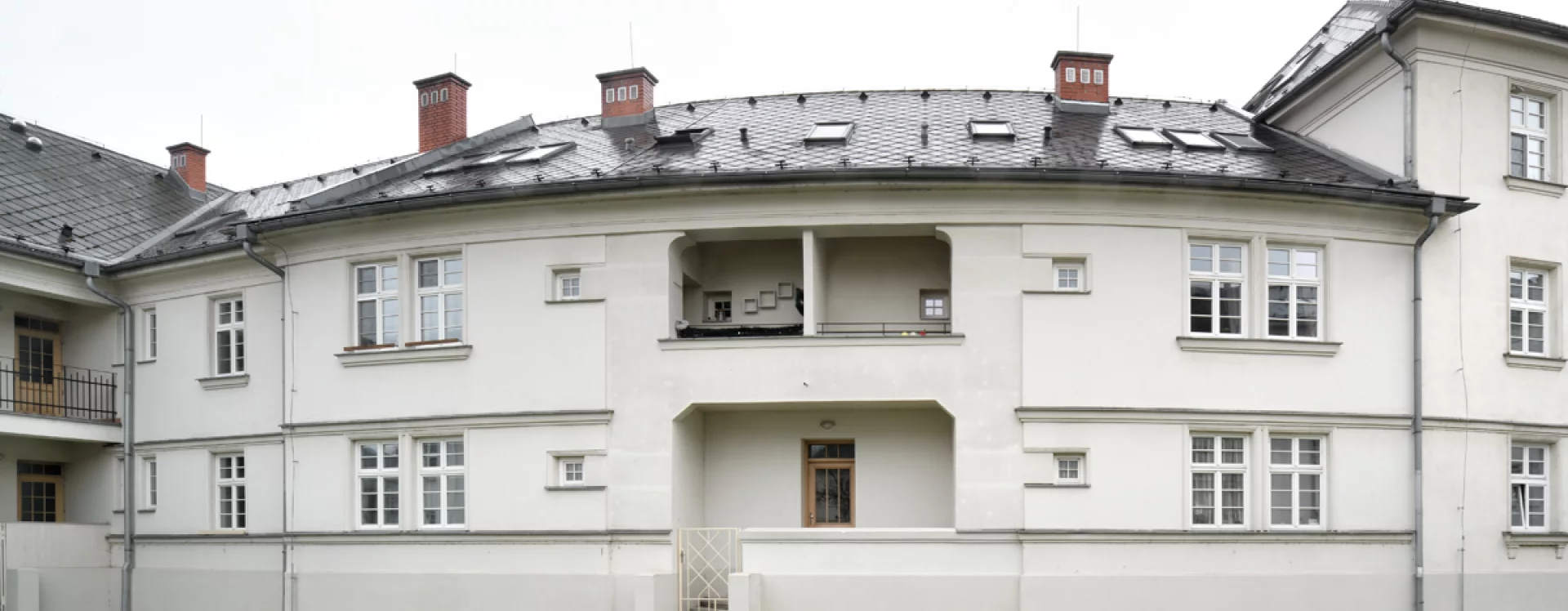
On the courtyard side, the building presents a five-bay façade organised around a central staircase axis, which forms its principal compositional element. At ground level, this axis takes the form of a pronounced entrance portal extending towards the axes of the small ventilation windows serving the sanitary facilities of the ground-floor flats. The recessed entrance is framed by a stucco surround with a cornice. On the first and second floors, the central axis is slightly set back from the plane of the façade and culminates, at the level of the divided crowning cornice, in an attic gable with acroterion motifs. The windows of the staircase axis are distinguished by diamond-pattern glazing bars. The façade is further structured by a system of cornices, including a continuous lintel cornice above the ground floor, a divided crowning cornice, and additional horizontal elements aligned with the central and adjoining bays.
The building is crowned by a pitched roof which, following reconstruction and the addition of attic living space, is fitted with roof windows, ventilation chimneys, and a hexagonal metal-clad rooftop structure with a terrace and metal railing positioned along the ridge. The building is arranged as a double-tract structure. Each floor contains two flats, arranged on either side of a central transverse axis comprising the entrance, corridor, and a two-flight staircase located in the southern tract.
The two flanking three-storey buildings (Jubilejní 310/46 and 312/50) adopt a similar façade composition, centred on a three-bay recessed balcony motif with the main entrance. In these cases, however, the vestibule within the balcony is accessed via an asymmetrically placed staircase, while the barrel-vaulted entrance to the building remains symmetrically positioned within the façade. On the first floor, the balcony openings are again barrel-vaulted and fitted with railings repeating the V and W motif. On the second floor, the balcony opens through rectangular apertures, with a central lintel incorporating an expressionist triangular arch. The side bays consist of rectangular windows with moulded surrounds, articulated ledge cornices with consoles, and decorative pediments on the ground floor, divided ledge cornices on the first floor, and a continuous ledge cornice on the second floor.
Towards the courtyard and Edisonova Street, both buildings present more restrained five-bay façades corresponding to the composition of the central building. All three buildings are topped with pitched roofs fitted with roof windows.
All the buildings described were restored according to designs by the architect Pavel Sedlecký. Owing to the heritage protection, their architectural character has been preserved. Public interior spaces have survived, while the flats have been modernised and additional residential units created through attic conversions.
In the second phase, Korner enriched the colony through the alternation of differently conceived building types and urban blocks, introducing a more varied and articulated urban structure. The U-shaped block thus represents one of the key components of the Jubilee Colony.
MSt
Literature
100 let Vítkovických železáren 1828–1928. Moravská Ostrava, Vítkovické železárny, 1928.
Petr Přendík, Radomír Seďa, Martin Strakoš. Jubilejní kolonie. 90 let dělnické kolonie v Ostravě-Hrabůvce. Ostrava, Montanex , Statutární město Ostrava, 2018. Společenský život a každodennost v Jubilejní kolonii, p. 99–119.
Petr Přendík, Radomír Seďa, Martin Strakoš. Jubilejní kolonie. 90 let dělnické kolonie v Ostravě-Hrabůvce. Ostrava, Montanex , Statutární město Ostrava, 2018. Výstavba Jubilejní kolonie, p. 21-68.
Petr Přendík, Radomír Seďa, Martin Strakoš. Jubilejní kolonie. 90 let dělnické kolonie v Ostravě-Hrabůvce. Ostrava, Montanex , Statutární město Ostrava, 2018. Rekonstrukce a modernizace, p. 185–192.
Petr Přendík, Radomír Seďa, Martin Strakoš. Jubilejní kolonie. 90 let dělnické kolonie v Ostravě-Hrabůvce. Ostrava, Montanex , Statutární město Ostrava, 2018. Architektura a památková ochrana Jubilejní kolonie, p. 145–183.
Historie Jubilejní kolonie. Available from: https://www.jubilejnikolonie.cz/historie-jubilejni-kolonie [accessed 14. 11. 2025]
Sources
plánová dokumentace 1920–1942. fond Archiv Vítkovice, a. s., fond Vítkovické horní a hutní těžířstvo, inv. no. 9579a a 1579a, fond Jubilejní kolonie v Hrabůvce.