Architect and civil engineer Ernst (later Arnošt) Korner was born into the family of merchant Johann Kohn from Uherský Brod. His brothers pursued careers in trade, economics, law, and the management of industrial enterprises, and studied in Vienna. Ernst Kohn, who later changed his name to Korner, left for Vienna after completing the technical secondary school in Brno, and in 1906–1911 studied structural engineering and architecture at the Vienna Technical University. There he met the painter Oskar Kokoschka, with whom he maintained contact in the following decades.
After his studies, Korner gained experience with various construction firms and architectural offices, including those in Moravská Ostrava, where his brother Benno Korner had been working as a builder since 1913. Ernst Korner settled in Moravská Ostrava in 1920 and in 1925 established his own architectural practice there. From the mid-1920s until his emigration, he used the Czech form of his name, Arnošt. Until 1938, he designed and built residential, commercial, and office buildings in Moravská Ostrava. His siblings were active in the city as well – in addition to the already mentioned Benno, Emil Korner served as the economic director in the management of the Vítkovice Ironworks, and lawyer Robert Korner represented major local companies and factory owners.
In his early creative period in the first half of the 1920s, Korner drew on conservative principles. His designs reflected post-Secession decorative tendencies, Neo-Classicism, and the Viennese Neo-Biedermeier tradition. This early phase is evident in the renovation of the apartment building at Dvořákova Streeet 1117/20 (1920) in Moravská Ostrava, in the design of the new office and residential building of the Rütgers company at Dr Šmerala Street 1626/2 (1921–1922), and in the alterations and extension to Dr Kraus’s villa for the needs of the Czech Union Bank (1921–1922, Nádražní Street 213/10).
During the 1920s, he gradually modernised the architectural expression of his projects under the influence of contemporary developments in Vienna and in Czechoslovakia. From the mid-1920s, his work increasingly displayed elements of Expressionism, Decorative Modernism, and New Objectivity. This can be seen, for example, in his competition entry for the New Town Hall in Moravská Ostrava (1923), as well as in his designs and realised projects for rental apartment buildings inspired by the large residential complexes of Red Vienna – vast, socially progressive housing blocks built by the Social Democratic administration for the city’s lower and middle classes.
Among Korner’s works belonging to this group are the second phase of the Jubilejní Colony in Ostrava–Hrabůvka from 1926–1931 (buildings on Edisonova, Jubilejní, Letecká, Slezská, Velflíkova, and Závodní streets) and the uncompleted complex of passage-linked buildings planned for the centre of Ostrava between 28. října Avenue and Denisova, Jurečkova, Střední, and Poděbradova streets.
In several projects from the late 1920s and early 1930s, Korner adopted the principles of New Objectivity, Purism, and Constructivism. This applies especially to the new Rix department store in the centre of Moravská Ostrava (1928, damaged in the 1944 bombing and demolished in 1945) and to the apartment building at Velká Streeet 64/21 (1930–1933).
Thanks to his family’s strong professional and social ties – particularly through the Vítkovice Mining and Metallurgical Company – Korner designed residential complexes for the Vítkovice Ironworks and their employees. This includes the second phase of the Jubilejní Colony, as well as further development in Vítkovice (Ruská Street, 1929–1930; Štramberská Street, 1929–1930) and in nearby Zábřeh (Krokova Street).
New Objectivity fully asserted itself in Korner’s work in the 1930s. This is visible, for example, in the residential block in Ostrava–Vítkovice (at the intersection of Závodní and Ruská streets) and in the apartment building U Sboru Street 1293 in his native Uherský Brod.
Fearing Nazi persecution because of his Jewish origins, Korner emigrated with his family to Great Britain. Soon afterwards they continued to Australia, where he designed his own house in the spirit of the International Style. In 2024, the area in central Ostrava where the unrealised opposite wing of Korner’s planned passage buildings would have stood was named Ernst Korner Park. A revitalisation of the site is now being prepared, ensuring its dignified integration into Ostrava’s public space.
MSt
Výběr z dalšího díla
Completed projects:
Česká banka Union (Czech Union Bank), Nádražní Street 213/10, Ostrava–Moravská Ostrava
Rütgers company office and residential building, now the regional headquarters of Czech Radio, Dr Šmerala Street 1626/2, Ostrava–Moravská Ostrava
Jubilejní Colony, semi-detached house with carriage entrance, Jubilejní Street 330/49a, 49b, Ostrava–Hrabůvka
Jubilejní Colony, residential building with recessed tripartite portico, Jubilejní Street 345/60, Ostrava–Hrabůvka
Jubilejní Colony, U-shaped block of apartment houses, Jubilejní Street 308/40 to 314/56, Ostrava–Hrabůvka
Jubilejní Colony, block of terraced houses in a sawtooth arrangement, Edisonova 377/15 to 382/25, Ostrava–Hrabůvka
Jubilejní Colony, semi-detached building with carriage entrance and retail ground floor, Velflíkova 258/8, Ostrava–Hrabůvka
Completed projects outside Ostrava:
residential house, U Sboru Street 1293, Uherský Brod
Kroner’s own detached house, Sydney, Australia
Literature
- Martin Strakoš. Architekt XLVII. 2001, roč. 8. sv. 8, p. 71–73.
- Průvodce architekturou Ostravy. 2009. p. 396, 416 ad. ISBN 978-80-85034-54-7.
- Kulturně-historická encyklopedie českého Slezska a severovýchodní Moravy I. (A-L). Ostrava, Ústav pro regionální studia, Ostravská univerzita, 2013. p. 468. ISBN 978-80-7464-386-6.
- Martin Strakoš. Architekt Ernst/Arnošt Korner a jeho ostravské dílo. In: Protimluv. 2016, 1-2. sv. 1-2, p. 94–99.
- Jindřich Vybíral. Zrození velkoměsta: Architektura v obraze Moravské Ostravy 1890–1938. Šlapanice, ERA, 2003. p. 112–118. ISBN 80-86517-94-2.
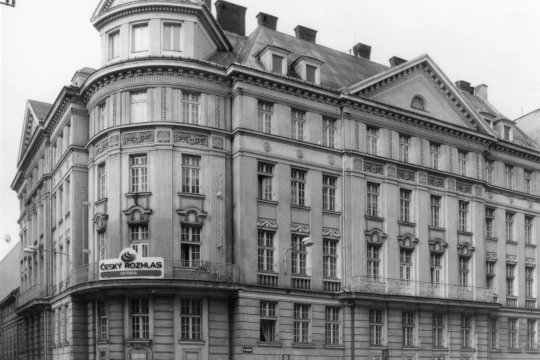 Rütgers Company Office and Residential Building
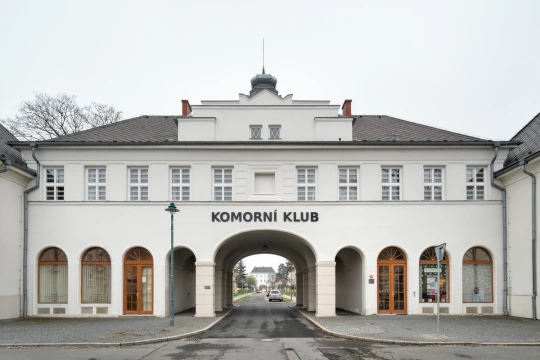 Jubilee Colony – Community Centre with a Passageway
 Jubilee Colony – Phase 2 – the “Accordion” Block
 Jubilee Colony – Phase 2 – U-shaped Residential Block
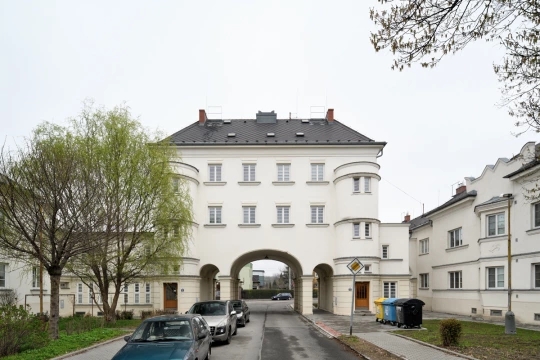 Jubilee Colony – Phase II – Residential Semi-Detached House with a Passageway
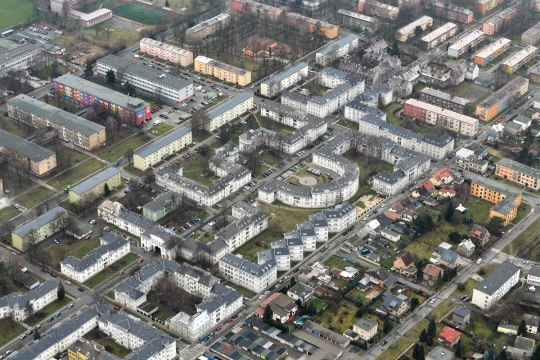 Jubilee Colony – Urban Planning