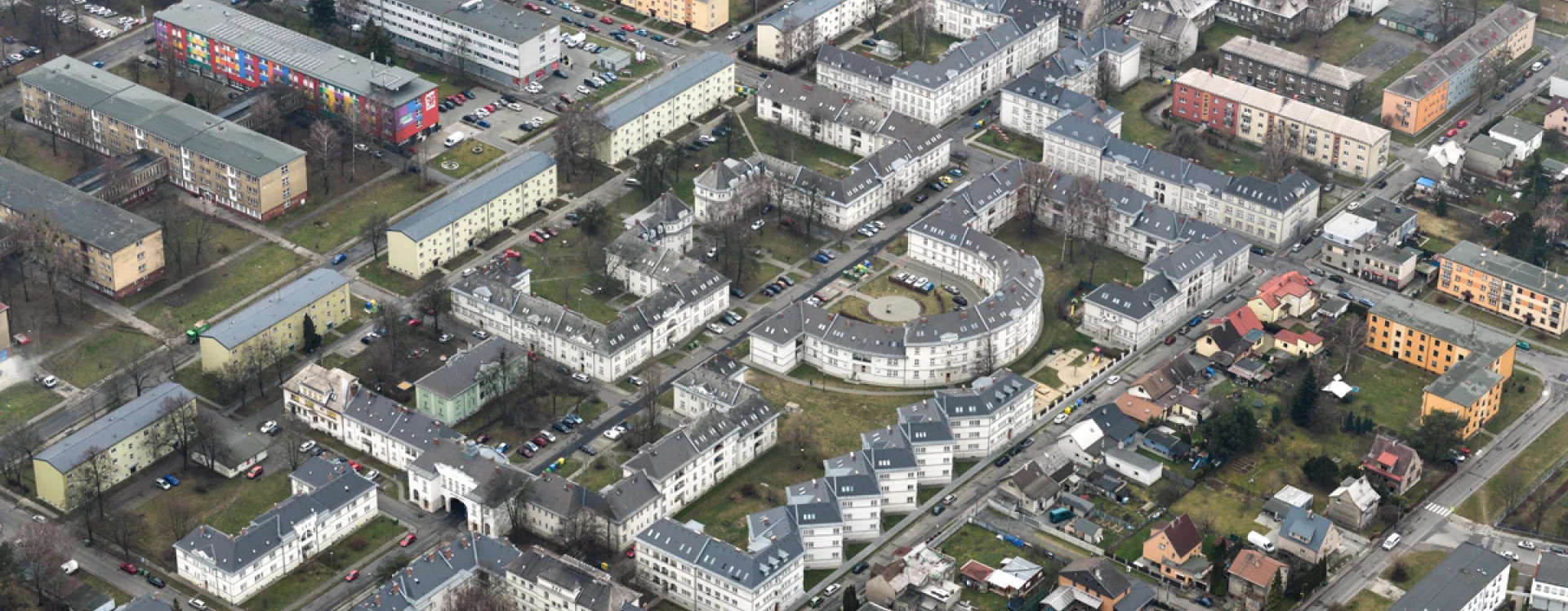
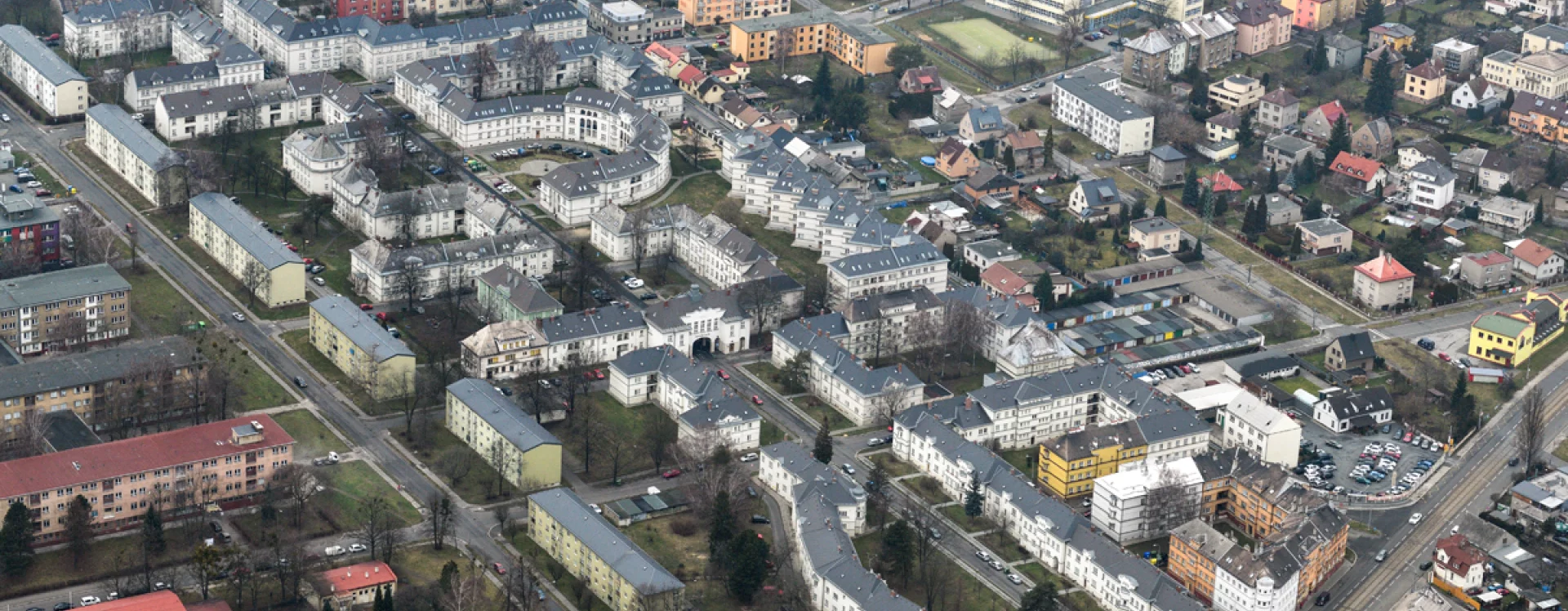
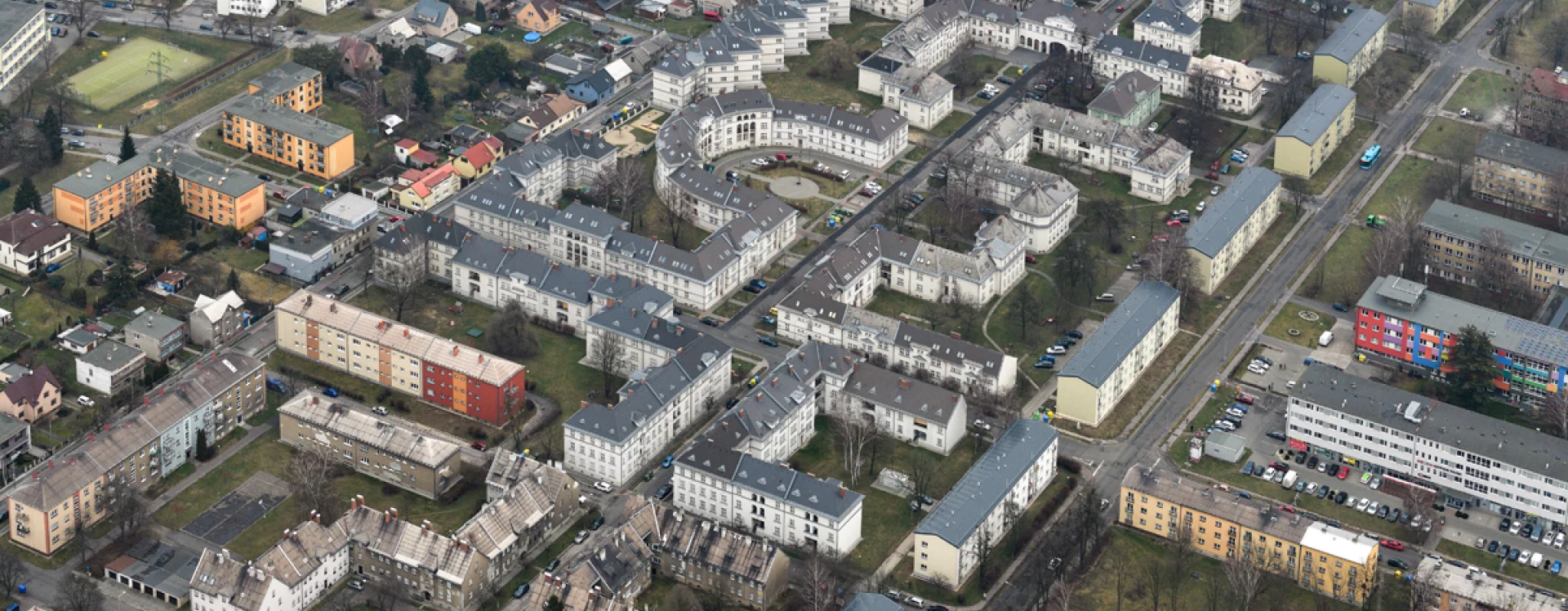
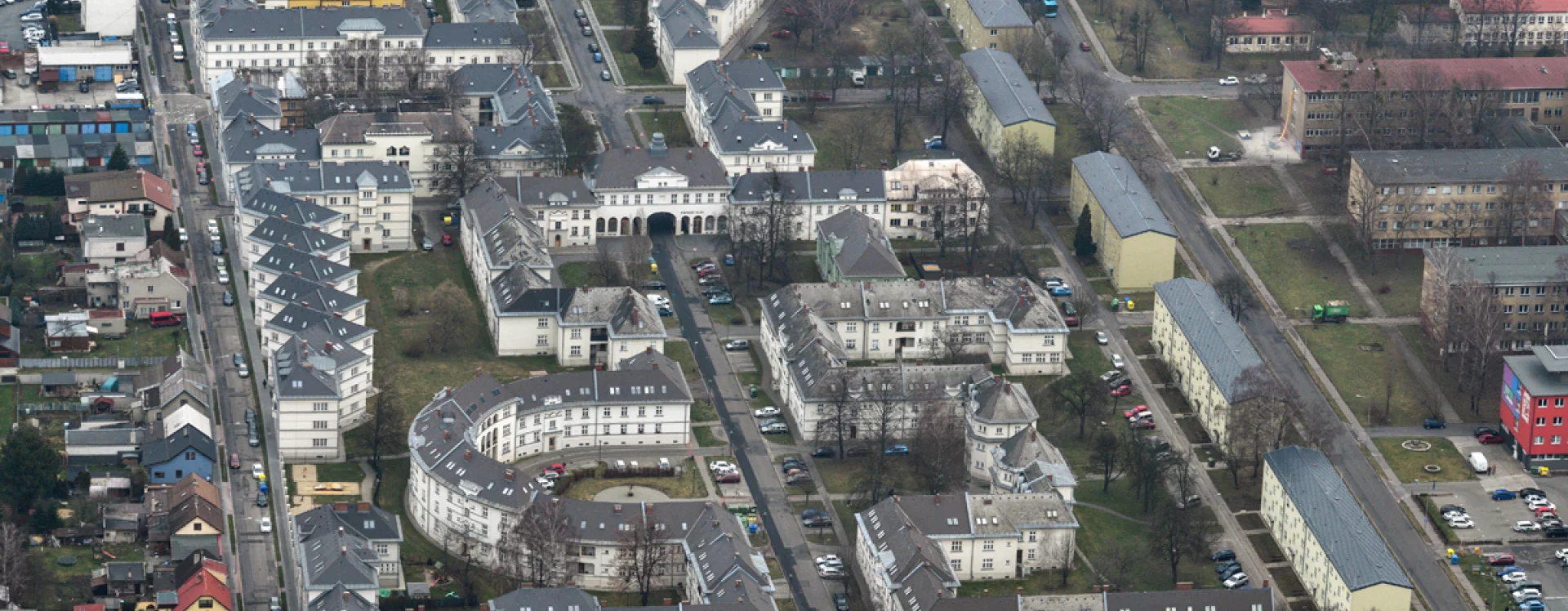
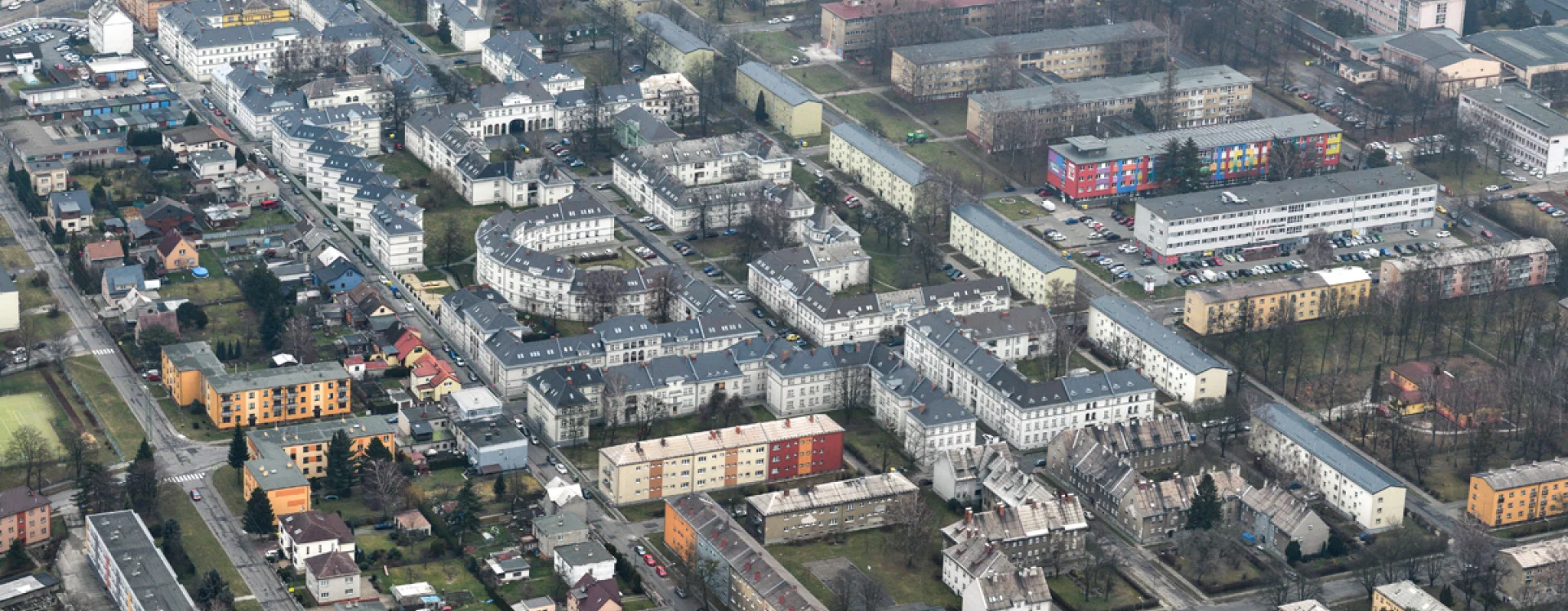
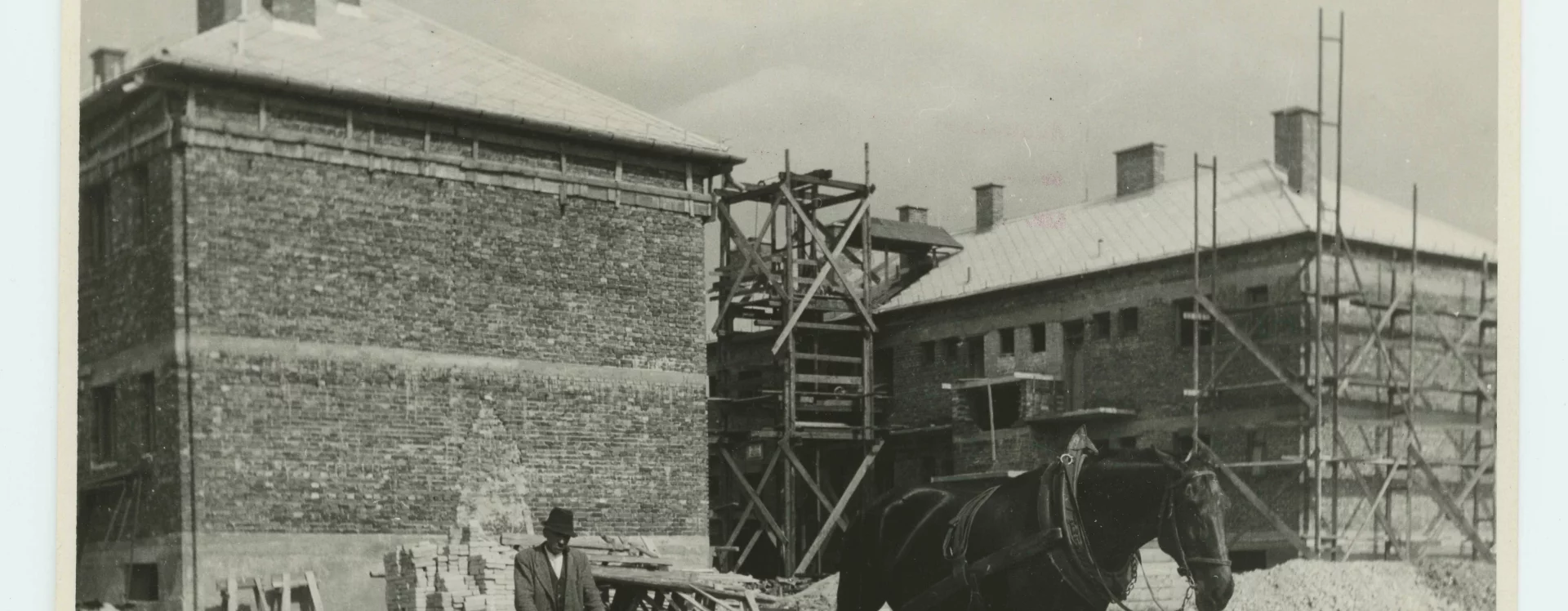
At the beginning of the 1920s, a housing colony for employees of the Vítkovice Ironworks began to take shape in Hrabůvka, then an independent municipality, close to the cadastral boundary with Vítkovice. As part of the celebrations marking the company’s centenary in 1928, it was given the name Jubilee Colony. Planning for the project had already begun in 1920. Several alternative urban schemes envisaged the construction of between twelve to twenty-four houses. Only in the spring of the following year did the Vítkovice Ironworks begin negotiations with the municipality of Hrabůvka about the construction of three apartment houses. A building permit for the first phase of the colony was issued in June 1921.
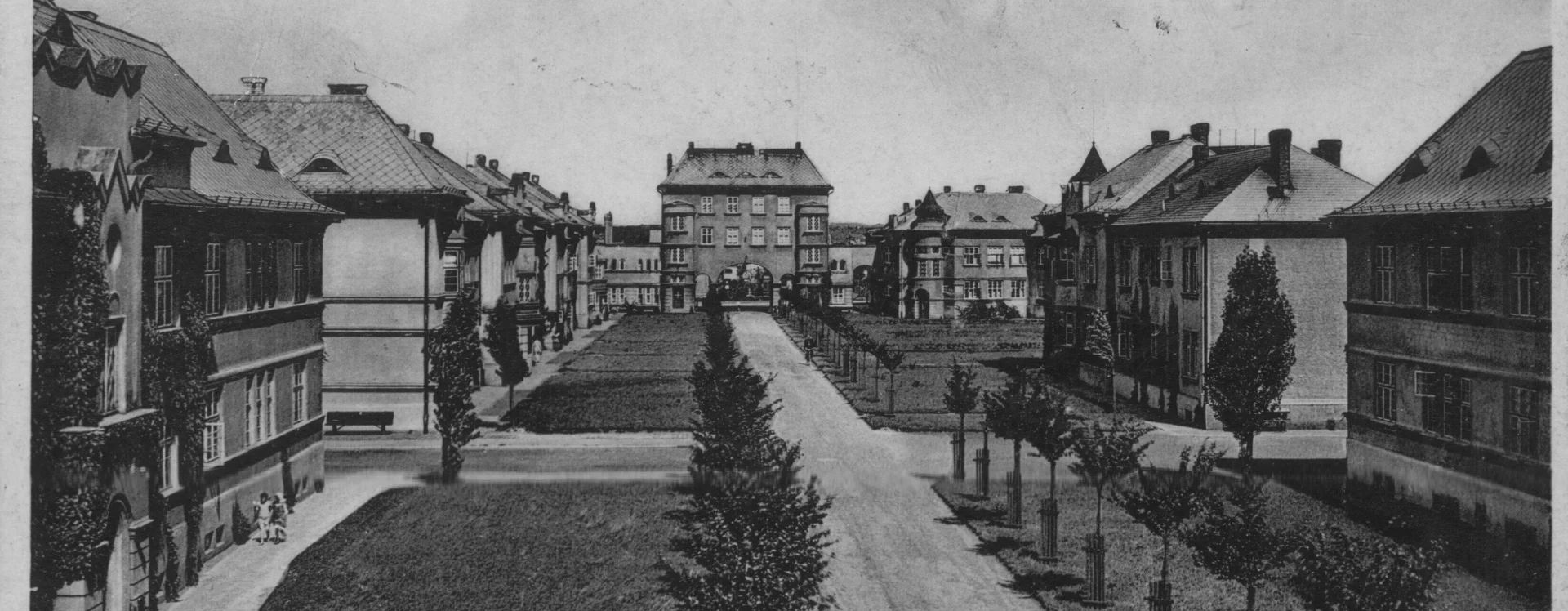
This initial phase consisted of nine freestanding two-storey apartment houses with four flats each, arranged along Jubilejní Street according to a design by the architect Friedrich Kober. On the north side of the street the houses were built parallel to the street line, while on the south side they were arranged along a curved line of the street. From the outset, the concept of the colony was inspired by the principles of the garden city. The houses were therefore surrounded by open green public space. Evidence of this approach can still be seen in the avenue of cherry trees planted along Jubilejní Street during the second phase of construction.
The earliest stage of the colony consisted of nine two-storey houses with rectangular plans and flats of a transitional layout type. Each apartment comprised an entrance hall, kitchen, living room, and a small study. The flats already had toilets, though these were not located inside the apartments themselves but beside the entrance doors on the staircase landings. Each house was intended to have a small garden, and in 1925 service outbuildings were constructed near the houses. These were soon removed, however, as the concept of the colony changed during the second phase of development designed by the Ostrava architect Ernst/Arnošt Korner.
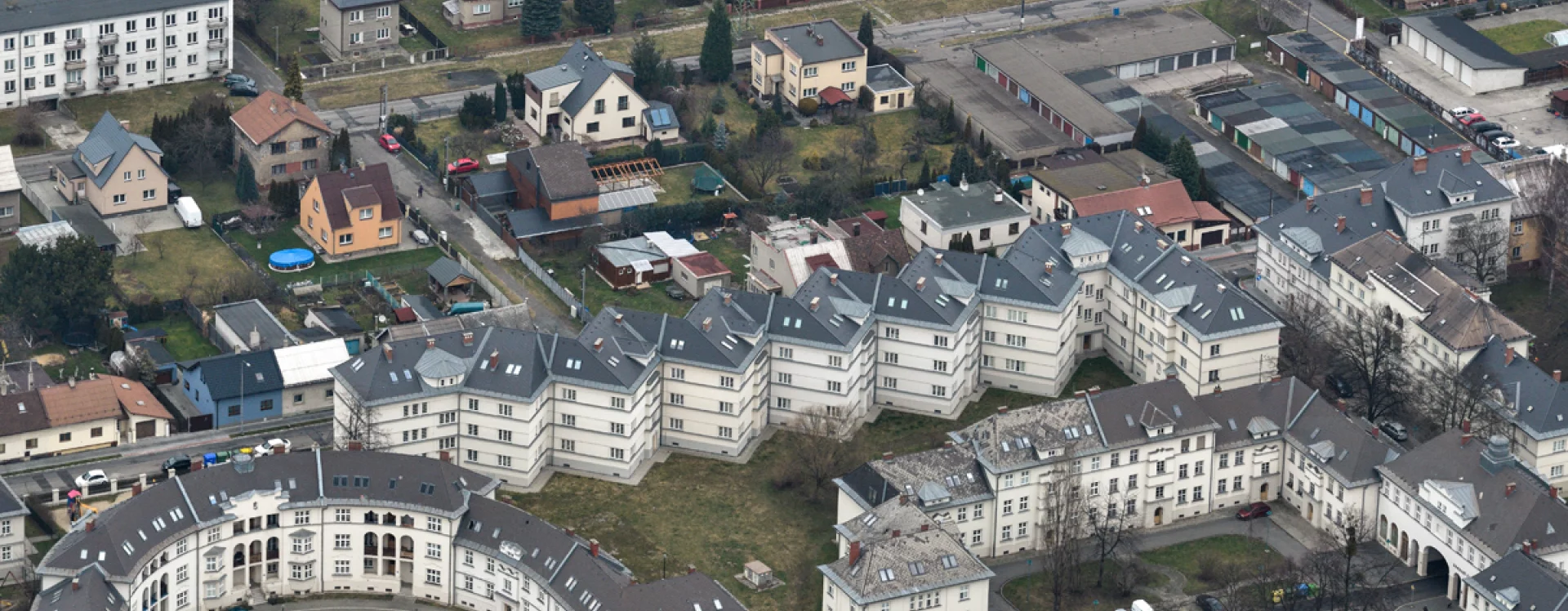
From the mid-1920s onwards, Korner proposed a transformation of the Jubilee Colony in Hrabůvka inspired by the large-scale municipal housing complexes in Vienna. Although the urban structure of the colony continued to follow the garden-city concept and developed along Jubilejní and Edisonova streets, the original plan of individually placed houses was replaced by apartment buildings integrated into continuous row development. These were arranged in semi-enclosed blocks of various shapes, including semicircular and rectangular forms. Instead of individual gardens, priority was given to landscaped public spaces with tree-lined avenues, including the aforementioned cherry trees along Jubilejní Street.
Korner also proposed to articulate the colony with more prominent and architecturally elaborate buildings that would rhythmically structure the individual urban units through gateway buildings at the entrances from Závodní and Velflíkova streets. To enliven the architectural expression of the colony, he employed a range of architectural elements, including risalits, portals, loggias, bay windows, attic gables, small towers, and stucco decoration, which animated the otherwise relatively restrained façades. Structurally and in terms of layout, the houses were designed as two-bay buildings containing mainly one-room flats with kitchen-diners. In this second phase the toilets were already integrated into the apartments. Because the flats still lacked bathrooms, communal bath facilities were built in the colony. A kindergarten for the children of ironworks employees also operated here. The central landmark of the second phase became the community building with a passage gateway in Velflíkova Street, which served as a library.
Construction resumed with a third phase in 1939–1940, although only two blocks designed by Korner were completed; their construction had originally begun in the early 1930s but was interrupted. A fourth phase followed in 1941–1942, carried out in the spirit of the German national Heimat style. These buildings are austere and characterised by steep gabled and hipped roofs, clearly distinguishing them from the earlier architectural concept of the colony. This phase produced two articulated housing blocks oriented towards Dvouletky Street and set back from the street line. They contained more generously designed flats for ironworks personnel, equipped not only with toilets but also with bathrooms. In the area of today’s Dvouletky Street, a square and a cultural centre had originally been planned.
After the Second World War, the concept for completing the housing development changed radically. In the final fifth phase, functionalist houses were built between Dvouletky and Stavbařů Streets according to a design by the architect Vladimír Krajíček, loosely continuing the earlier stages of development. Subsequent housing construction in Hrabůvka, however, followed entirely different planning concepts. Although Krajíček proposed a late-functionalist housing estate for the area in the late 1940s, this idea remained only on paper. Further development in Hrabůvka was shaped by changes in the political structure of the republic and by broader plans for the comprehensive reconstruction of the Ostrava region. The Jubilee Colony therefore remained limited to the phases described above.
Part of the development, built during the first and especially the second phases, represents a valuable urban and architectural complex from the era of the First Czechoslovak Republic, composed with a high degree of unity. Since 2024 the colony has also included a so-called Housing Museum located in a house at Slezská Street 390/13, dedicated to presenting the history of housing and the development of the Jubilee Colony.
MSt
Literature
100 let Vítkovických železáren 1828–1928. Moravská Ostrava, Vítkovické železárny, 1928.
Petr Přendík, Radomír Seďa, Martin Strakoš. Jubilejní kolonie. 90 let dělnické kolonie v Ostravě-Hrabůvce. Ostrava, Montanex , Statutární město Ostrava, 2018. p. 21-68.
Petr Přendík, Radomír Seďa, Martin Strakoš. Jubilejní kolonie. 90 let dělnické kolonie v Ostravě-Hrabůvce. Ostrava, Montanex , Statutární město Ostrava, 2018. p. 185-192.
Průvodce architekturou Ostravy. 2009. p. 192-194, 396, 416. ISBN 978-80-85034-54-7.
Petr Přendík, Radomír Seďa, Martin Strakoš. Jubilejní kolonie. 90 let dělnické kolonie v Ostravě-Hrabůvce. Ostrava, Montanex , Statutární město Ostrava, 2018. p. 145-183.
Martin Jemelka, Gabriela Pelikánová, Romana Rosová, Martin Strakoš, Radomír Seďa. Jan Prokeš: Ostrava na cestě k velkoměstu. Ostrava, Fiducia, 2023. p. 73-74. ISBN 978-80-907934-5-3.
Jindřich Vybíral. Zrození velkoměsta: Architektura v obraze Moravské Ostravy 1890–1938. Šlapanice, ERA, 2003. p. 118. ISBN 80-86517-94-2.
Sources
plánová dokumentace 1920–1942. fond Archiv Vítkovice, a. s., fond Vítkovické horní a hutní těžířstvo, inv. no. 9579a a 1579a, fond Jubilejní kolonie v Hrabůvce.