Marie Frommer was born on 17 March 1890 into a Jewish family in Warsaw, but she grew up in Leipzig. She first trained as a language teacher, and in 1911 she began studying architecture at the Royal Technical University in Charlottenburg (today the Technical University of Berlin). She was one of six women among 353 students. During her studies she became interested in urbanism and the development of cities. Because the Berlin Technische Hochschule was at that time relatively conservative, she continued her studies after graduating in 1916 at the Technische Hochschule in Dresden. There she focused particularly on the development of Dresden and on bridges and their role in the city, combining structural understanding with artistic requirements. Her mentor was Cornelius Gurlitt (1850–1938), who in 1919 helped her to become the first woman in Germany to receive a doctorate in architecture. Her dissertation, The Flow of Rivers and the Development of the City, examined the role of waterways in the construction and formation of urban organisms. She analysed in particular the development of Dresden’s so-called Brühl Terrace and critically assessed the new Academy of Fine Arts building erected there to the design of Constantin Lipsius between 1886 and 1893. She belonged to the very small number of women who began studying architecture during the German Empire and succeeded in establishing themselves as independent architects during the Weimar Republic, when women gained political rights and access to professions previously reserved for men.
After completing her doctorate, Frommer gained practical experience in architectural offices in Germany and abroad. She later returned to Berlin where, in 1925, she founded her own architectural practice with several employees. At first, she established herself through conversions of department stores, but she also designed new department store buildings, residential houses, villas, hotels, and public buildings, including their interiors and furnishings. She sought to enrich her designs with new and rarely used elements – such as light effects in residential zones, clubs, and public buildings – combined with expressive and unusual design features. She also supervised the construction of her projects.
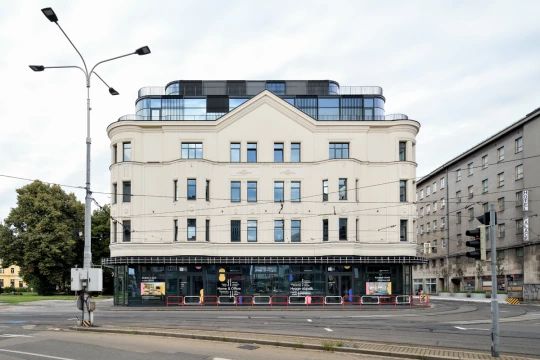
Frommer’s best-known work was the Villa Majestik in Berlin-Wilmersdorf (1929–1930), a hotel-style residence for single professional women. It was partly a new building and partly a reconstruction. Each residential unit had its own interior design and décor, giving it an individual character. The public rooms and common areas on the ground floor became a centre of women’s cultural and social life in Berlin, home to artists, writers, filmmakers, and intellectuals. Other notable projects by Frommer include the Jacoby shoe shop, the Leiser silk department store in Berlin, and the El Greco shoe shop in Paris. In Czechoslovakia she designed the Textilia department store in Moravská Ostrava in 1928, her only completed project on Czech territory. Her work was well received in the professional press. In 1930, she presented her projects at the exhibition Die gestaltende Frau (The Creative Woman) at the Wertheim department store. In 1931, she became a member of the Bund Deutscher Architekten (Association of German Architects). She was also socially active and wrote a regular column on housing in the magazine Die schaffende Frau (The Creative Woman).
Because of her Jewish origin, Frommer was prohibited from practising her profession after the rise of the Nazi regime in 1933 and was expelled from the Association of German Architects. For a short period, she could still undertake commissions for foreign clients. In 1936 she emigrated – first to London, where her brother and his family were living at that time. However, she was unable to find clients in England, partly because she was not admitted to the Royal Institute of British Architects. In 1939, she emigrated to the United States.
Little is known about her life in the USA. From the early 1940s, she designed buildings in New York, where she settled and continued her specialisation in department stores and hotels. In July 1944, the magazine Progressive Architecture – Pencil Points published her design for a club interior, created together with Paul Bry. In an exceptionally narrow, deep space, the architects used simple yet effective spatial and visual means, enlarging the perceived dimensions with light and mirrored surfaces. Another significant design was the Quaternian House, a four-building complex for low-income families, which she designed in 1948 (it is uncertain whether it was built). The scheme reflected the social ideas of Stephen Leeman.
In 1946, after passing the required examinations, Frommer obtained her New York State architect’s licence, enabling her to work independently and establish an office in Manhattan. In 1953, she became a member of the American Institute of Architects (AIA). She was also a founding member of the Soroptimist International Club, an organisation for working women, and a member of the international Saturday’s Children Club. Through these organisations Frommer managed to establish herself professionally in the USA. She also worked as an urban planning consultant in Spain. In 1969, the New York Times recognised her contribution to architecture.
Frommer’s American projects – from overall concept to furniture details – were rooted in the principles of New Objectivity architecture of the 1920s in Germany. They were influenced by experiments with light and by the use of expressive materials, shapes, and colours, aiming to create spatial tension. Frommer spent the rest of her life in the United States. She never married and had no children. She died in New York on 16 November 1976.
RR
Other Selected Works
Completed projects:
Textilia Department Store, 28. října Avenue 243/56, Ostrava-Moravská Ostrava, 1928–1929
Completed projects outside Ostrava:
Berlin, Leiser Silk Department Store, Königstrasse, 1920s
Berlin-Dahlem, Frankel Department Store, 1920s
Paris–Deauville, El Greco shoe shop, after 1924
Berlin-Wilmersdorf, Villa Majestic (residence for single professional women), 1929–1930
New York, library of the law firm Mansbach & Paley, 1945
Literature
- Průvodce architekturou Ostravy. 2009. p. 391. ISBN 978-80-85034-54-7.
- Jindřich Vybíral. Zrození velkoměsta: Architektura v obraze Moravské Ostravy 1890–1938. Šlapanice, ERA, 2003. ISBN 80-86517-94-2.
- Kerstin Dörhöfer. Pionierinnen in der Architektur. Eine Baugeschichte der Moderne. Tübingen, 2004.
- „Frauen auf die Strassen (-) schilder!“. Dresden, 2007. p. 31.
- Mary Pepchinski. Frau Dr. Ing. Marie Frommer. Die erste Doktorandin der Architektur an der Sächsischen T. H. Dresden. In: Karin Reiche (Hrsg.), Frauen aus Lehre, Forschung, Verwaltung. Dresden, 1996.
- Frauen und moderne Architektur. Drei Dresdnerinnen der Weimarer Zeit. In: Frauen an Hochschulen. Förderung, Konkurrenz, Mobbing: Frauen an Hochschulen, Kultur, Kunst, Können Komposition.. Dresden, 1995.
- Maria Scheunpflug, Irmhild Praus. Sie waren die ersten Frauen: Marie Frommer. In: Karin Reiche (Hrsg.), 90 Jahre studierende Frauen in Sachsen. Dresden, 1997.
- Myra Warhaftig. Deutsche jüdische Architekten vor und nach 1933. Das Lexikon. Berlin, 2005.
- Marie Frommer. Available from: https://web.archive.org/web/20150215233048/http://dresden.stadtwiki.de/wiki/Marie_Frommer [accessed 13. 10. 2025]
- Dr. Ing. Marie Frommer. Available from: https://tu-dresden.de/tu-dresden/universitaetskultur/diversitaet-inklusion/gleichstellung/sichtbarkeit-von-wissenschaftlerinnen/kalender-historische-promovendinnen/dr-ing-marie-frommer?set_language=en [accessed 13. 10. 2025]
- Marie Frommer. Available from: https://cs.wikipedia.org/wiki/Marie_Frommer#cite_note-4 [accessed 13. 10. 2025]
Sources
- Kerstin Dörhöfer. Eine Baugeschichte der Moderne. Tübingen, 2004.