The lawyer and politician Antonín Schauer (1864–1940) studied law at Charles University in Prague, where he subsequently spent his entire life. During the First Republic, he was president of the board of several major financial institutions and established himself as an adviser to industrial enterprises. Besides holding various functions in the local bar association for more than three decades, he was also a defense attorney for several political trials of his time.
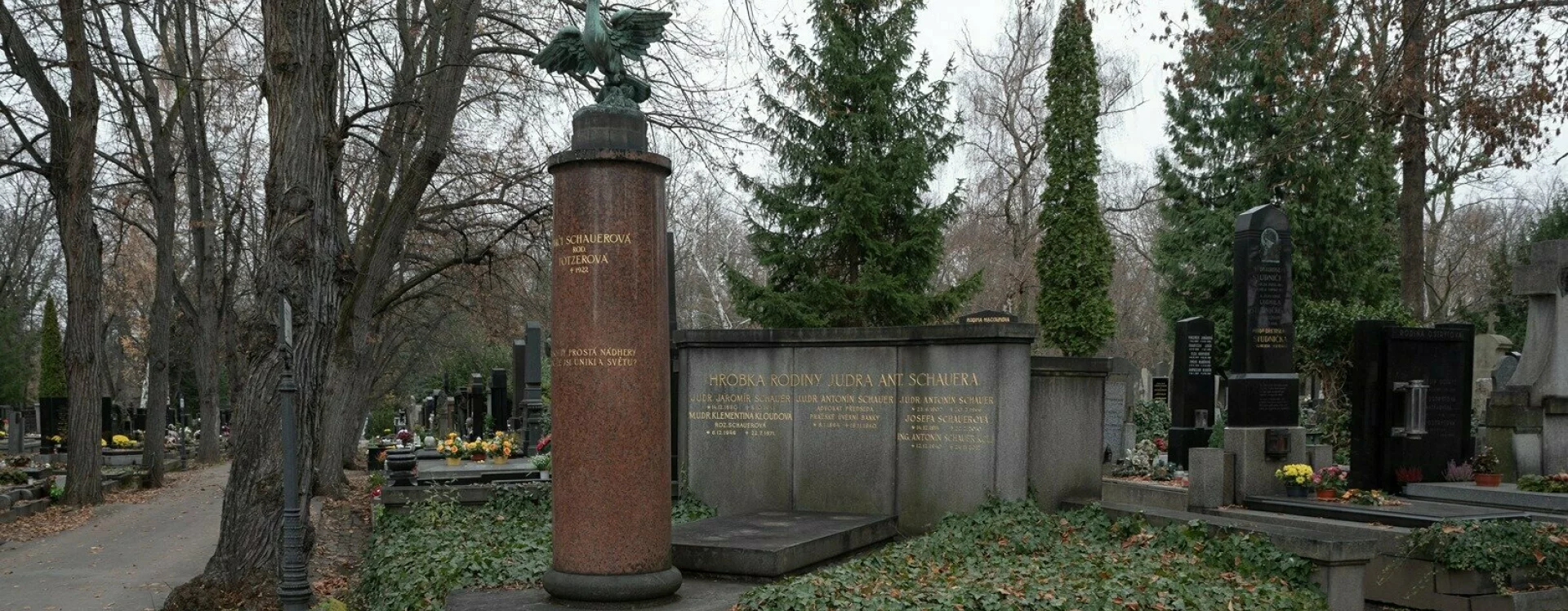
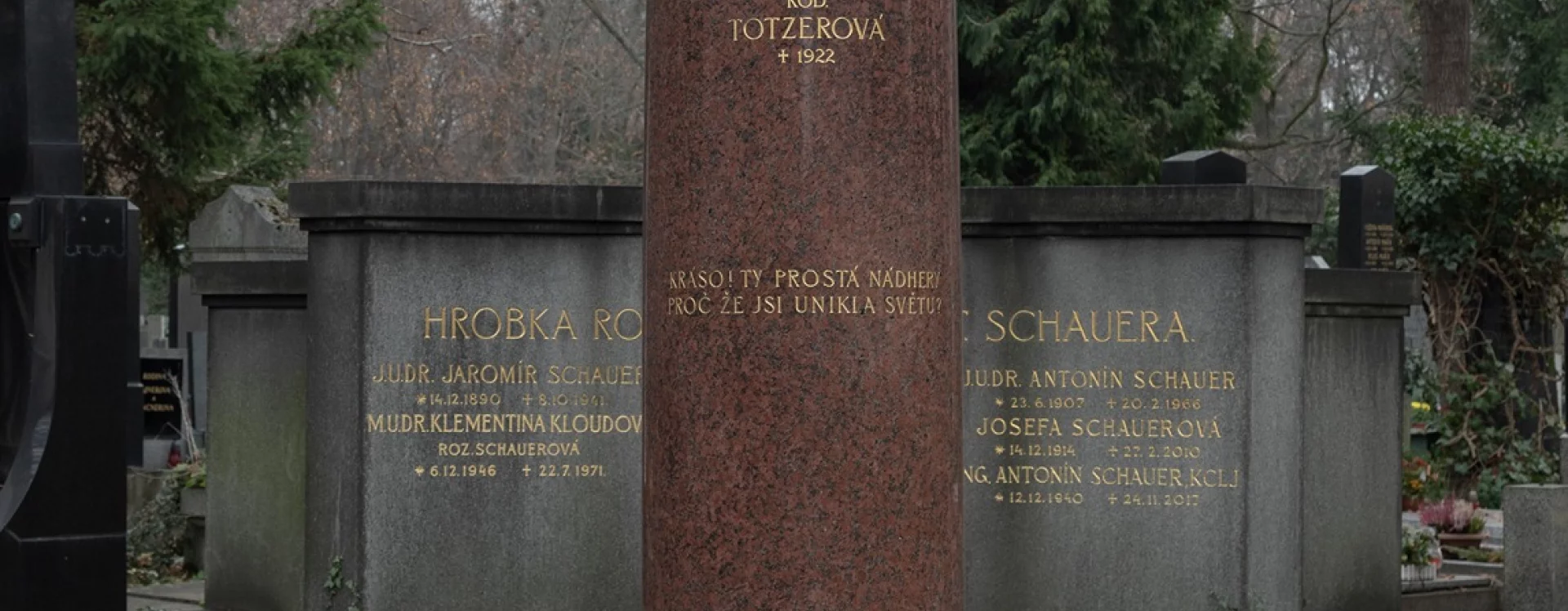
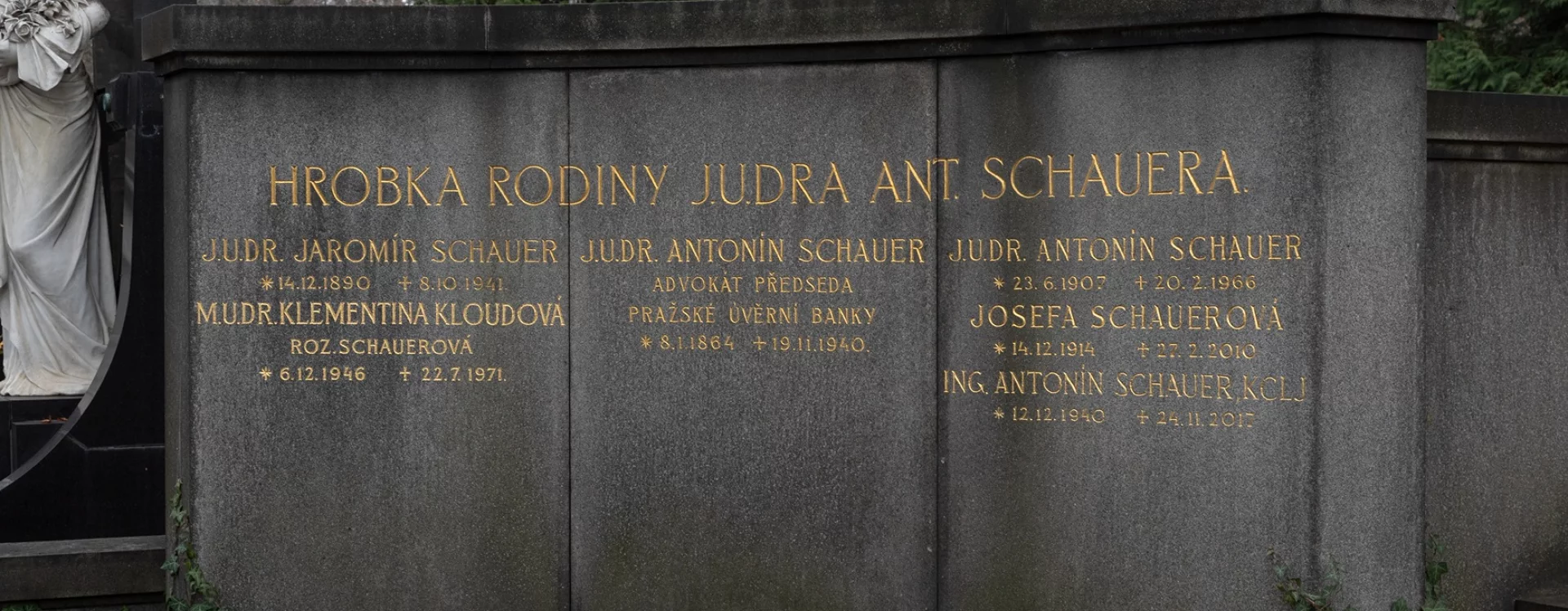
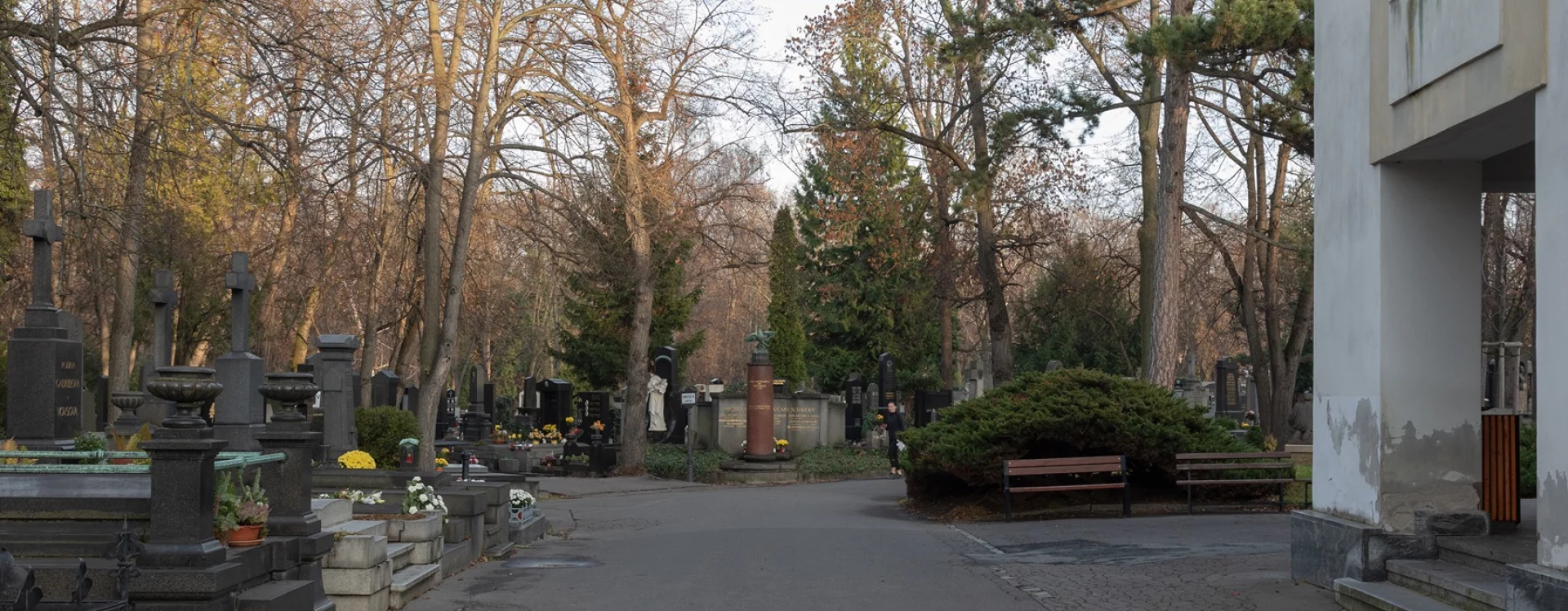
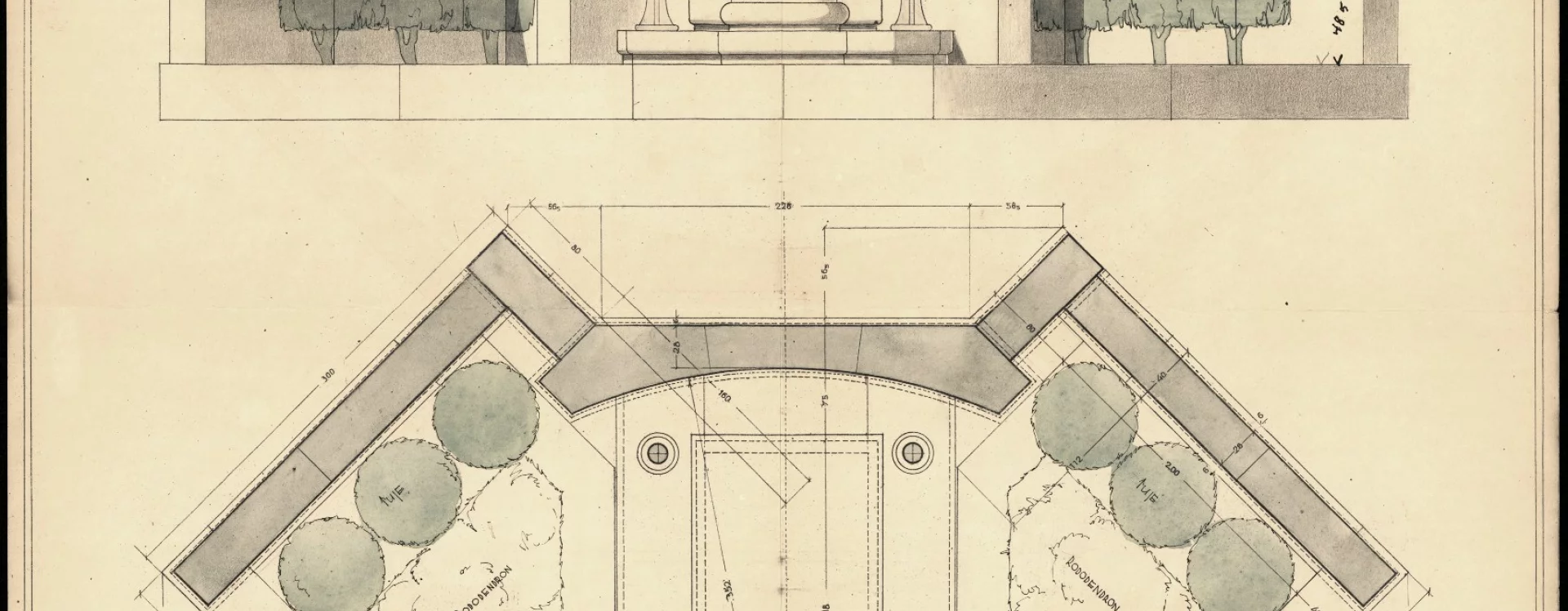
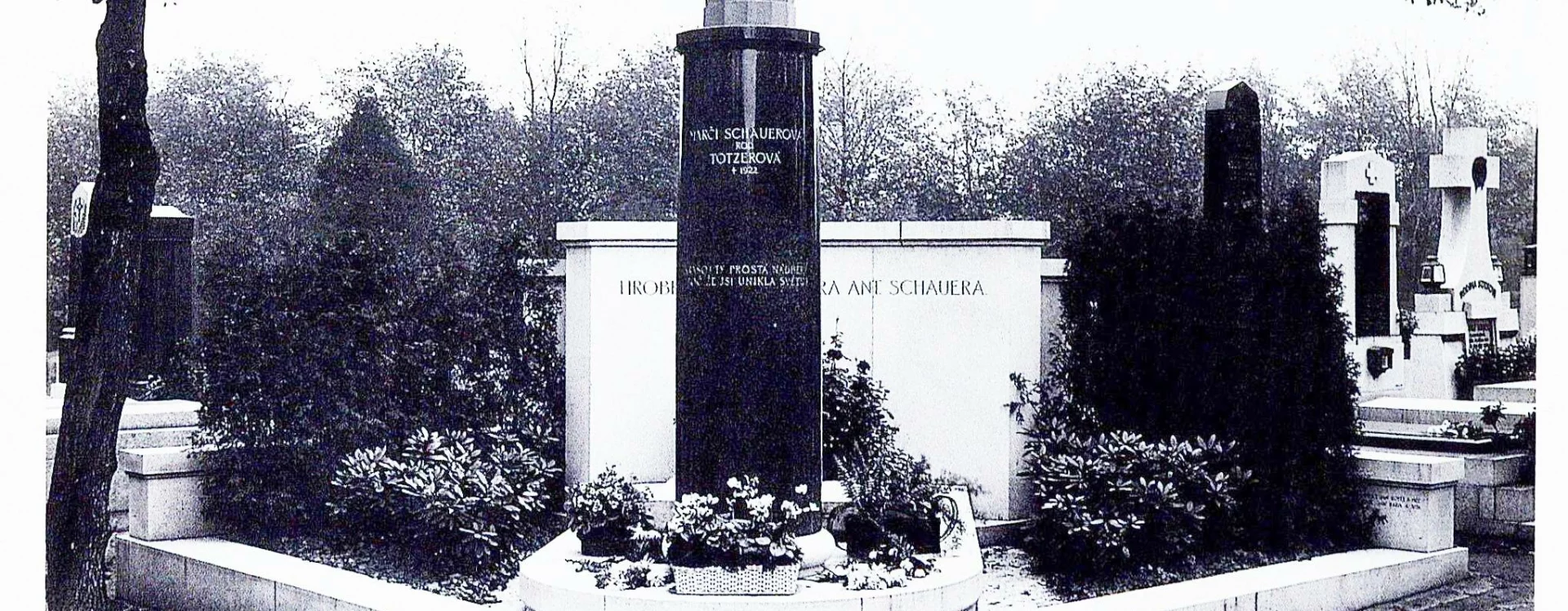
The site for the grave was acquired after the death of Schauer's second wife Marie (née Totzerová). The chance to come up with a design for the large corner plot went to Jan Kotěra, who made full use of the site. The plot is bordered along the sides by a low stone plinth, with a higher wall at the rear running up to the central block of the stele. Dominating the overall composition is a massive column of polished Swedish red granite standing on a stone step near the rounded front of the plot. The column's color forms a striking contrast with the gray honed and polished Mrákotín granite of the monumental triple-wing stele with a concave central slab, sheltered by a slightly projecting stone canopy. The stonework was done by the company of Jan Rada & Son, which owned granite and syenite quarries. The remaining space was apparently originally planted with sphere-shaped bushes.
This – his final sepulchral work – was the first time Kotěra introduced a column with a decorative capital. The original signed plans depict sculptural decoration on the column as well: a modernist variation on a Corinthian capital. In the end, however, production of the column was entrusted to the sculptor Otakar Španiel, who created a realistically rendered bronze sculpture instead, listed in his catalogue of works for the year 1923 as Departing Dove. In Christianity, the dove symbolizes the Holy Spirit and, by extension, the purified soul. In this case, it thus primarily represents the soul departing the world. It is also possible that this change was made only after Kotěra's death. Španiel's best-known funerary sculptures can be found in the cemeteries in Jaroměř, Potštejn, and Kolín, and at Vyšehrad and Olšany in Prague, where he did bronze sculptures for the grave monuments of professor Drtina, Dr. Fiedler (both in collaboration with the architect Josef Gočár), the Rada family, and Anna Chaloupková.
Anna Oplatková – Kateřina Lopatková, 2025
The site for the grave was acquired after the death of Schauer's second wife Marie (née Totzerová). The chance to come up with a design for the large corner plot went to Jan Kotěra, who made full use of the site. The plot is bordered along the sides by a low stone plinth, with a higher wall at the rear running up to the central block of the stele. Dominating the overall composition is a massive column of polished Swedish red granite standing on a stone step near the rounded front of the plot. The column's color forms a striking contrast with the gray honed and polished Mrákotín granite of the monumental triple-wing stele with a concave central slab, sheltered by a slightly projecting stone canopy. The stonework was done by the company of Jan Rada & Son, which owned granite and syenite quarries. The remaining space was apparently originally planted with sphere-shaped bushes.
This – his final sepulchral work – was the first time Kotěra introduced a column with a decorative capital. The original signed plans depict sculptural decoration on the column as well: a modernist variation on a Corinthian capital. In the end, however, production of the column was entrusted to the sculptor Otakar Španiel, who created a realistically rendered bronze sculpture instead, listed in his catalogue of works for the year 1923 as Departing Dove. In Christianity, the dove symbolizes the Holy Spirit and, by extension, the purified soul. In this case, it thus primarily represents the soul departing the world. It is also possible that this change was made only after Kotěra's death. Španiel's best-known funerary sculptures can be found in the cemeteries in Jaroměř, Potštejn, and Kolín, and at Vyšehrad and Olšany in Prague, where he did bronze sculptures for the grave monuments of professor Drtina, Dr. Fiedler (both in collaboration with the architect Josef Gočár), the Rada family, and Anna Chaloupková.
Anna Oplatková – Kateřina Lopatková, 2025
Literature
Vladimír Šlapeta, ed.. Jan Kotěra 1871-1923, Zakladatel moderní české architektury. Praha, 2001, s. 321, 325.
Drahomíra Březinová, Barbora Dudíková Schulmannová, Jana Růžičková. Jan Kotěra a Olšanské hřbitovy, Za Starou Prahu, Věstník za starou Prahu XXXIX. (X.), 2009, č. 3, příloha. 2009, p. nestr.
Rostislav Švácha ed.. Slavné vily Středočeského kraje. Praha, 2010, s. 198-201.
Jiří Hořava. Otakar Španiel I-III, Kniha první Život a dílo. Třeboň, 2024, s. 251.