


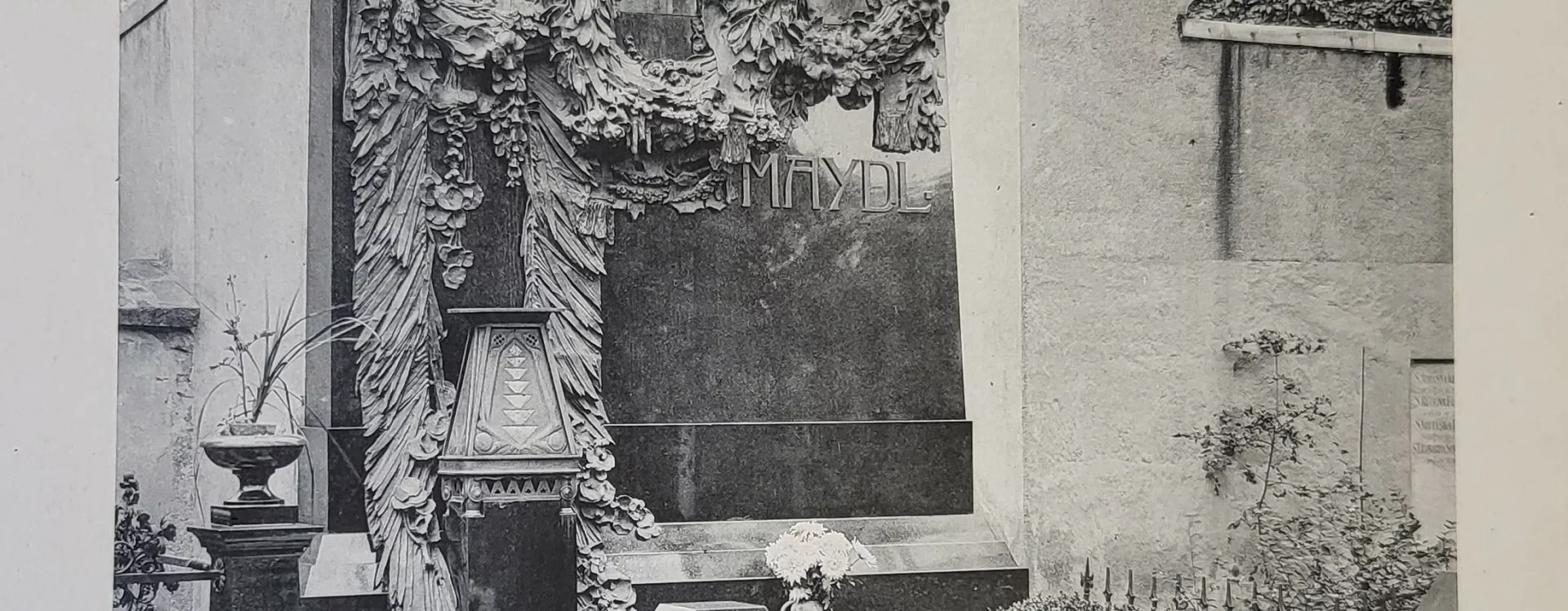
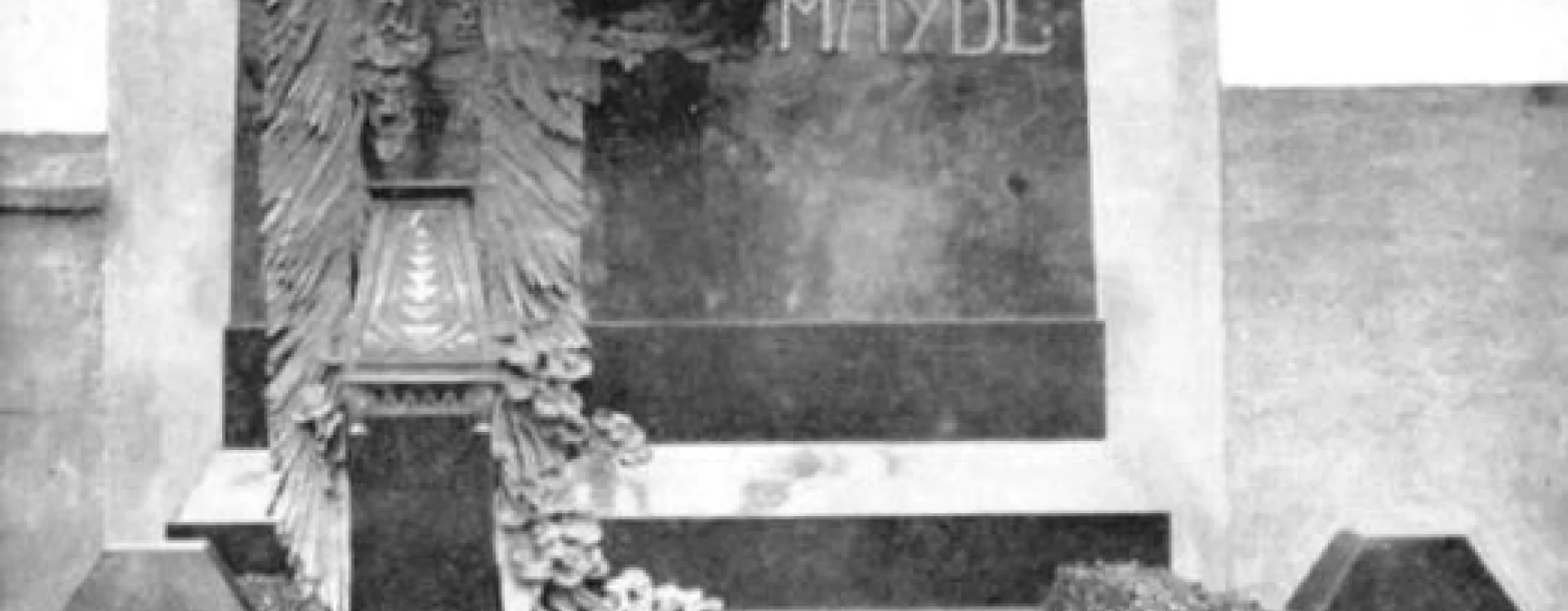
The grave monument of professor Karel Maydl, a surgeon of not only European but worldwide status, stands out for both its size and its workmanship. Contributing to its overall visual impression is the use of just a single word – MAYDL – on its inscription tablet.
Maydl trained as a surgeon in Innsbruck and gained further experience during the Serbian-Bulgarian war, when he was the head of Belgrade's military hospital. He subsequently worked in Vienna, and when he eventually was made the head of Prague's surgical clinic, he was already an established figure. In Prague, he trained a generation of outstanding doctors. He was open to the application of new knowledge and techniques that laid the foundations for modern twentieth-century surgery, be it the removal of a brain tumor or of a gallbladder. Maydl also introduced practices that we take for granted today, such as the wearing of white coats or the keeping of patient records and surgical logs. He was among the first in the world to operate on the large intestine and the bladder, or to perform hernia and gynecological operations. At the clinic, he implemented laboratory methods involving the use of microscopes, chemical analyses, and histological studies, and he pioneered new trends in anesthesiology. Besides being an excellent surgeon, he was also a scientist whose studies remain relevant to this day.
The Art Nouveau monument, with rich floral decoration in the form of three opulently modeled massive wreaths, was designed by the architect Jan Kotěra, who had returned from studying in Vienna six years earlier and whose elegant Art Nouveau designs helped to lead Czech architecture out of the dead end of historicism. Maydl's monument may in some ways be regarded as representing the pinnacle of this period in Kotěra's career, after which he moved away from ornamentation and toward the use of tectonics. Even so, the principles of construction and the clearly articulated composition of masses, though partly obscured by the work's decorative elements, are clearly visible here as well: for instance the steps with the low corner pylons, or the massive, almost square stele made of polished black Swedish granite.
While visiting the studio of the sculptor Bohumil Kafka – his colleague from the Academy of Arts, Architecture and Design and the Mánes Association – Kotěra saw a design for three hanging funeral wreaths that Kafka was working on at the time, and the two immediately agreed to work together. Kotěra later re-used this motif for the entrance to the Czech section of the Austro-Hungarian pavilion at the St. Louis World's Fair. Later, a cast of the three wreaths was used for the grave of Vojtěch Preissig's parents at the Vinohrady cemetery, whose architecture was designed by Josef Gočár. The casting process was performed by the Bendelmayer firm.
The monument's overall visual impact is somewhat weakened by the fact that some elements (the lettering, the lamp) have been stolen over the years.
Although there are ten more monuments by Kotěra at Olšany, none of the others achieves this level of monumentality.