Josef Fanta (1856–1954) is perhaps one of the most prominent figures of Czech architecture. Thanks in part to the fact that he lived to be nearly 100 years old, his body of work is unusually diverse. His undoubtedly most memorable project is the Art Nouveau building of Prague's main train station, but he drafted no less memorable designs in the field of funerary architecture, in which he was highly prolific. Besides countless individual gravestones at some of the country's most important cemeteries, including Vyšehrad and the Slavín pantheon, Fanta's most distinctive contributions to this field were two Art Nouveau projects: his plans for a new municipal cemetery in Kluk (a district of Poděbrady), and the Cairn of Peace, a memorial commemorating the Battle of Austerlitz that also serves as a resting place for the remains of fallen soldiers. For the decoration of his architectural designs, Fanta frequently collaborated with leading sculptors, first and foremost Čeněk Vosmík.
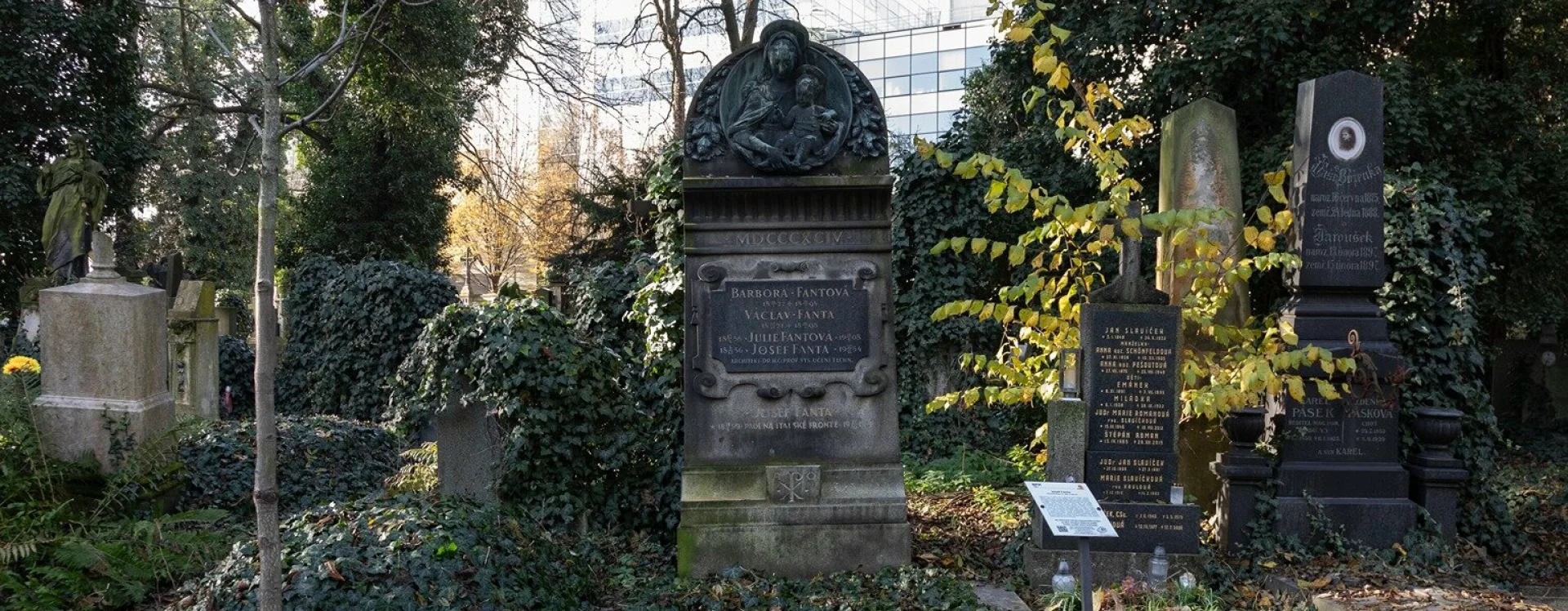
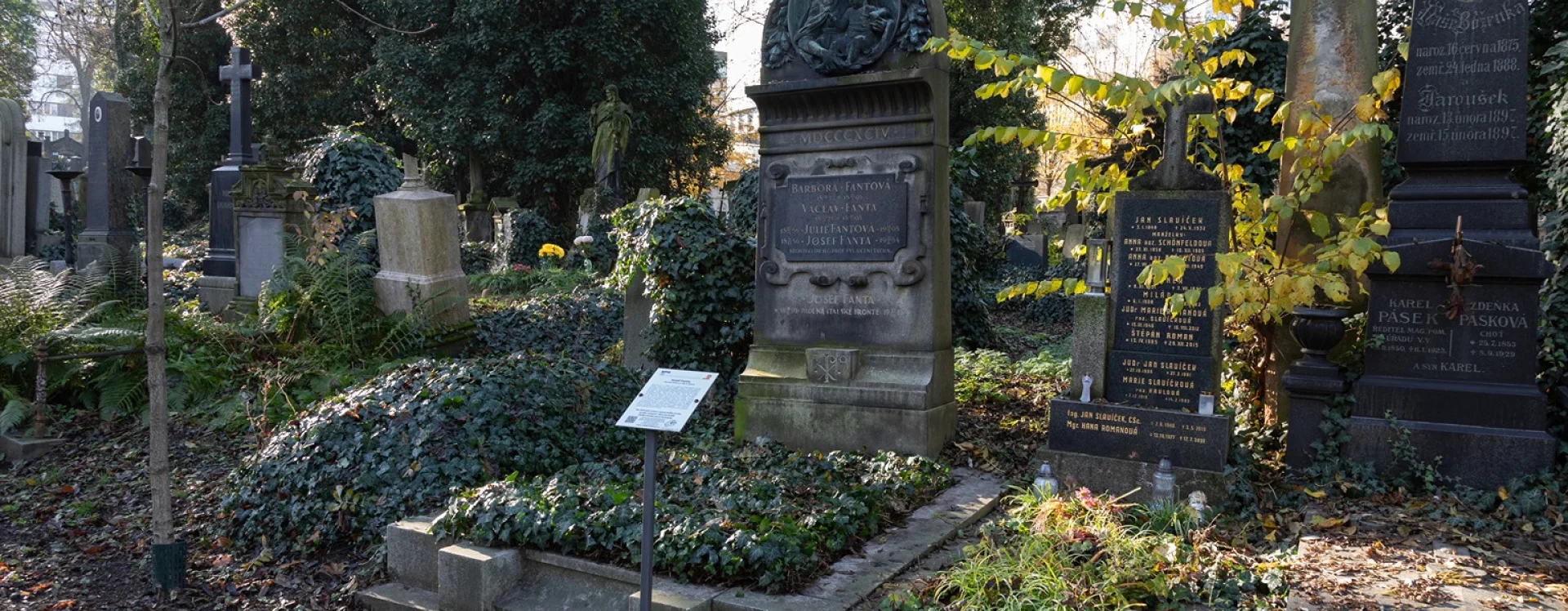
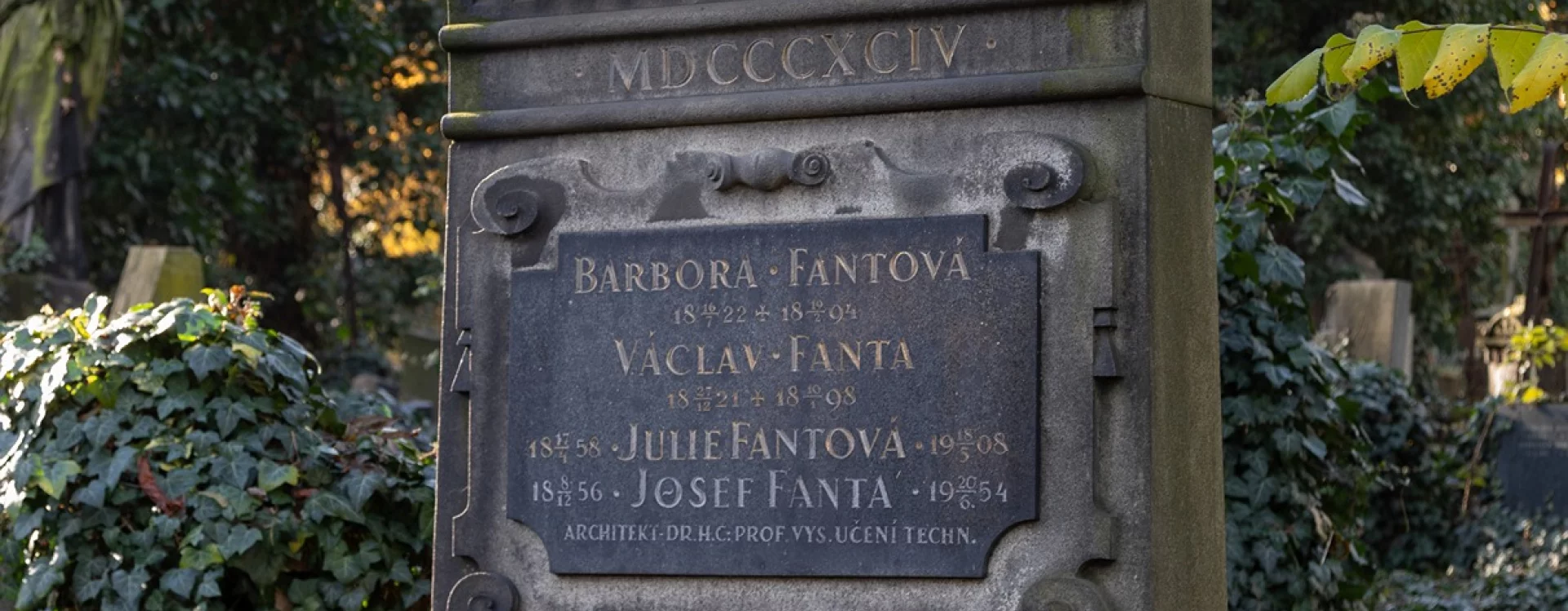
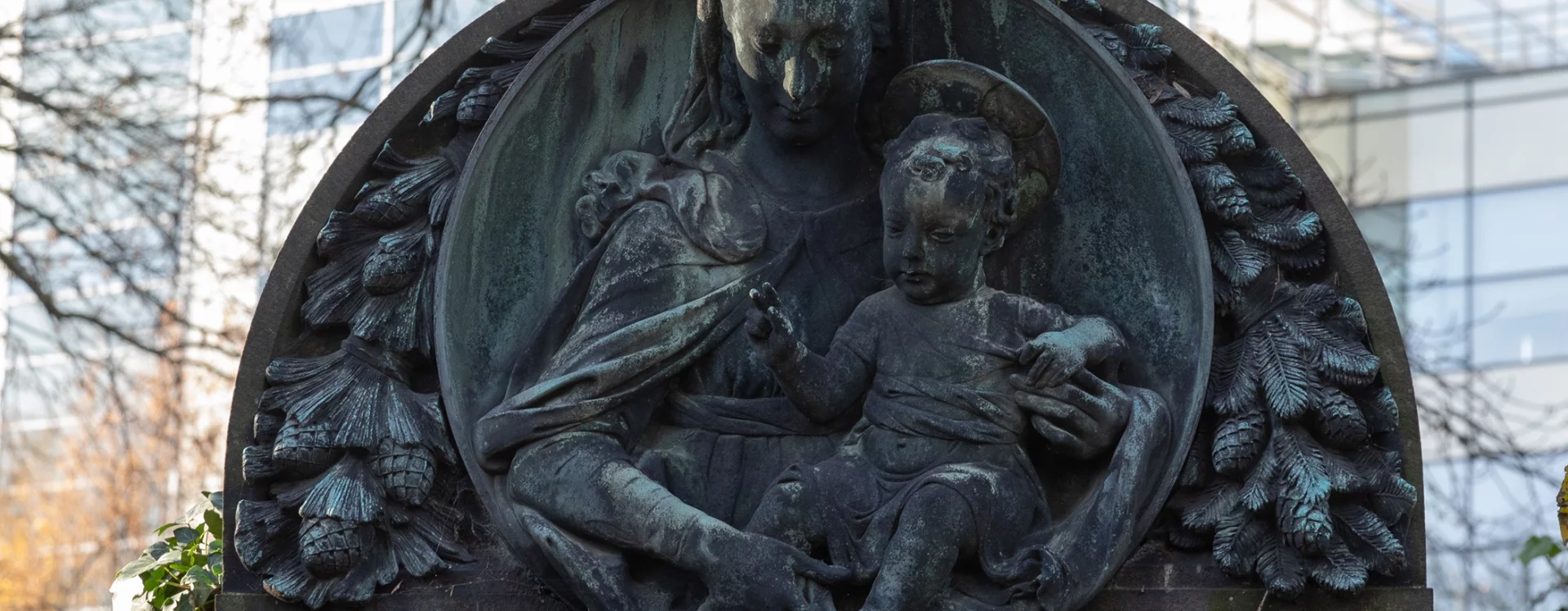
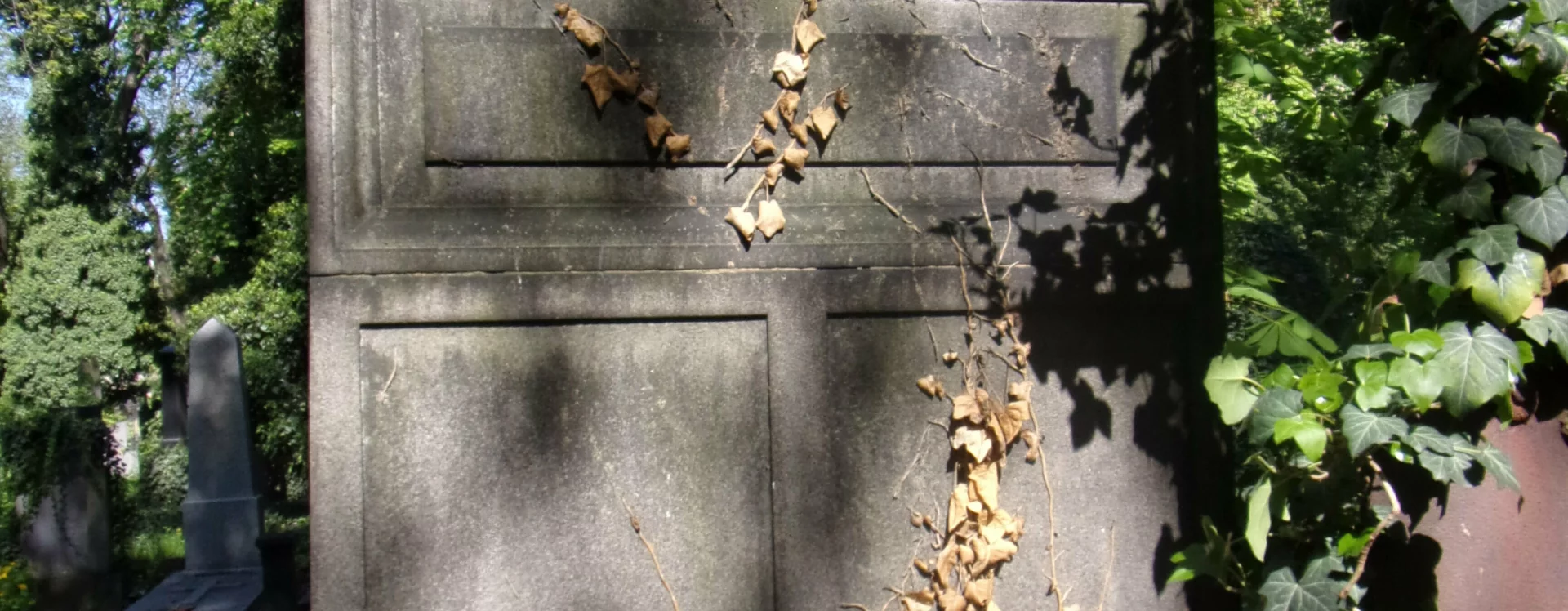
The gravestone at Olšany that he designed for his family in 1894 is no different. It was initially intended for his deceased mother Barbora Fantová, as among other things reflected by the iconographic symbolism of the bronze sculptural decoration. Its most distinctive section is the arched top made of light granite and decorated with a medallion depicting the Virgin Mary and the Christ child – a mother holding her child in a gentle embrace. The figures have been rendered in a loving manner. Mary holds her child by the feet, while he touches her fingers with his left hand and blesses visitors with his right. Another "human touch" is the fabric he wears, from which his bare belly peers forth. The Virgin Mary was of symbol importance as a guide to the afterlife and intercessor at the Last Judgment. This depiction of Mary with the Christ child was probably inspired by the early Renaissance relief by Antonio Rossellino in the Cappella del Cardinale del Portogallo in Florence's San Miniato Basilica. The medallion is decorated with a conifer festoon, an ancient symbol of eternal life. Already in Antiquity, the pinecone was considered a symbol of immortality thanks to its ability to protect the seeds inside. This symbolism later spread from the Mediterranean to Central Europe, where artists applied it to the cones of local evergreen trees. It is one reason, people make wreaths out of conifer cones on All Souls Day. The arched segment with the bronze decoration is separated from the main part of the stele by a cornice and the date of the grave's founding in Roman numerals. Below this, a scrollwork cartouche frames a dark tablet inscribed with the names of the deceased. At the very bottom, several Greek letters have been carved into the granite: in the middle, chi and rho are joined into a chrismon (the monogram of Jesus Christ), with alpha to the left and omega to the right. Together, they refer to the Last Judgment: "'I am alpha and omega, the beginning and the ending,' saith the Lord, who is, and who was, and who is to come." While the grave plot is no more than an inconspicuous horizontal surface overgrown with vines, the stele possesses an unusual visual design even on its rear, where we find a geometric relief in the form of three rectangular fields and a circle resembling the Eye of Providence.
Vladislava Holzapfelová, 2025
The gravestone at Olšany that he designed for his family in 1894 is no different. It was initially intended for his deceased mother Barbora Fantová, as among other things reflected by the iconographic symbolism of the bronze sculptural decoration. Its most distinctive section is the arched top made of light granite and decorated with a medallion depicting the Virgin Mary and the Christ child – a mother holding her child in a gentle embrace. The figures have been rendered in a loving manner. Mary holds her child by the feet, while he touches her fingers with his left hand and blesses visitors with his right. Another "human touch" is the fabric he wears, from which his bare belly peers forth. The Virgin Mary was of symbol importance as a guide to the afterlife and intercessor at the Last Judgment. This depiction of Mary with the Christ child was probably inspired by the early Renaissance relief by Antonio Rossellino in the Cappella del Cardinale del Portogallo in Florence's San Miniato Basilica. The medallion is decorated with a conifer festoon, an ancient symbol of eternal life. Already in Antiquity, the pinecone was considered a symbol of immortality thanks to its ability to protect the seeds inside. This symbolism later spread from the Mediterranean to Central Europe, where artists applied it to the cones of local evergreen trees. It is one reason, people make wreaths out of conifer cones on All Souls Day. The arched segment with the bronze decoration is separated from the main part of the stele by a cornice and the date of the grave's founding in Roman numerals. Below this, a scrollwork cartouche frames a dark tablet inscribed with the names of the deceased. At the very bottom, several Greek letters have been carved into the granite: in the middle, chi and rho are joined into a chrismon (the monogram of Jesus Christ), with alpha to the left and omega to the right. Together, they refer to the Last Judgment: "'I am alpha and omega, the beginning and the ending,' saith the Lord, who is, and who was, and who is to come." While the grave plot is no more than an inconspicuous horizontal surface overgrown with vines, the stele possesses an unusual visual design even on its rear, where we find a geometric relief in the form of three rectangular fields and a circle resembling the Eye of Providence.
Vladislava Holzapfelová, 2025
Literature
Petr Wittlich. Česká secese. Praha, 1982, s. 235.
Tomáš Vlček. Praha 1900. Praha, 1986, s. 294.
Alois Vanoušek ‒ Vojtěch Grametbauer (a kol.). Olšany, jaké neznáme. Praha, 2004, s. 58.
Jana Bělová ‒ Martin Lang. Hřbitove, hřbitove, zahrado železná. Hostivice, 2013, s. 17.
Kateřina Kuthanová (a kol.). Metamorfózy politiky, Pražské pomníky 19. století. Praha, 2013, s. 304.
Jana Tischerová. Pražské hřbitovy, pohřebiště a sepulkrální památky. Praha, 2023, s. 65.