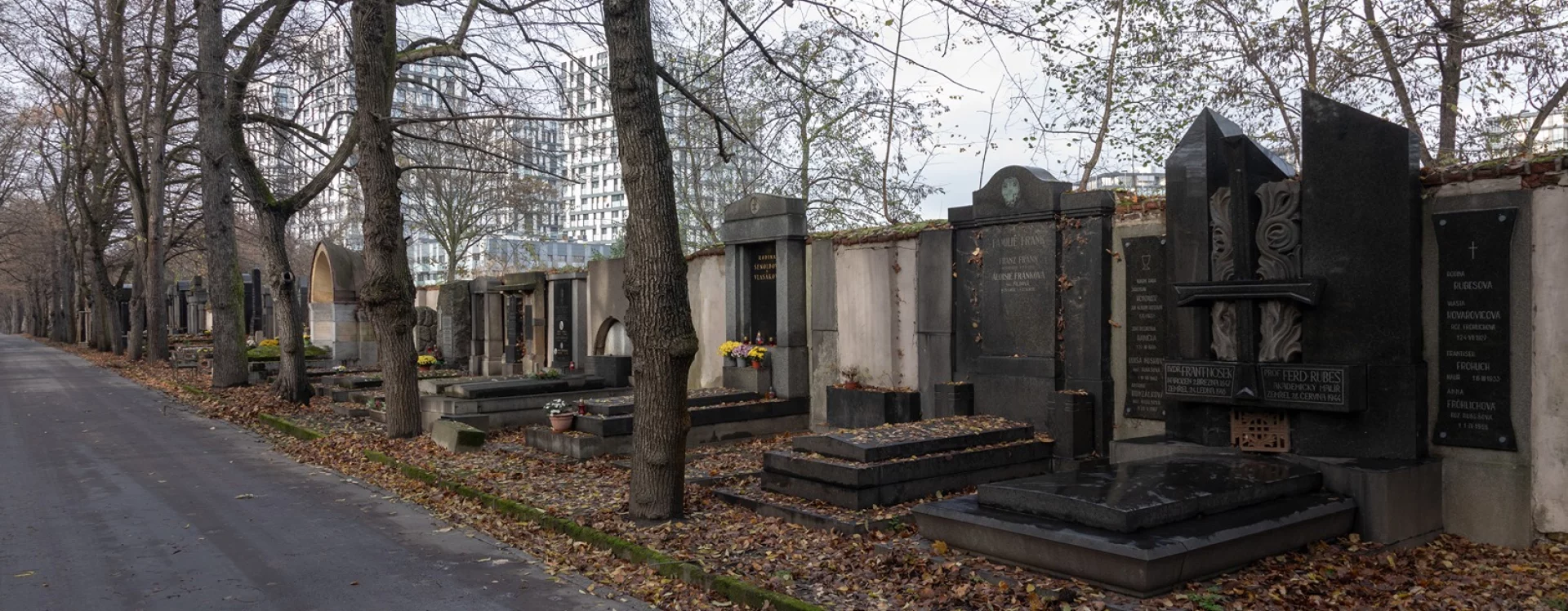
Built during the wartime slowdown in construction, this monument for the crypt of the related Nosek and Rubeš families falls within a period of Kotěra's life that Otakar Novotný later described as follows: "Seeing his wartime work arouses only sorrow. Grave after grave, war memorial after memorial, military cemetery after cemetery – that was his repertoire. To this we may add (if we count correctly) designs for two new and one remodeled family house… That is the four-year output of an architect approaching fifty at the height of his abilities."
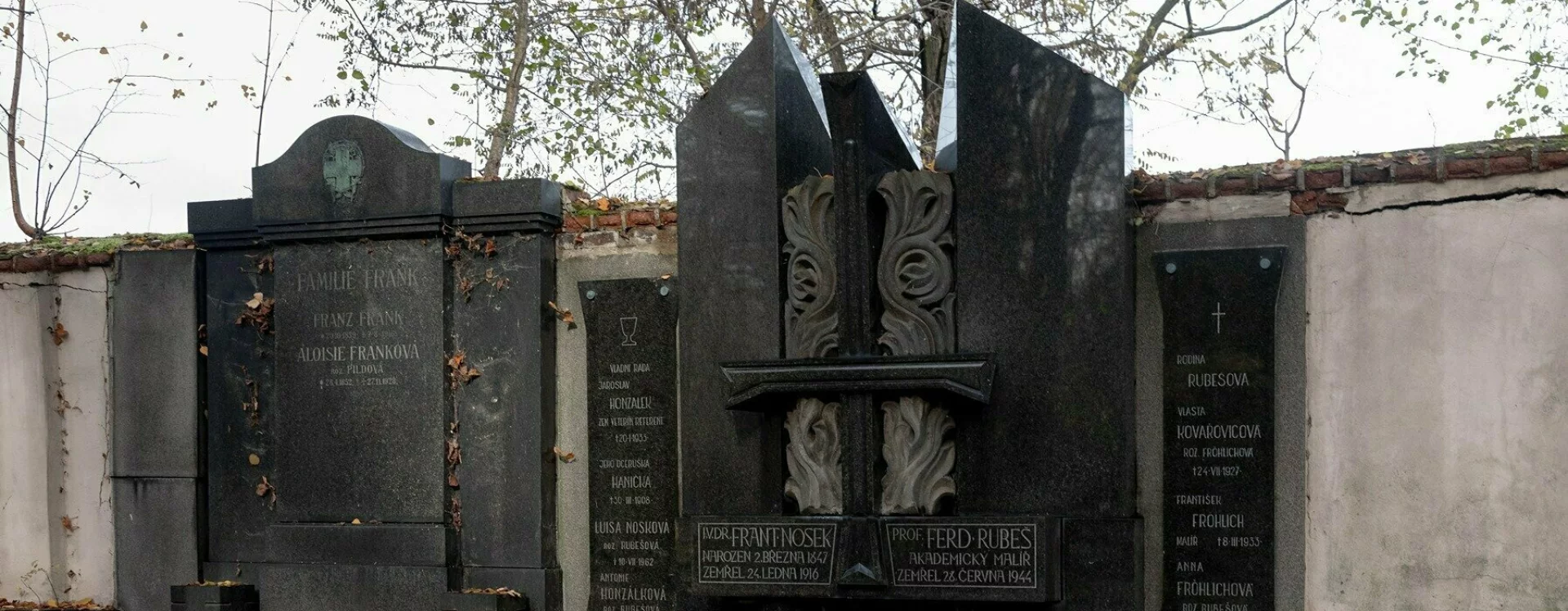
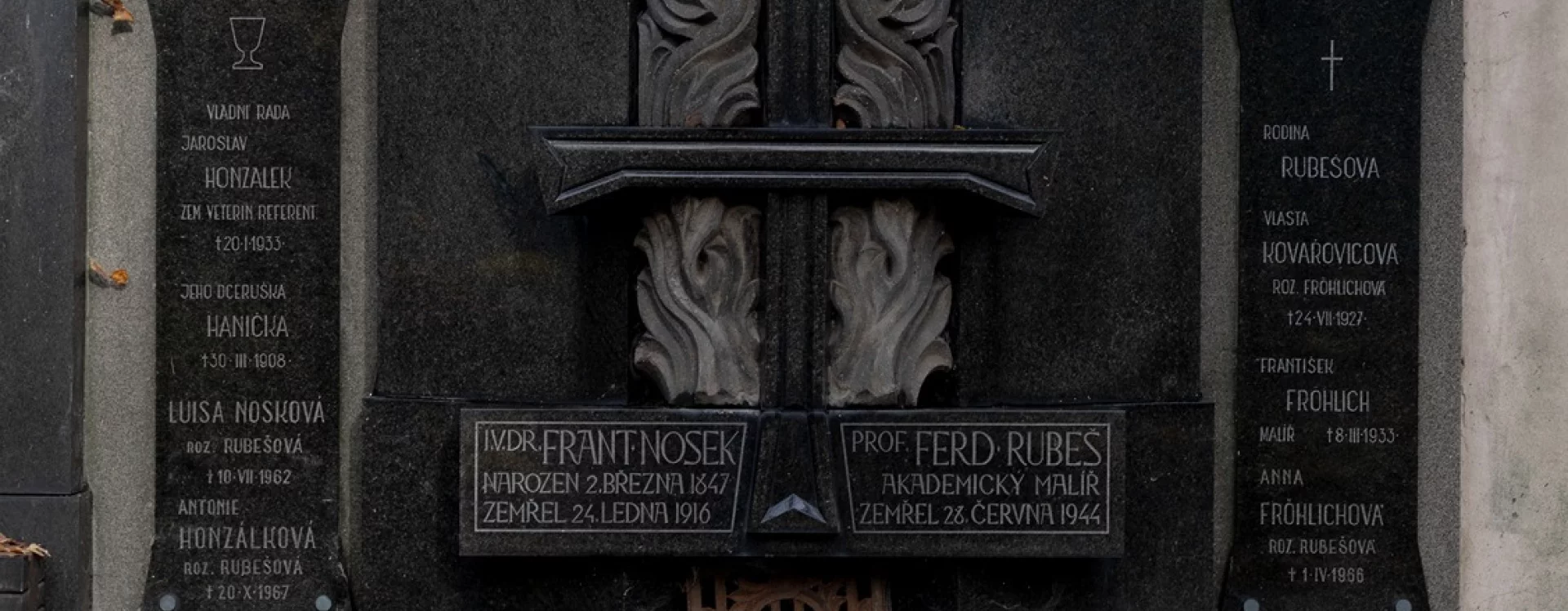
The large memorial is situated along the northern cemetery wall. František Nosek (not the former Czechoslovak minister) and the academic painter Ferdinand Rubeš hold places of honor on the inscription plaques. Their kinship can be inferred both from additional information on the plaques and from the fact that the work was commissioned by Luisa Nosková, née Rubešová. Even so, exact details of the families' relations are lacking. Rubeš was a painter and printmaker, attained the rank of staff captain, and after the war taught at the State School of Graphic Arts in Prague. As a member of the Association of Artists in Prague, he participated in a number of group exhibitions in 1937–1944. Also buried here is the painter František Fröhlich, likewise related to Rubeš, who did a mural for Kotěra at the Trmal Villa and worked on the paintings that decorate the Smetana House in Litomyšl and theaters in Pilsen and Pardubice. The crypt contains the remains of other members of the two families as well, including those of Luisa Nosková.
The monument for the Rubeš-Nosek family crypt is without doubt the most expressive of Kotěra's works. A dominant role in its dynamic composition is played by the massive, articulated gravestone rising above the stepped ledger with a gently arching top slab. The gravestone consists of two massive pylons, placed diagonally so as to open a cleft between them. Across this cleft, the pylons are linked by a Petrine Cross – a regular Latin cross, inverted in reference to the fact that Peter the Apostle was crucified upside down. The geometrically stylized scrollwork on the sides may allude to the cross as the tree of life. The stele's sharply pointed tips may be seen as echoes of Cubism. The ledger was originally flanked by long stone troughs – jardinières for planting ornamental vegetation – that have since been removed.
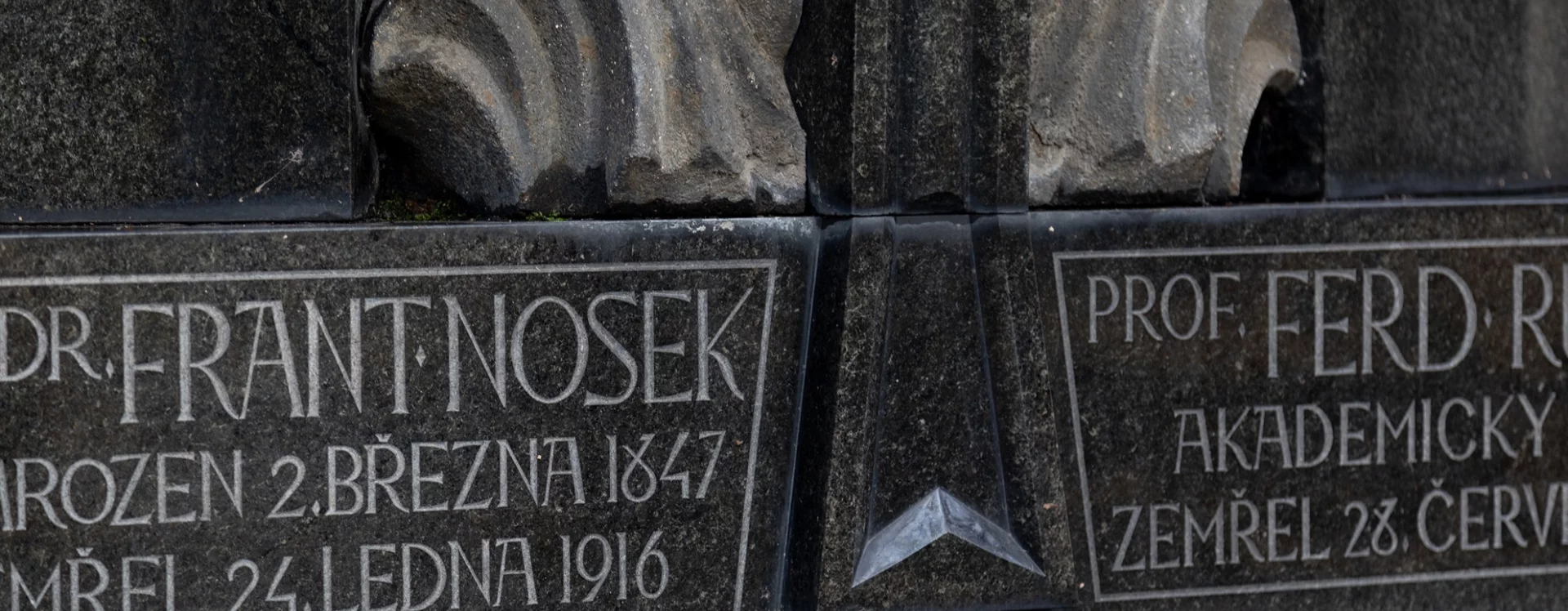
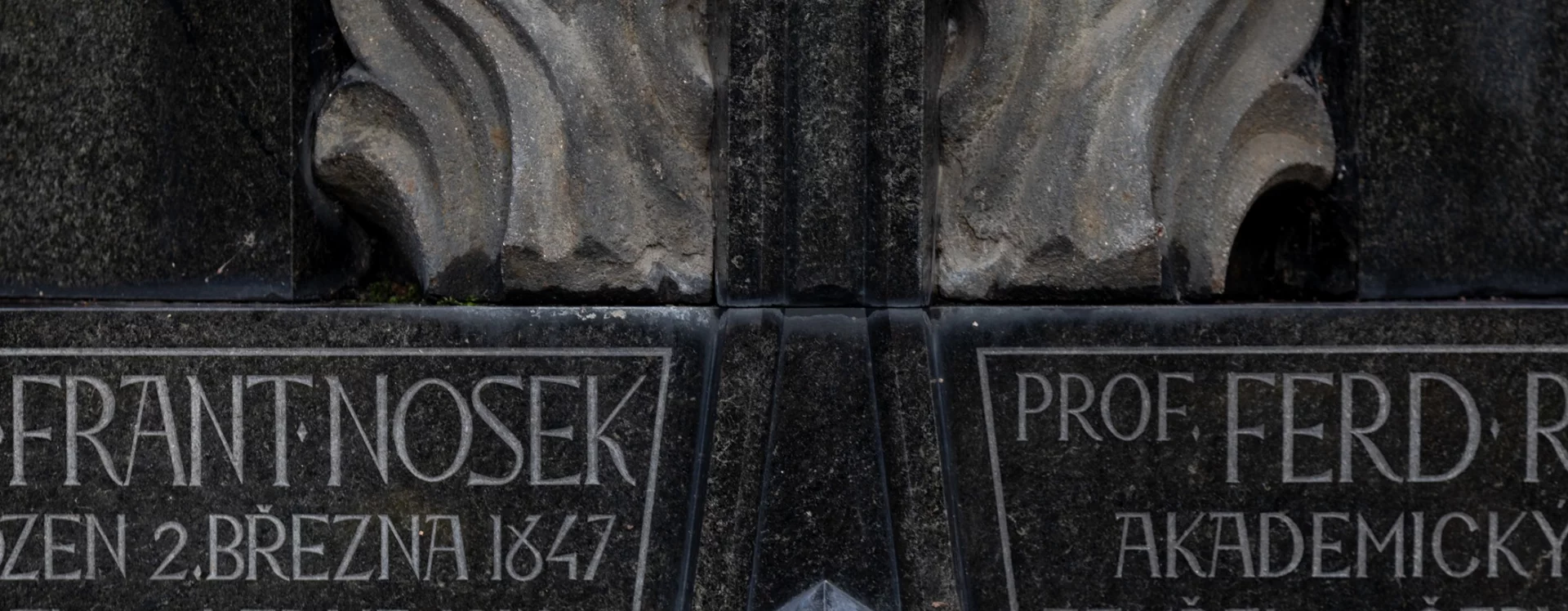
The lower part of the monument is most likely of Mrákotín granite, while the top slab of the ledger and the steles are made of polished larvikite imported to Bohemia from southern Norway. The same material, though with a honed finish, was used for the sculpted scrollwork.
Amáta M. Wenzlová, 2025
The large memorial is situated along the northern cemetery wall. František Nosek (not the former Czechoslovak minister) and the academic painter Ferdinand Rubeš hold places of honor on the inscription plaques. Their kinship can be inferred both from additional information on the plaques and from the fact that the work was commissioned by Luisa Nosková, née Rubešová. Even so, exact details of the families' relations are lacking. Rubeš was a painter and printmaker, attained the rank of staff captain, and after the war taught at the State School of Graphic Arts in Prague. As a member of the Association of Artists in Prague, he participated in a number of group exhibitions in 1937–1944. Also buried here is the painter František Fröhlich, likewise related to Rubeš, who did a mural for Kotěra at the Trmal Villa and worked on the paintings that decorate the Smetana House in Litomyšl and theaters in Pilsen and Pardubice. The crypt contains the remains of other members of the two families as well, including those of Luisa Nosková.
The monument for the Rubeš-Nosek family crypt is without doubt the most expressive of Kotěra's works. A dominant role in its dynamic composition is played by the massive, articulated gravestone rising above the stepped ledger with a gently arching top slab. The gravestone consists of two massive pylons, placed diagonally so as to open a cleft between them. Across this cleft, the pylons are linked by a Petrine Cross – a regular Latin cross, inverted in reference to the fact that Peter the Apostle was crucified upside down. The geometrically stylized scrollwork on the sides may allude to the cross as the tree of life. The stele's sharply pointed tips may be seen as echoes of Cubism. The ledger was originally flanked by long stone troughs – jardinières for planting ornamental vegetation – that have since been removed.
The lower part of the monument is most likely of Mrákotín granite, while the top slab of the ledger and the steles are made of polished larvikite imported to Bohemia from southern Norway. The same material, though with a honed finish, was used for the sculpted scrollwork.
Amáta M. Wenzlová, 2025
Literature
Otakar Novotný. Jan Kotěra a jeho doba. Praha, 1958, s. 63-64, obr. 270 (obrazová příloha nestr.).
Vladimír Šlapeta, Daniela Karasová et al.. Jan Kotěra 1871-1923: Zakladatel moderní české architektury. Praha, 2001, s. 324.
Drahomíra Březinová, Barbora Dudíková Schulmannová, Jana Růžičková. Jan Kotěra a Olšanské hřbitovy, Za Starou Prahu, Věstník za starou Prahu XXXIX. (X.), č. 3/2009, Příloha. 2009, p. nestr.