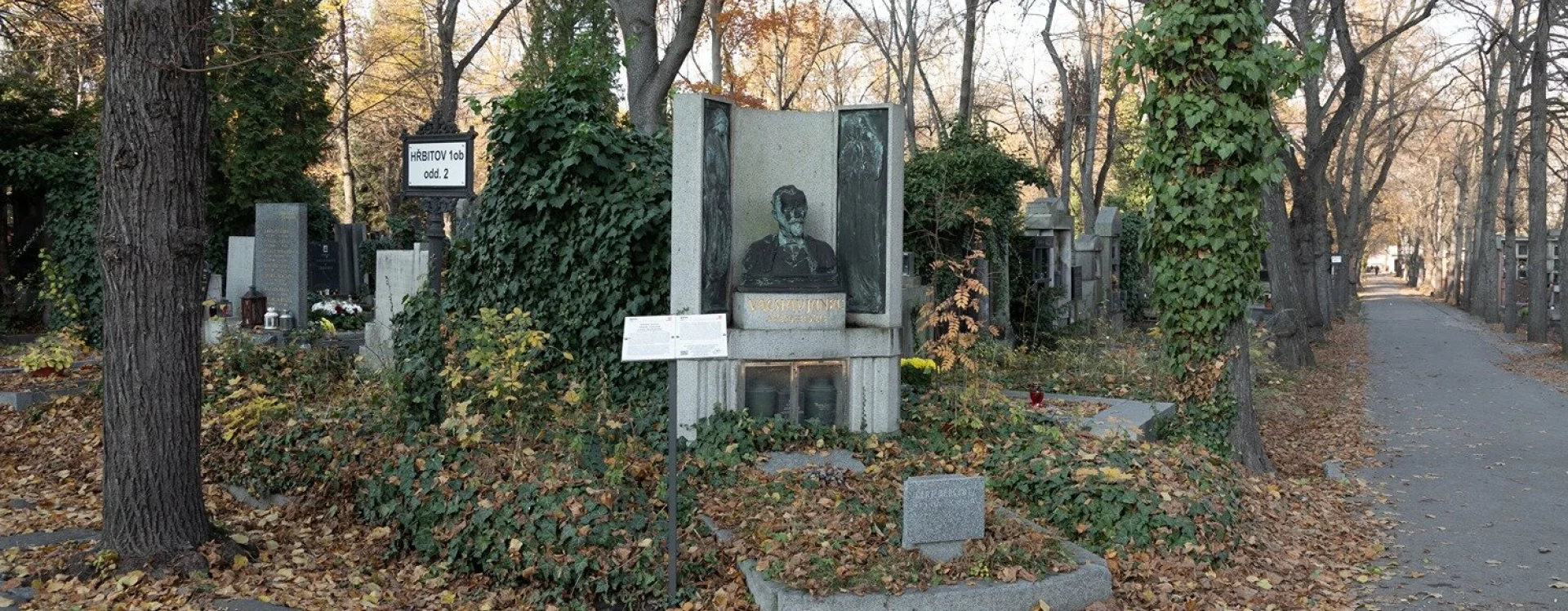
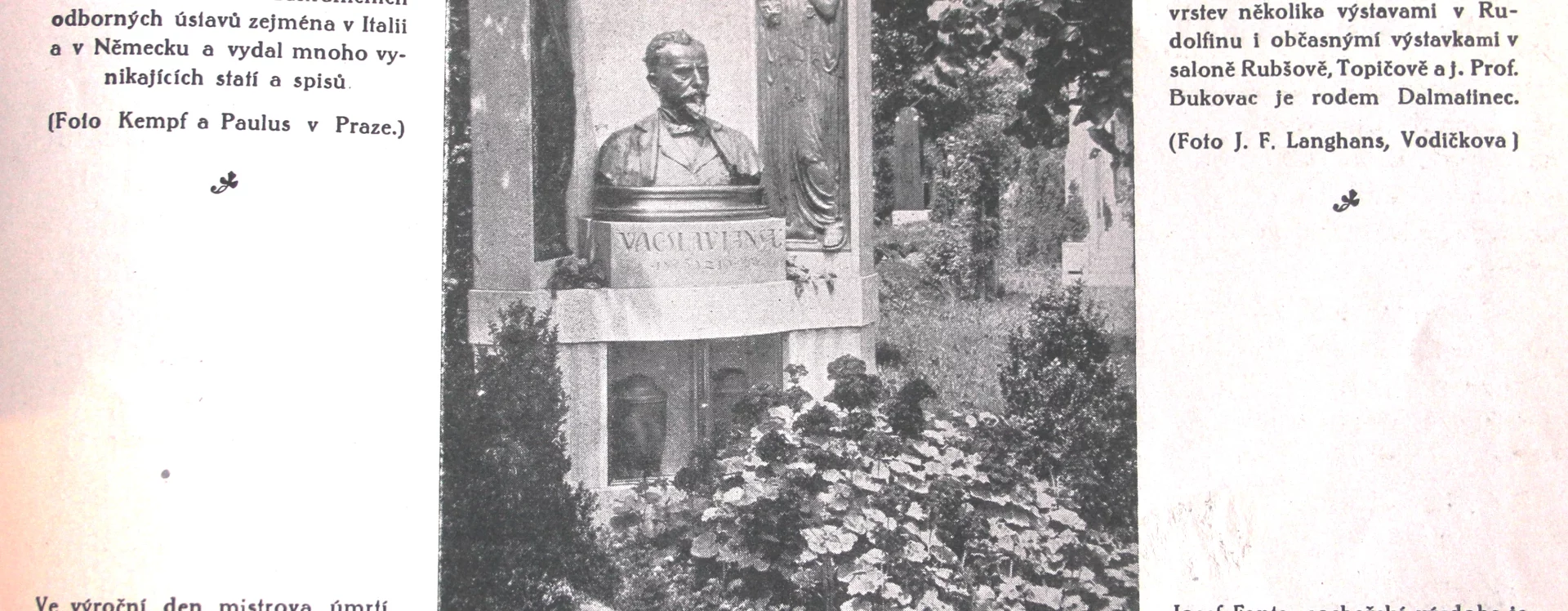
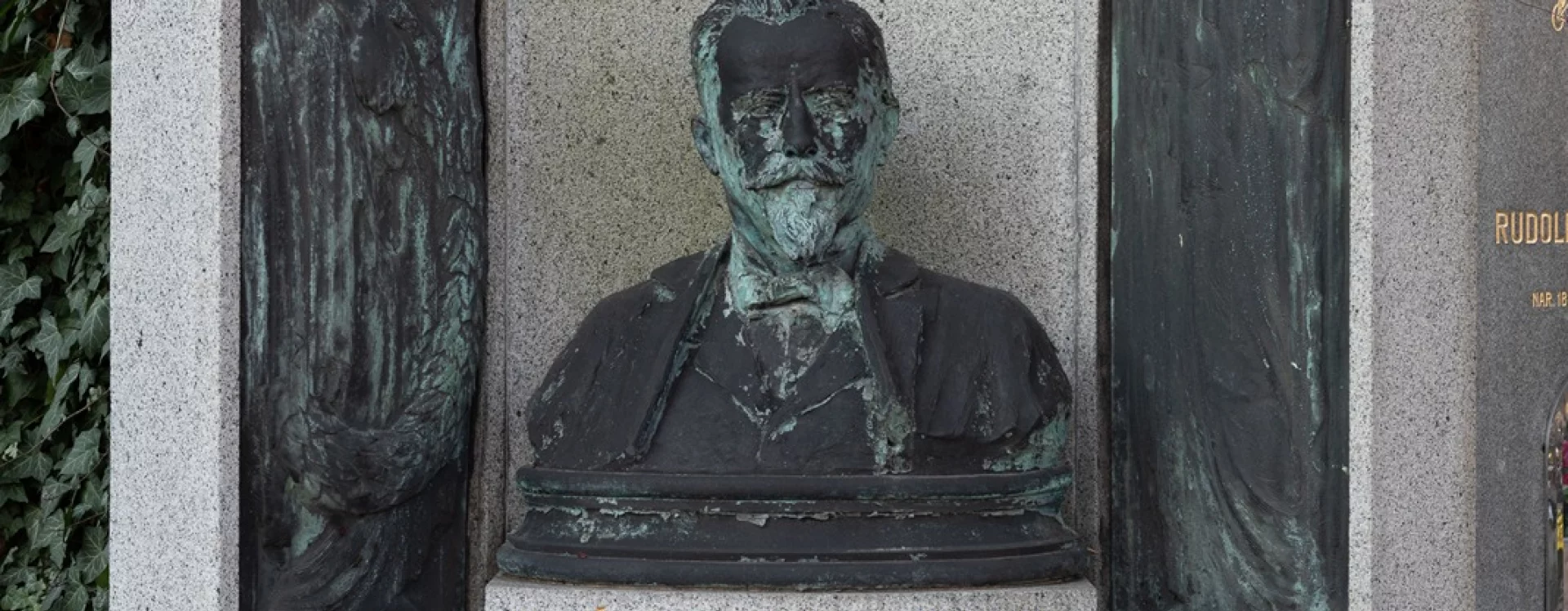
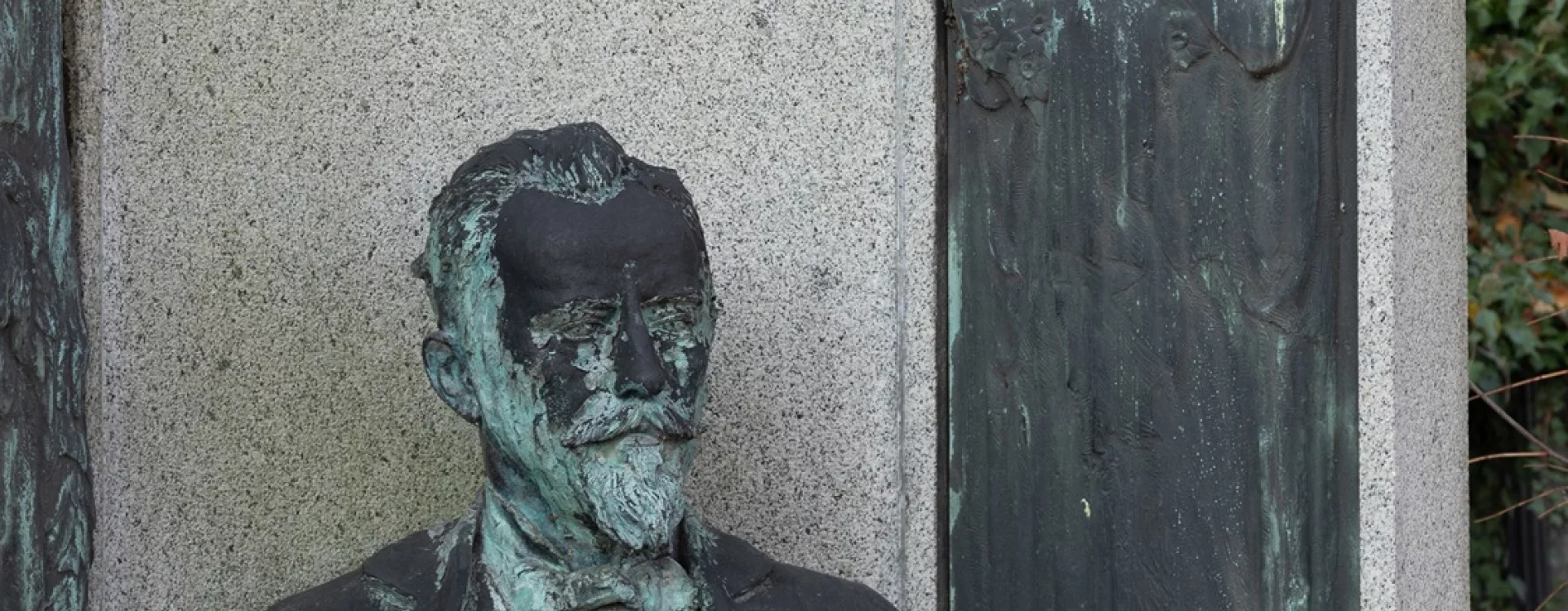
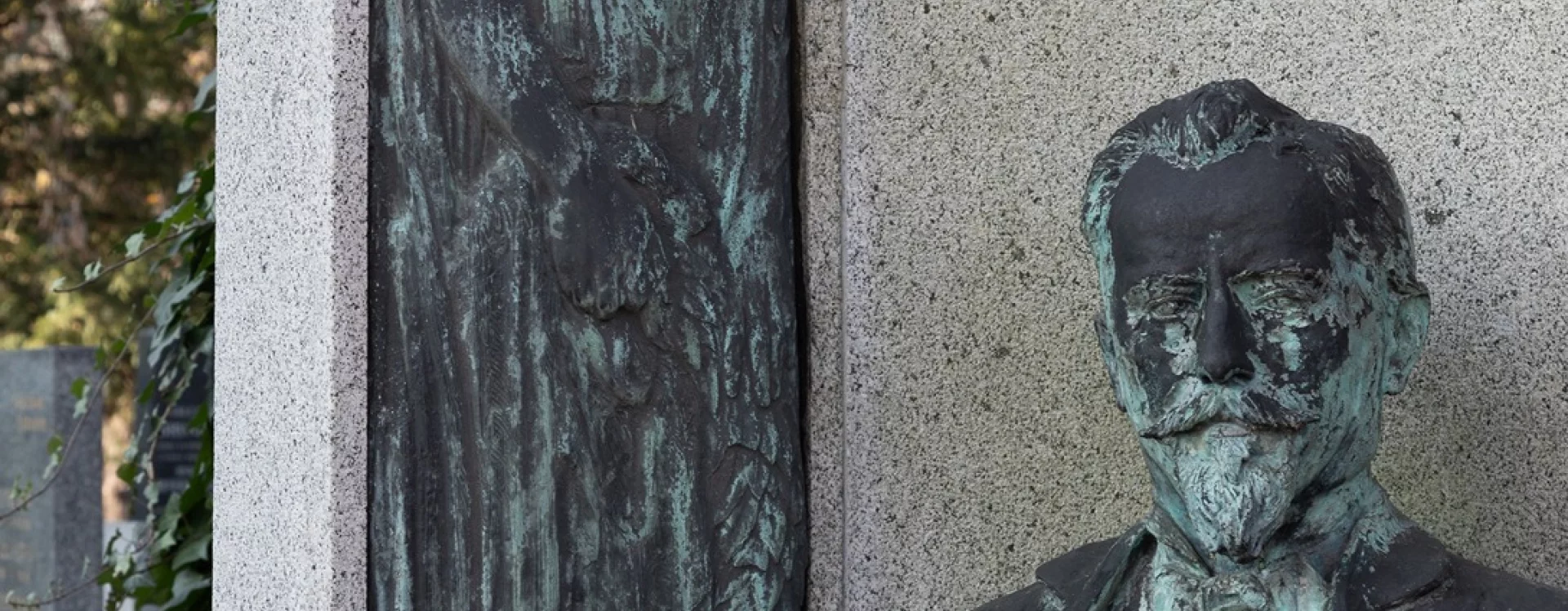
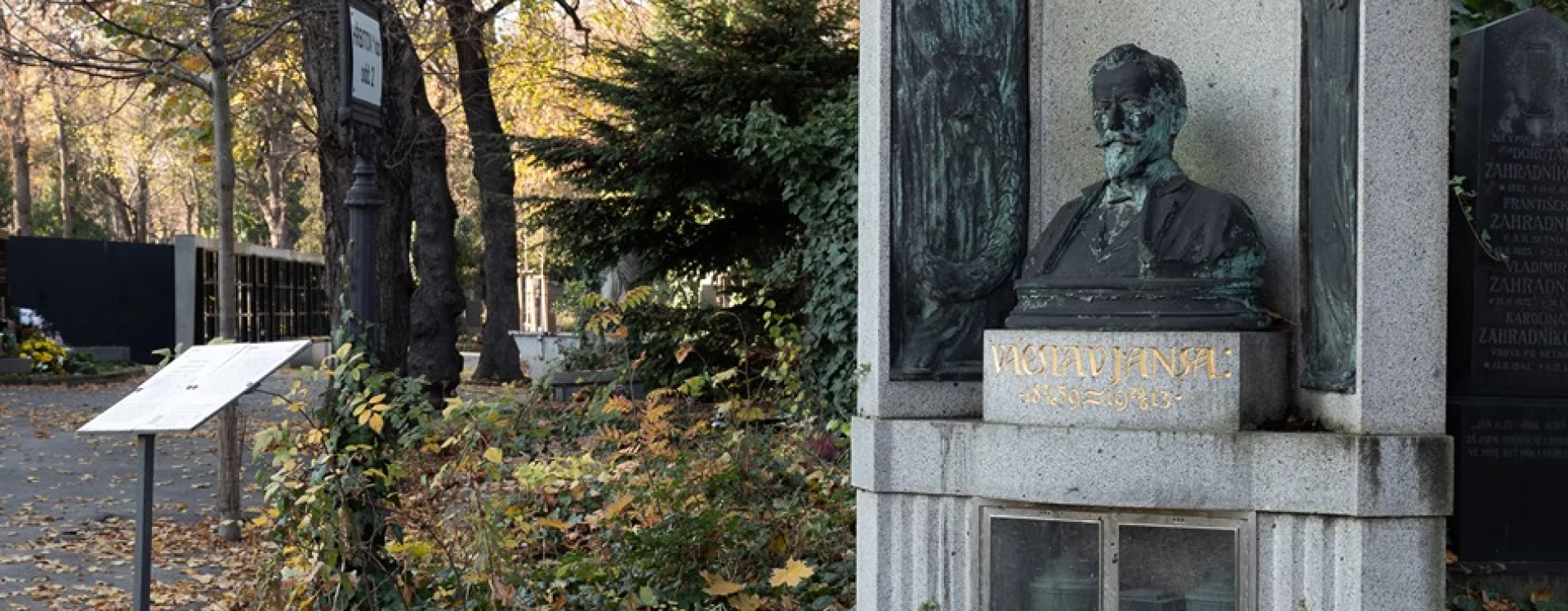
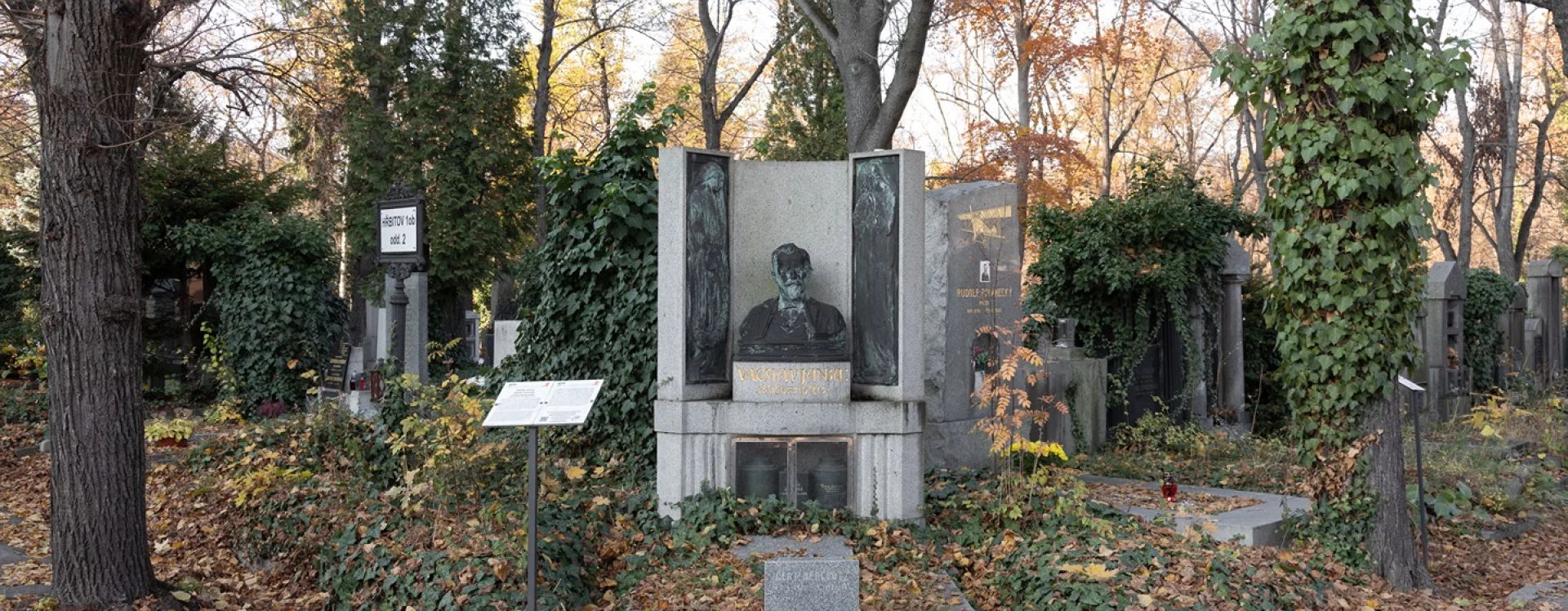
This unique grave marker, which is also a monument to an exceptional artist, was designed free of charge by the architect Josef Fanta using an earlier bust by Vilím Amort in which the sculptor depicted his friend Václav Jansa in his prime. Unusually, the urn with Jansa’s ashes was placed above-ground at a time when this manner of burial was not yet legal in Austria-Hungary. Following his death, Jansa’s body was brought to the German town of Zittau for cremation, and the urn was temporarily stored at the Náprstek Museum (which already housed urns containing the ashes of Vojta Náprstek and his wife Josefa). Besides one could already opt to be buried at a municipal cemetery established by the City of Prague instead of a Catholic cemetery, Jansa’s wish not to be buried in the ground could be fulfilled.
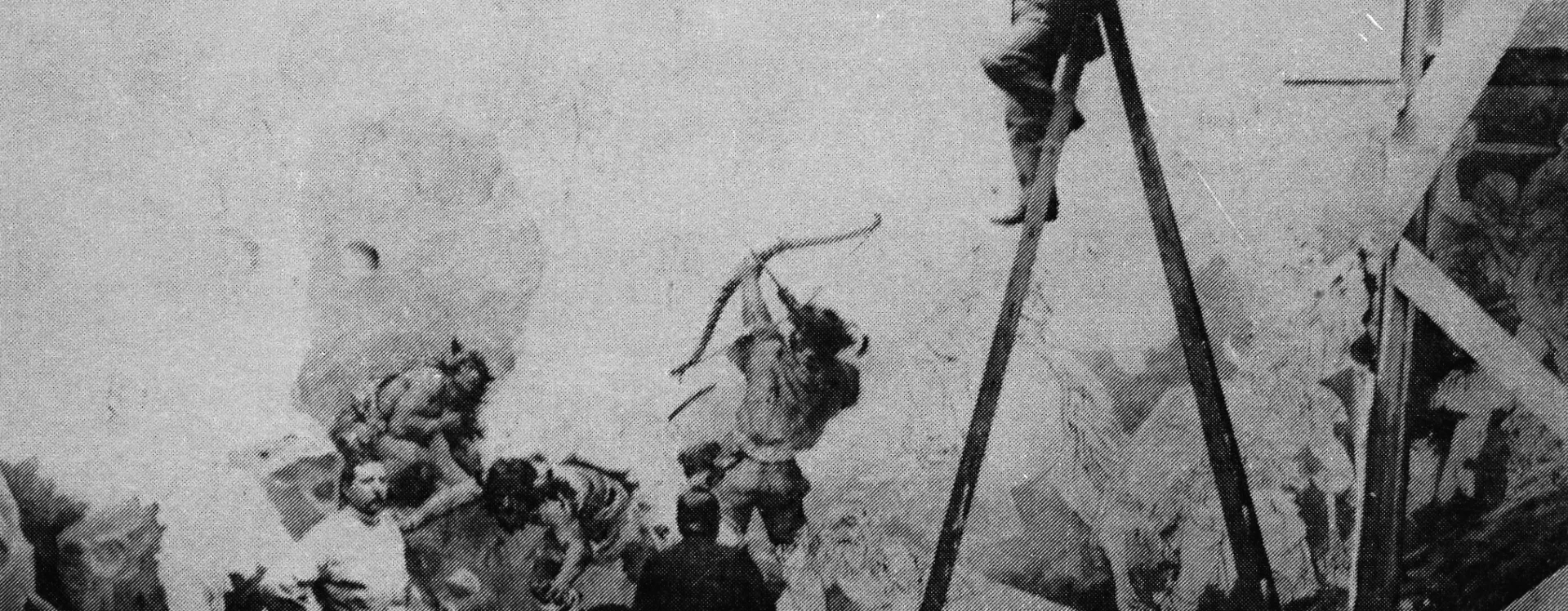
As a painter, Václav Jansa is associated mainly with watercolors depicting old Prague’s vanishing picturesque street scenes prior to its redevelopment. It is thus tempting to view him as old-fashioned, but despite his interest in historical monuments he was a highly modern individual. As a landscape painter, he depicted mountain and seaside scenes with photographic precision while also capturing the local atmosphere of colors and emotions. Jansa was involved in the creation of three enormous canvases shown as part of revolutionary exhibitions at Prague’s fairgrounds – in 1891 he painted the diorama The Giant Mountains for Count Harrach (Jubilee Exhibition), he contributed to the diorama Defeat of the Saxons at Hrubá Skála (after Mikoláš Aleš), and he worked on Marold’s panoramic painting The Battle of Lipany (1898).
Jansa’s daughter Libuše was the first female Czech archeologist, with a particular focus on the La Tène period. Her life partner was the archeologist Ivan Borkovský, whose area of expertise was the early Middle Ages and who is buried here alongside her and her father. The grave was restored under the auspices of the Czech Archeological Society as part of the Adoption of Significant Graves project.
The architect Josef Fanta worked on a wide range of commissions over the course of his long life, including funerary architecture. Much of his work in this field can be found at Vyšehrad Cemetery, where twelve such commissions were realized on a relatively small area. He was also involved in the renovation of the Slavín tomb at that cemetery, among other things by designing numerous details (including metalwork, lettering, and mosaics). Olšany is home to four typologically highly distinct grave monuments by Fanta, a diversity resulting only in part from the stylistic changes that were happening over the two decades around the turn of the century, when artists and architects moved from historicism via Art Nouveau to modernist forms of expression. Fanta’s monument to the painter Václav Jansa was one of the first cases in which an architect was presented with the task of creating a grave marker for cremated remains. At the center of Fanta’s symmetrical Neoclassical monument is a glass compartment for two urns, above which is a bust flanked by decorative wings with bronze reliefs of mourning women holding wreaths.