In 1885, the Olšany cemeteries were expanded by the addition of Cemetery VI and a Neorenaissance ceremonial hall. At the same time, new paths were laid out with spaces for the stately funerary monuments of wealthy Prague citizens.
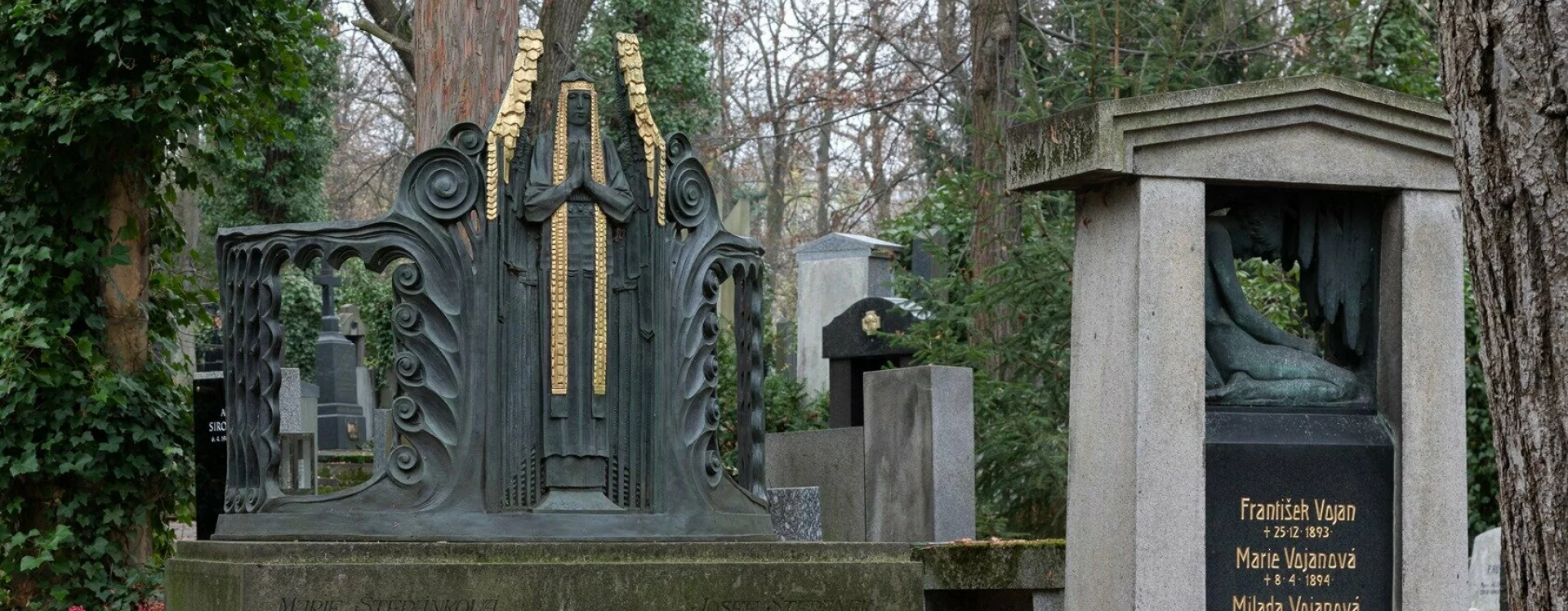
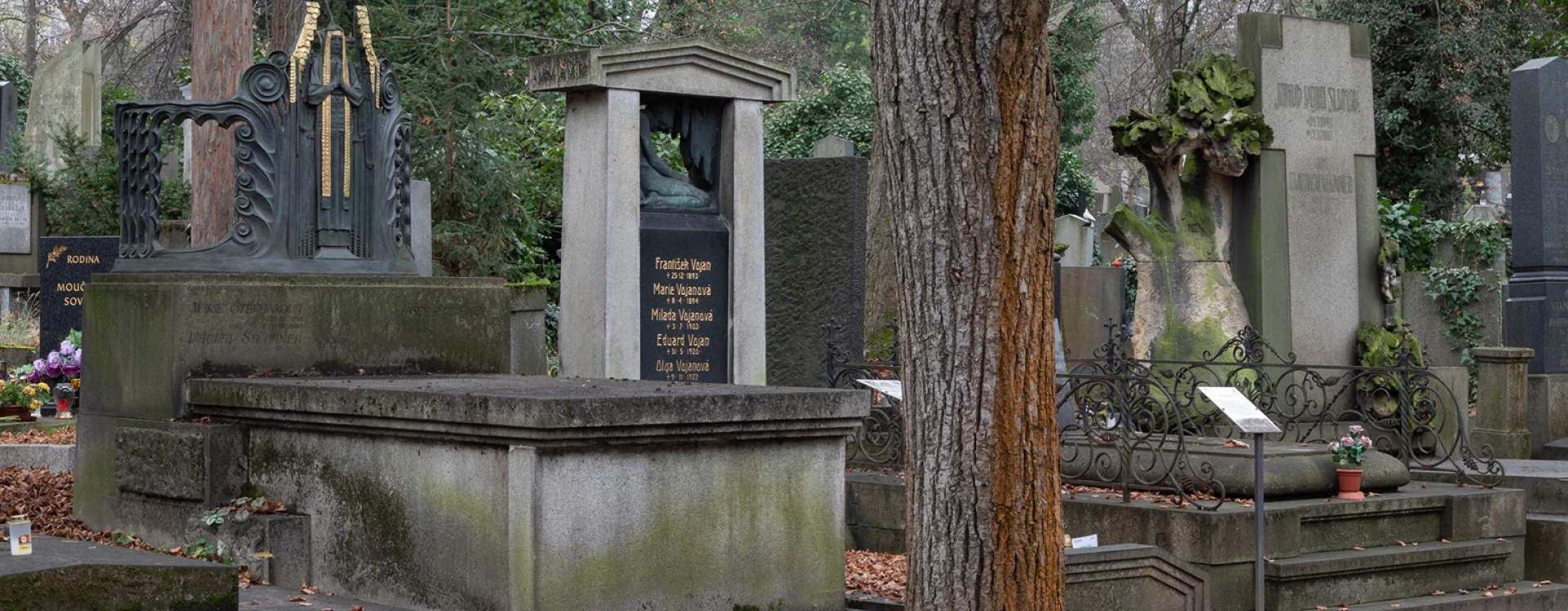
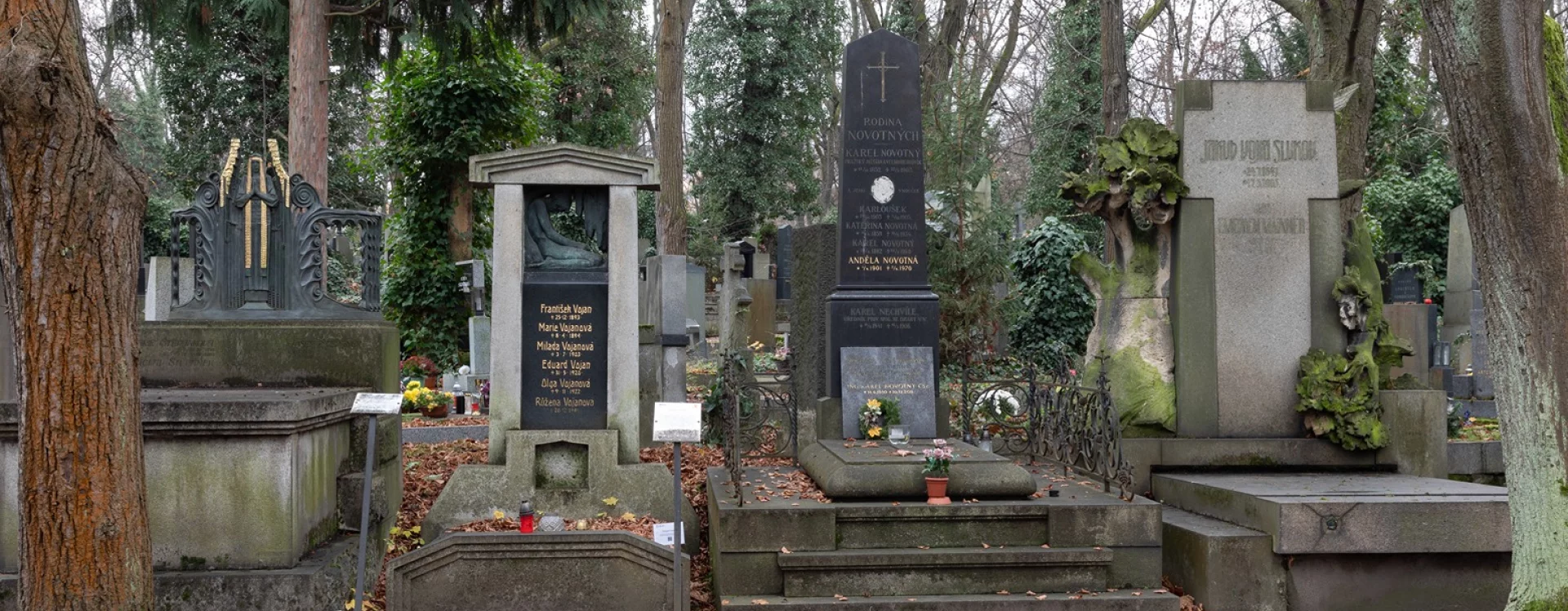
Along the central axis, near the monuments for the actors Sluka and Vojan created by the duo of Kotěra/Sucharda, Jan Kotěra designed another grave monument – this time for the family of the Prague burgher Václav Štěpánek, a miller and grocer who owned the mill at today's Novotného lávka. The first person to be buried there was his wife Marie (1848–1905).
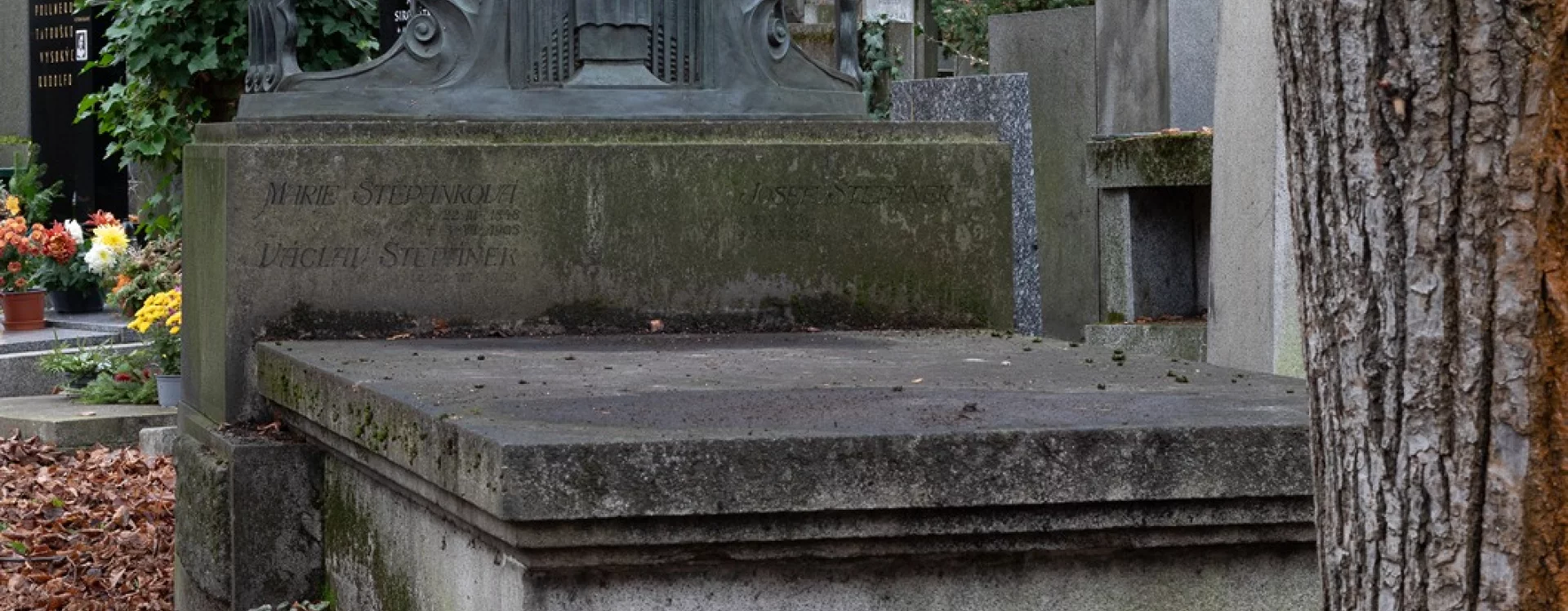
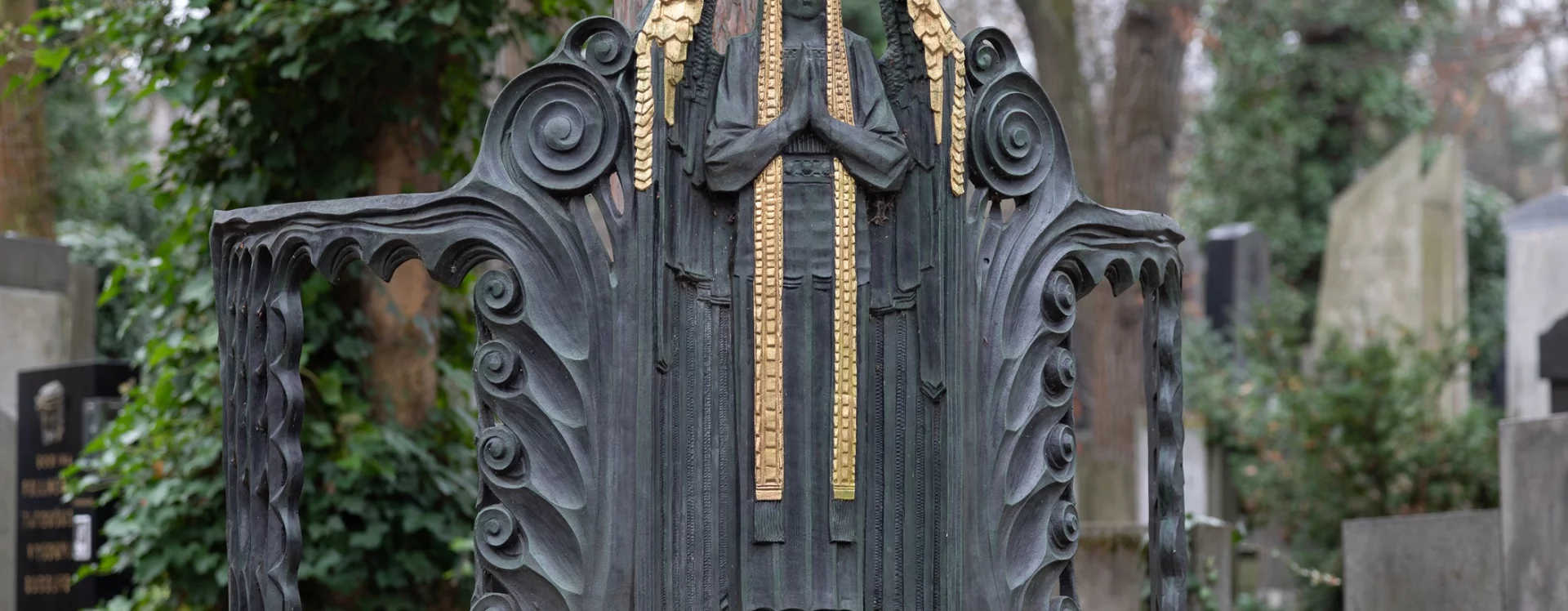
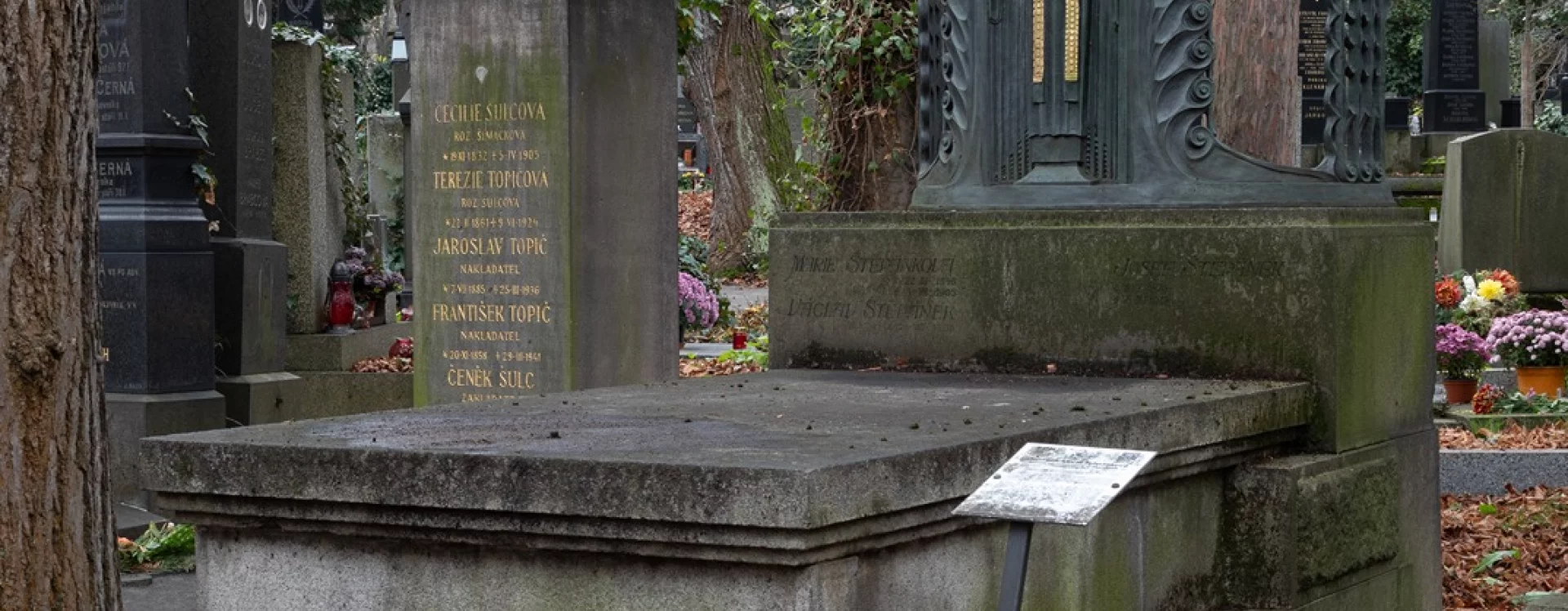
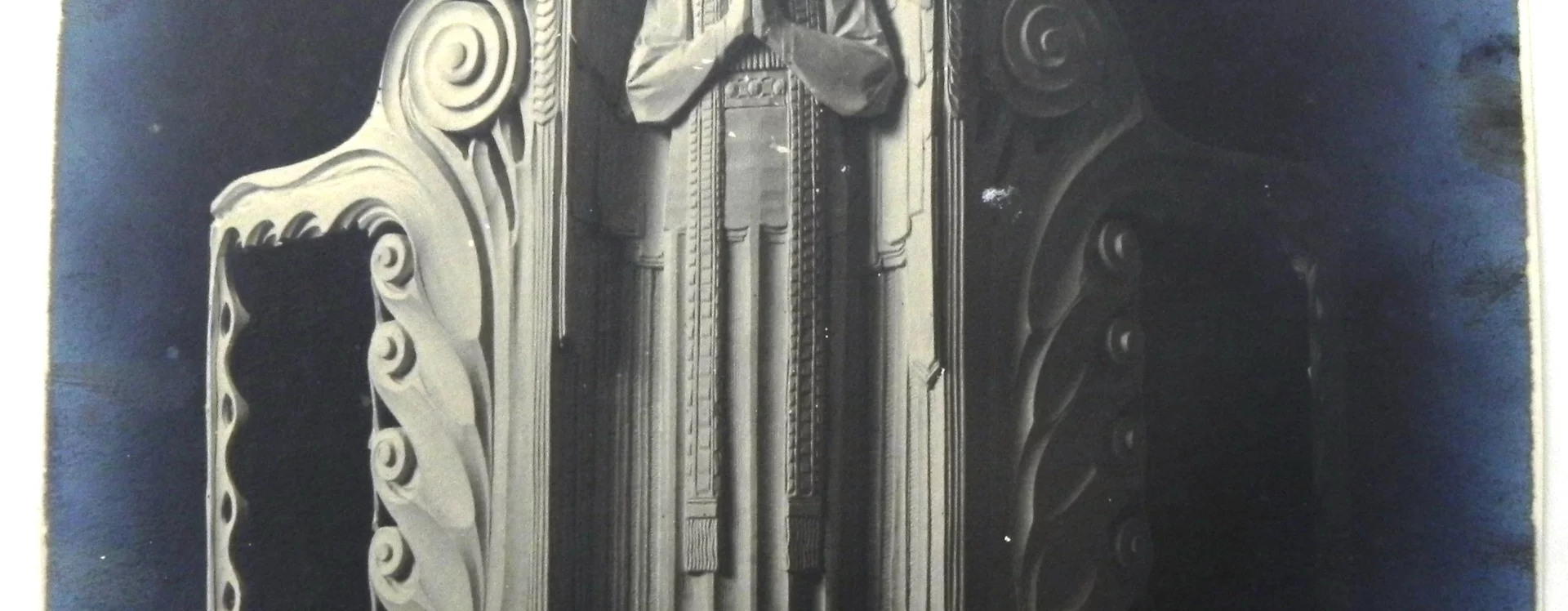
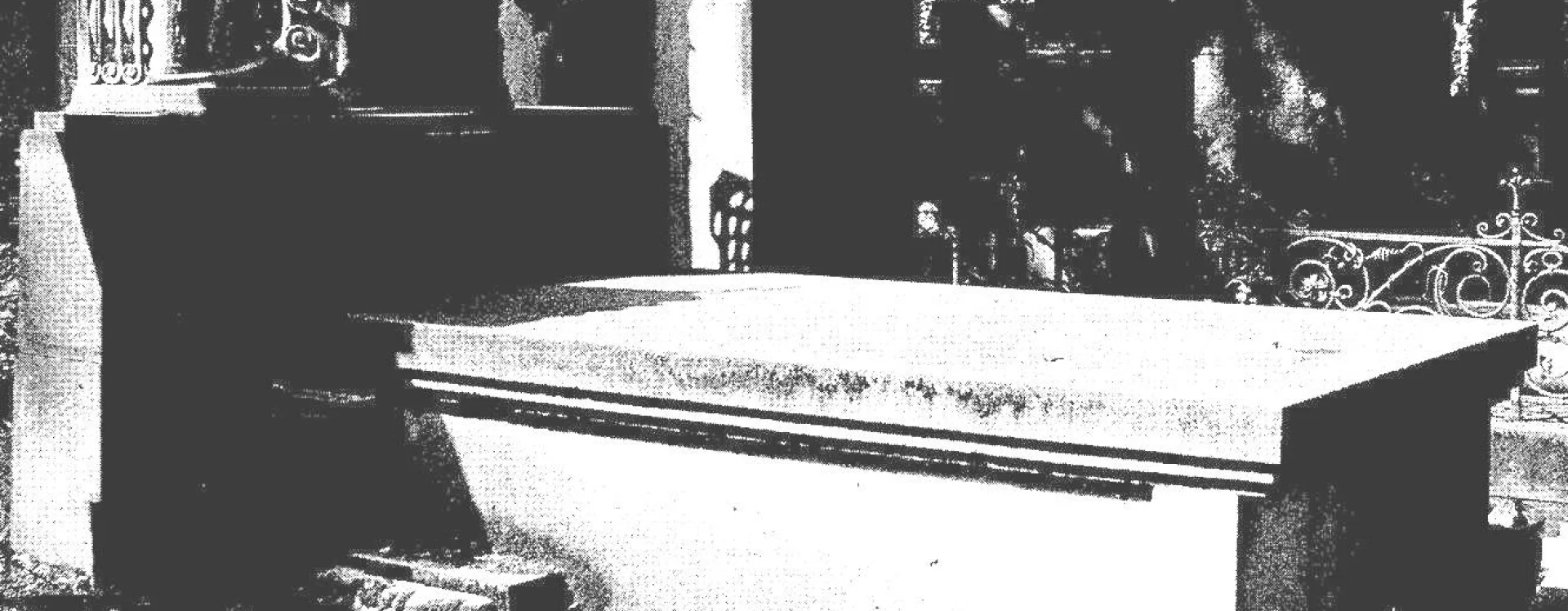
The granite sarcophagus consists of a simple, massive chest tomb with rusticated steps along the sides and a low inscription stele, which also serves as the pedestal for one of Kotěra's most original funerary works. At the center of the expansive composition is a statue of a praying angel, its wings blending into the fluting of the niche from which the figure emerges. Its design, which follows the established geometry of the ideal body and includes ornamental waves and spirals, was inspired in part by Assyrian-influenced currents in Art Nouveau, but mostly by the Beuronese style, with which the artist was well acquainted. This art movement, which had developed in the second half of the nineteenth century at the Benedictine monastery in Beuron, Germany, was focused on the study of human proportions and drew on ancient Egyptian forms. It was introduced onto the Czech scene through the Abbey of St. Gabriel in Prague (where the style's founder Desiderius Lenz was active) and by the architect Jože Plečnik, who designed the Church of the Most Sacred Heart of Our Lord in Prague's Vinohrady district. Of Kotěra's thirteen original works for Olšany, the Beuronese influence is most apparent in this design for Štěpánek, but Kotěra also worked Lenz's stylistic canon into the facade of Charles University's Faculty of Law, among others.
The elaborate Olšany statue was created by the sculptor Vojta Sucharda according to a design by Kotěra and was cast by Václav Mašek. In 2012, the bronze angel was cut from its pedestal by an unknown thief. Fortunately, most of the sculpture was found in the nearby bushes by the geologist Drahomíra Březinová, who worked for the cemetery as an external consultant. The missing parts were replaced and the entire ensemble was professionally restored. Today, an epoxide resin replica of the angel has been installed on the site, while Sucharda's original is preserved in storage.
For his Olšany commissions, Kotěra was assisted by the master stonemason Václav Žďárský (1854–1912), who in this case worked with honed granite from Mrákotín, with the inscription part done in a polished finish. On all the frames, he listed the architect's name, his own, and the date. Žďárský had a stonemasonry workshop on Štěpánská Street, and after 1884 was one half of the sculpture firm of Ducháček & Žďárský, Prague II, Spálená 6, which later supplied stonework details for the construction of Prague's new town hall on Mariánské náměstí, among other projects. He also collaborated with the architect Fanta on several graves at Vyšehrad Cemetery, including the monument to Zdeněk Fibich. Other funerary works from his workshop can be found at the Vinohrady cemetery and elsewhere.
By the time of this monument, the artistic metal caster Václav Mašek (1844–1914) had nearly forty years of professional experience. After years of earning experience abroad, in 1869 he established the First Artistic Foundry in Prague-Karlín. At Olšany, he worked for the sculptors Opatrný, Mauder, Myslbek, Schnirch, and Strachovský, and he also produced the bronze decoration for the sarcophagus of the architect Quido Bělský.
Anna Oplatková – Kateřina Lopatová, 2025
Along the central axis, near the monuments for the actors Sluka and Vojan created by the duo of Kotěra/Sucharda, Jan Kotěra designed another grave monument – this time for the family of the Prague burgher Václav Štěpánek, a miller and grocer who owned the mill at today's Novotného lávka. The first person to be buried there was his wife Marie (1848–1905).
The granite sarcophagus consists of a simple, massive chest tomb with rusticated steps along the sides and a low inscription stele, which also serves as the pedestal for one of Kotěra's most original funerary works. At the center of the expansive composition is a statue of a praying angel, its wings blending into the fluting of the niche from which the figure emerges. Its design, which follows the established geometry of the ideal body and includes ornamental waves and spirals, was inspired in part by Assyrian-influenced currents in Art Nouveau, but mostly by the Beuronese style, with which the artist was well acquainted. This art movement, which had developed in the second half of the nineteenth century at the Benedictine monastery in Beuron, Germany, was focused on the study of human proportions and drew on ancient Egyptian forms. It was introduced onto the Czech scene through the Abbey of St. Gabriel in Prague (where the style's founder Desiderius Lenz was active) and by the architect Jože Plečnik, who designed the Church of the Most Sacred Heart of Our Lord in Prague's Vinohrady district. Of Kotěra's thirteen original works for Olšany, the Beuronese influence is most apparent in this design for Štěpánek, but Kotěra also worked Lenz's stylistic canon into the facade of Charles University's Faculty of Law, among others.
The elaborate Olšany statue was created by the sculptor Vojta Sucharda according to a design by Kotěra and was cast by Václav Mašek. In 2012, the bronze angel was cut from its pedestal by an unknown thief. Fortunately, most of the sculpture was found in the nearby bushes by the geologist Drahomíra Březinová, who worked for the cemetery as an external consultant. The missing parts were replaced and the entire ensemble was professionally restored. Today, an epoxide resin replica of the angel has been installed on the site, while Sucharda's original is preserved in storage.
For his Olšany commissions, Kotěra was assisted by the master stonemason Václav Žďárský (1854–1912), who in this case worked with honed granite from Mrákotín, with the inscription part done in a polished finish. On all the frames, he listed the architect's name, his own, and the date. Žďárský had a stonemasonry workshop on Štěpánská Street, and after 1884 was one half of the sculpture firm of Ducháček & Žďárský, Prague II, Spálená 6, which later supplied stonework details for the construction of Prague's new town hall on Mariánské náměstí, among other projects. He also collaborated with the architect Fanta on several graves at Vyšehrad Cemetery, including the monument to Zdeněk Fibich. Other funerary works from his workshop can be found at the Vinohrady cemetery and elsewhere.
By the time of this monument, the artistic metal caster Václav Mašek (1844–1914) had nearly forty years of professional experience. After years of earning experience abroad, in 1869 he established the First Artistic Foundry in Prague-Karlín. At Olšany, he worked for the sculptors Opatrný, Mauder, Myslbek, Schnirch, and Strachovský, and he also produced the bronze decoration for the sarcophagus of the architect Quido Bělský.
Anna Oplatková – Kateřina Lopatová, 2025
Literature
Ukázka některých prací firmy V. MAŠEK. První pražská umělecká slévárna v Praze-Karlíně. Praha, 1903, p. nestr.
Drahomíra Březinová, Barbora Dudíková Schulmannová, Jana Růžičková. Jan Kotěra a Olšanské hřbitovy, Za Starou Prahu, Věstník za starou Prahu XXXIX. (X.), 2009, č. 3, příloha. 2009, p. nestr.
Rodina Žďárských. Zpravodaj Černovicko, 2019, č. 5. 2019, s. 12-16.
Jana Tischerová. Pražské hřbitovy, pohřebiště a sepulkrální památky. Praha, 2023, s. 118.