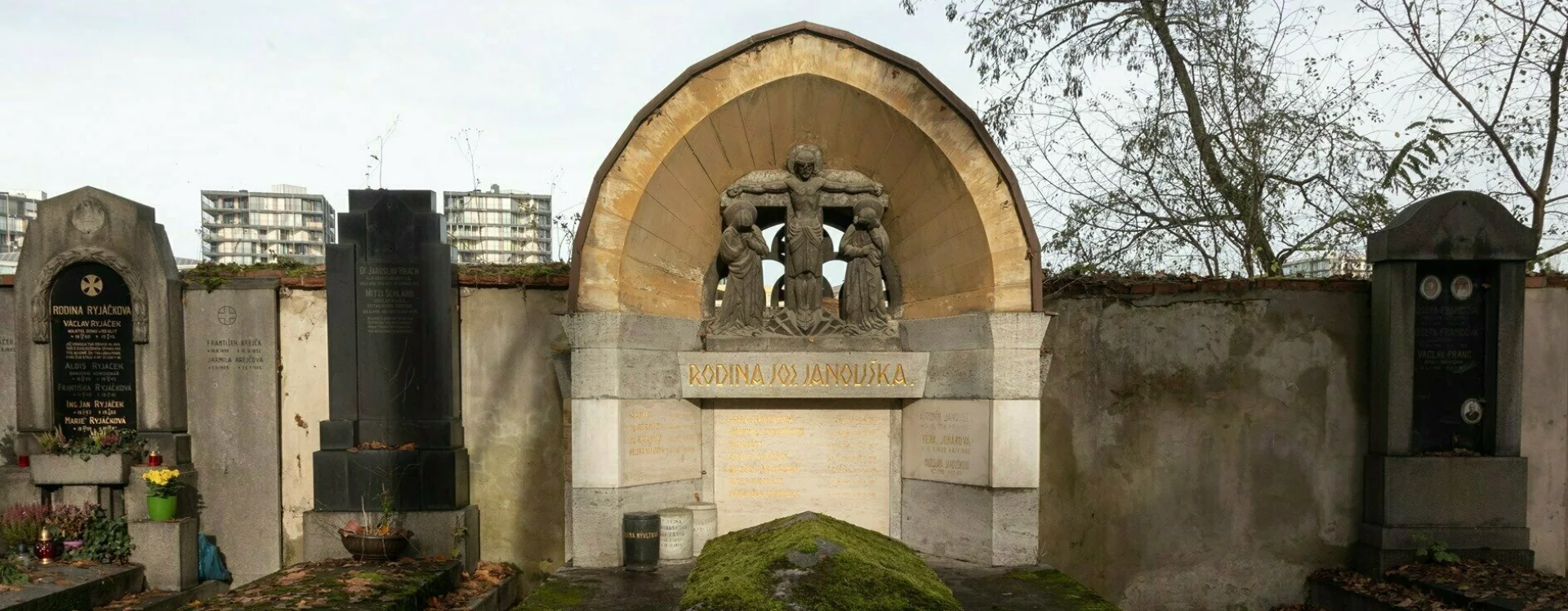
Designed by the architect Jan Kotěra, the monument decorating this crypt was built less than a year into the First World War, but these depressing circumstances apparently did not influence its monumentality, choice of luxury materials, or architectural ambitions.
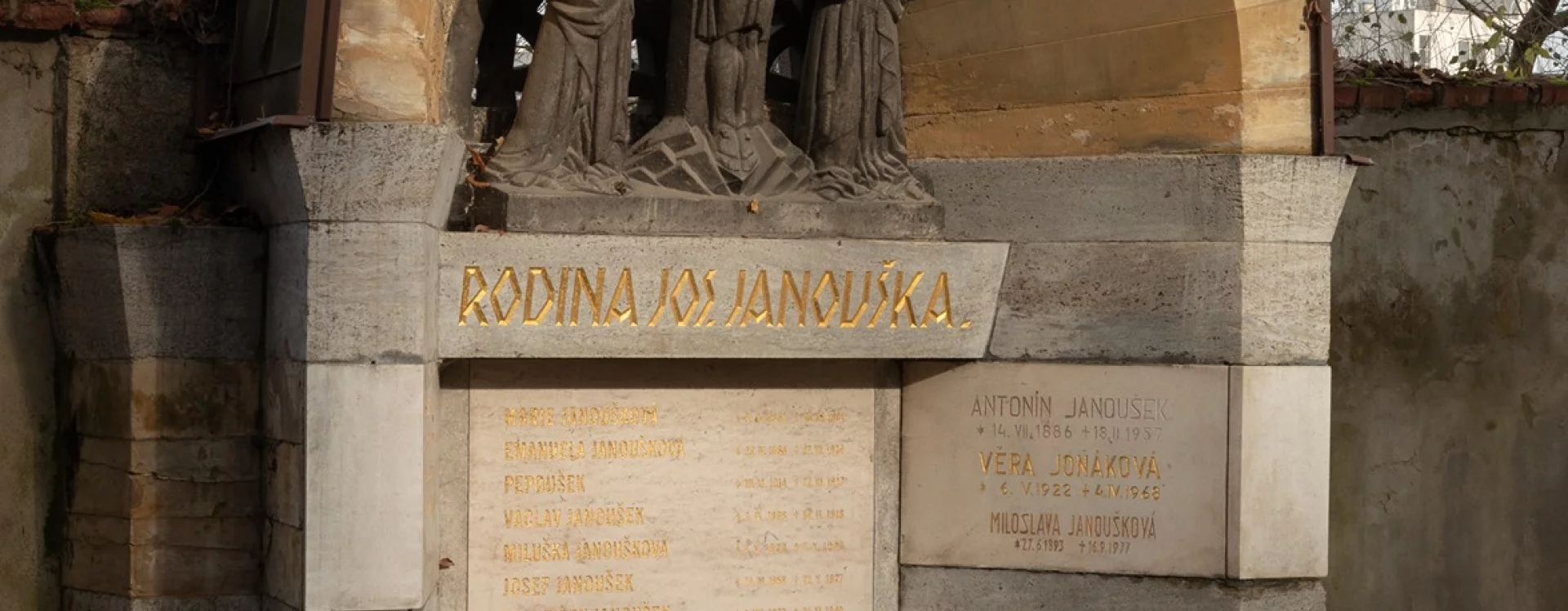
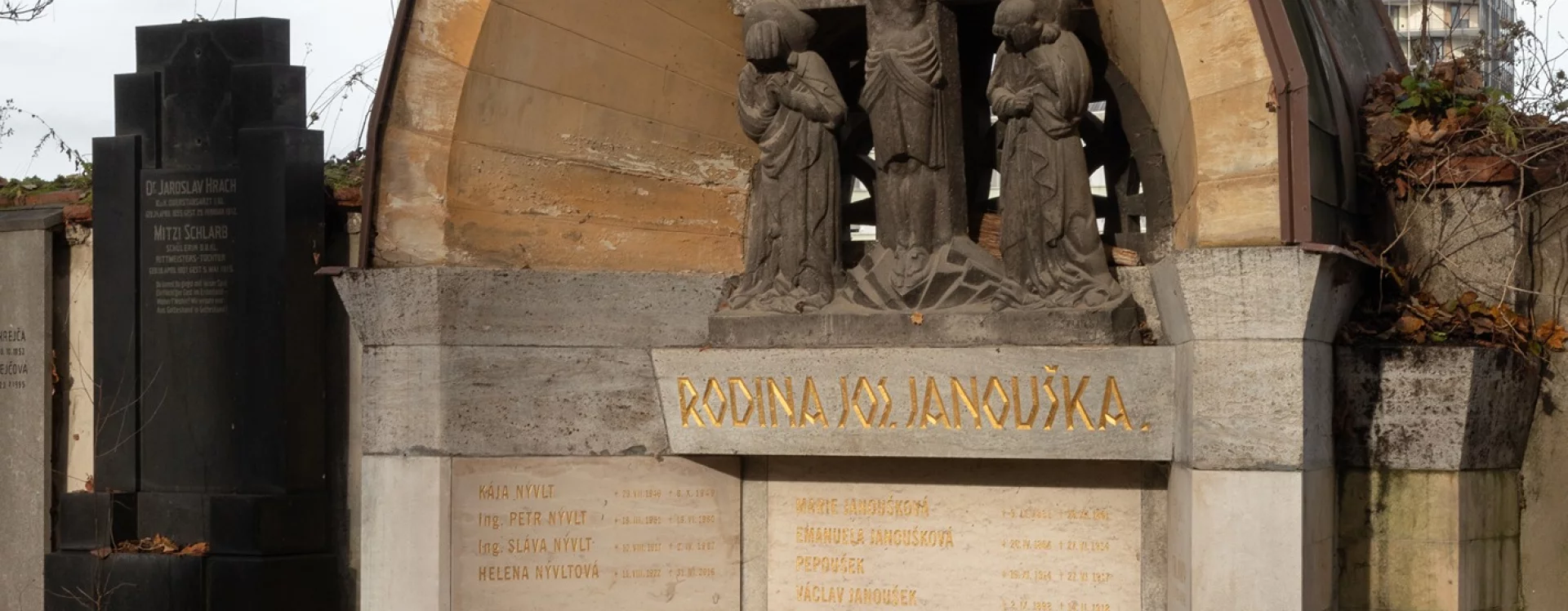
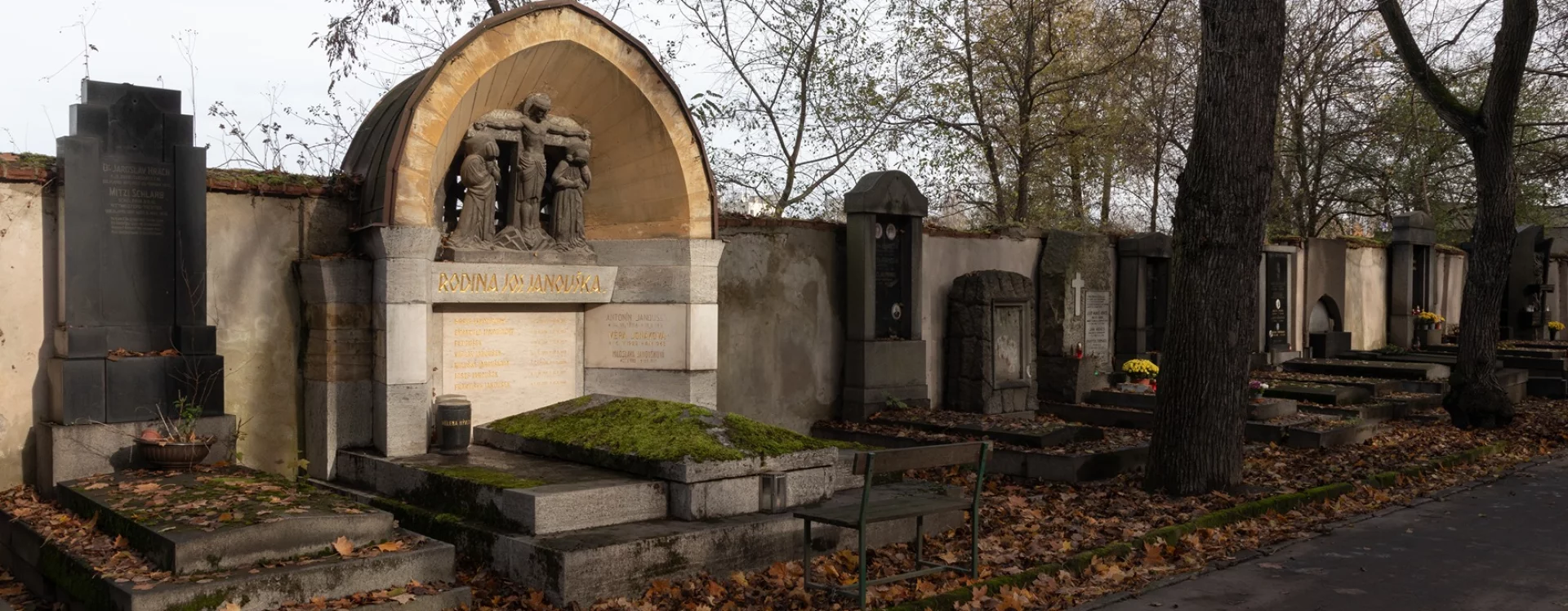
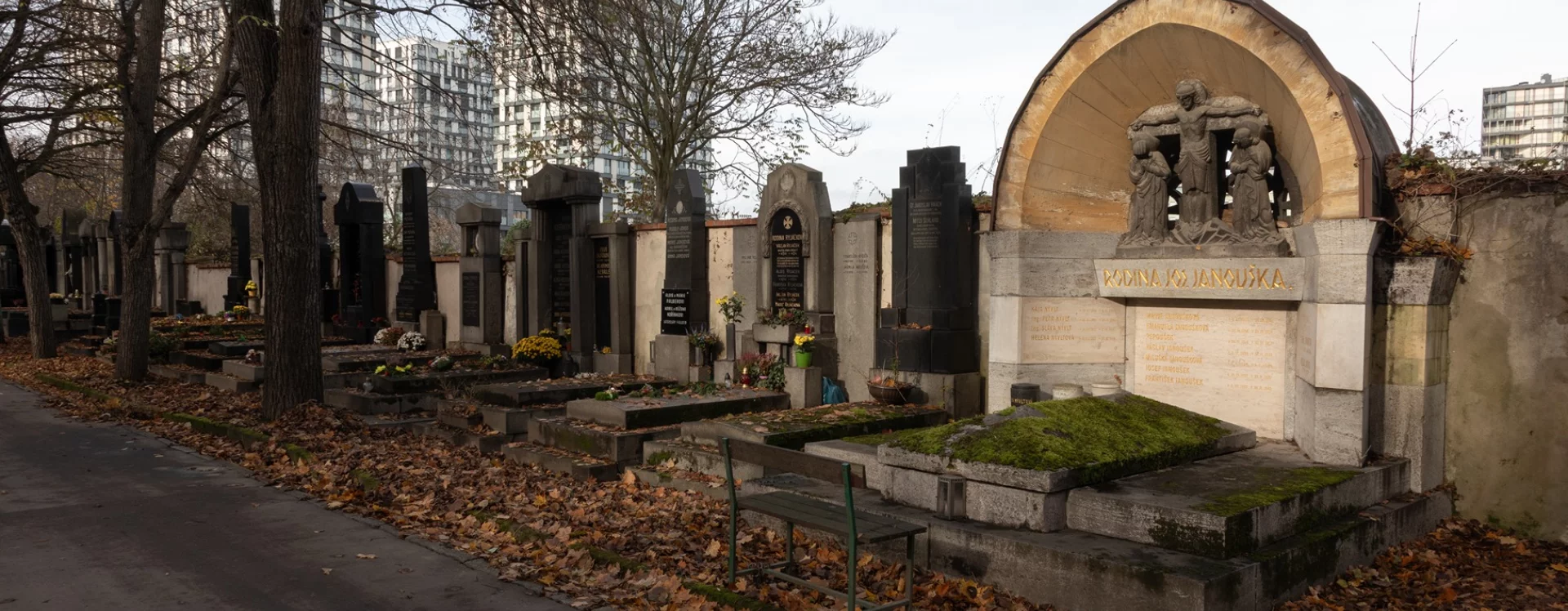
The large crypt, which according to the inscription panels contains the physical remains of at least nine members of the Janoušek family and five members of the Nývlt and Jonák families, is set against the northern cemetery wall along one of the cemetery's main paths and is clearly visible from afar. Kotěra's first funerary work, it shows Cubist influences even though he had previously distanced himself from the style.
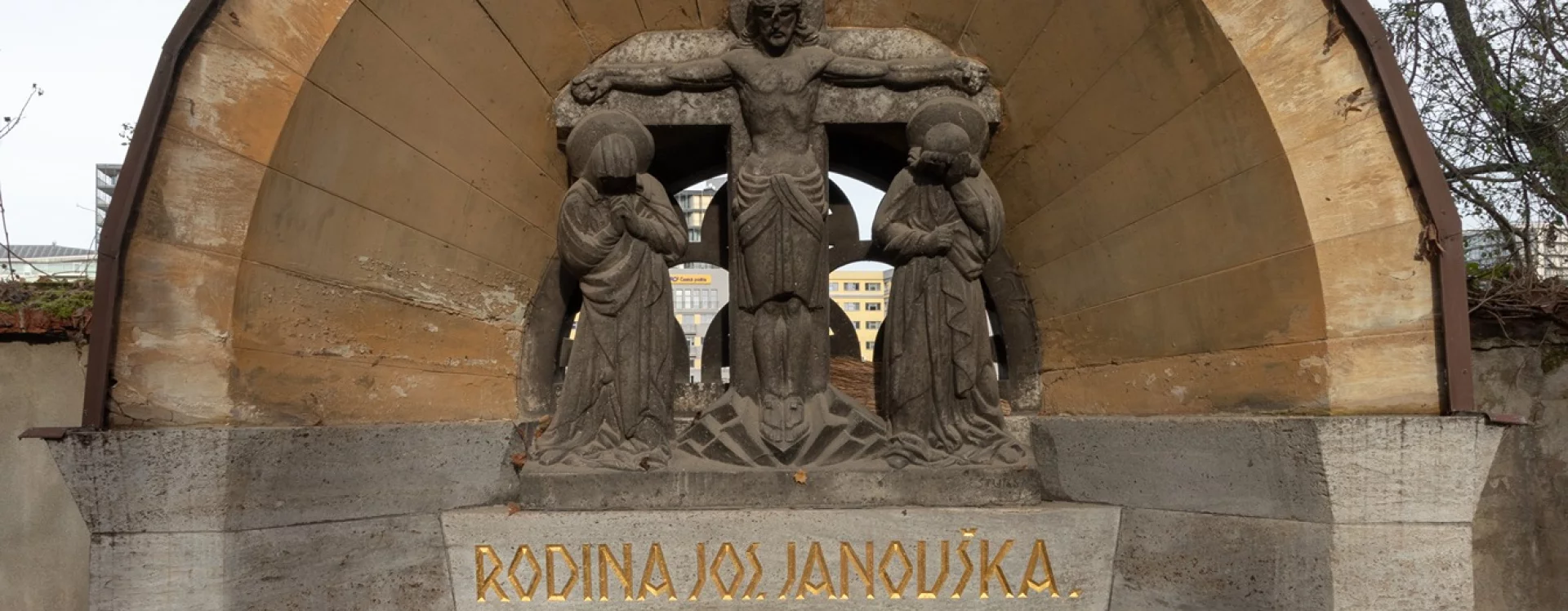
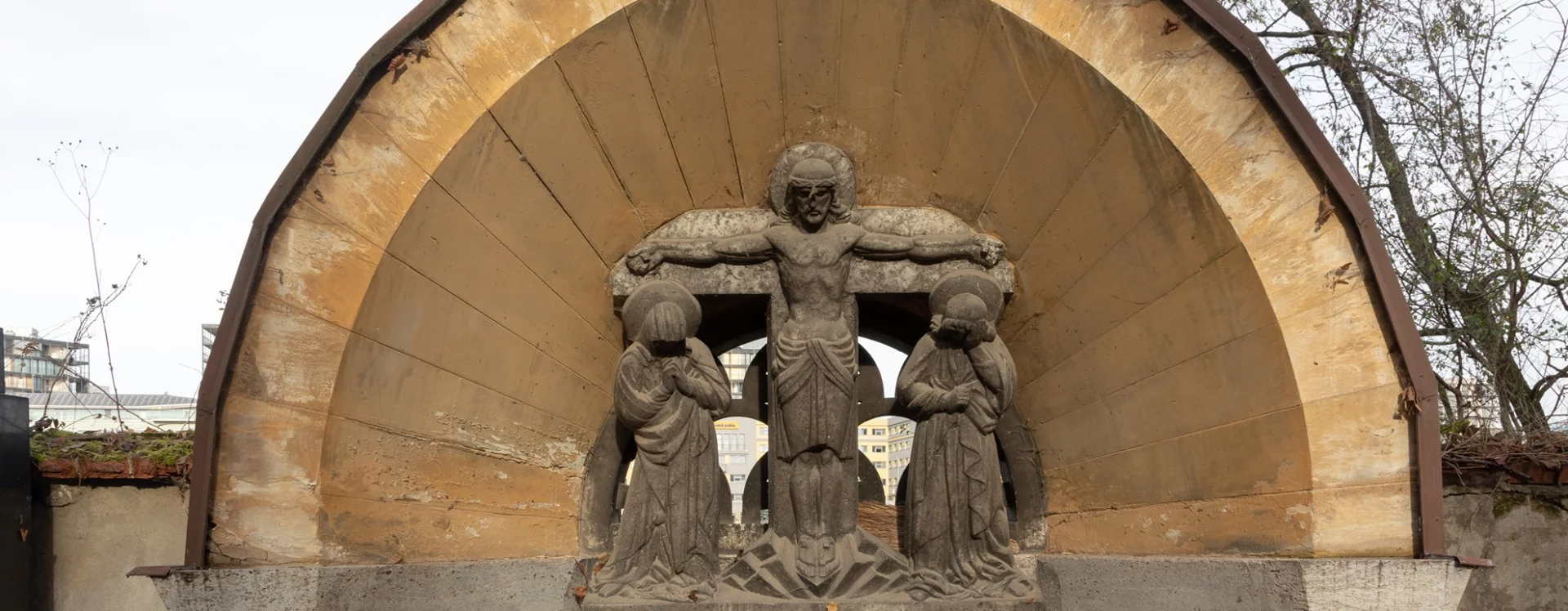
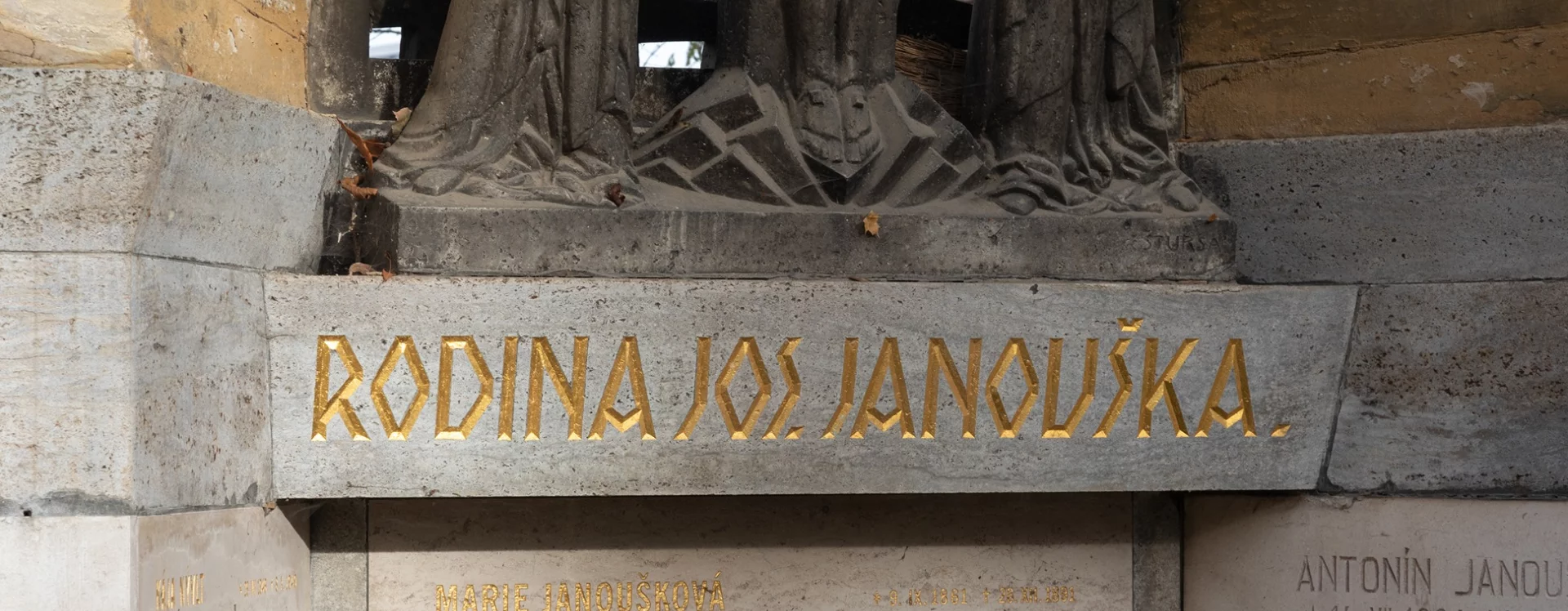
As is typical for the Cubist style, the ledger is of a stepped design, crowned by a centrally placed slab shaped like a hipped roof. The headstone itself has the form of a stylized, smooth Romanesque-Gothic portal over a deep recessed space. The space seems to converge in on itself, an impression further reinforced by the exposed joints of the voussoirs, which strongly promote the sense of movement. The lower section consists of plain stone slabs topped by an architrave and a conical cordon ledge. The portal's tympanum rises above the top of the cemetery wall, allowing light to pass through its rear. Located in the space of the tympanum is a sculptural group depicting the scene of the Calvary: Christ on the cross flanked by the Virgin Mary and John the Apostle. A wrought-iron grille behind the figures is decorated with cross motifs. Thanks to the open rear, the sculpture is bathed in light. The pointed arch may allude both to the continuity of the Church and to the cultural flourishing of the Gothic era. The tympanum's conical shape is of a remarkably dynamic character, simultaneously converging/receiving and diverging/expanding. According to some scholars, this is an expression of the symbolic connection of the human and the divine at the moment of Christ's death. In this sense, the design may be understood not only as an expression of the spirituality of the client or the commissioned artists, but also as a universal symbol of hope during a tragic era. Surviving sketches show the design's gradual evolution from a more complex architecture to a simple pointed arch. Kotěra's drawings showing a design inscribed within a geometric grid testify to his heightened interest in the study of proportions. Historical photographs indicate that, originally, the only inscription was on the central beam of the architrave, with the text Rodina Jos. Janouška (Family of Josef Janoušek) done in stylized Cubist lettering.
The ledger and the Calvary group are made of shelly limestone, while the tympanum vault is of marlstone, a material that can be seen as a reminder of the earliest Christian churches in the Czech lands. Because this stone is sensitive to environmental influences, it was later protected with a sheet-metal covering. The lower part of the tympanum, including the inscription panels, is made of Istrian limestone.
The ledger and the lower part of the tympanum were restored in 2016.
Amáta M. Wenzlová, 2025
The large crypt, which according to the inscription panels contains the physical remains of at least nine members of the Janoušek family and five members of the Nývlt and Jonák families, is set against the northern cemetery wall along one of the cemetery's main paths and is clearly visible from afar. Kotěra's first funerary work, it shows Cubist influences even though he had previously distanced himself from the style.
As is typical for the Cubist style, the ledger is of a stepped design, crowned by a centrally placed slab shaped like a hipped roof. The headstone itself has the form of a stylized, smooth Romanesque-Gothic portal over a deep recessed space. The space seems to converge in on itself, an impression further reinforced by the exposed joints of the voussoirs, which strongly promote the sense of movement. The lower section consists of plain stone slabs topped by an architrave and a conical cordon ledge. The portal's tympanum rises above the top of the cemetery wall, allowing light to pass through its rear. Located in the space of the tympanum is a sculptural group depicting the scene of the Calvary: Christ on the cross flanked by the Virgin Mary and John the Apostle. A wrought-iron grille behind the figures is decorated with cross motifs. Thanks to the open rear, the sculpture is bathed in light. The pointed arch may allude both to the continuity of the Church and to the cultural flourishing of the Gothic era. The tympanum's conical shape is of a remarkably dynamic character, simultaneously converging/receiving and diverging/expanding. According to some scholars, this is an expression of the symbolic connection of the human and the divine at the moment of Christ's death. In this sense, the design may be understood not only as an expression of the spirituality of the client or the commissioned artists, but also as a universal symbol of hope during a tragic era. Surviving sketches show the design's gradual evolution from a more complex architecture to a simple pointed arch. Kotěra's drawings showing a design inscribed within a geometric grid testify to his heightened interest in the study of proportions. Historical photographs indicate that, originally, the only inscription was on the central beam of the architrave, with the text Rodina Jos. Janouška (Family of Josef Janoušek) done in stylized Cubist lettering.
The ledger and the Calvary group are made of shelly limestone, while the tympanum vault is of marlstone, a material that can be seen as a reminder of the earliest Christian churches in the Czech lands. Because this stone is sensitive to environmental influences, it was later protected with a sheet-metal covering. The lower part of the tympanum, including the inscription panels, is made of Istrian limestone.
The ledger and the lower part of the tympanum were restored in 2016.
Amáta M. Wenzlová, 2025
Literature
Otakar Novotný. Jan Kotěra a jeho doba. Praha, 1958, s. 63-64, obr. 263-264 (obrazová příloha nestr.).
Alois Vanoušek. Olšanské umění, jeho tvůrci a doba. Praha, 2000, s. 100.
Petr Kovařík. Klíč k pražským hřbitovům. Praha, 2001, s. 40, 43.
Vladimír Šlapeta, Daniela Karasová et al.. Jan Kotěra 1871-1923: Zakladatel moderní české architektury. Praha, 2001, s. 324.
Drahomíra Březinová, Barbora Dudíková Schulmannová, Jana Růžičková. Jan Kotěra a Olšanské hřbitovy, Za Starou Prahu, Věstník za starou Prahu XXXIX. (X.), č. 3/2009, Příloha. 2009, p. nepag.