Augustin Kožíšek, himself an architect and imperial ministerial councilor, commissioned this funerary monument for his daughter Mařenka (†1902) from the established artists Jan Kotěra and Stanislav Sucharda. At the time, Kožíšek was collaborating on the urban plan for the university campus at Albertov (1901–1902) as well as on various campus buildings, including the Chemistry Institute of Charles University (1903–1905) and the Physiological Institute of the German University (1904). After the First World War, he worked on the second stage of the campus's construction, including the German University's Chemistry Institute (1919) and the Hlava Pathological Institute (1913–1921), although the main architect for both buildings was Alois Špalek.
The first design, submitted to the Kožíšeks in the year of their daughter's death, was a historicist monument with two lanterns flanking a stele by the stonemason Ludvík Šalda. Like the eventually realized design, this version envisioned the inclusion of a bust of the deceased. A request for a building permit for this proposal is dated 19 September 1902. The reason it was never realized remains unknown. Kotěra's new and significantly more modern Art Nouveau design dates from the following year. Although Kotěra had by then already produced numerous important funerary monuments in Prague and elsewhere, this is one of his first works at Olšany.
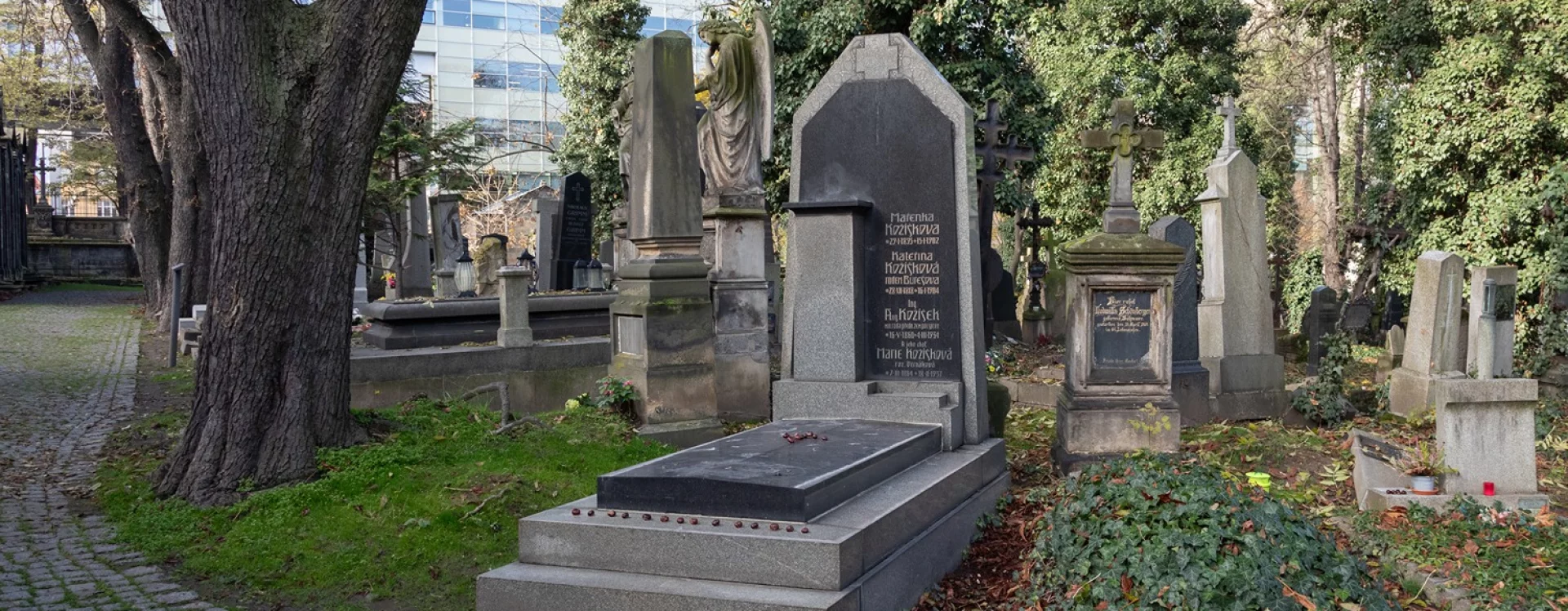
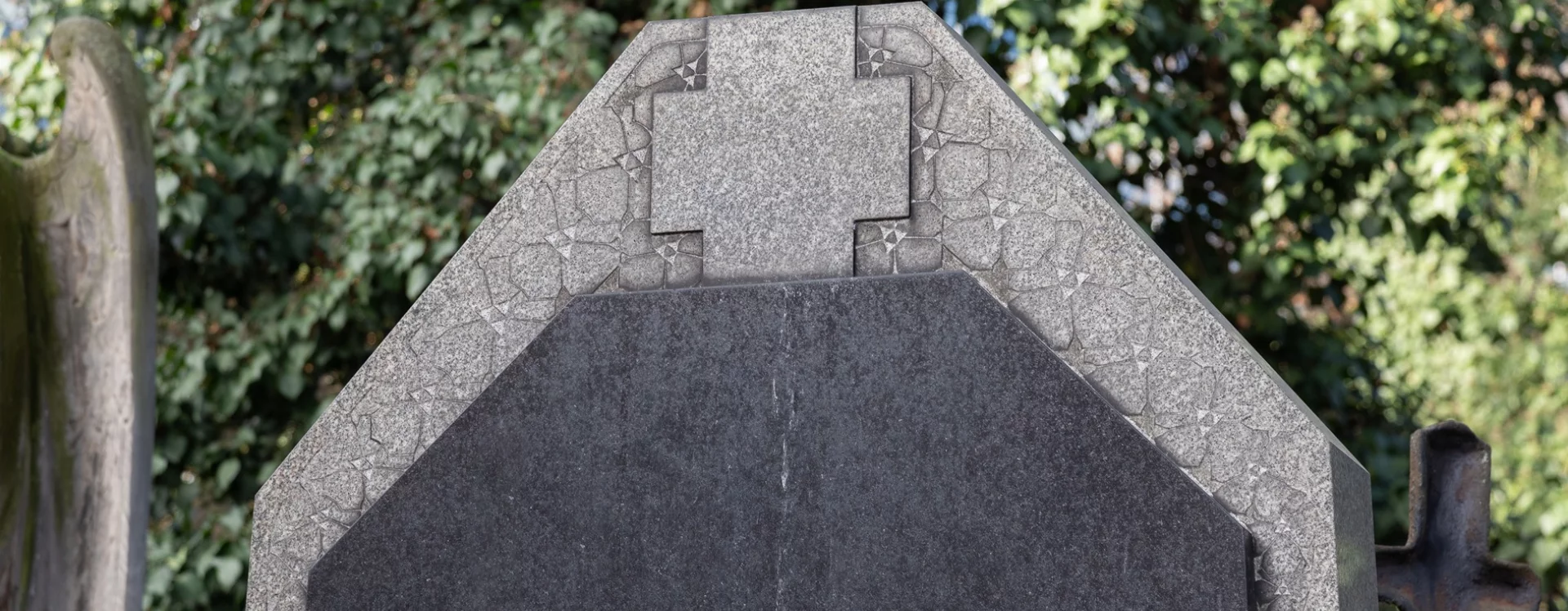
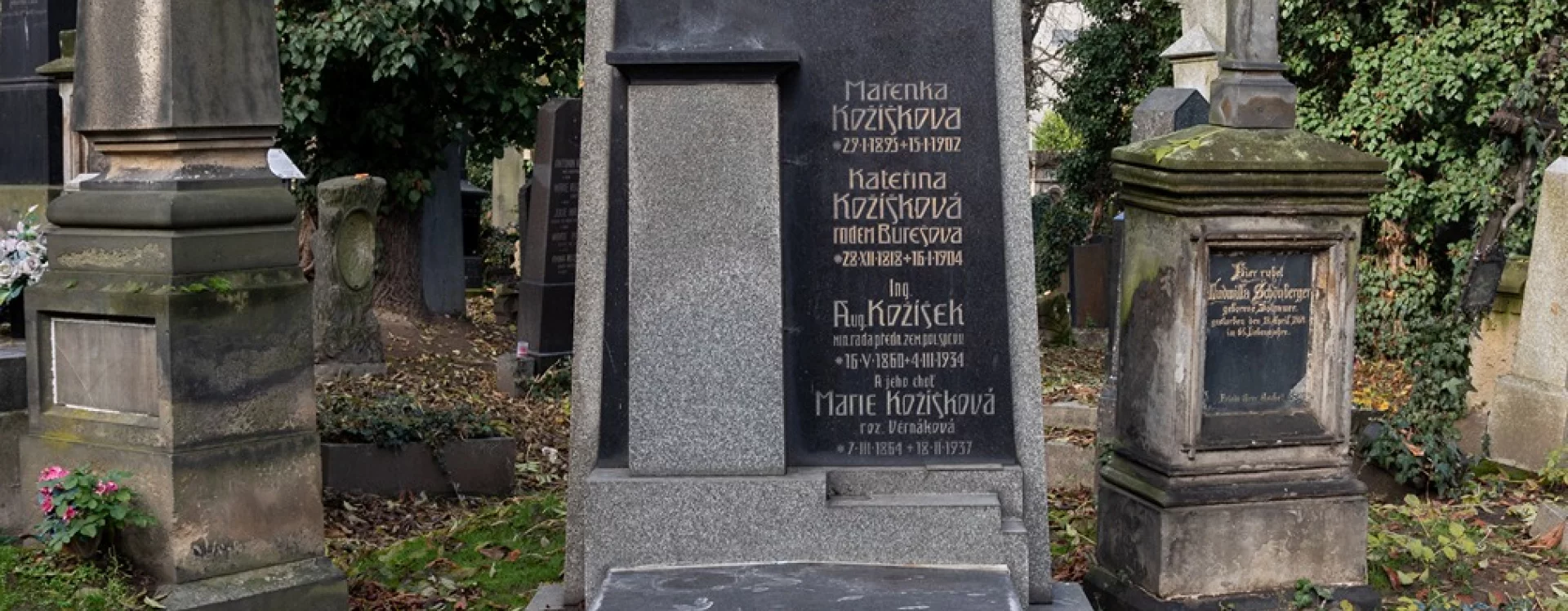
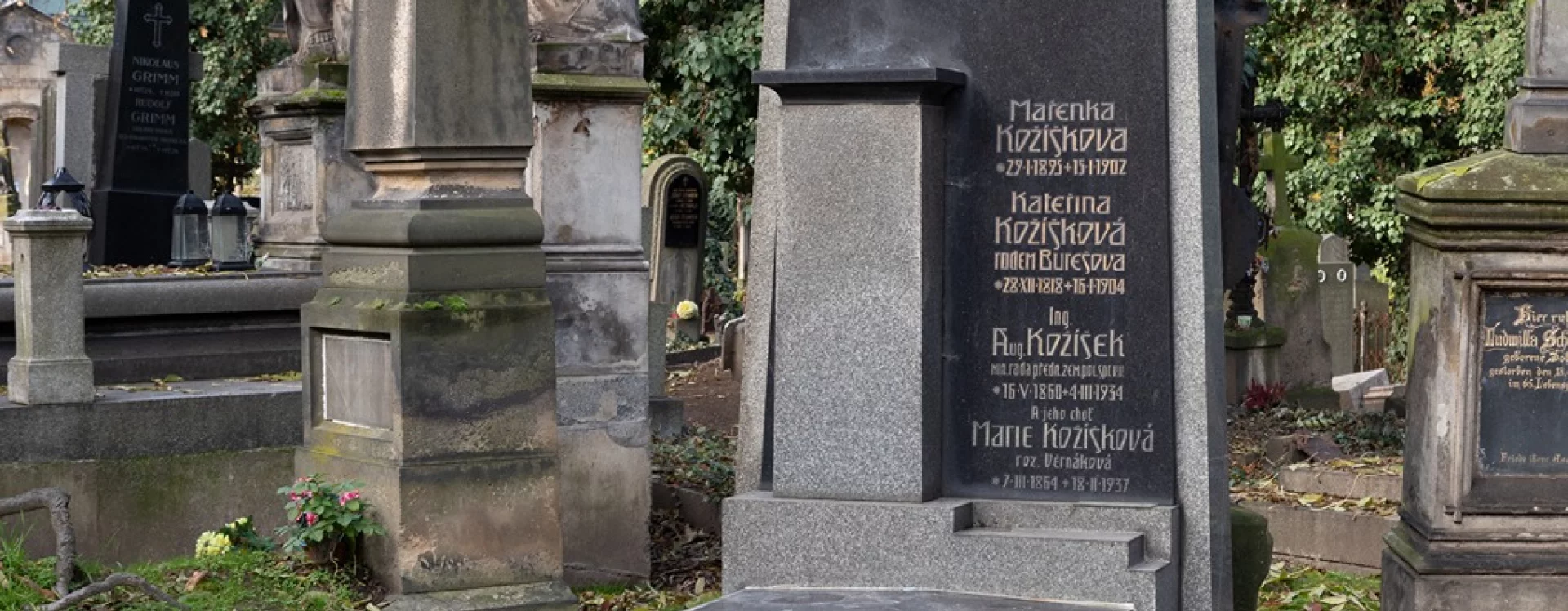
Mařenka Kožíšková's grave marker builds on a contrast between honed and polished Mrákotín granite and dark polished gabbro. A dark, vaguely roof-shaped ledger stone sits atop the grave's stepped granite base. The flat stele with chamfered upper corners is slightly tapered towards the top, giving it the kind of elegant silhouette typical for the Art Nouveau style. On the stele above the inscription panel is a low-relief equal-armed cross framed by geometrically stylized vegetal festoons. In front of the left half of the stele, a pilaster with a polished black capital served as a plinth for a bronze bust of the young girl. Originally, a metal lantern was located in front of the ledger stone. Its feet, shaped like withered leafy twigs, not only reflected Art Nouveau's penchant for melancholy and its fascination with vegetative processes, but also symbolized the futile nature of death. Both metal features were stolen at some unknown date. Compared with Kotěra's more robust monument erected nearby that same year for Vojta Slukov, this is a more delicate design. Although the sophisticated design has been robbed of its most valuable artifacts, it is otherwise in a good state and shows no signs of abandonment.
Amáta M. Wenzlová, 2025
The first design, submitted to the Kožíšeks in the year of their daughter's death, was a historicist monument with two lanterns flanking a stele by the stonemason Ludvík Šalda. Like the eventually realized design, this version envisioned the inclusion of a bust of the deceased. A request for a building permit for this proposal is dated 19 September 1902. The reason it was never realized remains unknown. Kotěra's new and significantly more modern Art Nouveau design dates from the following year. Although Kotěra had by then already produced numerous important funerary monuments in Prague and elsewhere, this is one of his first works at Olšany.
Mařenka Kožíšková's grave marker builds on a contrast between honed and polished Mrákotín granite and dark polished gabbro. A dark, vaguely roof-shaped ledger stone sits atop the grave's stepped granite base. The flat stele with chamfered upper corners is slightly tapered towards the top, giving it the kind of elegant silhouette typical for the Art Nouveau style. On the stele above the inscription panel is a low-relief equal-armed cross framed by geometrically stylized vegetal festoons. In front of the left half of the stele, a pilaster with a polished black capital served as a plinth for a bronze bust of the young girl. Originally, a metal lantern was located in front of the ledger stone. Its feet, shaped like withered leafy twigs, not only reflected Art Nouveau's penchant for melancholy and its fascination with vegetative processes, but also symbolized the futile nature of death. Both metal features were stolen at some unknown date. Compared with Kotěra's more robust monument erected nearby that same year for Vojta Slukov, this is a more delicate design. Although the sophisticated design has been robbed of its most valuable artifacts, it is otherwise in a good state and shows no signs of abandonment.
Amáta M. Wenzlová, 2025
Literature
Zlatá Praha. Obrázkový týdeník pro zábavu a poučení. Praha 1904. 1904, s. 35.
Künstleriche Grabdenkmale. Moderne Architektur & Plastik von Friedhöfen und Kirchen in Oesterreich Ungar, serie 5. Vídeň. 1905, s. 138.
Vladimír Šlapeta, Daniela Karasová et al.. Jan Kotěra 1871-1923: Zakladatel moderní české architektury. Praha, 2001, s. 324.
Drahomíra Březinová, Barbora Dudíková Schulmannová, Jana Růžičková. Jan Kotěra a Olšanské hřbitovy, Za Starou Prahu, Věstník za starou Prahu XXXIX. (X.), č. 3/2009, Příloha. 2009, p. nestr.
Miloš Szabo. Pražské hřbitovy. Olšanské hřbitovy IV.. Praha, 2012, s. 245, 267.