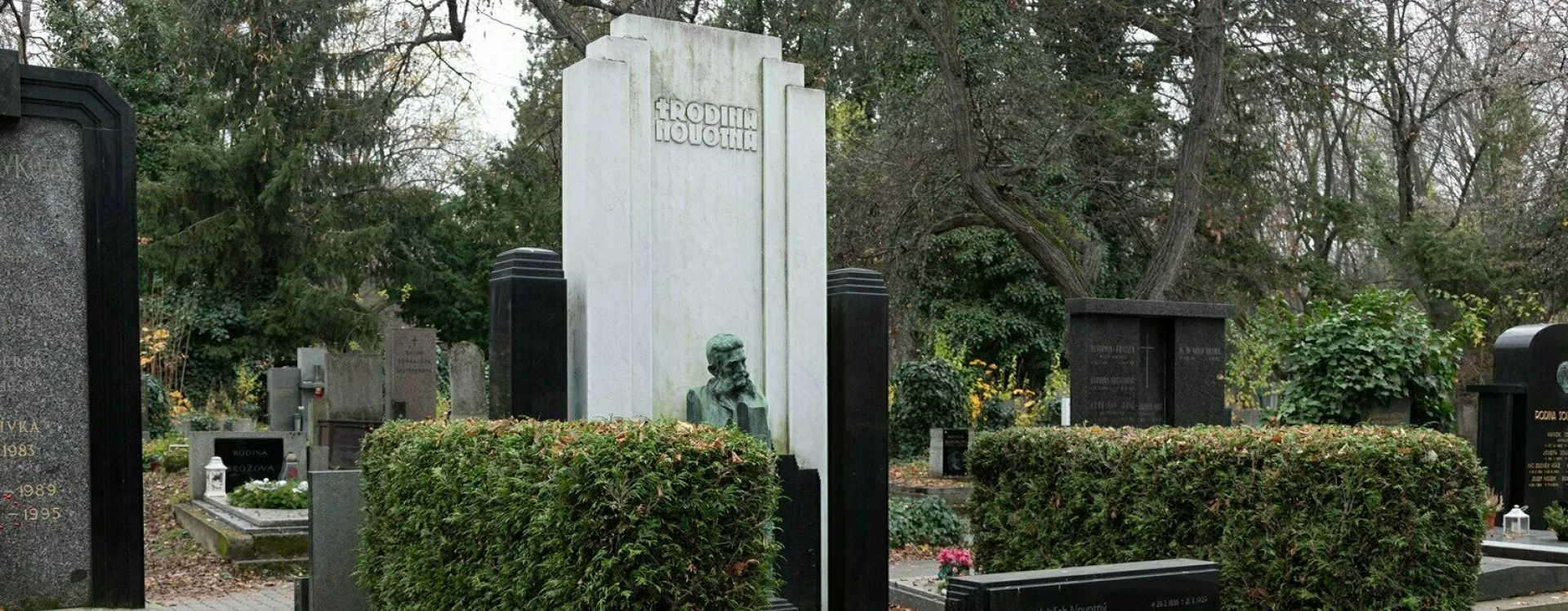
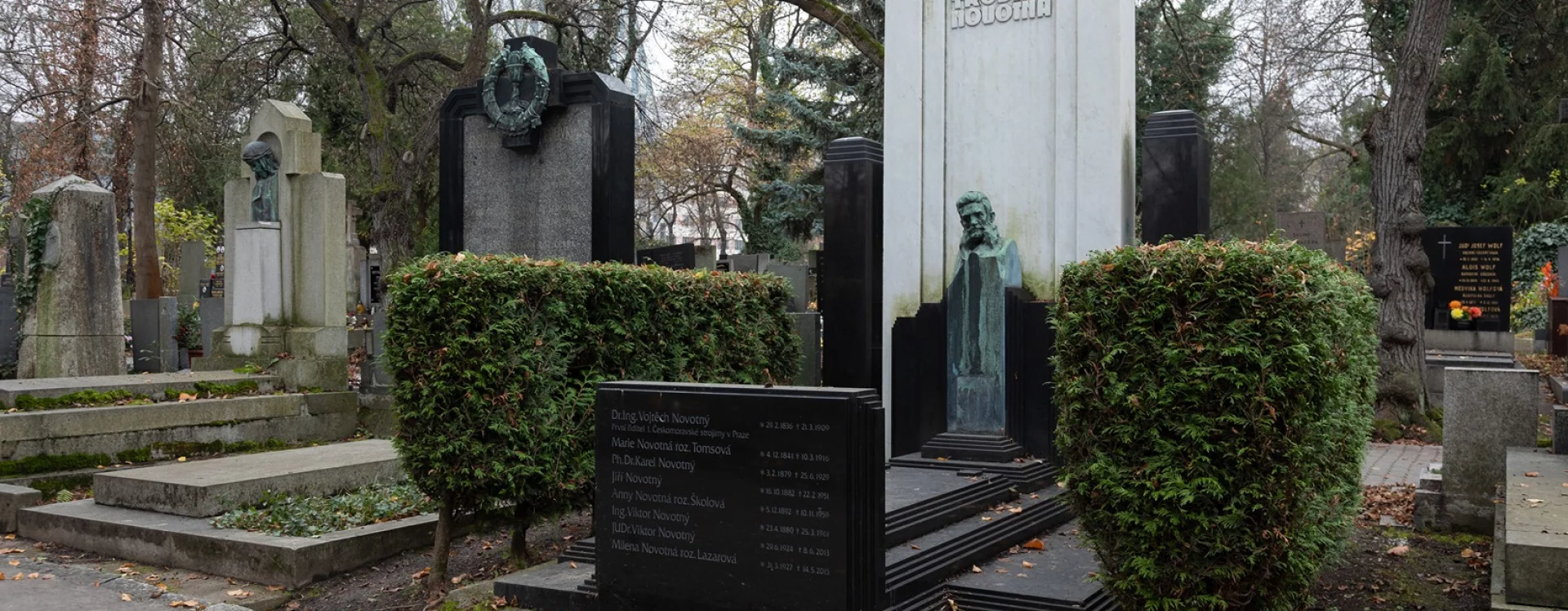
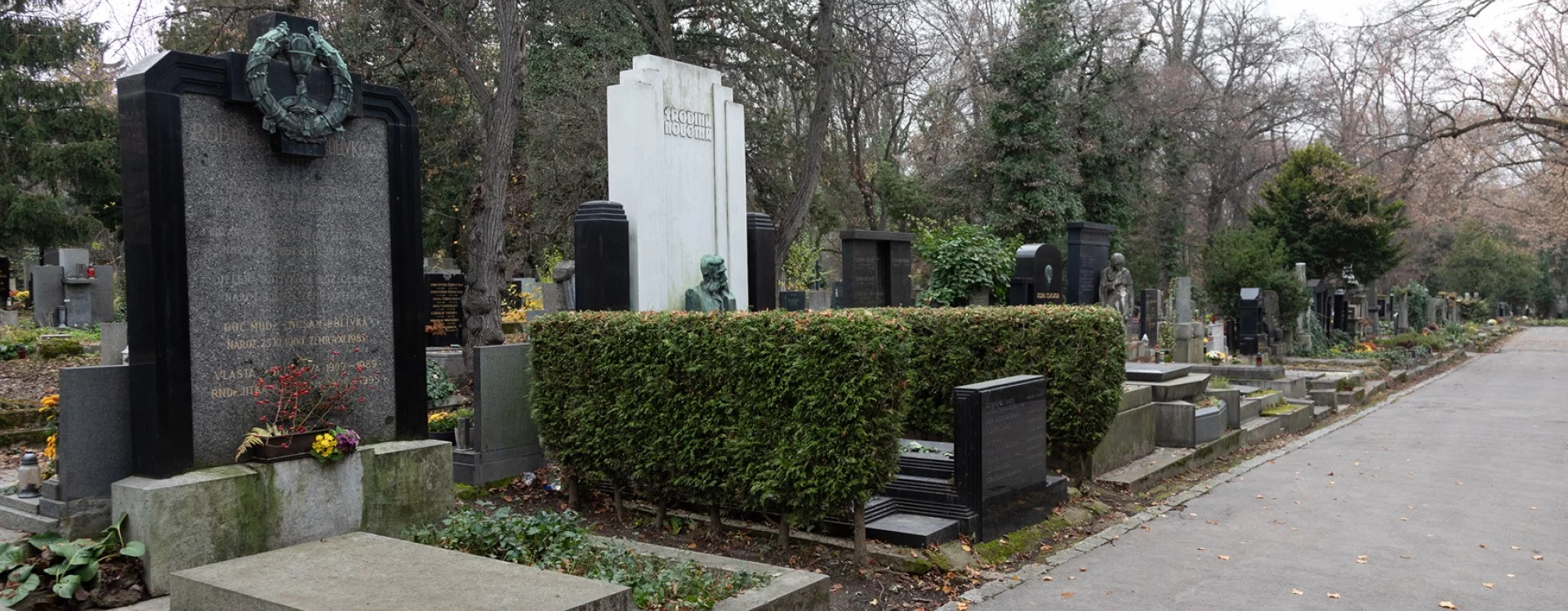
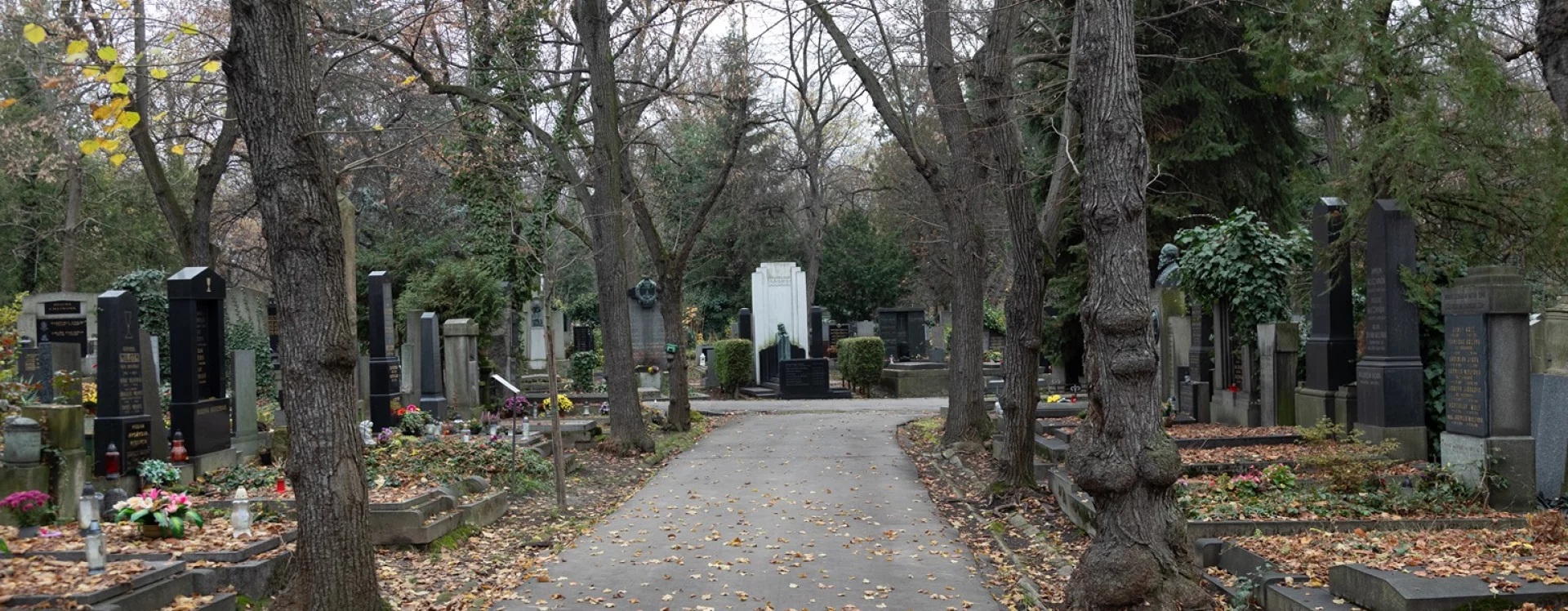
The monument marking the Novotný family's crypt is perhaps one of the most magnificent examples of geometric Art Nouveau in the funerary arts. It was commissioned by Marie Novotná in 1909 after the death of her husband, Dr. Ing. Vojtěch Novotný, director of the First Czechoslovak Machine Works in Prague. Mrs. Novotná entrusted the architectural design to Otakar Novotný (1880‒1959), a student of Jan Kotěra and one of the most prominent Czech architects of the first half of the twentieth century. (The fact that architect and client shared a surname was most probably a coincidence.) Otakar Novotný produced a remarkable body of work in each of his creative periods, which ranged from Cubism to Functionalism. Important examples of his work include the late Art Nouveau Štenc Building and the Cubist residential block known as the Teachers' Houses (both in Prague's Old Town), Kbely Airport, and the Functionalist Mánes Building, which he designed when he was president of the Mánes association.
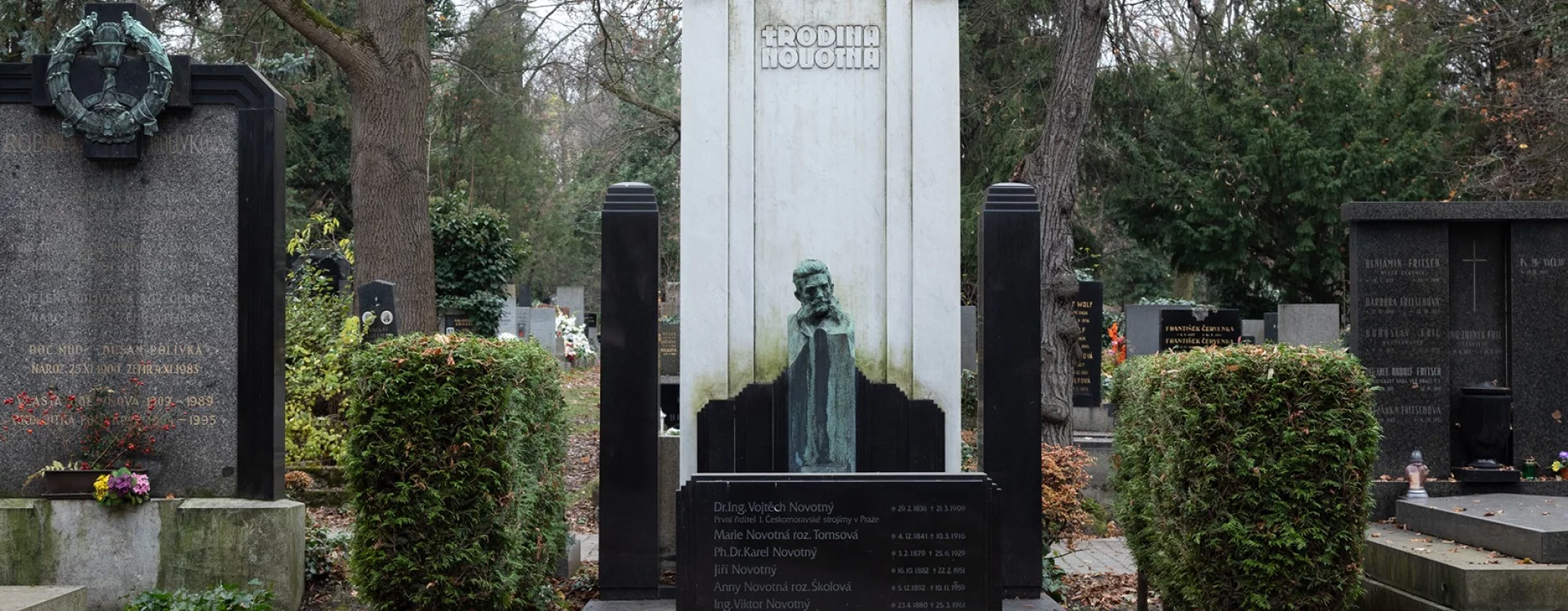
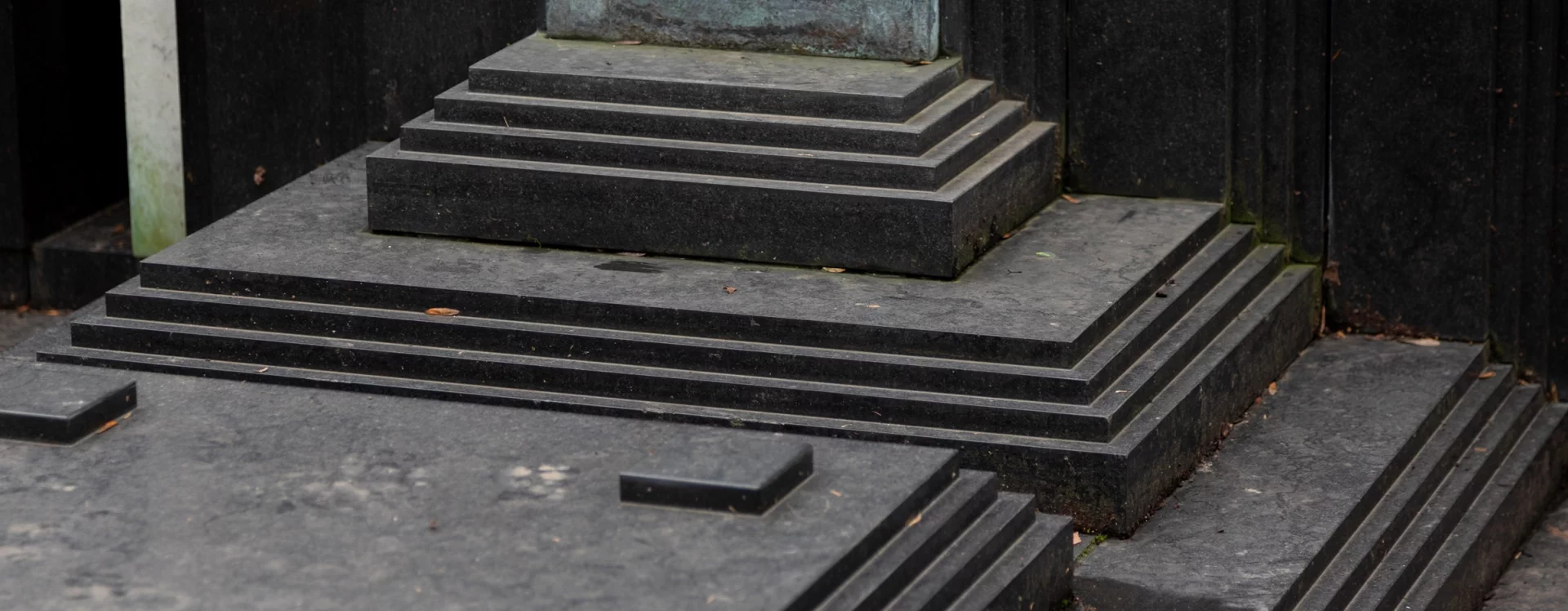
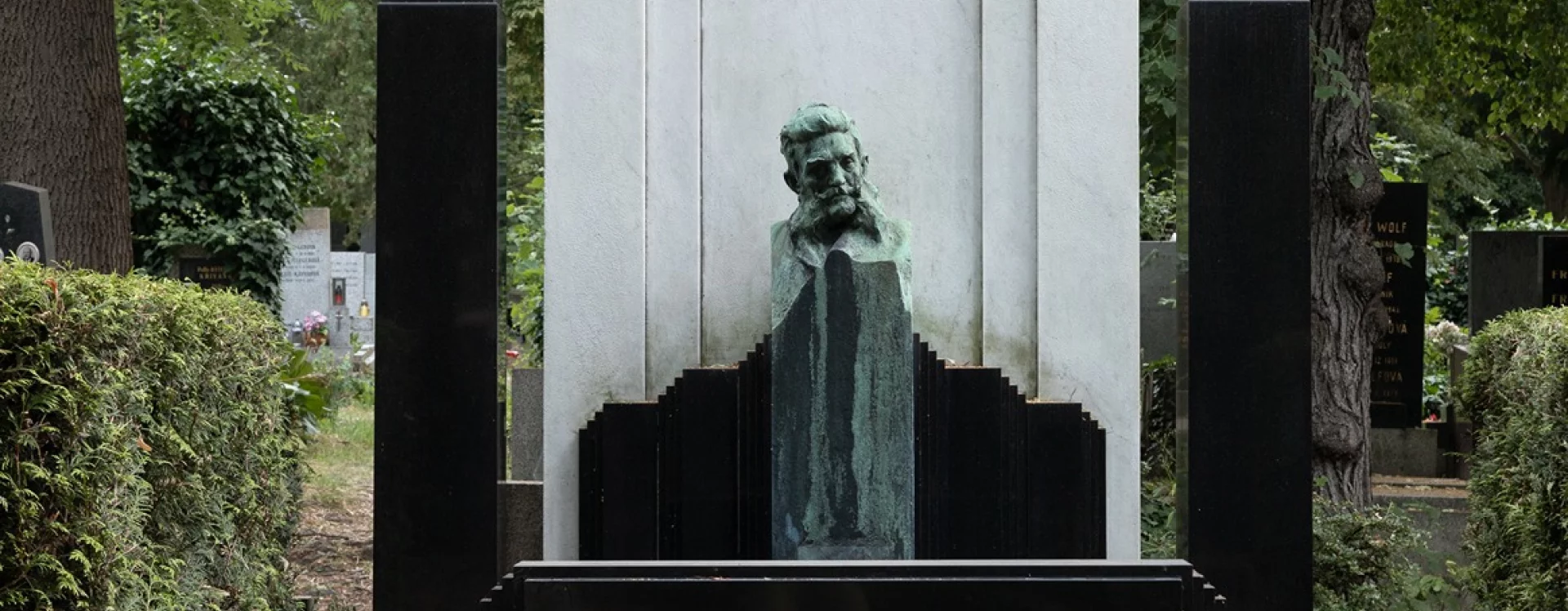
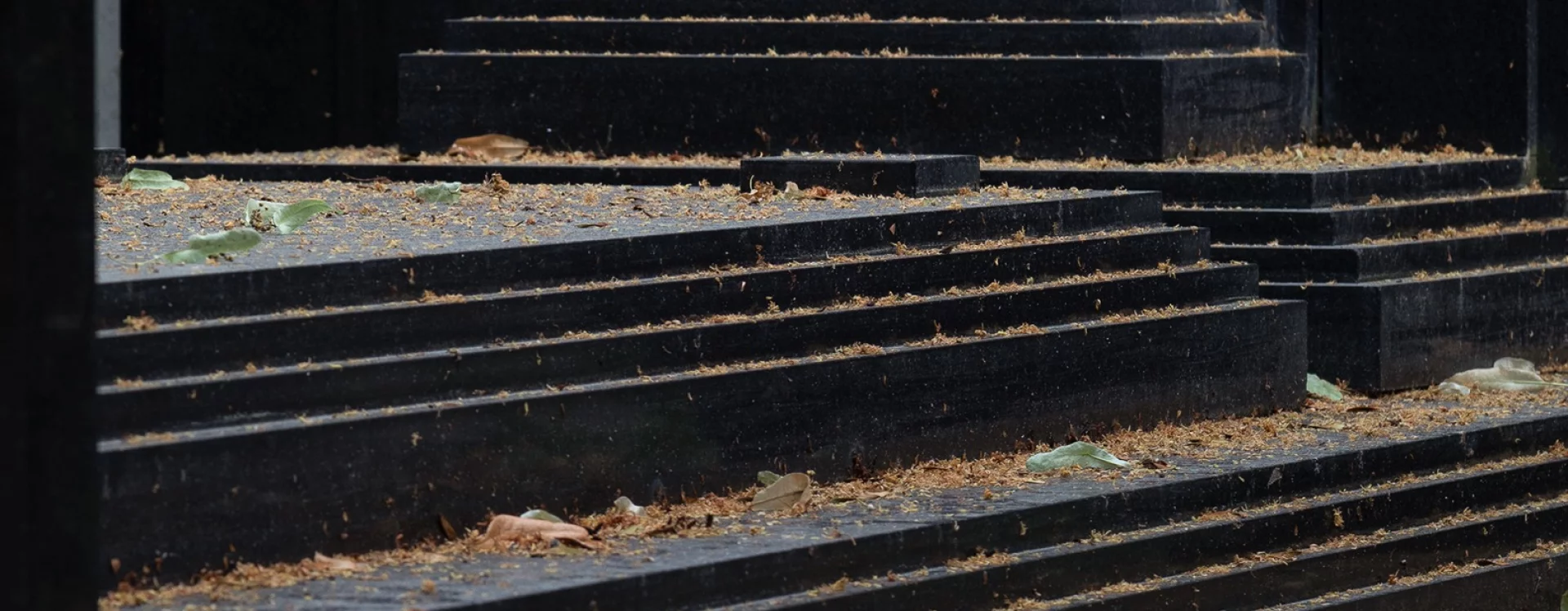
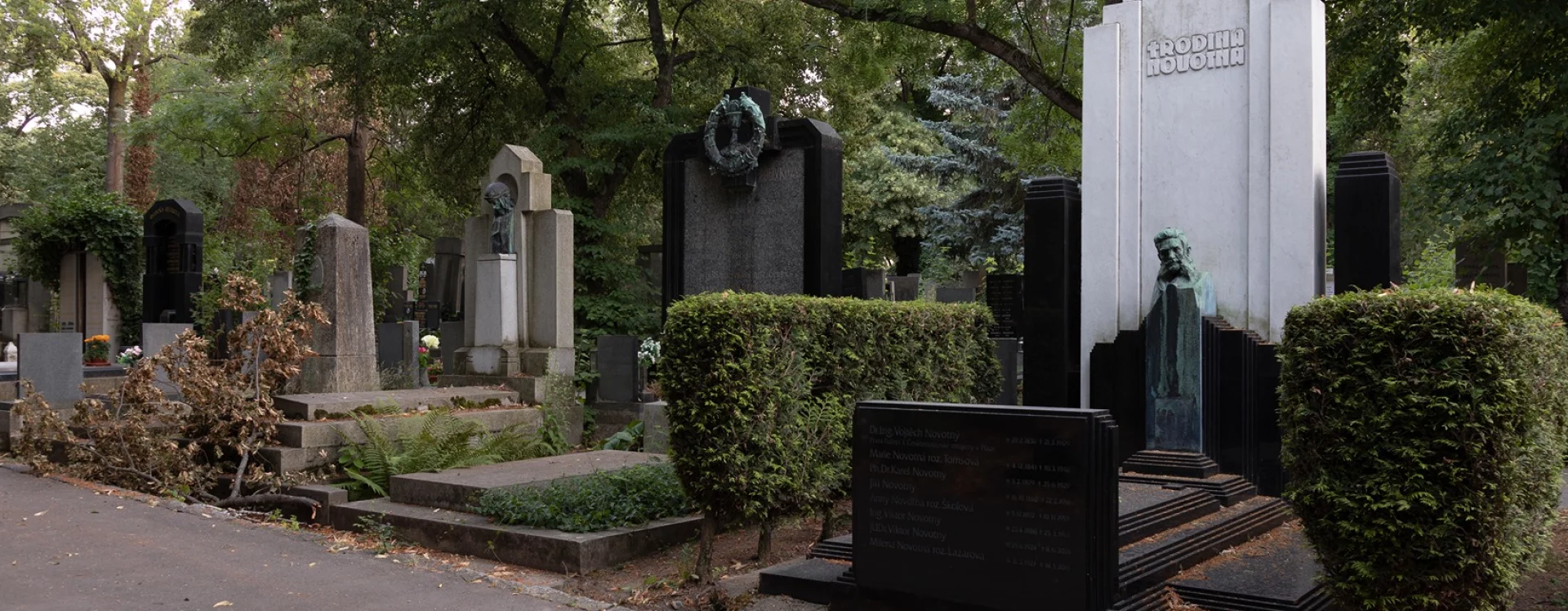
Novotný designed the monument as a kind of bed. At its head is a tall stele with a likeness of the deceased; at its foot is a lower plaque with an inscription. The effect of this unusual composition is amplified in particular by the contrast between the exclusive white and black materials, the choice of which is documented among other things by a 1909 note from the stonemasonry business of Ludvík Šalda: "The lower part of the structure will be on three levels, with a lower area for collecting water made of bricks and cement mortar. The upper part will be of polished black Swedish granite and white Carrara marble, and the decoration and bust will be bronze." Thanks to the perfect interplay of geometric surfaces and the contrasting colors of the stone, the monument is a visually highly impressive work. The tall white stele, its rear side decorated with the letter "N," is flanked by a pair of black obelisks. Black material was also used for the horizontal surface of the ledger stone and the inscription plaque. Initially featuring a modern relief typeface, it was covered by a plaque with a new inscription in 2016.
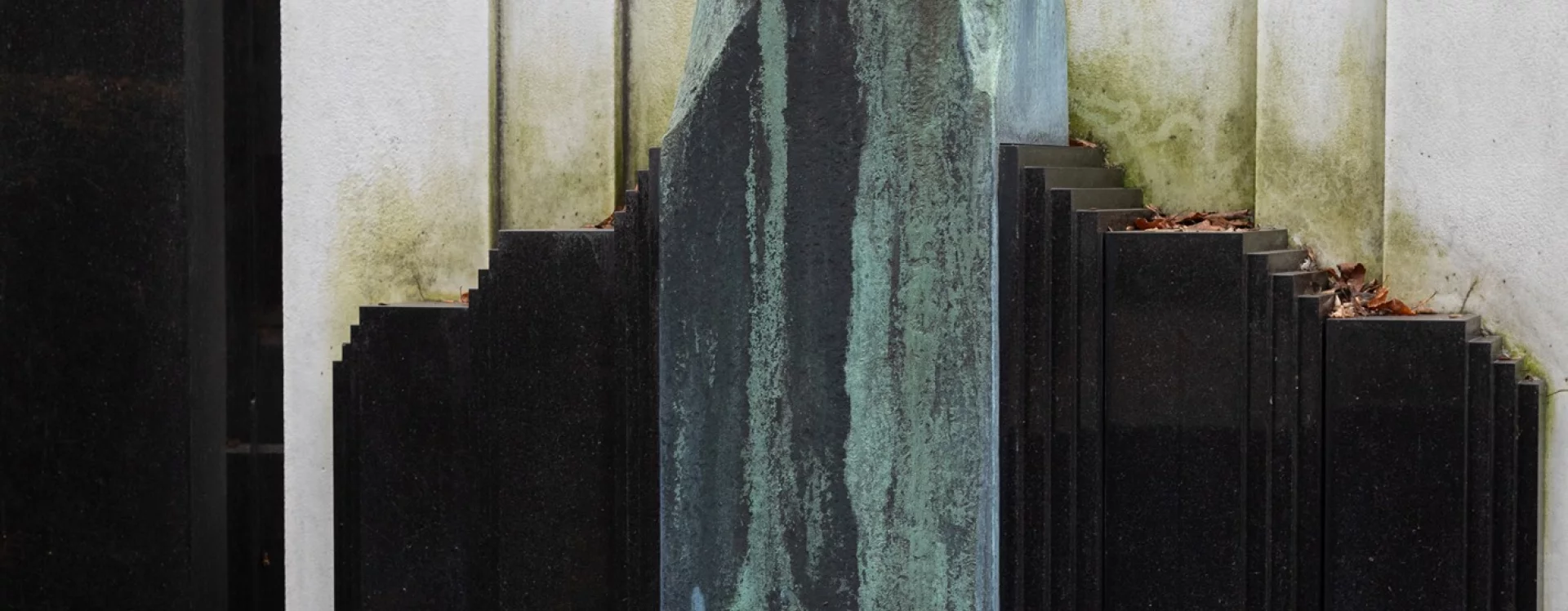
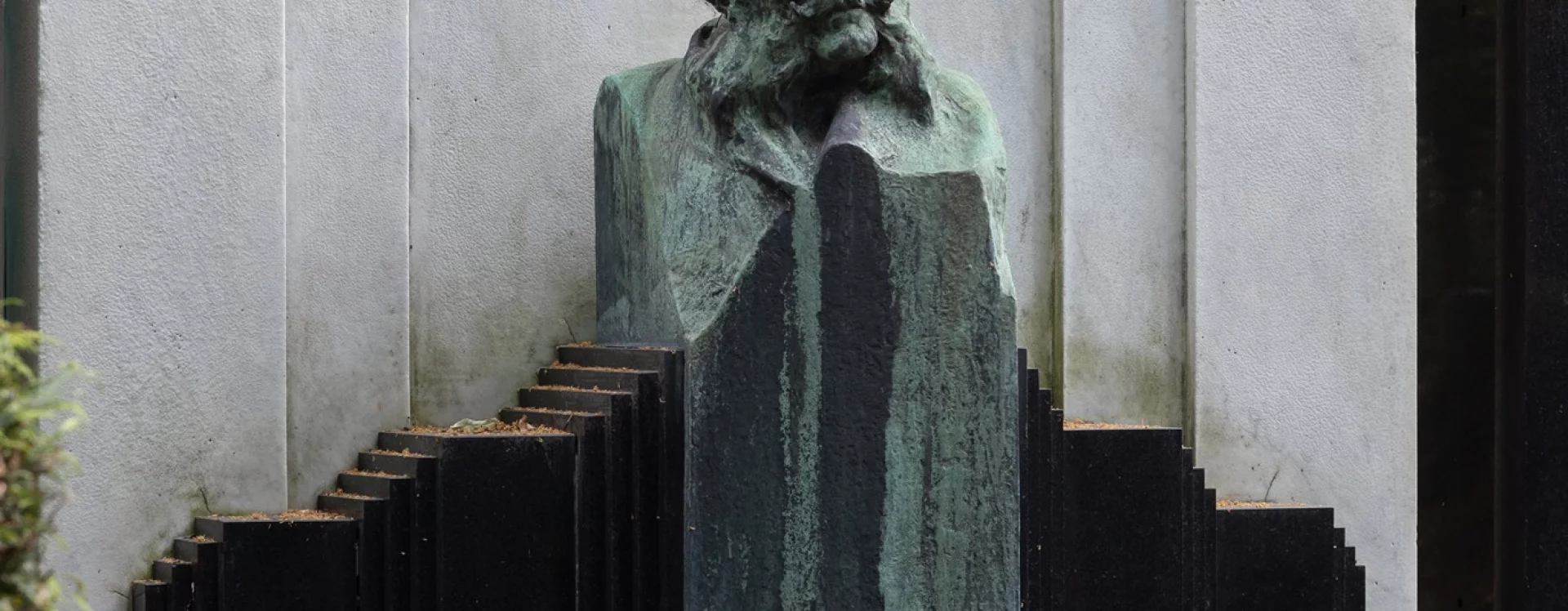
The gravestone's high aesthetic quality is further increased by the bust of the deceased emerging from the "roughly worked" raised pedestal. It was produced by the sculptor Stanislav Sucharda, who is known for the František Palacký monument in Prague (completed around the same time as this grave design) and for numerous important funerary works (several of them at Olšany in collaboration with Jan Kotěra). The bust is an original copy of a portrait that Vojtěch Novotný had received from the shareholders of the First Czechoslovak Machine Works on the occasion of his seventieth birthday and the thirty-fifth anniversary of his tenure as the company's director. The bronze decorative elements also included vertical grates with a lacework pattern that, like the chrome lanterns at the foot of the pedestal bearing his likeness, have unfortunately been irretrievably lost.
The architect Otakar Novotný was buried at the Vinohrady cemetery, as was his son Jiří Novotný (1911‒2000), an architect and urban planner whose works include the highly valued urban designs for the Invalidovna, Prosek, and Ďáblice housing estates in Prague.
Vladislava Holzapfelová, 2025
Novotný designed the monument as a kind of bed. At its head is a tall stele with a likeness of the deceased; at its foot is a lower plaque with an inscription. The effect of this unusual composition is amplified in particular by the contrast between the exclusive white and black materials, the choice of which is documented among other things by a 1909 note from the stonemasonry business of Ludvík Šalda: "The lower part of the structure will be on three levels, with a lower area for collecting water made of bricks and cement mortar. The upper part will be of polished black Swedish granite and white Carrara marble, and the decoration and bust will be bronze." Thanks to the perfect interplay of geometric surfaces and the contrasting colors of the stone, the monument is a visually highly impressive work. The tall white stele, its rear side decorated with the letter "N," is flanked by a pair of black obelisks. Black material was also used for the horizontal surface of the ledger stone and the inscription plaque. Initially featuring a modern relief typeface, it was covered by a plaque with a new inscription in 2016.
The gravestone's high aesthetic quality is further increased by the bust of the deceased emerging from the "roughly worked" raised pedestal. It was produced by the sculptor Stanislav Sucharda, who is known for the František Palacký monument in Prague (completed around the same time as this grave design) and for numerous important funerary works (several of them at Olšany in collaboration with Jan Kotěra). The bust is an original copy of a portrait that Vojtěch Novotný had received from the shareholders of the First Czechoslovak Machine Works on the occasion of his seventieth birthday and the thirty-fifth anniversary of his tenure as the company's director. The bronze decorative elements also included vertical grates with a lacework pattern that, like the chrome lanterns at the foot of the pedestal bearing his likeness, have unfortunately been irretrievably lost.
The architect Otakar Novotný was buried at the Vinohrady cemetery, as was his son Jiří Novotný (1911‒2000), an architect and urban planner whose works include the highly valued urban designs for the Invalidovna, Prosek, and Ďáblice housing estates in Prague.
Vladislava Holzapfelová, 2025
Literature
Zdeněk Lukeš. Praha Moderní. Praha, 2012, s. 230.
Kateřina Kuthanová (a kol.). Metamorfózy politiky, Pražské pomníky 19. století. Praha, 2013, s. 199.