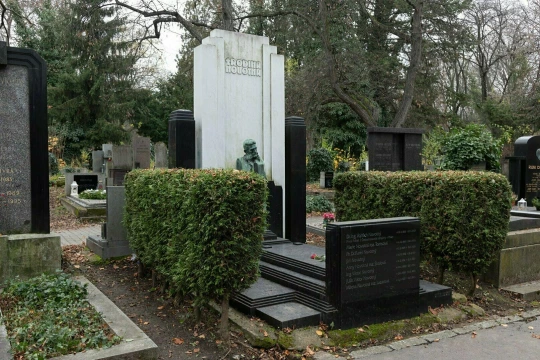
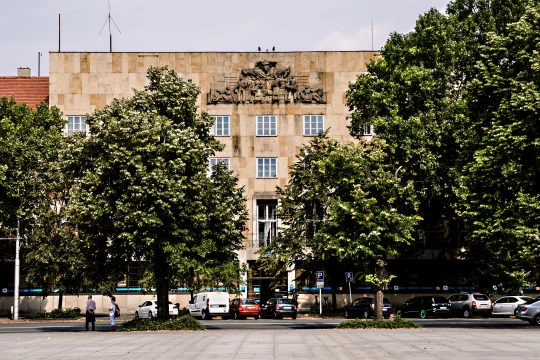
Otakar Novotný, a versatile and organizationally capable architect, graduated from an engineering school and trained under Josef Schulz. Between 1900 and 1903, he studied architecture under Jan Kotěra at the School of Applied Arts. He was so influenced by Kotěra’s concept of modern architecture that he joined his studio as an employee after graduation. He worked there from June 1903 to July 1904. According to his memories, he worked on the construction of the District House in Hradec Králové in 1903–1904 because Kotěra was busy with a government contract for the Czechoslovak pavilion at the World’s Fair in St. Louis, USA, at that time. Then Novotný left the studio and worked independently. He was also a pedagogue: between 1906 and 1909, he taught drawing evening classes at the Museum of Applied Arts; in 1912–1914, he taught at a girls’ academy. After Kotěra’s death in 1923, Novotný briefly took over his special school of architecture at the Academy; between 1929 and 1941, he taught at the School of Applied Arts where he also was the rector (in 1935 and 1937). In addition, he was the editor of the architectural feature in Styl magazine where he also published a number of articles, including standard-setting texts promoting the principles of European modernism such as Charakter zahrady (The Character of the Garden), Interiér, architekt a obecenstvo (The Interior, Architect and Audience, 1909), Architektonický impresionismus (Architectural Impressionism) Tvoření formy v architektuře (Creating Form in Architecture), etc. (1912). Shortly before his death, Novotný published the first critical monograph of Jan Kotěra, Jan Kotěra a jeho doba (Jan Kotěra and His Time), combining an unbiased interpretation of Kotěra’s buildings in the broad European context and personal memories of Kotěra and other protagonists of Czech modernism. In 1959, he published an anthology of his texts, O architektuře (On Architecture); another anthology was published posthumously by the Museum of Applied Arts in 1984 [1].
Literature
- Volné směry, 1929-1930. roč. XXVII. sv. XXVII, p. 194–200.
- Otakar Novotný. O architektuře. Praha, 1959.
- Otakar Novotný. Vybrané stati o architektuře, interiéru, užitém umění a uměleckém průmyslu z let 1909–1954. Praha, 1984.
- Alexandr Skalický, Otakar Novotný. casa Bartoň a Náchod. Firenze, 1999.
- Encyklopedie architektů, stavitelů, zedníků a kameníků v Čechách. Praha, 2004. p. 454–455.