The architect Vladimír Bolech is mainly associated with Mladá Boleslav, where he spent most of his life and created the largest collection of predominantly public buildings. He was born and educated in Prague, where the whole family had moved from Netolice in South Bohemia a year before his birth. His father, Václav Bolech, was a clerk and his mother, Anna, née Janoušková, was a private teacher of literature. Together, they also had an elder son Jaroslav (born 1895).
In 1921, Bolech successfully completed his architectural studies under Professor Josef Plečnik at the School of Applied Arts in Prague. Several interesting unrealised projects have been preserved from his time in Prague, including a design for the extension and adaptation of Švanda Theatre (1920–1921), a project for a new Czech theatre in Prague (in collaboration with his fellow student Josef Fuchs, 1922), a conceptual design for a girls' boarding school in Vouziers, France (1926), and a design for the Church of St. Wenceslas (Kostel sv. Václava) in Vršovice (1928). Both of the latter projects were awarded and commissioned.
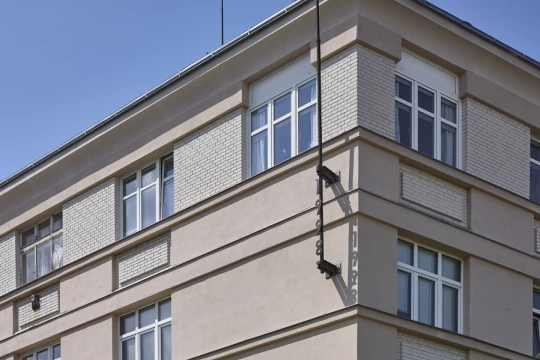
Towards the end of the 1920s, Bolech began to shift his focus from Prague to Mladá Boleslav, where he became the most prolific interwar architect after Jiří Kroha had left for Brno (1927). In this period, he implemented the project for the Vocational School for Women's Professions (Odborná škola pro ženská povolání), and simultaneously designed tenement houses for the state tobacco factory in Jihlava. These buildings show his characteristic architectural rendering of the interwar period, consisting of the division of the building into horizontal strips and, above all, the use of fired bricks in combination with pale plaster. Bolech was able to enrich the distinctive modernist position of architecture, always taking the role of the building into account. In some of the new school buildings, references to classicism can be seen, but the architect also worked with the functionalist position of architecture, which he mainly applied in the design of villas.
His post-war activities are unknown. He died in Mladá Boleslav in 1970.
LVo
In 1921, Bolech successfully completed his architectural studies under Professor Josef Plečnik at the School of Applied Arts in Prague. Several interesting unrealised projects have been preserved from his time in Prague, including a design for the extension and adaptation of Švanda Theatre (1920–1921), a project for a new Czech theatre in Prague (in collaboration with his fellow student Josef Fuchs, 1922), a conceptual design for a girls' boarding school in Vouziers, France (1926), and a design for the Church of St. Wenceslas (Kostel sv. Václava) in Vršovice (1928). Both of the latter projects were awarded and commissioned.
Towards the end of the 1920s, Bolech began to shift his focus from Prague to Mladá Boleslav, where he became the most prolific interwar architect after Jiří Kroha had left for Brno (1927). In this period, he implemented the project for the Vocational School for Women's Professions (Odborná škola pro ženská povolání), and simultaneously designed tenement houses for the state tobacco factory in Jihlava. These buildings show his characteristic architectural rendering of the interwar period, consisting of the division of the building into horizontal strips and, above all, the use of fired bricks in combination with pale plaster. Bolech was able to enrich the distinctive modernist position of architecture, always taking the role of the building into account. In some of the new school buildings, references to classicism can be seen, but the architect also worked with the functionalist position of architecture, which he mainly applied in the design of villas.
His post-war activities are unknown. He died in Mladá Boleslav in 1970.
LVo
Objects of the author in other architectural manuals