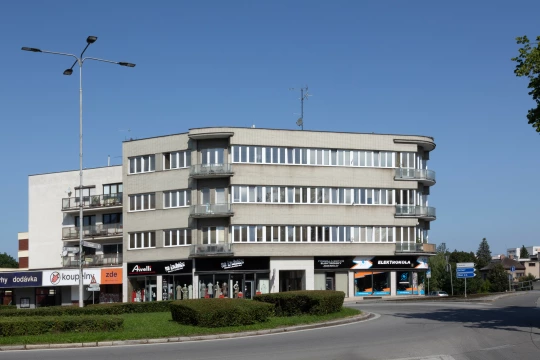
At the beginning of the interwar period, Německý (Havlíčkův) Brod received a new zoning plan (1922) from urban planner Vladimír Zákrejs, which brought order to the rapidly expanding town. From the early 1920s until the outbreak of the economic crisis in 1929, several buildings were constructed with funding from the provincial government and other supra-regional institutions. The most significant nationwide project was undoubtedly the extensive psychiatric hospital complex, built between 1920 and 1934.
The 1930s marked a period in which the historic town centre came into dialogue with modern architecture, often implemented against the advice of heritage authorities. Public buildings and spaces were developed by prominent architects such as František Albert Libera, Josef Gočár, Bohumil Hypšman, and Karel Roštík. During this time, a number of notable artists also contributed works for public spaces, including Bohumil Kafka, Jan Štursa, Julius Pelikán, Vincenc Makovský, and Jan Lauda.
Rapid population growth led to a persistently unsatisfactory housing situation, which failed to be rectified even by construction work supported with municipal and state funds. Prewar building activity came to an end with the development of a domestic airport and military barracks, although these were only completed under occupation (1937–1940). The pause on construction work during the Protectorate was followed by a brief postwar period focused on repairing buildings and infrastructure damaged during liberation, most notably the bridge over the Sázava River in 1946, which was significantly widened.