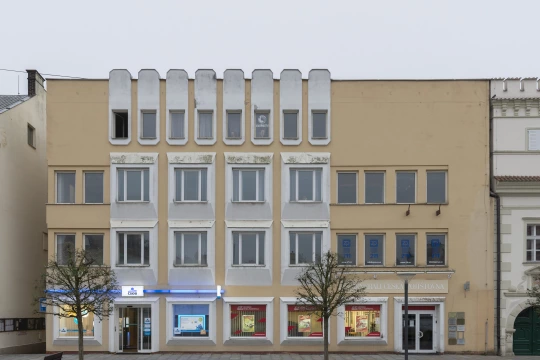
Due to its strategic location, the rapidly growing town was becoming an increasingly important hub for both road and rail transport. The Communist takeover led to the nationalization of privately owned businesses and buildings, many of which were converted into flats. However, this did little to resolve the ongoing housing shortage, which was exacerbated not only by the rising population but also by the poor condition of the housing stock, largely made up of 18th- and 19th-century buildings.
Centrally planned construction began in the late 1950s in the eastern part of the town (the Obránců míru housing estate, today Dolní Žižkov), extending the residential developments initiated in the late 1940s. In 1960, the town became the seat of the district, incorporating the surrounding municipalities of Perknov, Okrouhličtí, and Pohledští Dvořáci. The establishment or expansion of numerous industrial enterprises—including Pleas, Zetor, Motorpal and Rico—brought a further influx of residents.
After lengthy negotiations, a master plan was approved in 1963 anticipating a population increase of up to 25,000. On this basis, in the second half of the 1960s, the prefabricated panel housing estates of Vítězného února (today Pražská) and Gottwald Square (today Jihlavská) were constructed. The appearance of the town was greatly transformed by the clearance of roughly two-thirds of the historic centre, which led to the loss of many valuable buildings. A housing estate was built on Smetana Square and its immediate surroundings, and its second phase, at the turn of the 1970s and 1980s, employed standardized panel construction which greatly damaged the character of the town centre. Panel housing was complemented by private developments in the Žižkov, Vysočany, and Vršovice districts. Throughout the 1970s and 1980s, construction continued in the northern part of town, where the Na Spravedlnosti and Na Výšině housing estates were established, as well as in the area east of the Žižkov II park.