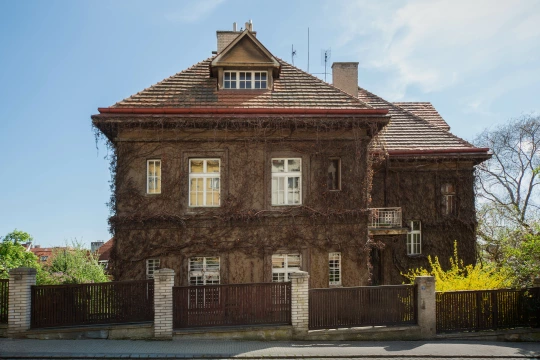
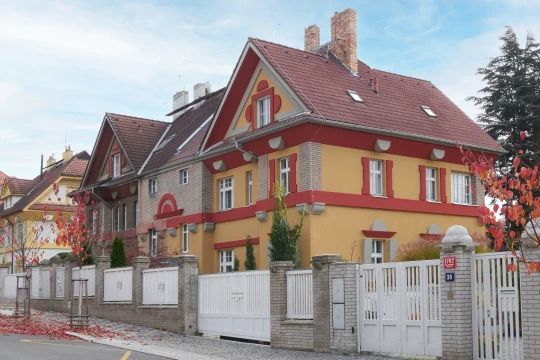
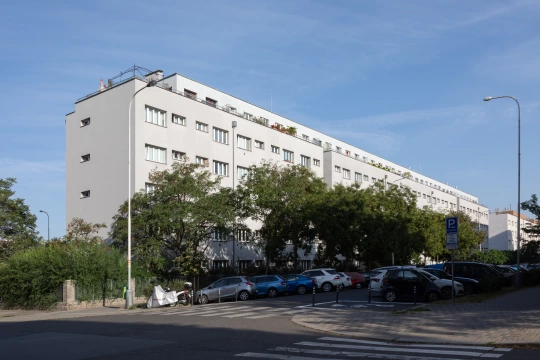
In the history of Czech modern architecture, František Albert Libra ranks among the most prolific authors of the interwar period. The abundance and diversity of his realised buildings, competition projects and urban plans, as well as designs of exhibition installations and displays, graphic works and theoretical works demonstrate Libra’s creative versatility.
František Albert Libra was born in Český Herálec in the Vysočina Region on 8 April 1891 (today Herálec pod Žákovou horou). After graduating from a German secondary school in Jihlava in 1910, Libra studied at the Czech Technical University in Prague, where he received traditional training from Professors Jan Koula, Josef Fanta, Adolf Liebscher and others. In 1913, he moved to the German Technical University in Prague. However, his studies were interrupted by the First World War, during which he was drafted; from 1916 he stayed in Austria in Vienna Neustadt, only to later be transferred to the Romanian Front. He finished his studies after the war in 1921, passing the Second State Examination.
In his youth, Libra didn’t have many opportunities for academic or business trips abroad. He undertook his first such trip in 1925, visiting France. Yet he was lucky to have encountered foreign architects the year before, when Prague hosted a famous series of lectures by the leading personalities of the art and architecture life of that time such as Le Corbusier, Amédée Ozenfant, JJP Oud, Walter Gropius and Adolf Loos.
František Albert Libra started his career as a professional architect in the autumn of 1921. He shared his first office with a student of Kotěra, Josef Karel Říha in the Prague suburb of Vinohrady (however, they never worked on a joint project). Although his formal authorial style was affected by nearly all of the interwar styles (National Style, Decorativism and Purism), it was Functionalism imbued with Traditionalist elements – as though casting aside Libra’s sympathies for Classicism and Otto Wagner’s creative principles.
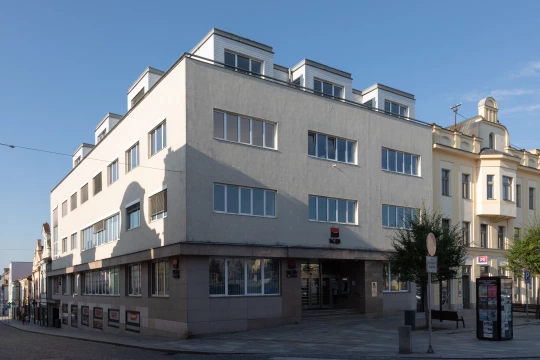
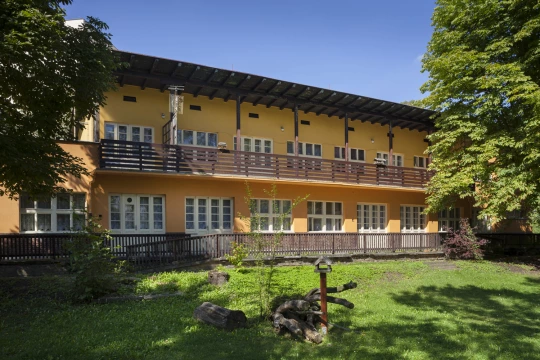
Among his most common tasks were the designs of savings banks buildings, whose façades he liked to finish with noble stone claddings meant to inspire the impression of a stable, reliable and credible institution in customers. He was also engaged with the typology of savings banks in his theoretical work, but compared to his architectural work this was a rather marginal interest of his. Let us mention here, for example, the articles “Několik poznámek k půdorysnému řešení spořitelních budov“ / ”Some Remarks on the Lay-Out Solution of Savings Banks Buildings” (Stavba / Building, 1934–1935) and “Problém stavby peněžních ústavů” / “The Issue of Financial Institution Construction” (Architektura / Architecture, 1941). Libra became famous especially thanks to the realisation of the largest Functionalist buildings in the then Czechoslovakia – the Masaryk Sanatorium for the treatment of tuberculosis in Vyšné Hágy – designed together with Jiří Kan in 1932. With the exception of this Slovak realisation and the Dům energetiky / The House of the Power Industry in Ostrava from the final period of his career (1954), all his projects concerned Prague and smaller rural towns in Bohemia. Among these localities outside Prague, Rakovník stands out – the town for which Libra designed a number of projects (a school, a savings bank, a swimming pool, an urn grove, town regulations etc.) during the Twenties and Thirties.
After World War II, and especially in the period known as the “Two-Year Plan for the National Economy” in the years 1947–1948, Libra focused on projects of social and health care facilities (crèches, baths, factory canteens, surgeries etc.), industrial buildings and small residential houses (mostly in workers' colonies). After February 1948, when Socialist Realism became the only officially recognised artistic style in Czechoslovakia, Libra had no choice other than to adapt to it as well. However, as evidenced by one of his last realisations – the administrative building of Energovod in Prague (1953), on which he cooperated with Jiří Jakub – he deftly coped with the required Historicist expression of the building while continuing his favourite Wagnerian tradition to the maximum possible extent without reducing his work to a schematic application of shallow ideological decoration.
In the interwar period, Libra was also actively involved in community life. He was a member of the Club of Architects, the Union of Czechoslovak Creative Work Association, the Association of Czechoslovak Artists, and the Union of Architects of the Czechoslovak Republic, as well as the heritage conservation Club for Old Prague, under whose influence he always paid attention to the urban context of the place in the design. As a music lover and a keen cellist, he was also a member of the Music Department of the Umělecká Beseda Club, the Association for Contemporary Music and the Czech Chamber Music Society. He had a great liking for the automobile, as evidenced by his membership in the Autoklub of the Czechoslovak Republic, for which he designed a new logo in the years 1936–1937.
František Albert Libra died in June 1958, succumbing to a malignant kidney tumour after several years of treatment.
AŠ
Literature
- Oldřich Starý. 1958, roč. XVII. p. 365–367.
- Eva Librová. Architekt F. A. Libra. Hrst vzpomínek na otce. Praha, 2008.
- Michal Kohout. Česká republika – moderní architektura. Čechy. Praha, 2014.
- Oskar Schürer. 1930, roč. VI. sv. 9, p. 201–209.
- Vítězslav Procházka. 1991, roč. XXXVII. sv. 9, p. 4.
- Rostislav Švácha. Praha, 1995. p. 449.
- Eva Librová, Radomíra Sedláková. Harmonický racionalismus. Architektonické dílo Františka Alberta Libry. Praha, 1997.
- Marie Benešová. 1998. sv. 2, p. 30–31.
- Ivana Čapková. 1998. sv. 8, p. 26–28.
- Radomíra Sedláková. 1998. p. 215–216.